Shelach Lekha 5774 – Making the Minyan

A man living in Jerusalem was saying the mourner’s kaddish for his mother.  That’s the prayer that Jews say for eleven months after the death of a parent.  In order to say it, however, one needs to be praying with a minyan, a quorum of ten Jewish adults over the age of Bar Mitzvah.

Every day, consistently, the man would go to a synagogue so that he could pray with a minyan, and thus be able to say the prayer.  One night, the man returns home really late, at 3 am.  He collapses into bed, exhausted.  As soon as he turns out the light, he bolts upright.  “Oh no!  I did not pray Arvit!” the evening prayer.  “I missed saying kaddish for my mother!”

With tremendous effort, he drags himself out of bed and starts to dress.

Where is he going to find a minyan at this hour?

No problem.  As anyone who lives in Jerusalem can tell you, day or night, you can always find a minyan at the Shteibelach— a building filled with a bunch of small synagogues in the Zichron Moshe neighborhood.  People gather in one of the rooms, and as soon as a minyan shows up, they start praying.  You can show up at pretty much any time of day and find a service about to begin.

But not at 3 am.  When the man gets to the shteibelach, it is empty.

He takes out his cell phone and dials the number for a taxi company.

“Hello! Can you please send six taxis to the Shteibelach in Zichron Moshe?”

Adoni (my dear sir)! It’s three o’clock in the morning! You think I have six taxis? What do you think I am, a magician? …I only have five.”

“Okay. So send five!”

He dials another number. “Hello, please send five taxis to Zichron Moshe…”

Atah meshugah! You’re crazy! I only have four!

“Fine.  I’ll take them.”

Within twenty minutes, there is a line of nine taxicabs parked neatly outside the Shteiblach.

Adoni,” says one of the drivers, “Why do you need nine taxis? There’s no wedding here, no Bar Mitzvah, nothing.”

“I want you all to turn your meters on and come inside with me. We are going to pray together the evening prayer — arvit.  I will pay each of you just as if you’re giving me a lift.”

These taxi drivers are not observant Jews.  Some of them have not been inside a synagogue since their Bar Mitzvah.  Although they are fluent in Hebrew, they have no idea how to pray: what and when to answer; when to speak aloud and when to stay quiet.

It takes them quite a while. But the kaddish man, shows them exactly what do do.  At 3:30 am in Jerusalem that night, he is able to say kaddish for his mother.

Afterwards, they all go outside to the taxis; the meters in the cars are pushing upwards of 90 shekels per car.  The man pulls out his wallet and starts to count out the approximately 800 shekels it is going to cost him.  That is more than two hundred dollars

“How much do I owe you?” he asks the first taxi driver in the line.

Adoni, what do you take me for? Do you honestly believe I would take money from you. who just gave me such an opportunity to help my fellow Jew say kaddish?”

He moves down the line to the second driver, who gives him the same answer.  “Do you know how long it is since I prayed?”

And the third and the fourth, all the way down the line to the ninth…

Not one takes a shekel.

And so they embrace and drive off to a new morning in the holy city of Jerusalem!


The name of the prayer the man said, the Kaddish, comes from the word Kadosh, meaning holy.  It is an ancient prayer in which we publicly proclaim the sanctity, or holiness, of God’s name.  A leader recites the words, and the congregation responds in certain places with various interjections: Amen, B’rikh Hu, or Y’hei Sh’mei Rabba m’vorach l’alam ul’almei almayah – May God’s great name be blessed throughout Eternity.  The Rabbis of the Talmud think it is so important that they declare that a person who responds to the Kaddish with enthusiasm is assured of a place in the world to come.

There are other important prayers that are also connected to this word.  The Kedushah is the special set of verses that we recite during the reader’s repetition of the Amidah.  In it, we act as if we are Divine Beings, blessing God like the angels.

In order to be able to recite both the Kaddish and the Kedushah, we are required to have a minyan.  A person praying alone, or in a group of less than ten Jewish adults, must skip over those sections of the service.

Why is that?

Our Rabbis of the Talmud teach that “Any words of holiness may not be recited with less than ten.”  (Babylonian Talmud, Megillah 23b)  In order to sanctify God’s name, that is to say, declare God’s holiness in a particularly special way, we must have a minyan.

In addition to reciting the Kaddish and the Kedushah, the Talmud identifies other religious actions which also require ten.   Chanting the Torah in public, invoking God during the introduction to the Grace After Meals, and forming a line away from a funeral to comfort the mourners are several more examples.

In ancient times, only Jewish males over the age of Bar Mitzvah were included to make up a minyan.  In recent years in the Conservative movement, we have expanded our interpretation of Jewish law to include Jewish females over the age of Bat Mitzvah as well.

Our tradition has always placed great value on communal prayer.  In Judaism, our prayers are said to reach higher into the heavenly chambers when we are together in a minyan as compared to when we pray alone.  The Talmud teaches, “Whenever ten pray together, the Shechinah (God’s Presence) is with them.”  (BT, Berachot 6a)  It seems to be taken almost as a given that minyan equals ten.

But there must be a reason.  Why ten?

Whenever I pose the question, I tend to receive several responses.

The first, and perhaps most obvious: ten fingers.

The second is from the Book of Genesis, when Abraham argues with God over the fate of wicked inhabitants of the cities of Sodom and Gomorrah.  He convinces God to save the cities if ten righteous individuals can be found.  Alas, ten cannot be found, and the cities are demolished.

But the reason that is offered by our ancient sources is different.

The Talmud identifies this morning’s Torah portion as the origin of the minyan.  It uses a particular kind of interpretational tool called a gezera shava.  A verbal analogy.  The way a gezera shava works is as follows.  We identify two completely separate biblical passages that have nothing to do with one another.  They do, however, share a word in common.  That word in common allows us to make an analogy between the two verses.  If something is true in one verse, it must also be true in the other verse.

The Tamud asks why is it the case that God’s name cannot be sanctified with less than a minyan of ten Jewish adults.  Now please bear with me for a minute.  This is kind of complicated.

Rabbenai, the brother of Rabbi Hiyya bar Abba, a Babylonian Sage from the third century, brings the answer, using a two step gezera shave.  (BT Berachot 21b)

Here is step one.  In this morning’s Torah portion, after the spies have given their report about the land of Israel and its inhabitants, sowing seeds of panic amongst the people, God becomes enraged.  Ad matai la-edah ha-ra’ah hazot asher hemah malinim alai – “How much longer shall that wicked community keep muttering against Me?”  (Numbers 14:27)  In next week’s portion, Moses and Aaron are facing a challenge from their cousin Korach and his followers.  Again, God becomes angry, and instruct Moses and Aaron to back off from the rebels so that God can cause the ground to swallow them alive.  Hibad’lu mitokh ha-edah ha-zot – “Separate yourselves from among this congregation!”  (Numbers 16:21)

Notice that the word edah, meaning “congregation,” appears in both passages.  In the first one, the story of the spies, we know exactly how many people are present.  There are twelve spies in total.  Joshua and Caleb bring a positive report.  That leaves ten remaining spies.  Therefore, we conclude, the word edah refers to a group of at least ten individuals.

Now for step two.  Back in Leviticus, God declares v’nikdashti b’tokh b’nei Yisrael – “And I will be sanctified among the children of Israel.”  (Leviticus 22:32)  Again we refer to the verse from next week’s Torah portion: hibad’lu mitokh ha-edah ha-zot – “Separate yourselves from among this congregation.”

Now we focus on the common word tokh – “among” – which appears in both passages.  If God is to be sanctified b’tokh – “among” – the children of Israel, exactly how many does that imply?  Well, since tokh and edah – “congregation” – appear together in the other verse, it must mean at least an edah‘s worth.  How many is an edah?  From the story of the spies, we know it is at least ten.

Therefore, to sanctify God’s name requires at least ten Jewish adults to come together.

Admittedly, this explanation seems convoluted, and perhaps a bit of a stretch.  It is quite possibly an after-the-fact justification of a long-accepted and widely-embraced tradition.  But there is a deeper message that goes beyond the linguistic gymnastics.

The whole concept of a minyan is quite positive.  It encourages community.  Jewish worship takes place not in a synagogue, but in any place where ten Jewish adults come together.  It is about the people, not the building.

For thousands of years, the idea of the minyan reinforced Jews’ motivation to live in close proximity to one another.  Jews needed to be able to pray together, support one another in times of loss, and celebrate holidays with community.  Even God is sanctified when Jews form a minyan. It is impossible to lead a complete Jewish existence by oneself.

But the origin of the number ten, we now learn, comes from what is perhaps the greatest sin committed by the Israelites in the entire Torah.  Believing the spies that they have no hope of defeating the Canaanites and conquering the Land of Israel is the sin that earns the Israelites forty years of wandering in the wilderness.  After all they have seen, the miracles in Egypt, the splitting of the Sea of Reeds, the Revelation at Mount Sinai, the Israelites lack the imagination and the faith to believe that God can deliver the land into their hands, as promised.

Rooting the minyan in this story of faithlessness is ironic.

Perhaps joining together in the same symbolic number gives us the opportunity to repent of our ancestors lack of faith.  Once upon a time, it was ten people who failed to sanctify God.  Now we come together as ten to sanctify God.

Perhaps another lesson is that things can go either way.  When we come together in community, things can go the way of the ten spies, in which one person’s fears spread to the entire group.  Or, we can inspire one another.  One person’s kavannah, spiritual focus, can help the other worshippers express what is in their hearts too.

In the story of the nine taxi drivers, one mourner’s kavannah to honor his mother by saying kaddish for a year inspired the rest of the minyan to connect to a ritual that they had not encountered for many years.  Surely, God’s Presence was among that edah, that holy congregation, at 3:30 am that morning in Jerusalem.

When we come together as a community, whether to worship here in the sanctuary on Shabbat, or to support someone during shiva, the week of mourning, our kavannah can be contagious.  We give each other strength: strength to connect with what is in our hearts, strength to express ourselves with honesty, strength to connect with each other, with our tradition, and with God.

In that way, God is truly sanctified amongst the People of Israel.

Why BDS is completely misguided

In the past year, the Boycott, Divestment, Sanctions movement, otherwise known as BDS, has really heated up.

The BDS movement tries to apply economic and political pressure on Israel to acheive its three goals, which are, in its words:

1.  the end of Israeli occupation and colonization of Arab land

2.  full equality for Arab-Palestinian citizens of Israel

3.  respect for the right of return for Palestinian refugees

They use three main tactics.  The first tactic is a boycott of Israeli products and companies which they claim profit from violating Palestinian rights.  There is also a cultural boycott: convincing artists and musicians to refuse to perform in Israel.  And finally. there are academic boycotts, whereby Israeli professors and academic institutions are not permitted to participate in partnerships, conferences, and academic collaborations.

The second tactic is divestment, which means convincing those who control pension funds or universities with large endowments to not hold in their portfolios any stocks of corporations which they claim are complicit in violating Palestinian rights.

The third tactic is sanctions, which means keeping Israel out of various diplomatic and economic forums.

More generally, the BDS movement tries to negatively influence public opinion about Israel.

There have been a number of prominent people who have joined in on the boycott.  Stephen Hawking boycotted the Israeli Presidential Conference last year.  Also last year, the Association for Asian American Studies announced a boycott of Israeli universities and academic institutions.  Roger Waters, former front man for Pink Floyd, has been quite vocal in his participation in the BDS movement.

You may have heard the flap around the SodaStream commercial during the Superbowl this year.   SodaStream is an Israeli company based in Ashkelon that has a factory in the West Bank.  So, it has been included in the boycott.  The actor Scarlett Johanson, in addition to being the star of the commercial, had also been an official ambassador for Oxfam for eight years.  Oxfam supports BDS.

When all of this went public, Scarlett Johanson resigned her position with Oxfam (which is a big score for the Jewish people).

The ironic thing is that the SodaStream factory is a model for economic cooperation.  It employs Israeli Jews and Arabs along with Palestinians.  The Palestinians are paid way above market rates and recieve great benefits.  They are given a lot of workplace employee protections.  The CEO of SodaStream built the factory explicitly to promote economic cooperation and further the cause of peace.

But the BDS folks went crazy over Scarlett Johanson sticking to her principles and resigning from Oxfam.

There have also been numerous attempts on universtity campuses to pass student resolutions calling for endowments to divest from Israeli corporations.  I will speak more about that later.

What is wrong with BDS?  On its surface, the idea of nonviolent protest for a political cause seems reasonable.  It’s better than suicide bombings.  But the BDS movement is deeply flawed for a number of reasons.

First of all, while the BDS movement is not explicitly anti-semitic, many of those who are involved in it are, and the rhetoric often turns nasty and personal.

The BDS movement does not actually target Israeli policies.  Rather, it aims to undermine the very legitimacy of Israel.

The idea that Israel, more than any other nation in the world, is deserving of a boycott, divestment and sanctions campaign is fundamentally ridiculous.  Israel is far from perfect.  There are many injustices in Israeli society, including in its treatment of Arab citizens in Israel and Palestinians in the territories.  The government has made a number of mistakes which have harmed the peace process.

That said, I don’t need to remind you that Israel is the only democracy in the Middle East.  It is one of the most progressive countries in the world with regard to gay rights and women’s rights.  It is the only country in the Middle East with a free press.  Arab Israelis vote, serve in government, and bring cases to the Israeli Supreme Court where they are heard by Jewish and Arab justices sitting next to each other.

The BDS movement singles out Israel for denying citizenship to Palestinians.  Let us remember that Palestinians are not Israelis.  They, in fact, vote in Palestinian elections.  Compare their enfranchisement to the rights of the vast numbers of Palestinians living in refugee camps in other Arab countries like Lebanon, Syria, and Kuwait, where they have been denied citizenship for generations and live in horrible conditions.  Why?  Because those regimes are terrified that large numbers of Palestinians might further destabilize their hold on power.  Also, because it has enabled them to keep the pressure on Israel ratched up for the past sixty years.

Where is the protest on behalf of the one hundred fifty thousand people killed and millions of displaced Syrians?  Where are the campus protests calling for an end to discrimination against women in Saudi Arabia?  Why is there no movement to eliminate honor killings, which are accepted outright in some societies, or treated in other legal systems (such as the Palestinian Authority) as a mitigating factor that carries a lighter sentence.

Not to excuse improper actions by the Israeli government, but there is at best a gross naivety when one compares the moral challenges in the Israeli-Palestinian conflict with some of the terrible atrocities that are committed in repressive societies around the world.

This is nothing new for Israel.  Israel has been held to an unequal standard for its entire existence.  Of the 1822 resolutions passed by the U.N between 1948 and 2009, 235 involved Israel, which equates to 13% of all resolutions.  Since the formation of the United Nations Human Rights Council in 2006, Israel has been condemned forty five times, which comprises 45.9% of all country-specific resolutions passed by the council.

Dealing with international condemnation is nothing new for Israel.  In fact, despite such antagonism throughout its existence, Israel has built a thriving society.  It long ago learned to ignore most of what comes out of the UN and the international community.  The following story illustrates the point.  To understand it, you will need to know that the Hebrew acronym for the U.N. is או”ם, “um.

It is 1955, and the Israeli cabinet is debating what to do about increasing cross-border fedeyeen terror attacks from Egypt.  They are considering whether to invade and capture the Gaza Strip to prevent the attacks, and are debating the international repercussions.  Prime Minister Moshe Sharett points out that if it had not been for the 1947 U.N. resolution, Israeli would not have been founded.  In response, David Ben Gurion, who was the Defense Minister at the time, snaps “Um shmum!”  And that has been a pretty good description of how Israel has felt about the United Nations ever since.

So what else it wrong with BDS?

Simply put – it will not work.

Israel has become so successful in the global economy.  Its businesses are integrated with corporations and countries around the world.  Just think about all of the connections between Silicon Valley and Israel.  National borders are becoming increasingly irrelevant when it comes to the expansion of global businesses.  I am highly doubtful that a BDS campaign could negatively impact the thriving Israeli business and academic climates in any meaningful way.  It’s just not going to work in a globalized world.

But there is another, far more important reason why the BDS movement is completely misguided.  Historically, whenever Israel has felt pressure from the outside, it has dug in with even greater stubborness.  The idea that imposing sanctions and boycotts will bring Israel to its knees and force it to give in is totally naive.  If anything, BDS will acheive the opposite result.

Those who want to promote the cause of the Palestinians, improve the chances for coexistence, and possibly even bring about a peaceful solution, ought to do the exact opposite of BDS.

Instead of pulling money out of corporations doing business in Israel, pour money in.  Invest in economic development in the West Bank.  Invest especially in joint business and research ventures between Israelis and Palestinians.  Build more SodaStream factories.  People are willing to make concessions when they feel secure and when they have hope that their lives will improve.  People will take risks for peace when they can see the realistic possibility that their children will enjoy a higher standard of living than they themselves have experienced.

That is only going to happen when there is not only dialogue on a grassroots level between Israelis and Palestinians, but when there are real economic incentives for building something together.

Unfortunately, the BDS movement is not actually interested in pursuing peace.  In calling for the right of return for all Palestinians to Israel and the granting of citizenship to all Palestinians, combined with intensive delegitimization, it seems clear that what the BDS movement is really after the dismantling of Israel as a Jewish state.

The most hurtful aspects of the BDS campaign, sadly, occur at universities.  On numerous campuses, local BDS groups bring forth resolutions calling for the university to divest from corporations that do business in Israel.  The tactics are often filled with intimidation.

There are practical reasons why divestment is a bad idea.  Harvard President Drew Faust said last year, “Significantly constraining investment options risks significantly constraining investment returns.”  In other words, artificially imposing limits on investment opportunities will result in less money available for university programs.  That is bad for students.

The other reason is ethical and political.  The Israeli-Palestinian conflict is not a one-sided issue.  The plight of the Palestinians is wrapped up in complicated international histories and relationships.  There are many parties that bear responsibility, including Arab governments, the Palestinian Authority, Hamas, and yes, Israel.  To single out one side is ignorant and irresponsible.

Plus, these kinds of movements on university campuses are often experienced by Jewish students, staff, and faculty as unfair and discriminatory.  BDS campaigns often intimidate students, stifle constructive debate, and repress free speech.

Jewish students at NYU and other universities recently had mock eviction notices placed under their doors.  Students are sometimes harrassed walking across campuses.  The tone of the rhetoric is often hateful, equating Israel with Nazi Germany or apartheid South Africa, and targeting pro-Israel students in ways that often cross the line of anti-Semitism.  Some BDS protests have turned violent.

It is happening all over the country.  Five UC campuses, including UC Santa Cruz last week, have passed BDS resolutions.

Also last week, the student Senate at the University of Washington resoundingly rejected a BDS resolution by a vote of 59 to 8, with 11 abstentions.  That is the biggest defeat of a BDS resolution so far, and that is pretty remarkable at a school like UW, which has a history of anti-Israel activity.

The reasons it failed at UW are important.  Hillel students spent a full two years preparing for a resolution that they knew would be coming.  They did so in a grassroots way that united individuals who did not agree with each other.  It brought together students on the right and the left who were affiliated with AIPAC, Stand With Us, and J Street.

As a result of their efforts, the broader student body felt that the dialogue that had taken place had been respectful and substantive.

The UW outcome is a tremendous victory that has left students feeling energized and empowered, but it comes at a cost.  For two years, Jewish students and leaders on campus devoted an enormous amount of their energies to defending Israel.  What was neglected?  After all, there is more to being Jewish than defending Israel.  Think of all of the positive Jewish programming that did not take place because of the resources devoted to defeating a BDS campaign.  University is supposed to be a time for gaining independence, being exposed to new ideas, and engaging in constructive dialogue with people of different backgrounds and opinions – not defending yourself from attack and discrimination.

In an article published after the victory, Rabbi Oren Hayon, the Executive Director at UW Hillel, describes the numerous students who came to him under tremendous stress.  He writes critically of the treatment of students by people on both sides of the issue as “‘troops’ to be mustered, ‘vessels’ to be filled, ‘fields’ to be planted, and ‘assets’ to be positioned.  Rarely, if ever,” he writes, “were they celebrated as thinkers, partners, or colleagues.”  That is a shame.

What can we do?

It seems that we may need to get more involved.  Not because BDS poses a great threat to Israel’s security, but because it places harmful pressure on Jews living in the Diaspora, especially college students.  And we cannot simply rely on campus Hillels to bear the burden.

One simple thing that is easy for all of us: Buy Israeli products.

Also, do not get into emotionally-laden shouting matches with BDS supporters.  You are not going to change their minds.  Speak about Israel with people you know: friends at work and at school.  Don’t be shy about it.  But always speak with respect, ask lots of questions, and always listen.

Bechukotai 5774 – Climate Change, DNA, and God’s Challenge to Us

On Monday of this week, two scientific papers were released by two separate teams that studied melting patterns on the West Antarctic Ice Sheet.  The groups conducted their studies independently, and used different methods to conduct their studies.  They did, however, come to the same conclusion.

The West Antarctic Ice Sheet sits on a bowl shaped depression of earth, with the base of the ice below sea level.  Ice on the edge of that bowl has been melting as it comes into contact with warming ocean water.  As that ice melts, it destabilizes the rest of the ice sheet, starting a chain reaction that will cause it to slide off the continent into the ocean.  The studies found that the melting has passed the point of no return.  Even if the water temperature goes back down, the progress of the glaciers cannot be stopped.  In fact, they will continue to accelerate into the ocean.

The cause is not clear.  Scientists think it has something to do with stronger winds stirring up the ocean and raising water temperatures.  Some think the stronger winds are caused by increased temperatures in other parts of the world due to global warming.  Others think that the hole in the ozone layer over Antarctica has added energy to the winds.  Natural variability may also be a factor.

The result, according to the studies, will be an additional rise of global sea levels of up to twelve feet over the next few centuries.  That is on top of other predictions, which do not take the melting of the West Antarctic Ice Sheet into account.  The United Nations Intergovernmental Panel on Climate Change has already warned that sea levels could rise up to three feet by the end of the century without significant reductions in greenhouse gas emissions.  With the new discovery, that estimate will have to be raised.

We are not going to go into whether global warming is caused by humans or not.  People’s emotions tend to overwhelm their brains in such discussions.

Let me state one undeniable fact: climate change, whatever the cause, exists.

What will the impact of rising sea levels be?  In America, a rise of up to four feet would inundate the homes of 3.7 million Americans.  Cities like Miami, New Orleans, Boston, and New York would all be vulnerable.

It is already happening.  The question is: what are we doing to prepare for it?  The collective decisions that we make over the coming decades will determine what kind of toll climate change will take on human lives.

The first half of this morning’s Torah portion, Bechukotai, records a series of blessings and curses which will befall the Israelites depending on their adherence to the covenant with God.  Im bechukotai telechu… it begins.  “If you follow My laws and faithfully observe My commandments, I will grant your rains in their season, so that the earth shall yield its produce and the trees of the field their fruit…”

The blessings are everything that ancient people could want: abundant rain, successful crops, peace in the land, strength to defeat their enemies, and a constant awareness of God’s Presence and love in their midst.

The curses are the opposite.  The sky will turn to iron, the land will not produce food, disease will spread, famine will ensue, enemies will terrorize the land, and eventually the nation will be exiled.

Whether the blessings or the curses befall the Israelites is entirely up to them.  The national fate will be determined by whether the people follow the mitzvot, that is, the commandments outlined in the Torah that are the Jewish people’s covenental obligations to God.

As moderns, the idea of the weather or the conduct of enemy nations being determined by our actions is a troubling theology.

What these blessings and curses are describing is not so much theology, however, but human nature.  The extent to which a community embraces shared values determines to a large extent whether a crisis will result in blessing or curse.

When the oceans rise, the impact on human lives will be determined by how we have prepared for that event, and how our society cares for the people that are affected.  Developed countries will fare better than poor countries.  We know this, because that is what always happens in natural disasters.  But human societies, whether in local communities, in nations, or globally, have it in their hands to do something about it.  The question is: will we?

Unfortunately, the answer is probably: not very likely.

Every living creature has a biological imperative to perpetutate its own existence.  Human beings are no different.  It is built into our DNA.  But that imperative operates at the individual level rather than the collective.  Individuals tend to do things which enhance their own abilities to survive, thrive, and repopulate.  It seems that there is no collective biological imperative for the perpetuation of humanity’s existence.

We form groups for the benefits they bring to our own ability to survive.  We make choices about what we think will further our own well-being, but are far less inclined to make decisions that will benefit humanity, especially when it will involve some sort of self-sacrifice.

This is not a moral point.  It is a matter of biology and genetics.

So many human civilizations over the millenia have ignored the warning signs and gone down paths that led to their collapse.  The biological imperative is for individual survival, not for collective survival.  That perhaps explains why so many societies today engage in wasteful and self-destructive behaviors.  We are not naturally inclined to do what is best for humanity as a whole.

So we pollute our environment, we use up too much of our fresh water, and we drive other species into extinction.  Why?  Because there is nothing in our DNA to stop us.

The Torah challenges us to overcome our biology.  The mitzvot, the commandments, are a comprehensive system of laws that govern all aspects of our lives: how we treat ourselves, how we function within our families and our communities, and how we are to treat the strangers among us.

Our tradition also tells us how to function within the context of a larger society that is not Jewish.

And of course, Jewish life is full of rituals that bind us through the observance of sacred practices and the marking of sacred time to Jewish people of the past, present and future.  Ritual also enables us to express our yearnings to God.

In asking us to live by the mitzvot, God challenges us to rise above our genetics.

To follow halakhah, the Jewish system of commandments, is to impose an unnatural code of ethics on our human interactions, and to instill a deep sense of humility into our relationship with Creation.

Ki li kol ha-aretz  “For the entire Earth is Mine,” God declares at Mount Sinai before giving us the Ten Commandments.  As Jews in a covenantal relationship with God, we are asked to remember this at all times, and not treat the earth as something that exists only for our exploitation.  As God’s possession, the earth must be treated with reverence.

In the kedushah we recite the words kadosh kadosh kadosh, Adonai tzeva-ot, m’lo kol ha-aretz kevodo.  “Holy, holy, holy, the Lord of hosts, the fullness of the the entire earth is God’s glory.”  How might human treatment of our planet differ if we saw every element in the natural world as a manifestation of God’s glory?  Think about the impact on things like pollution, deforestation, and carbon emissions.  Consider how our own behavior might change with regard to the kinds of plants we put in our gardens, the length of our showers, and the things we choose to purchase, if we were conscious of utilizing resources that belonged to God.

The Torah is speaking to a particular community: the Jewish people.  The Torah’s way is the Jewish recipe for overcoming our basic human instincts.  But the underlying principle is universal.  It applies to all peoples separately, and to humanity as a whole.  God asks all of us to be more than our DNA.  To work for the flourishing of all people, and to treat the earth with humility.

As evidenced by our behavior, it seems that humanity does not have an especially humble posture with regard to the earth.

A detail in the presentation of curses reveals an insightful point about human behavior.  The curses do not all happen at once.  They come in waves.  After each wave, we are offered a chance to return to God.  If we do not take advantage of that opportunity, then the next wave will strike.  One gets a sense that God really wants Israel to redeem itself, to prevent further curses.  But the Torah describes it as almost inevitable that the community will not be able to reverse course.  Curses will follow more curses, with people never recognizing that their fate is the result of having gone off course from the path of blessing.

The cycle ends with the land desolate and the people in exile.  Only then will a small remnant realize their mistakes and the mistakes of their ancestors and return to the covenant.  When that happens, God will be waiting, eager to take them back.

Weird weather, rising ocean temperatures and acidity, melting glaciers, more powerful hurricanes, shrinking fresh water reserves – as we see sign after sign pointing to increasingly severe consequences of climate change, what are we going to do?

When will we start to take real action?  The kind of action that calls on us to make lifestyle changes, to transform how and where we live, and what we eat.  Action that will shift how our economy is structured and how success is measured?

Humanity’s track record is not great.  We tend to not be good about making investments in preventative strategies for catastrophes that are not yet upon us.

Whether the challenge is man-made or not, our responses are always in our own hands.  The way that we come together as a community will determine whether this challenge will become a curse or not.

Emor 5774 – The Corners of the Fields, the Omer, and Homelessness in Our Community

Chapter twenty three of Leviticus is one of several texts in the Torah that describes the various holidays.  Each time the Torah lists all of the holidays, there are slight variations, including how exactly they are observed, the names that are used, their symbolic meaning, and so on.  As we might expect from the Book of Leviticus, the emphasis here is on agriculture, and the proper offerings that must be brought to the Priests to be offered as sacrifices.

It starts with Shabbat, then continues with Passover, the counting of the Omer, Shavuot (although it is not given a name),  Rosh Hashanah (again without being named), then Yom Kippur, Succot, and finally Shemini Atzeret.

The descriptions here discuss the various sacrifices that must be offered, as well as some of the rituals that individuals must observe – practices like not performing any labor, taking the Four Species on Succot, eating unleavened bread on Passover, and so on.

But there is one verse appearing precisely in the middle of this detailed calendar of holidays that does not seem to fit.  In the 44-verse chapter that lists all of the holidays, it is verse 22.  It comes between the descriptions of Shavuot and Rosh Hashanah.

And when you reap the harvest of your land, you shall not reap all the way to the edges of your field, or gather the gleanings of your harvest; you shall leave them for the poor and the stranger: I the Lord am your God.  (Leviticus 23:22)

There are a few problems raised by this verse’s appearance here.

First of all, what does it have to do with the holidays?

Second, we already heard this commandment last week.  Just four chapters previously, in Parashat Kedoshim, we read the exact same mitzvah – word for word.  The Torah is repeating itself, as if we have already forgotten.  For a book that does not like to waste ink with superfluous and repetative details, this seems strange.

The commentators pick up on these questions, and offer some answers.  Ibn Ezra, the twelfth century Spanish Rabbi, points out that it appears precisely in the context of the holiday of Shavuot.  As an agricultural holiday, Shavuot marks the beginning of the barley harvest.  Barley is the first of the major cereal grains to ripen.  Wheat comes later on during the summer.  As we are getting excited to start bringing in the grain, the Torah repeats its instruction to leave the corners of the fields unharvested for the poor and the strangers in our communities.

Ramban and Rashbam offer a different explanation.  They say that it has to do with the description of the Omer a few verses earlier.  The Torah describes what is going to happen when the Israelites enter the Promised Land.  They are going to plant their crops and reap the harvest.  Before they can consume any of that crop themselves, they have to bring the first sheaf, the omer, to the Priest.  He will then wave it around as an elevation offering before God.  This is going to take place, at the earliest, on the second day of Passover.  None of the new crop may be consumed until this omer waving presentation has taken place.

This is where Ramban and Rashbam’s explanation comes in.  The Torah is warning us that the mitzvah of gathering the first of the crop as a presentation to God does not override the requirement to leave the corners of the field untrimmed for the poor and the strangers.

Put another way, the ritual obligation does not take precedence over the moral obligation.

There are several important lessons here.

First, that we cannot own the land outright.  Ultimately, the earth and everything in it belongs to God.  We are given permission to use and enjoy it, but not without certain qualifications.  L’ovdah u-l’shomrah, “to work it and to protect it,” God instructs the first human in the Garden of Eden.

Here, in the context of describing sacred time, we are told that we must both acknowledge God as the Creator of the earth and the One who makes it possible for us to cause it to produce food, and to provide for those who are less fortunate.  Only then may we enjoy it ourselves.  To consume the grain before both these steps have been taken is tantamount to theft.

The second lesson is that our dedication to religious ritual does not obviate our obligation to other human beings who need us.  This is the message of Prophets like Isaiah.  Don’t think that God wants your sacrifices while you let the weakest among you starve, he reiterates over and over again.

For us to do our part as Jews in our covenantal relationship with God means both that we acknowledge God’s Presence in our lives through ritual, and that we affirm God’s presence in other human beings through serving them.

In an agricultural society, the requirement to leave the corners of the fields untrimmed was public.  Everybody could see that a farmer had done his duty.  Not just the hungry who relied on it, but also fellow farmers and members of the community.  If someone shirked his or her responsibilities, everyone would know it.

Today, we are so far removed from from the most vulnerable members of society.  We can pretend that human suffering does not exist without suffering any consequences.

But suffering certainly exists among us.

Homelessness in our community is a human tragedy in our backyard. Santa Clara County has the fifth-largest unsheltered population in the country with the highest percentage of homeless veterans anywhere.  More than 7,500 people are homeless on any given night, with almost three quarters of that number unsheltered.

The tent city that has grown up along the Guadalupe River by Story Road is the largest homeless encampment in the country.

The numbers have ballooned in recent years, due by a significant degree to the high cost of housing in the Bay Area.  The reasons for homelessness are complicated, and solutions are elusive.

But if our tradition teaches us anything, it is that we have an obligation to care for the strangers who live among us because of our experience as strangers in the land of Egypt.

The lesson of leaving the corners of our fields unharvested and bringing the omer to God are that we cannot take the blessings in our lives for granted.  Our tradition offers us specific ways to acknowledge that gratitude: offering thanks to God, and being generous to our fellow human beings.

Rashi adds an additional commentary on the appearance of the mitzvah of leaving the corners of the fields in the middle of the sacred calendar.

Why does the text teach this in between the festivals, with Passover and Shavuot on one side and Rosh Hashanah, Yom Kippur, and Sukkot on the other?  To teach you that everyone who leaves gleanings for the poor is rewarded as if he had built the Temple and offered sacrifices there.  (Rashi on Leviticus 23:22)

As we struggle in our broader  community to address the challenges of /homelessness, may we open our eyes to the human suffering around us.  Through our actions, let us build a Temple of compassion and generosity as we recognize that so many of the blessings in our lives come from the Ultimate Source of compassion and generosity.


Passover 5774 – I And No Other

Every year, when we read through the Haggadah at our Seders, the same sections seem to catch our attention year after year:  This is the bread of affliction; The Four Questions; The Four children; The Ten Plagues; Dayeinu.

But one of the most difficult parts of the haggadah to understand is the part that comes right in the middle.  We read a collection of four verses from chapter 26 of the Book of Deuteronomy.  They begin with Arami oved avi.  Translated either as “My ancestor was a wandering Aramean,” or “An Aramean persecuted my ancestor…”  The four verses are a concise summary of the story of the Exodus from Egypt.

Their brevity is in fact the reason they were chosen.  Exodus chapter 12 would have been a much more detailed option, but it would have been too long.  The Deuteronomy text keeps it short and sweet.

The haggadah then proceeds to offer a phrase by phrase midrashic interpretation of each word and expression.  Usually, a more extensive passage is quoted from some other part of the Bible, with a short analysis of what it means.

The origins of the midrash that appears in our haggadah goes back to the second century in the Land of Israel, although significant portions were added and incorporated over the next thousand years.

It is hard for us to understand today because it takes significant unpacking to figure out what is going on.  So while we may pause in our seders to ask a question about an expression that seems strange or that grabs our attention, rarely do we spend too much time on it.

Of course, as a Rabbi, I get some post-Seder questions too.  I’d like to address a question that I was asked earlier this week.  It is a midrash that seems to contradict everything we know about the story of the Exodus.  Here is the passage as it appears in the Haggadah:

“‘Adonai brought us out of Egypt’ (Deut. 26:8) – not by an angel and not by a seraph and not by a messenger, but rather the Holy One of Blessing Himself.”

And then it quotes Exodus 12:12:

“As it says:  ‘I will pass through the Land of Egypt this very night and slay every first-born male in the Land of Egypt, from human to beast, and I will bring judment upon all the gods of Egypt, I, Adonai.'”

Then the haggadah gives its phrase by phrase interpretation of the Exodus passage:

“‘I will pass through the land of Egypt’ – I and not an angel (mal’akh).  ‘And slay every first-born male’ – I and not a seraph.  ‘I will bring judgment upon all the gods of Egypt’ – I and not the messenger (shaliach).  ‘I, Adonai’ – I am He, and none other.”

What is going on here?  The story of the Exodus is filled with angels and messengers doing God’s bidding.  Everybody knows this.

Who carried out the tenth plague, the killing of the first born?  The angel of death.  Look at Exodus 12:23, just a few verses later:

For when the Lord goes through to smite the Egyptians, He will see the blood on the lintel and the two doorposts, and the Lord will pass over the door and not let the Destroyer (HaMashchit) enter and smite your home.

The haggadah is trying to get us to ignore vs. 23 in favor of vs. 12.  Is it God or the Angel of Death that executes the 10th plague?

And there is another problem as well.  If I were to ask you who brought the Israelites out of Egypt, what would you say?

Moses, of course.

Everybody knows this, so why does the haggadah make the point so emphatically that it was God directly who did these things?  “I and not a shaliach, a messenger.”  Here is Numbers 20:16:

We cried to the Lord and He heard our plea, va-yishlach mal’akh, and He sent a messenger, who freed us from Egypt

Why is Moses being dissed like this?

It is often pointed out that Moses’ name is not mentioned in the haggadah.  (Actually, it does appear once)  Why?  So that we would not come to worship Moses as a deity.  Come on!?

There is no explicit evidence that the rabbis were particularly concerned about this.  Yes, they occasionally tell us not to worship Moses, but they never polemicize against it.

On the contrary, our literature is filled with interpretations and midrashim that attribute extraordinary events to Moses.  He had a miraculous birth.  He came out circumcised.  We call him the greatest of the Prophets.  The Torah calls him the humblest of all men.  He is Moshe Rabeinu.  Moses our Teacher.  The teacher par excellence!

Do we really think that keeping his name out of the haggadah is going to prevent the deification of Moses?

There is another reason why this is not likely.  As I mentioned earlier, the haggadah is a composite document that developed and grew over a period of more than 1,000 years.  There is no consistent, unified purpose that links every element of the seder that we have today.  If Moses’ name is absent from the Haggadah, it is not by design.  We can speak of the intent of a specific passage in the haggadah, but not of the haggadah in its entirety.

This brings us back to our earlier question.  Why in this particular midrash is the role of Moses deemphasized?  What reason could there be to highlight God as the sole, direct Redeemer?

Like many other passages, it is a polemical midrash.  But a polemic against whom?

This passage is one of the earliest elements of the haggadah.  In the third century, Christianity had emerged, but had not yet fully separated from Judaism.  A Jew might go to pray in a synagogue, and then go pray in a Church, or vice versa – just in case.  It’s good to cover all your bases.

The early Church fathers hated this, and introduced all sorts of rules to discourage Christians from participating in Jewish practices.  The Rabbis felt the same.  They were particularly concerned with rooting out heretical beliefs among one’s people.

The Rabbis, by the way, felt this way about numerous sectarian Jewish groups.

By emphasizing that it was God who personally carried out the plagues, redeemed the Israelites, and brought them out of Egypt, the haggadah hints at a rejection of any other intermediary, or manifestation of the Divine Presence, i.e. Jesus.

The early Christian figure Origen of Alexandria and the leading Sage of the Palestinian Talmud, Rabbi Yochanan were embroiled in controversy over these kinds of theological issues at the same time that this midrash was likely composed.

So how do we feel about this passage now, in an age when we embrace interfaith cooperation?  What does it mean for us to have a polemical passage like this in the haggadah?

Another post-seder conversation this week had to do with the humanistic messages that are often included in seders today.  Contemporary haggadot tend to universalize the lessons of suffering, slavery, and freedom.

These are certainly important lessons, but as far as I know, every single element of the haggadah is there for particularist purposes.  The composers of the haggadah did not intend for Jews to think about examples of modern day slavery and discuss how we are obligated to bring freedom to those who lack it.  The  sixteenth century German Jews who introduced the idea of spilling wine out of our cups during the recitation of the ten plagues were not expressing sorrow at the suffering of the Egyptians.  Quite the opposite, they were praying that their contemporary enemies’ blood should also be shed.

Until the modern era, the innovators of the haggadah in every generation intended our gaze to be inward – towards our lives and our own people.  We are obligated to see ourselves personally in this story.  We are not obligated to insert others’ experiences into it.

The passage we’ve been discussing is an example of one polemic that was composed at a unique time in Jewish history, and represented the very real concerns of a community of Jews that saw its existence under threat.  We honor their experience, and their contribution to our tradition, by studying their words and trying to understand their lives.

But we also must remember another important phrase in the haggadah:  “And the more one talks about the Exodus from Egypt, behold, this is praiseworthy.”

So I think it is ok, and even encouraged, for us, here in the (make air quotes) “enlightened” 21st century, to be open to more universal lessons from our experience with slavery.  But let’s not be afraid to dive in to our texts to discover meanings and lessons that spoke in personal ways to earlier generations of our people.

Perhaps their struggles have a lesson for us too.


[Thanks to The Schechter Haggadah, by Dr. Joshua Kulp and Rabbi David Golinkin, and My People’s Passover Haggadah, edited by Lawrence A. Hoffman and David Arnow.]

Shabbat HaGadol 5774 – Becoming Elijah

Eliyahu Ha-navi

Eliyahu Ha-Tishbi

Eliyahu, Eliyahu, Eliyahu ha-Gil’adi

Bimheira b’yameinu, yavo eileinu

Im mashiach ben David, im mashiach ben David.


Elijah the Prophet.

Elijah the Tishbite.

Elijah the Gileadite.

Speedily, in our days, may he come to us

with the Messiah, son of David.


We’ll be singing these words at the end of our meals in just a couple of days as we invite the biblical prophet Elijah to join us at our Seder for a drink.

When we actually read the stories about Elijah in the Bible, though, he seems like an unlikely drinking buddy.

Elijah lived in the ninth century, b.c.e., during the reign of King Ahab and Queen Jezebel.  Jezebel is a Pheonician princess who brings her worship of Baal with her.  Her devoted husband Ahab even builds a Temple where Israelites can worship the God of Israel and Baal side-by-side.

Elijah is not happy.  He challenges the four hundred fifty prophets of a Baal to a showdown on Mount Carmel, and invites all of Israel to watch.  It’s a great scene, one that always reminds me of a professional wrestling match.  In bombastic language, Elijah challenges the audience:  “How long will you keep hopping between two opnions?  If the Lord is God, follow Him; and if Baal, follow him.”  (I Kings 18:21)

The silence is deafening.

The four hundred fifty prophets set out their sacrifices and pray to their god to send fire down to consume them… and nothing happens.  Elijah taunts them:  “C’mon you guys.  Baal can’t hear you.  Maybe he’s asleep, or on a journey.  Shout louder.”  So they scream and shout, and gash themselves with knives.  Nothing happens.

Now it’s Elijah’s turn.  He sets out his sacrifices, and then turns on the fire hose.  He douses everything with water until it’s streaming in rivulets down the mountain.  Elijah then prays to God, and fire shoots down from heaven, consume the burnt offering in an instant.  The crowd goes wild.  At Elijah’s command, they slaughter the prophets of Baal.

Jezebel is not happy, so she puts a bounty on Elijah’s head.  Elijah flees to the South, arriving at Mount Horeb, otherwise known as Sinai, where he stays for forty days and forty nights and encounters God in the midst of a storm.  Sound familiar?

Elijah eventually returns to Israel, where he continues his prophesizing and miracle-working.  He takes on an apprentice named Elisha.  Before he leaves with his new master, Elisha wants to gives his mother and father a hug and say goodbye.  Elijah does not approve.

Elijah grows old, but he does not die.  Instead, a fiery chariot with flaming horses scoops him up and carries him off into the sky.  It’s the ninth century b.c.e. version of a Harley Davidson.

That’s Elijah.  He is not a patient prophet.  He is zealous for God, but does not relate well to people.  He sees the world in black and white.  You are either for God, or for Baal.  Elijah does not seem to understand that life is full of gray zones.

After his fiery exit into the heavens, legends about Elijah begin to emerge.

We hear of Elijah later on in the Bible from the prophet Malachi, in a passage that we read today in the conclusion of the Haftarah for Shabbat HaGadol.

Lo, I will send the prophet Elijah to you before the coming of the awesome, fearful day of the Lord. He shall reconcile parents with children and children with their parents, so that, when I come, I do not strike the whole land with utter destruction.  (Malachi 3:23-24)

Elijah is said to not have died (one of only two biblical figures, the other being Enoch).  Instead, he is wandering the earth, waiting for the time when he can announce the coming of the Messiah and the redemption of the world.

Elijah is invoked at particular moments in Jewish life: at the Passover Seder; during Havdallah at the end of Shabbat; and at a brit milah.

The speech I give at a bris goes like this:  It is said that in every generation there is a potential messiah in hiding.  It could be this new baby, who holds in him the potential to redeem the world.  That is why we set aside a special chair for Elijah and invite him to the bris.  We want them to meet each other, just in case.

Rabbi Joseph Telushkin offers a slightly darker interpretation.  Eliyahu’s presence at a brit milah is in fact a punishment.  Elijah in the Bible demonstrates little understanding of the relationship between parents and children.  He constantly complains to God that the people Israel have abandoned the covenant and turned to idol worship – every single person except for him.  And so, because of his excessive zeal, Elijah will have to stick around through the millenia.  Telushkin writes:

He who sees himself as the last Jews is fated to bear constant witness to the eternity of Israel, to be present when every male Jewish child enteres the covenant, and when every family celebrates the Seder… Elijah stands in a long line of despairing Jews who erroneously have prophesied the end of the Jewish people.  (Joseph Telushkin, Biblical Literacy, pp. 257-258)

His eternal life is a kind of curse.  He has to wander the earth and wait, watching, always watching, bearing witness to humanity’s imperfections, to the inability of people to get along, to the ever-present divisions between parents and children.

This helps us understand Malachi’s prediction, that Elijah will be the one who brings about reconciliation between parents and children.  The prophet who would not allow his disciple and successor, Elisha, to say goodbye to his parents, will have to correct the misunderstanding and act with compassion to save humanity.  For the world to be redeemed, it is Elijah himself who must also be redeemed.

He is sentenced to be the great reconciler.  He is cursed, but it is a hopeful curse.

There is more to the legend of Elijah.  More folktales of Elijah exist than any other biblical figure.

He usually appears in disguise, his identity revealed only at the end.  He is often a beggar, dressed in rags, or else a kind and wise old man.  He tends to play one of several different roles.  He visits a downtrodden person or family whom he helps out through gifts, treasure, the granting of a child, and so on.  He often performs miracles.

Other times, he comes to teach a lesson of compassion by punishing the unjust, often a wealthy person, or a supposedly-wise Torah scholar.

There are also stories in which a particular Rabbi knows Elijah’s secret identity, and consults him on some matter relating to the readiness of humanity for redemption.  The answer is always the same.  We’re not ready yet.

Finally, there are times when Elijah shows up in shul on Yom Kippur to be the tenth person, the one to make the minyan.

In this way, Elijah is “the Jewish alter-ego, the symbol for the whole people; exiled and tortured, but alive and hopeful.”  (Gerson D. Cohen, Studies in the Variety of Rabbinic Cultures, p. 35)

So why does Elijah visit us during Passover?  We take it for granted that opening the door for Elijah is one of the central components of the Seder, but doesn’t it seem kind of odd?  Elijah does not play any role in the Passover story.  In fact, he was born about 300 years after it took place.  If we were going to pick somebody to visit us, I can think of better candidates:  Moses, Aaron, Miriam.

A midrash from the tenth century predicts that Elijah will appear on the eve of Passover.  (Exodus Rabbah 18:12)  It makes a certain sense.  The Exodus from Egypt is the prototype for every subsequent act of redemption.  It is not farfetched to imagine that the final redemption will occur on Passover.

The tradition of opening our doors and reciting the biblical verses beginning with Sh’fokh chamat’kha – “Pour out Your wrath,” most likely began in the Middle Ages, in the wake of the Crusades.  This is how the tradition goes:  After we have finished eating, we open the door and recite several biblical passages.  Here’s the first one:

Pour out Your wrath on the nations that do not know You, upon the kingdoms that do not invoke Your name, for they have devoured Jacob and desolated his home.  (Psalms 79:6-7)

Some of us are a little uncomfortable with the violence of these words, and yet it is important to consider the context.  The Jews who first introduced this tradition into the Seder had experienced wave after wave of anti-Semitic pogroms and faced the constant threat of the blood libel.  Every year, around this time, there was a very real fear that a dead Christian baby would be planted on the doorstep of a Jewish home to incite the mob against the community.

For Jews to pray for God to punish their tormentors in times like these is understandable.  Even today, let’s acknowledge that there is terrible evil in the world.  Is it so unreasonable to recite these words asking God (not human beings mind you, but God) to bring the perpetrators of evil to justice?

Opening our doors is a symbolic act of faith.  To open the door is to trust that God will protect us, even though we expose the safety of our homes to the danger and uncertainty of an unpredicable world.  It is also a statement of faith in the ultimate redemption.

It is not surprising that traditions about Elijah came together with traditions of opening our doors and praying for redemption.  Folktales are told of Elijah as something of a Medieval superhero, coming to defend Jewish communities under attack by the blood libel.

Elijah’s Cup is the fifth cup of wine, the cup of future redemption that we do not drink, because the world, and we, are not yet ready.  By inviting Elijah to join our Seder to partake in that fifth cup, we express our hopes for the coming of the Messiah and the final redemption of the world.  When Elijah finally comes to drink that cup, we will be able to join him.  Then he will make a great drinking buddy.

On the other hand. perhaps we ought not take our invitation for Elijah to join us quite so literally.

Menahem Mendel of Kotzk, the great Hassidic Rebbe of the early 19th century, warned that “we err if we believe that Elijah the Prophet comes through the door.  Rather, he must enter through our hearts and souls.”  (Yitzhak Sender, The Commentator’s Pesach, p. 220)

There is a nice custom that has developed in recent years.  Just before we open the door for Elijah, we pass around his empty cup.  Each person at the table then pours a little bit of wine (or grape juice) from his or her own cup.  It symbolizes that we all have a role to play.  To fill up the fifth cup, the cup of future redemption, will require the combined contributions of every one of us.

To illustrate this, I’ll end with a story of Elijah told in Hassidic circles.  (from Aharon Wiener, The Prophet Elijah in the Development of Judaism, p. 139)

A pious and wealthy Jew asked his rabbi, “For about forty years I have opened the door for Elijah every Seder night waiting for him to come, but he never does.  What is the reason?”

The rabbi answered, “In your neighborhood there lives a very poor family with many children.  Call on the man and propose to him that you and your family celebrate the next Passover in his house, and for this purpose provide him and his whole family with everything necessary for the eight Passover days.  Then on the Seder night Elijah will certainly come.”

The man did as the rabbi told him, but after Passover he came to the rabbi and claimed that again he had waited in vain for Elijah.

The rabbi answered: “I know very well that Elijah came on the Seder night to the house of your poor neighbor.  But of course you could not see him.”

And the rabbi held a mirror before the face of the man and said, “Look, this was Elijah’s face that night.”

When we open our doors to invite Elijah to our Seders this year to herald our redemption, may we merit to see his face reflected in ourselves.


(Many of the ideas and sources for this D’var Torah are from David Arnow’s Creating Lively Passover Seders, pp. 301-315.)

Building Our Singing Community

The most profoundly meaningful moment of prayer in my life occurred on the day that I did not get in to Rabbinical School.

Growing up, I was about as involved in my childhood Conservative synagogue as you could be.  I was a leader in USY.  I was first a teacher’s assistant and then a full teacher in the Religious School.  I came to services just about every Shabbat throughout middle school and high school.

So naturally, everybody who knew me, from the members of the congregation, to the Rabbi, to my non-Jewish public high school teachers, told me that I should become a Rabbi.

While I was a well-behaved teen-ager, I still wasn’t about to do what a bunch of adults told me to do, so I did not give it too much thought.

As I went through university, however, I stayed Jewishly connected, and by the time I graduated, becoming a Rabbi had become a very real possibility.  I spent a couple of years working outside of the Jewish world, just to be sure, and that helped me make my decision.  It was now time to apply.  And this is where I made my big mistake.

I believed what everybody had been telling me.

I figured I was a shoe-in, but I did not really understand what I was in for.

There is a legend about rabbinical school entrance interviews at the Jewish Theological Seminary.  The stories go like this:  There is a panel of 6-7 esteemed professors and Rabbis sitting around a table, with the candidate alone on one side.  The table is glass.  At some point they offer the candidate a glass of water and watch to see whether or not he or she recites a blessing before drinking.  They ask the candidate what the current date is on the Hebrew calendar.  And so on.

The Seminary was under renovations at the time of my interview, so I didn’t experience the glass table, the water, or the calendar question.  I was asked about faith and practice.  What do I believe about the origins of Torah, and how are my actions expressions of that belief?

These are certainly important questions about religious authenticity for a prospective rabbinical student, but I had never considered them for myself, and certainly did not have the language to discuss the matter.  I totally bombed the interview.

A certain member of my interview committee was not pleased, and he let me know it in no uncertain terms – so much so that the Dean of the Rabbinical School, Rabbi Alan Kensky, had to intervene and gently tell him to back off.

I was allowed to attend a preparatory program, but I would have to re-interview at the end of the year to begin Rabbinical School.

That experience was crushing to me.  At the time it felt terrible, but in retrospect it was one of the most important experiences in my religious life.

All of this took place on a Friday.  Shabbat was beginning that night.  I didn’t have any close friends in New York City at the time, so I walked by myself to a modern Orthodox synagogue on 110th Street, Congregation Ramat Orah.

My ego having been deflated that morning, there was an empty space in my heart that night for true prayer.

I still remember it.  The wooden-pew lined sanctuary was packed with people who were all strangers to me.  Chandaliers hung from a tall ceiling, lighting the room with a warm glow.  And everyone sang.  I still remember the melody for L’cha Dodi.  It was slow.  It took a really long time.  And it was perfect.

In one of the rare true-prayer experiences of my life, my usual barriers were stripped away.  I was vulnerable.  My emotional state, combined with an atmosphere in which it felt safe to let go, provided an opportunity to pray to God in an honest way.  To recite words which were familiar, but infused with kavanah that could only come from a place of brokenness.

Those moments have been rare in my life.  I suspect that moments like this are rare for many of us.

Last Shabbat, our community had a unique prayer experience.  Joey Weisenberg, a musician and ba’al tefilah, prayer leader, introduced us to the idea of building a singing community.

While Joey spent some of his time with us talking about what makes prayer “work,” the most profound lessons came when we experienced it first hand.

I learned a few things last weekend:

1.  We can sound really good.  [Listen to this brief recording of our pre-Kabbalat Shabbat session]

2.  The physical space in which we are praying matters.  Singing in the chapel, close together, is very different than singing in the sanctuary when we are spread much further apart.  The acoustics of the social hall, with its sound dampening ceiling tiles and carpet, is radically different than the reflective tile and glass surfaces of the foyer.

3.  How we are configured matters even more.  To be a singing community, people have to hear and see each other.  It is hard to do when we are far apart.  It is easy when we are close together – and as we found out when we crammed together around the podium, that means really close.

4.  The melody is secondary to all of these other factors.  When we came together in the center of the room and sang the exact same niggun as when we were spread out to the edges, people were brought to tears.

And finally, the last point, which is the most crucial of all:

5.  To build a singing community, the members of the congregation are at least as important as the person leading it.

That means that it is up to all of us.  If we want to continue our transformation into the singing community that we experienced last Shabbat, we have to do things differently than we have been doing them.  We have to break patterns.  We have to allow ourselves to be vulnerable.  I promise:  It will be uncomfortable.

But isn’t that kind of the point?

So many of our people say that they don’t find services to be spiritually meaningful.  American Jews report that they are more likely to feel God’s presence in the woods than in a synagogue.  If that’s the case, then we are doing something wrong.  Where else should a Jew expect to find God than in a synagogue?

Listen to these words describing the synagogue in America:

Services are conducted with dignity and precision.  The rendition of the liturgy is smooth.  Everything is present: decorum, voice, ceremony.  But one thing is missing: Life.  One knows in advance what will ensue.  There will be no surprise, no adventure of the soul; there will be no sudden outburst of devotion.  Nothing is going to happen to the soul.  Nothing unpredictable must happen to the person who prays.  He will attain no insight into the words he reads; he will attain no new perspective for the life he lives.  Our motto is monotony.  The fire has gone out of our worship.  It is cold, stiff, and dead.  True, things are happening, of course, not within prayer, but within the administration of the temples…

When do you think this was written?

Abraham Joshua Heschel delivered these words to Conservative Rabbis at the 1953 Rabbincal Assembly Convention.  He later incorporated them into his beautiful book on prayer, Man’s Quest for God.  (pp. 49 – 50)  In it, he offers a poignant critique on Jewish worship that is as relevant today as it was then.

But don’t conclude that the problem lies in the rote nature of the prayer itself.  Don’t assume that by changing the words of the siddur and introding flashy innovations, we will suddenly be able to feel something when we pray and have real kavanah.  Heschel suggests otherwise:

The problem is not how to revitalize prayer; the problem is how to revitalize ourselves. (p. 77)

I first read this book in Rabbinical School, and it has stuck with me.  One section in which Heschel discusses the role of the sermon has particularly resonated.  The sermon, he says, was never of primary importance during Jewish worship.  And yet now, as he speaks to his rabbinic colleagues in the mid-1950’s, it is given “prominence… as if the sermon were the core and prayer the shell.”  (p. 79)  Then he complains about sermons that are indistinguishable from editorials in the New York Times, popular science, or the latest theories of psychoanalysis.  Or, that Rabbis deliver scholarly, intellectual discourses that identify the historical pre-Israelite pagan roots of various Jewish holidays.  All of this misses the point entirely.

“Preach in order to pray.”  Heschel urges.  “Preach in order to inspire others to pray.  The test of a true sermon is that it can be converted to prayer.” (p. 80)

Heschel’s plea is always present for me.  Always.

“Preach in order to pray.”  I find it to be a tremendous challenge.  My default mode is “intellectual.”  I do not think of myself as the kind of person who expresses a sense of deep spirituality.  I am not someone who would be comfortable leading meditation.  I am very comfortable discussing the various traditional interpretations of a biblical phrase, and then comparing them to modern biblical scholarship.

“Preach in order to pray.”  That would require me to be open, honest, and vulnerable.  That is scary.  On the other hand, the times in my life when I have allowed myself to be vulnerable in front of others – times when I have been honest about my mistakes, my fears, and my doubts – those are the times when I have been able to pray with the greatest kavanah.  But to bring myself to do that every week is not easy for me.

But this is not about me.  It is about our community.  Heschel’s challenge, and Joey’s, is to us not as individuals, but as a community.

Do we want this to be a place in which tears can flow?  Do we want to be surprised when we pray in this room?  Do we want to find God in our synagogue?

There are numerous ways in which to build a community in which these kinds of things can happen.  Heschel doesn’t have anything specific in mind.  He writes:

“My intention is not to offer blueprints, to prescribe new rules – except one: Prayer must have life.  It must not be drudgery, something done in a rut, something to get over with…”  (p. 76)

Singing together is a powerful way to give prayer life.  It has been an important part of Judaism ever since we crossed the Sea of Reeds.

So here is what I suggest.  And again, it is up to us.  It will be different, and possibly uncomfortable.  When we return the Sefer Torah to the ark in just a few moments, we’ll bring the Torah around the room.  Today we’ll go around the back and come down the aisle on the other side so that we cover more ground.  As the Torah passes you, if you like, join in the procession behind it, continuing all the way up to the ark, where we will sing Etz Chayim Hi together.  It’s a Tree of Life – but only when we give it life.

Then, we’ll go straight into musaf.  Again, you are invited to stay up front and stand close together around the podium, joining all of our voices in song and prayer together.

If we are going to become a singing community, we’ve got to commit.  If we make that commitment, I am confident that it will happen.

Ki Tissa 5774 – The Horns of Moses

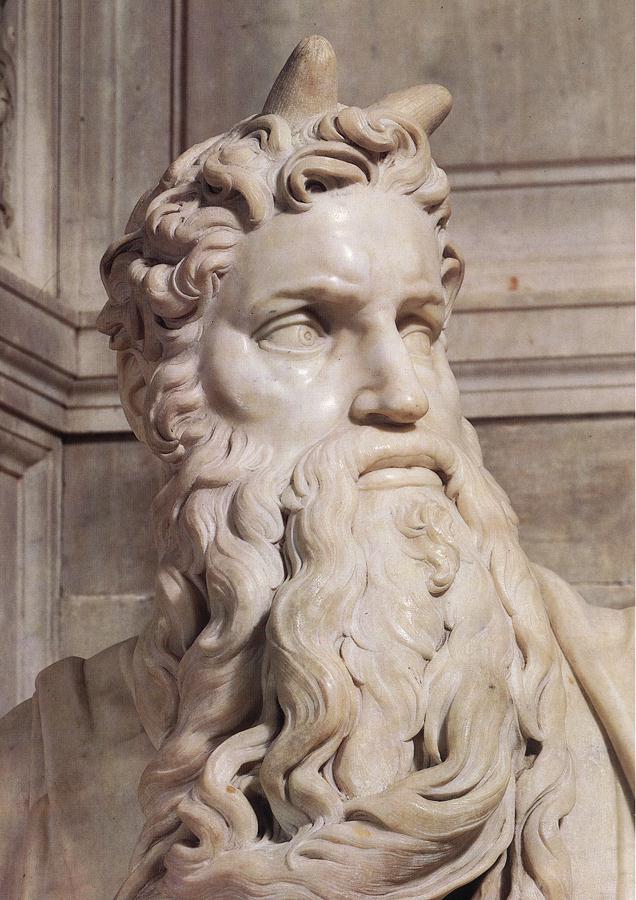
In 1505, Pope Julius II commissioned the Renaissance artist Michelangelo to design and contruct his tomb in Rome.  In the course of his work, Michelangelo created one of the most famous statues in the world, known simply as the Moses.  Giorgio Vasari, a contemporary of Michelangelo, wrote a description of the statue:

Michelangelo's MosesMichelangelo finished the Moses in marble…, unequalled by any modern or ancient work. Seated in a serious attitude, he rests with one arm on the tables, and with the other holds his long glossy beard, the hairs, so difficult to render in sculpture, being so soft and downy that it seems as if the iron chisel must have become a brush. The beautiful face, like that of a saint and mighty prince, seems as one regards it to need the veil to cover it, so splendid and shining does it appear, and so well has the artist presented in the marble the divinity with which God had endowed that holy countenance. The draperies fall in graceful folds, the muscles of the arms and bones of the hands are of such beauty and perfection, as are the legs and knees, the feet being adorned with excellent shoes, that Moses may now be called the friend of God more than ever, since God has permitted his body to be prepared for the resurrection before the others by the hand of Michelangelo. The Jews still go every Saturday in troops to visit and adore it as a divine, not a human thing.  (Giorgio Vasari, Lives of the Artists Michelangelo Buonarotti of Florence, Painter, Sculptor and Architect)

Where did they come from?

This morning’s Torah portion, as it turns out.

After the disaster with the Golden Calf, God wants to wipe out the Israelites altogether and start over with a new nation descending from Moses.

Moses, in his role as God’s therapist, manages to talk God down and gets God to give the people a second chance.  Moses then descends the mountain to investigate the damage.  He breaks the tablets with the Ten Commandments on them, cleans house, and heads back up to the top of Mount Sinai to reestablish the relationship between God and Israel.

Moses is on a roll.  So he decides to strike while the iron is hot.  Now is the time to ask God the question that he has been saving for just the right moment:  “Show me Your glory.”

Moses wants to see God’s essence.  That, it turns out, is a bit too much even for someone like Moses to handle, so God agrees to shelter Moses in the cleft of a rock while the Divine Countenance is revealed.  Then, Moses will be able to catch a glimpse after God’s Presence has passed by.

Even that is pretty impressive.  When Moses comes down the mountain after forty days, everybody is excited for the reunion.  Moses has a shiny new set of Tablets, and the people are eager to have their leader back.  But as soon as they see him, the Israelites recoil in fear.

In his encounter with God, something has happened to Moses’ face.

The Torah describes it.  קָרַן עוֹר פָּנָיו (karan or panav) – Our Etz Hayim chumash translates it as “the skin of his face was radiant.” (Exodus 34:29) Robert Alter says, “the skin of his face glowed.”

In other words, Moses was radioactive.

But it is kind of a strange expression.  In fact, it is the only time in the entire Hebrew Bible that the verb karan appears.  The word means “to send out rays [of light]”

There are far more common words that would have conveyed the same image.  L’ha-ir, for example, is a common Hebrew word that means “to shine.”  Why didn’t the Torah use that word?  There must be something unique about this particular event that would explain the use of such a rare expression.

In the 4th century, Saint Jerome translated the Bible into Latin for the Catholic Church.  When he got to our word, he connected the verb karan to the noun keren, which is a common Hebrew word that means “horn.”  He translated it into the Latin cornuta, meaning “horns.”  The Latin translation would go something like this:  Moses had sprouted horns from the skin of his face.

It doesn’t really fit the context.  First of all, horns would grow from the head, not from the skin of the face, as the text describes.  Second, it makes a whole lot more sense that Moses would come away from his encounter with God reflecting some of the Divine fire that engulfed the mountain.

Jerome probably did not mean anything negative by attributing horns to Moses.  In the ancient world, horns were often associated with power.  The Babylonians and Egyptians had horned deities, and the Romans used horns to symbolize might, depicting horned statues of Jupiter.

The Septuagint, the Greek translation of the Bible, which Jerome certainly knew and understood, translated karan as “glorified.”  Jerome probably had something similar in mind.

But not everyone knew that.  It was in the 11th century that depictions of a horned Moses started appearing in Christian art.  The idea of Jews having horns also emerged around this time.  It was an especially pernicious accusation, possibly rooted in  a misunderstanding of Jerome’s translation.

In 1267, the Council of Vienna decreed that all Jews had to wear a special, pointed, horned hat.  Jews in other European communities over the following centuries were forced to wear other degrading symbols or items of clothing – often having something to do with horns.  (Joshua Trachtenberg, The Devil and the Jews, pp. 44-46.)

Why horns?

Horns were associated with the devil.  And so along with horns, Jews were also accused by medieveal European anti-Semites of having large, hooked noses, tails, goat-like beards, and cloven hooves.  It was a nasty rumor that persists to this day.  When my sister-in-law met her roommate upon first arriving at university, she asked her, in all sincerity, “where are your horns?”

What did Michelangelo mean by giving his Moses horns?  It’s hard to say.  There had been artistic renderings of Moses for hundereds of years, some with horns, and some without.  Some of those that depicted him with horns did so in a particularly evil light.

But there is no evidence that Michelangelo meant anything nasty by it in his Moses.  He was an artist, not a biblical scholar.  So he made Moses according to the words in his Bible: with horns coming out of his face.

But we still haven’t answered the question of why the Torah uses such an unusual word in Hebrew.  The Bible scholar Nahum Sarna suggests that the word karan “is probably a pointed allusion to the golden calf, for keren is the usual word for a horn.  It subtly emphasizes that the true mediator between God and Israel was not the fabricated, lifeless image of the horned animal, as the people thought, but the living Moses.” (Nahum Sarna, The JPS Torah Commentary: Exodus, p. 221.)

In other words, the Torah describes Moses’ glowing face with the word karan to emphasize that there can be no physical representations of God.  A horned calf made out of gold is a false god.  God cannot be encountered through an idol.  The Divine is not comprised of stone, wood, or precious metals, which are inanimate and lifeless.  God’s will is transmitted through human beings – through the Prophet Moses, and through the written and oral Torah that our tradition traces back to Moses’ intimate conversations with God.

After the people recoil from Moses’ glowing face, he gently urges them to come back.  “It’s ok.  It’s ok.  Everything will be fine.”

From then on, whenever he shares his conversations with God, the Israelites are illuminated by the Divine light reflecting off of Moses’ face.

And it is a conversation that continues to this day.  We have the records of Moses’ interactions with God, and the records of generation after generation of students and teachers trying to understand, apply, and extend those conversations to meet the evolving needs of contemporary life.  Whenever we engage in that conversation, we too are illuminated by the radiance that shone from the skin of Moses’ face.

A Different Kind of Hero

Gary and Sheila with the Berkenwalds

Gary and Sheila with the Berkenwalds

We recently lost my beloved father-in-law, Dr. Gary Romalis, z”l.  The following is a short tribute I delivered during the week of mourning.  For a more detailed article about Gary, see this article written by my wife’s cousin, Renee Ghert-Zand.

A Jewish teaching that is often quoted at funerals is from Pirkei Avot, a collection of wisdom passed down from teacher to student nearly 2,000 years ago.  Eizehu gibor.  “Who is a hero?” it asks.  And then it gives the answer one would not expect.  Instead of describing someone strong physically, it offers a different answer, a Jewish answer.  Eizehu gibor – “Who is a hero?”  Hakovesh et yitzro – “A hero is someone who can master his desires.”  Self-control.  That is the Jewish definition of heroism.

My father-in-law Gary was not that kind of hero.  One of his favorite meals went something like this:  A piece of rye bread, a half-inch thick piece of salami, a half inch thick slice of onion, a half-inch thick layer of mayonnaise.

Gary was the other kind of hero – the kind who puts his own life at risk to save others.  He dedicated himself to protecting women, ensuring that they would always have control over their own bodies.  After being shot and nearly killed in his home while eating breakfast, Gary continued practicing medicine.  After being stabbed at work six years later, he persisted.  That kind of selflessness is heroic.

But there is much more to this hero.  My wife Dana often talks of the kind of father he was.  This hero, despite his long hours at the hospital, made his daughters his number one priority.  When he came home from work, there was nothing that could distract him from them.  Gary knew how to shut out all the distractions and be fully present.  When they were with him, they were the center of his world – and they knew it.  Whichever one was sitting on his lap, in that moment, was “his favorite.”

I did not know Gary then, but I can picture it because I have seen him as a grandparent.  This hero loved nothing more that to strip down to his underwear and give his grandchildren a bath.  Gary just wanted to be in their presence.

Gary was so proud of his children and grandchildren, and he let us know it constantly.  He gave love freely and unconditionally.  Whenever I shared a sermon, Gary was usually the first person to respond, always with “I love you and am so proud of you.”

As a father, it is Gary who I think about as my model for being Present with my children.  With all of the technology that modern life provides, it is so easy to be distracted from those we love.  Gary liked his technological toys, whether the latest iPhone or his GPS.  But it was always put away around his grandkids.  As a father, I think about Gary whenever I am tempted to look at my cell phone around my children.

I’d like to share two personal memories.

Back when Dana and I were dating, we hit a bump at one point, and she broke up with me, leaving me pretty devastated.  I found myself back in the house with Gary, in the kitchen.  Without saying a word, he pulled me into a big hug.  He then told me, both of us with tears in our eyes, that he and Sheila would always love me and that I would always have a place in their home.  That was the most memorable hug of my life.

Several years ago, Dana developed a pregnancy complication that endangered her life.  It was exactly the kind of serious medical condition that Gary specialized in.  Of course, Gary was on the phone with friends and colleagues at San Francisco General Hospital.  Only the best would be allowed to care for his daughter.

When she went in for surgery, Gary was with me in the hospital.  After the initial procedure, a nurse came up to report that Dana had developed complications in surgery.  I remember it vividly.  We were in the hallway.  I became faint, and had to sit down on the floor against the wall.  I can only imagine what he was feeling on the inside, but Gary’s external calmness was so reassuring.

A little while later, Dana was in the surgery recovery room, where visitors are normally not allowed.  That wasn’t going to keep us away.  I will always remember what he told me.  “Walk in like you own the place.”  And we did.  Thank God, Dana recovered.  Gary and Sheila’s presence at that difficult time was so comforting.  I will be forever grateful.

As one of three men blessed to be married to “a Romalis girl,” I am eternally indebted to my father-in-law.

I will miss him deeply.  He was a hero.

Coming Face to Face with Poverty – Vayechi 5774

In the last few weeks, I have been approached on two separate occasions by people, both Christians, about our community getting involved in charitable causes.

The first was for limited involvement in Santa Clara county’s Faith-Based Reentry Collaborative.  For a criminal who has served his or her time, getting back into society can be extremely difficult.  There is a high rate of recidivism, of people not being able to get their lives back together and winding up back in prison.  People often don’t have the social resources to become self-sufficient.  Perhaps they have burned their bridges with family members who could take them in.  Or maybe their criminal record makes it difficult to find work.  They fall back in to unhealthy social circles.

As a society, we do a terrible job of helping people reintegrate into society in a healthy and productive way.  The county has recently begun to establish partnerships with local houses of worship that will welcome former prisoners into their communities and provide them with mentorship and support.  So far, three local churches have opened up reentry centers, and the county is still trying to figure out ways for other faith communities to help.

I was approached about getting the Sinai community involved in a limited way.  A newly released prisoner often has nobody to come and pick him or her up.  Furthermore, the prison does not issue clothing, so they wear what they came in with, which may not be sufficient.

Members of our community could help out in that critical first 24 hours by picking up a released prisoner at midnight, bringing a set of warm clothes, dropping him or her off at a motel which we paid for, and providing them with a meal.  There would not be any further obligations.  Just that one night.

The second program about which I was approached is called Refugee Foster Care.  It is sponsored by Catholic Charities of Santa Clara County.  It would involve a far more substantial commitment.  A family or individual would become foster parents for a child who has no parents, either because they were killed, or because they gave them up.  The kids are between 12 and 17 years of age and come from war-torn places around the world.

These two solicitations for our community’s involvement got me thinking.  Would Sinai members be interested in taking on causes like these – causes which bring us face to face former criminals, with children who have experience suffering most of us cannot even imagine?

Why is it that many Christian communities seem to be so motivated to get involved with human suffering in this way?  Why are we not involved in projects like these?  Projects of bringing people into our cars, or our homes.  Causes that demand us to give of ourselves?  Aren’t these essential Jewish values?

Our ancestors make the transition from a family into a people in this morning’s Parshah, Vayechi.  Jacob dies, and his sons carry out their promise to return his body to the land of Canaan to be buried in the Cave of Machpelah.  After the mourning period ends, the brothers are terrified that Joseph has only been behaving civilly to them out of respect for their father.  Now that he is gone, they worry that Joseph is going to take revenge for what they had done to him so many years before.  They send word to Joseph that their father had wished for him to forgive his brothers.

Joseph’s reaction surprises them.  He cries.  So they appear before him themselves, offering to become his slaves.  Joseph reassurs them that it was all part of God’s plan.  He has no intention whatsosever of taking revenge.  Not only that, he offers to help.  “And so, fear not.  I will sustain you and your children…” he says.

Joseph has introduced the idea that will be elaborated extensively throughout the Torah – that a Jew who is in the position to do so has an obligation to provide for other Jews who need help.

It is significant, perhaps, that the transformation into a people and Joseph’s commitment to care for them occurs outside of the Promised Land, in the Diaspora.  For millenia, Jewish communities in far-flung locations around the world found themselves in situations of having to take care of their own.

Until the last century, most Jewish communities were poor.  They also tended to be tightly knit.  Most people knew each other.  The community had to take on the responsibility of caring for its own poor – because there was nobody else to do so.

This was done in a variety of formal and informal ways.  There was a communal tzedakah fund called the kupah, with elected collectors and distributors.  It served as a kind of tax to cover communal expenses and provide a safety net for the poorest members of the community.

In addition, there was the tamchui, which was kind of an ad hoc soup kitchen.  The official collector might show up at your doorstep to collect a meal on behalf of another individual or family in the community who needed it.

At celebrations, the needy would be welcomed to attend.  They did not need an invitation.  People would go out of their way to invite poor people to their Shabbat and holiday tables.

Consider the passage that we recite at the beginning of the Passover seder.  We open the door and announce “Let all who are hungry come and eat…”  I don’t think it used to be a metaphorical statement, as it is for most of us today.  I think there were times, until very recently, when those who could afford it would invite those who could not to their dinner tables, including those who might have been homeless.

In Pirkei Avot (1:5), the collection of ethical teachings that was compiled nearly 2,000 years ago, Yossi ben Yochanan of Jerusalem teaches “Let your home be wide open, and make the poor into members of your household.”

Just think about all of the folktales from our tradition, covering all periods of history except the modern era, in which poor Jews are welcomed into the homes of other Jews.  I assume that those stories exist because things like that used to actually happen on a regular basis.

Synagogues used to function kind of like homeless shelters, especially on Shabbat.  Travelers, poor students, and people who did not have anywhere to stay would sleep on the benches of the shul.  The community would often provide them with a meal.

As Jews, we used to come face to face with poverty regularly.  Thankfully, Jewish communities today are wealthier than ever before.  It’s not to say that there are not plenty of Jews who struggle financially.  There are.  It is undeniable, however, that the global Jewish community has thrived in contemporary times.

Our empasis on tzedakah (charity) and gemilut chasadim (act of lovingkindness) remains important, but the way that we express those values has shifted along with economic and social realities.  Jews continue to give a lot to charity, but instead of a mandatory tax on the members of our community, everything is voluntary.

With the almost total acceptance of Jews into American society, the proportion of funds donated to Jewish non-profit organizations has fallen dramatically, especially among younger generations.  Our giving is directed to causes that we care about.  But rarely is money or assistance given face to face to needy members of our own community.

Like in most synagogues, a minuscule portion of Sinai’s annual budget goes towards charitable activities and social action.

Sinai has had some great Tikkun Olam activities over the past couple of years.  But for the most part, our efforts have not put us into direct contact with poverty.  We have served several meals at local soup kitchens, but even then the contact with the homeless is limited.

We have not invited the homeless into our synagogue.  We have not sponsored programs that would assign members of our community to be mentors to people who could really benefit from that kind of guidance, whether former prisoners, kids who cannot read, or refugees.

How would we respond if someone who was obviously homeless walked into the synagogue during Shabbat services?  Would we welcome that person with open arms?  Would we be worried about safety?  Would we ask him to leave?

In the Bar Area, there are churches, and even some synagogues, that house rotating homeless shelters.  Why not us?

There are other religious traditions that seem to place a much greater theological emphasis on direct service to the poor.  For example, there is a story in the New Testament of Jesus washing the feet of his disciples’ feet.  The new Pope, Francis, recently made news when he washed the feet of 12 juvenile prisoners.  Back when he was the Archbishop of Buenos Aires, he would frequently wash the feet of AIDS patients and drug addicts.  It is about humbling oneself in service to other human beings.  For Christian communities who are trying to literally follow Jesus’ example, having that direct contact with the poor makes sense, theologically.

For most of Jewish history, our communities could not afford to direct so much of our charitable activities beyond our own communities.  Facing so much discrimination, Jews had to take care of their own – and they did a phenomenal job of it.  But now that the direct need is either not as great, or just more hidden, what should we be doing?

My goal this morning is to raise questions.  Should we be devoting considerable resources to directly serve those who need it most?  Should we open up our synagogue, or even our homes, to people who would otherwise never enter our lives?  Should we give substantively of ourselves to non-Jews?

The answer is not easy.  Jewish communities around America are struggling to retain and attract sufficient members and funds to remain viable.  Can we afford to send our limited resources outside our community?

When asked, American Jews seem to recognize the importanec of serving humanity.  A 2001 study asked American Jews about involvement in this kind of work.  It found that around ninety percent of American Jews agreed to the following statements:

  • “Jews have a responsibility to work on behalf of the poor, the oppressed, and minority groups”
  • “When Jewish organizations engage in social justice work, it makes me feel proud to be a Jew.”
  • “Jews’ involvement in social justice causes is one good way to strengthen ties with other groups in society.”

The difficulty is, it is possible to feel just as strongly about working on behalf of the underserved without attributing those motivations to Judaism.  I do not need to be Jewish to help the poor.  What is it from our own tradition that would compel us to give so much of ourselves to non-Jews?

It is an open question.  The invitations stand  As a Jewish community, do we want to help human beings who have made some wrong decisions in life get back on track after they have been released from jail?  Do we want to encourage and support Jews in our community who are willing to foster a teen-ager whose life has been torn apart by war?

I would like to hear from you – either today during kiddush, or some other time.  What should we be doing as a kehillah kedoshah, as a holy Jewish community?

When Joseph makes the commitment to his brothers, “fear not, I will sustain you and your children,” he is committing to serve his own siblings.

In the 21st century, who are our brothers and sisters?