Reading – and Speaking – About Sexuality on Yom Kippur Afternoon – Parashat Acharei Mot/Kedoshim 5777

Our Mahzor Lev Shalem offers two possible readings for the afternoon of Yom Kippur.  The Traditional one from Leviticus, chapter 18, or an Alternate reading from Leviticus, chapter 19.

Leviticus 18 describes what are commonly referred to as the arayot – forbidden sexual relationships, mainly incest.  Also included  are adultery and the now infamous Leviticus 18:22, which describes male homosexuality as an “abomination.“

Leviticus 19 is known as “The Holiness Code.”  It opens with the instruction Kedoshim tih’yu ki kadosh Ani adonai Eloheikhem – “You shall be holy, for I, Adonai your God, am holy.”  It then lists a variety of commandments that constitute a guide to a life of holiness.  The diverse subjects of these commandments include interpersonal relationships, business practices, ritual behavior, criminal law, and more.

Neither Leviticus 18 nor Leviticus 19 contain a single reference to Yom Kippur or any of its themes.

This morning,  as luck would have it, we read the double portion of Acharei Mot and Kedoshim.  In years when these parashiyot are combined, it creates a juxtaposition of the 18th and 19th chapters of Leviticus, the Traditional and Alternate Torah readings that appear in our High Holiday Mahzor.  In fact, parts of both chapters are even read in the same aliyah.

When they chose to add a second possible reading to Mahzor Lev Shalem, the Editors forced communities to ask themselves a question that they might otherwise never have considered: which portion should we read?  This year, our congregation has been addressing this question.

As the Rabbi of Congregation Sinai, I am the Mara D’Atra, Aramaic for “Master of the Place.”  This means that I am entrusted with the responsibility for making halakhic decisions for the community.

As you may recall, I wrote an article about it in the January Voice.  That month, there was an open meeting of the Ritual Committee to learn about the issues and hear from each other.  Personally, I have spent countless hours researching and consulting with members, colleagues, and teachers.

I am enormously uncomfortable being the decider.  When a decision is made to abandon or change a practice, there usually is no going back.  As a Rabbi, I think about that a lot.  Who am I to change thousands of years of tradition?  Sometimes, of course, change is necessary.  But when does the need for change outweigh the demands of history?  I don’t take that dilemma lightly.

For some people, this is a serious, emotional issue.  Whatever the outcome is, someone is going to be upset.  I lose sleep knowing this.  Please understand that I have attempted to reach a conclusion in good faith.  I take the sacred role that you have entrusted with me seriously.  I am strengthened by knowing that, whatever the outcome, you have my back.

Before I share my decision, let me clarify a few things.  We read the entire Torah every year.  We do not skip over any troubling passages because we do not like them.  And there is plenty in the Torah that is troubling.  This is not a question about eliminating a Torah reading.  We will continue to chant Torah on the afternoon of Yom Kippur.

Let’s be honest about Minchah on Yom Kippur.  When the service begins, around 5:00 in the afternoon, there are typically about 75 people in the room.  At that point in the day, they are weak from the fast, and a bit spacey.  Of those 75 people, how many of them are paying close attention to the Torah reading, and really pondering its message for their lives?  Our sanctuary is not exactly filled with kavanah – religious intension.  From that perspective, it does not matter which of the two readings we select.

I hope that by addressing this question, we can transform a relatively lazy part of Yom Kippur into a meaningful, kavannah-infused moment.

So why would a congregation choose to read the Traditional or the Alternate portions?  Mahzor Lev Shalem includes meaningful commentaries and explanations for both readings.  It does not, however, explain why the Alternate reading was included, nor does it suggest any reasons for why a community might choose to replace the Traditional reading.

I consulted with Rabbi Elliot Dorff, the Chair of the Committee of Jewish Law and Standards, which issues halakhic rulings for the Conservative Movement.  He responded to my inquiry that the particular selection of readings for the holidays is custom rather than law.  Rabbi Dorff explained that “the authors of Mahzor Lev Shalem were concerned with bringing up the prohibition of homosexual relations in Leviticus 18, given what we have done with that halakhically.”  He was referring to the CJLS’s decision in 2006 to overturn Judaism’s traditional ban on homosexuality.  He added that “Leviticus 19 is much more uplifting and much more connected to the theme of Yom Kippur than Leviticus 18 is.”

In other words, the Alternative reading was added because a lot of Conservative Jews are troubled by Leviticus 18:22, which states “Do not lie with a male as one lies with a woman; it is an abomination.”

The question comes down to: do we change a long-established custom because we are offended by a particular verse?

Where did the Yom Kippur afternoon Torah reading come from? Even though it makes no mention of Yom Kippur and does not deal with any of the basic themes of the holiday, at some point, a person or community thought it would be a good idea to read about forbidden sexual relationships on the afternoon of Yom Kippur.

The earliest mention of it occurs in the Talmud, in Tractate Megillah (30b-31a).  A second century text from the land of Israel states “At minhah [on Yom Kippur] we read the section of forbidden sexual relationships (that is to say, Leviticus 18) and for haftarah the book of Jonah.”

The Talmud records numerous variant practices for which portions are read at the various holidays.  There were significant discrepancies between Israel and Babylonia.  But with regard to the Yom Kippur minchah reading, there are no differences.  We can say with a high degree of certainty that Jews have been reading Leviticus 18 on Yom Kippur afternoon since at least the second century, making it a 1,900 year old custom.

But why this reading?  The Talmud offers no answers.  In his commentary, Adin Steinsaltz writes:  “Given the solemnity and holiness of the day, this choice of Torah portion is quite surprising.  Various suggestions for the choice have been offered…”

One possible reason is suggested a Mishnah in Tractate Ta’anit that describes a custom that took place during Second Temple times.

There were never happier days for the Jews like the fifteenth of Av and Yom Kippur, for on those days the daughters of Jerusalem would go out wearing borrowed white clothing so that they should not embarrass those who did not own such… The daughters of Jerusalem would go and dance in the vineyards and say, ‘young man, lift up your eyes and see what you choose. Do not look for beauty, look for family…’

With all of this matchmaking taking place on Yom Kippur afternoon, it would have been especially important to remind all of the single people who is and is not eligible to them.  This might explain why Leviticus 18 was chosen.  It should be noted, however, that the Talmud itself does not make this connection.

Rashi, in the eleventh century, points out that sins having to do with sexual relationships are ever-present, and a person’s desires and inclinations can be overwhelming.  They also tend to be secret.  And so, on the afternoon of Yom Kippur, reading about prohibited sexual relationships is meant to awaken a person to teshuvah about something which is so difficult to resist.

Tosafot, in Rashi’s grandchildren’s generation, adds that women are often dressed up fancy on Yom Kippur.  The Torah reading, therefore, serves as a reminder to worshippers not to stumble.

Turei Zahav, a seventeenth century commentator on the Shulchan Arukh by Rabbi David ha-Levy Segal captures it succinctly:

In my opinion, since a person’s soul thirsts for forbidden sexual relationships more than all [other] sins, we are warned about it on Yom Kippur, which is an awe-some day that is inscribed upon the human heart more than all the other days of the year.

Human nature has not changed much over the centuries in that regard.  Would anyone suggest that we, in our “enlightened” twenty first century, do a better job of controlling our sexual urges than in previous generations?

I think not.

Leviticus 18 certainly has something to tell us today.  It might not be quite as uplifting as Leviticus 19’s “You shall be holy…,” but it is a message we need to hear.

Judith Plaskow wrote an influential article in 1997 called “Sexuality and Teshuvah: Leviticus 18.”  In it, she writes:

As someone who has long been disturbed by the content of Leviticus 18, I had always applauded the substitution of an alternative Torah reading—until a particular incident made me reconsider the link between sex and Yom Kippur. After a lecture I delivered in the spring of 1995 on rethinking Jewish attitudes toward sexuality, a woman approached me very distressed. She belonged to a Conservative synagogue that had abandoned the practice of reading Leviticus 18 on Yom Kippur, and as a victim of childhood sexual abuse by her grandfather, she felt betrayed by that decision.  While she was not necessarily committed to the understanding of sexual holiness contained in Leviticus, she felt that in quietly changing the reading without communal discussion, her congregation had avoided issues of sexual responsibility altogether.

Our failure in the past has not been that we have continued to read a passage that is offensive to gay men.  Our failure has been that we have not openly addressed issues of sexual abuse and impropriety.  To cease reading the traditional Torah portion would be just as problematic as if we kept on reading the words while ignoring their meaning.

We cannot expand understanding, tolerance, and acceptance of GLBTQ individuals if we refuse to acknowledge that there is an issue.

If, instead, we maintain the traditional reading and address the issues that it raises, our kavanah will improve.

This is why I have decided, as Sinai’s Rabbi, that we will continue the traditional practice of reading Leviticus 18 during the afternoon of Yom Kippur – with an addition.  There will be a D’var Torah delivered by a Sinai member to introduce the Torah reading.  The purpose will be to reflect on themes raised by the portion so as to draw us into the reading, and provoke us to respond to it in some way.  Torah is not supposed to make us feel good.  It is supposed to challenge us.  If Torah makes us feel good, it is not doing its job.

Reading and speaking about Leviticus 18, on the holiest day of the year, will give us an opportunity to reflect on the most intimate aspects of our lives, rather than pretend they do not exist.  It will also allow us to recognize the pain and exclusion that our GLBTQ friends and relatives have faced over the millennia because of Judaism’s, and society’s, past intolerance.

In this ruling for our community, both aspects are equally important.  Our members will be called upon to consider how Leviticus 18 speaks to us today.  I hope you will consider giving a D’var Torah on Yom Kippur afternoon.  Of course, I am here to help.

It is important to recognize that this approach – dealing with a difficult text by speaking about it – has been embraced by numerous communities in every denomination: Reform, Reconstructionist, Conservative, and Orthodox.  This solution puts Sinai in good company.

One of the sidebar commentaries in our Mahzor is by Judith Plaskow.  She writes: “Leviticus 18 seeks to implement [its] ideas in its own time and place.  But we need to find ways to express those insights in the context of an ethic of sexual holiness appropriate for the 21st century.”

May Torah inspire us to holiness in all aspects of our lives.


Bibliography

Rabbi Jeffrey Brown, “Preaching Against the Text: An Argument in Favor of restoring Leviticus 18 to Yom Kippur Afternoon” – This is an important article by a Reform rabbi that argues why it is important for communities to continue reading Leviticus 18.

Keshet is a national organization that works for full LGBTQ equality and inclusion in Jewish life.  Its website contains a wealth of information, including numerous sermons and kavanot  on Levitucs 18.

Breaking the Stigma of Mental Illness – Yom Kippur 5777

There is a town in Belgium called Geel (Hyale), with a remarkable 700 year old custom of compassion.

Its origin lies in a legend about a seventh century Irish princess named Dymphna.  When Dymphna’s mother died, her father went mad, insisting on marrying her.  Dymphna fled to the continent.  When he caught up to her in Geel, he beheaded her.  Dymphna was sainted, and pilgrims began visiting the site of her martyrdom in search of miraculous cures, especially for mental illness.

A church was built in 1349, and later, an annex to house the visitors.  Eventually, the townspeople began to welcome the mentally ill relatives of pilgrims into their homes as “boarders.”  For the townspeople, it was an act of charity to open up their homes.  “Boarders” stay with their hosts for long periods of time, as many as fifty, or even 80 years, becoming part of the family.

At its peak in the 1930’s, there were 4,000 boarders living amongst a local population of 16,000.

The residents do not use terms like “mentally ill,” “psychiatric,” or “patient.”  Behavior that in any other part of the world would be considered odd or crazy, like people talking to themselves on the streets, is normalized in Geel.

This system does not take the place of medical treatment.  There is a psychiatric hospital on the outskirts of town.  What it does is treat people with dignity who would in any other community likely be hidden away or abandoned on the street.

Since the 19th century, Geel has been held up in psychiatric circles as the best way to address mental illness.  It is an ideal model for integration and normalization within a supportive community.

Sadly, as the world has changed, Geel is changing along with it.  As the result of the pressures of modern life, and the increasing medicalization of mental illness, there are today only 250-300 boarders left.  But for the residents of Geel, this custom of compassion is an important part of their heritage.

Let’s try to imagine, for a moment, what it would be like if our community was so accepting and welcoming to those who do not conform to what we typically think of as normal behavior.

Psychiatric care in the United States used to center on institutionalization in asylums.  People who were “crazy” were sent away to facilities that often had terrible conditions, where they received treatments that were often tantamount to torture.  In 1972, the psychiatric hospitals began to close.  This was supposed to be accompanied by investment of resources into community-based treatment centers.  But the investment did not happen.  As a result, many of those living with mental illness became homeless.  This is a tragedy that persists to this day.

Unlike the example of Geel, there has been no normalization of mental illness.  The mass shootings that we have seen over the past few years has prompted discussions of the need to invest more money and resources in mental health screening and treatment, but little has been done.

There is still so much fear and stigmatization.  The truth is, members of our community live every day with mental illness, whether it affects them personally, or someone close to them.

But we don’t talk about it openly.  We are scared of “strange” behavior.  When someone exhibits signs of mental illness, we tend to back away.

Think about language that we toss around casually: crazy, cuckoo, nuts.

Mental illness is so much more widespread than we typically acknowledge.  One out of every five adults in America experiences mental illness.  One in twenty five live with a serious chronic condition.

1.1% of the adult population has a diagnosis of schizophrenia.  2.6% has bipolar disorder.  6.9% suffer from major depression.  And 18.1% have an anxiety disorder.

Most signs of mental illness present themselves when we are young, with half of all chronic mental illness beginning by age fourteen.

We do not adequately treat mental illness.  60% of adults and 50% of youth aged 8-15 with mental illness did not receive mental health services in the last year.

There is a terrible price that we pay.

Depression is the leading cause of disability worldwide.  It is estimated that serious mental illness costs America over 190 billion dollars per year in lost wages.

Suicide is the 10th leading cause of death in America overall, and the second leading cause among those aged 15-34.  It is estimated that 90% of those who die by suicide suffer from depression.  As much attention as there has been to the mass killings, twice as many people die in America by suicide than by murder.

Rabbis give lots of sermons this time of year about teshuvah, repentance.  It is a wonderful concept – truly one of Judaism’s most insightful principles.  Every year, we engage in cheshbon hanefesh―self-reflection―examining our lives, and identifying ways we can be better.  We reach out to those we have wronged and seek to make amends.  We turn to God, confess our sins, and ask for forgiveness.

But what if there is no getting better?

Many of us live with mental health conditions for which there is no “cure.”  No amount of cheshbon hanefesh is going to enable us to “fix” ourselves.

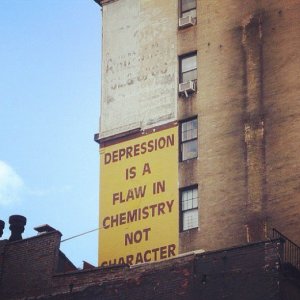
But that does not make us failures.  “Depression is a flaw of chemistry, not character,” reads a Manhattan billboard.6fe75f9ff1353866f3da9ebdcc988d8c

The field of human psychology is just over a century old.  Our understanding of mental illness, and our ability to treat it, ha experienced a sea change in that time.  But that does not mean that our ancestors did not have any appreciation or compassion for those whose behaviors did not conform to social norms.

In the Bible, the best depiction of a major character suffering from mental illness is King Saul.  Listen to how the Bible describes the onset of his condition:  “Now the spirit of the Lord had departed from Saul, and a ruach ra’ah – an evil spirit – from the Lord began to terrify him.”  (I Sam 17:14)  Saul’s courtiers do not know how to address their king’s new state of mind, so they suggest searching for a musician to soothe him whenever the ruach ra’ah manifests itself.  A search leads to David, who, among other talents, is a skilled lyre player.

Saul’s ruach ra’ah comes and goes.  He has episodes of paranoia and mania interspersed with periods of normal function.  Some modern readers have suggested that he might have suffered from a bipolar disorder, although we should be cautious about making a diagnosis based on a three thousand year old text.

Some time later, David kills the Philistine Goliath and then has to flee from Saul’s wrath.  He winds up in the court of King Achish of Gat, Goliath’s home town.  To avoid arrest, David pretends to be insane, scratching marks on the doors and letting his saliva run down his beard.  Achish, afraid of this behavior, scolds his attendants.  “You see the man is raving; why bring him to me?  Do I lack madmen that you have brought this fellow to rave for me?  Should this fellow enter my house?”  (I Sam. 21:15-16)

Many of the Psalms, traditionally attributed to King David and his court, express the anguish of a troubled mind.

My soul is in anguish, and You, O Lord―how long?

Turn, Lord, set my soul free; save me for the sake of Your love…

I am weary with my sighing.

Every night I drench my bed, I soak my couch with my tears.

My eye grows dim from grief, worn out because of all my foes…  (Psalm 6)

These sound like the words of a person living with severe depression.

In Rabbinic texts, there is much discussion about mental illness.  The term that is used to describe such a person is shoteh.  The shoteh, along with the deaf-mute, is generally not granted much legal status, as they are assumed to not understand what is happening around them.

But what constitutes a shoteh?

A single talmudic passage offers an inconclusive definition.  “Who is a shoteh?  A person who goes out alone at night; sleeps in a cemetery; and tears one’s clothing.”  (BT Chagigah 3b)  One Rabbi explains that all three behaviors need to be exhibited, while another Rabbi argues that just one is needed.  Then, the Talmud suggests that there could be rational reasons for a person would go out alone at night, sleep in a cemetery, or tear clothing.  The question is left unresolved.

Nearly one thousand years later, Maimonides is discussing laws pertaining to who may serve as a witness in court.  A shoteh, someone who is mentally or emotionally unstable, is not considered to be obligated in the mitzvot, and thus cannot serve as a witness, he says.  But who is a shoteh?  As a legal scholar, a physician, and a community judge and leader, Maimonides offers a more nuanced, and I would suggest compassionate, way of looking at the shoteh.

First he describes someone who is unable to understand basic matters or recognize simple contradictions.  He is describing what we might call someone with an intellectual disability, or low IQ.

Maimonides then writes about emotional instability.  He says that is is not merely someone who “goes around naked, destroys utensils, and throws stones.  Instead, it applies to anyone whose mind is disturbed and continually confused when it comes to certain matters, although he can speak and ask questions to the point regarding other matters.”

But his final comment is the most poignant.  “This matter is dependent on the judgment of the judge. It is impossible to describe the mental and emotional states of people in a text.”  (Edut 9:9-10)

Every person is unique.  Someone might be capable and functional in some aspects of his or her life, but troubled in other aspects.  Emotional instability might come and go.  We cannot make categorical assumptions without even getting to know a person.  We have to take the time to listen.

Pretty progressive for the twelfth century.

Today, we know that mental illness is not a punishment from God, and it is not something that can be cured with sacrifice or prayer.  Whereas it was once attributed to possession by a ruach ra’ah, we now understand mental illness as being caused by chemical and/or physical processes in the brain.

And, there is often treatment that can reduce symptoms of mental instability and make it possible for someone living with a mental illness to flourish in ways that would have been unimaginable in previous eras.  Someone who once would have been considered a shoteh, and not held accountable for his or her actions, can now have a family and a successful career.

While not perfect, we do a pretty good job of accommodating the needs of people who live with physical disabilities.  The Americans with Disabilities Act, signed into law in 1990, “prevents discrimination and guarantees that people with disabilities have the same opportunities as everyone else to participate in the mainstream of American life.”

It has changed such basic things as how we design buildings.  When our synagogue was built ten years ago, for example, we included a ramp to enable someone who uses a wheelchair or walker to come up to the bimah.  Earlier this year, we installed railings to make it easier to walk up the steps to the bimah.

We do a reasonably good job of ensuring that our synagogue is a welcoming home for anyone with a physical disability.

But what about for someone suffering from a psychiatric illness?

One of the most meaningful parts of our weekly Shabbat services is the Mi Sheberach L’cholim, the prayer for the sick.  Our practice is to invite anyone who would like to include the name of someone who seeks healing to form a line.  Each person has an opportunity to recite the names of those who are ill.  It is one of the most personal parts of the service for many of us, including me.

I recognize many of the names that are recited, and I am familiar with the illnesses that many of them face: cancer, chronic conditions, acute sickness, dementia.  But have we created a culture in which we would think to include someone struggling with mental illness in our prayers for healing?

Would someone who is him or herself experiencing depression feel welcome to include his or her own name?

It would certainly be appropriate to do so.  The language of the prayer acknowledges that there are physical and spiritual dimensions to healing.  We pray for r’fuat hanefesh ur’fuat haguf―healing of spirit and healing of body―in that order.

Prayer is not a treatment for mental illness.  It is not a substitute for medications that address chemical imbalances in a person’s brain.  But religion, and a religious community, ought to be an important component in healing.  Where better for someone living with depression to turn for support and acceptance than a house of worship?

We need to do better.  Congregation Sinai needs to be a community in which those suffering with a mental illness can be open about their struggles.  We need to break the stigma that leads so many of us to keep our struggles inside.

If you feel comfortable sharing your struggles with someone else, please take the courageous step and do so.  For someone who feels embarrassed or self-conscious about opening up, knowing that there are others who have shared similar experiences can make a huge difference.  It sends the message that “you are not alone.”

I have an anxiety disorder and Adult ADHD, for which I take psychiatric medications.

Over the past ten years or so, I have experienced occasional panic attacks.  I get dizzy.  The world starts to spin.  The edges of my eyesight get blurry, and I worry that I am going to pass out.  On some particularly bad occasions, I feel like I am having a heart attack, or at least, what I imagine a heart attack would feel like.

Scariest of all is when I have a panic attack while behind the wheel of a car.  One of my triggers is driving over tall bridges.  A few years ago, I was driving over the Golden Gate Bridge with my brother-in-law in the passenger seat and our kids in the back.  Halfway across the bridge, I could feel an attack coming on.  “Keep an eye on me,” I told my brother-in-law.  As soon as we got to the other side, I pulled over to the shoulder and gave him the wheel.

A couple of years ago, I had a panic attack in the middle of the night.  I thought I was having a heart attack.  I woke Dana up, and asked her to keep an eye on me.  I was upset with myself.  “What is wrong with me?  I should be able to just get myself under control.  After all, this is all just in my head.”

Dana, in her wisdom, responded, “Your brain is the most complex organ in your body.  What makes you think that you can just get it under control?”

Looking back, I realize that I had succumbed to the stigma of mental illness.  I felt guilty for not being able to control something “that was just in my head.”

It is not “just in my head.”  It is “in my head,” and that is not something to take lightly.

While real to me, my struggles are minor inconveniences compared to the serious mental afflictions that impact some peoples’ lives.  I do not know what it is like to live with schizophrenia or a bipolar disorder.

But I can hold someone’s hand and listen.

This year, I ask that we make it a priority that our synagogue become a place in which those living with mental illness can find compassion, acceptance, and healing.  I will speak of it more explicitly from the bimah.  From now on, when I lead the prayer for healing, I will change the way that I introduce it to something like the following:

I am now going to recite the Mi Sheberach L’cholim, the prayer for healing for those with physical and mental illness.  If you would like to include someone, or if you yourself are in need of healing, please come up and form a line to my right.

I ask that we commit to being there for each other with open minds and open hearts.

We all bring our tzarot, our troubles, to shul.  Especially on a day like Yom Kippur, with its focus on sin, repentance, atonement, and mortality.

Yom Kippur is really a day for spiritual healing.  In the Temple, it was the day when the High Priest conducted the rituals that restored the spiritual relationship between God and the Jewish people.  Today, our prayers and our fasting accomplish the same.

Let this day, this synagogue, and this community, offer healing and comfort to all those who have brought their tzarot with them.

I would like to close with this prayer composed by Rabbi Elliott Kukla, of the Bay Area Jewish Healing Center.

May the One who blessed our ancestors bless all who live with mental illness, our care-givers, families, and friends.  May we walk in the footsteps of Jacob, King Saul, Miriam, Hannah, and Naomi, who struggled with dark moods, hopelessness, isolation, and terrors, but survived and led our people.  Just as our father, Jacob, spent the night wrestling with an angel and prevailed, may all who live with mental illness be granted the endurance to wrestle with pain and prevail night upon night.  Grace us with the faith to know that though, like Jacob, we may be wounded, shaped and renamed by this struggle, still we will live on to continue an ever unfolding, unpredictable path toward healing.  May we not be alone on this path but accompanied by our families, friends, care-givers, ancestors, and the Divine presence. Surround us with loving-kindness, grace and companionship and spread over us a sukkat shalom, a shelter of peace and wholeness. And let us say: Amen.

G’mar Chatimah Tovah.  May we all be inscribed and sealed in the Book of Life for a year of blessing and healing.

Let’s Talk About Death So That We Can Live – Yom Kippur 5776

This is going to be a difficult sermon for some of us to listen to.  But it is an important one for all of us to hear.  And today, Yom Kippur, more than any other day, is the time for us to hear it.

On this day we face our own mortality, and admit to ourselves that so much of our destiny is out of our control.  Any of us could die tomorrow.  We could be hit by a bus or diagnosed with cancer.  We owe it to ourselves, and to our loved ones, to begin a serious conversation about our own deaths.  Let this be our resolution for the new year.

Our Jewish tradition is totally unequipped to answer questions about end of life issues in the modern era.  The prayer that I have been spending a lot of time with these High Holidays, B’rosh Hashanah Yikateivun, lists the various decrees that are at God’s disposal – who by fire, who by water, who by sword, who by beast, hunger, thirst, earthquake and plague.

Notice something common to all of these deaths.  They are all sudden.  There is nothing in this medieval prayer about Congestive Heart Failure, breast cancer, kidney disease, or Alzheimer’s.

While the language of the mahzor suggests that God has decreed our fates for the coming year and there is little we can do about it, the truth is quite the opposite.  We have an unprecedented ability to extend life, in some cases indefinitely.  We do not yet have the religious language to address all of the new challenges this presents.

This is not unique to Judaism.  Until the onset of modern medicine, most human death came suddenly.  People died from things like a kitchen injury that got infected, or the flu.

For the last one hundred years, though, humanity is increasingly gaining the ability to prolong dying.  The quick progression of medicine has taken us completely off guard.  We are no longer prepared to confront our own mortality under these circumstances.

In 1900, the average life expectancy in the United Staes was under fifty years old.  By the 1930’s it had risen to over sixty.  As of 2012, it was nearly seventy nine years old.

One hundred years ago, most people died in their own homes.  Nowadays, about a quarter of us die at home.  The rest of us die in hospitals, nursing homes, and other managed care facilities.

And that means that we, our loved ones, and the medical establishment, are faced with decisions that no previous generations ever had to consider.

You may have experience with this.  Some of you have had to make decisions about whether to continue treatment for a person you love.  Perhaps you felt confident that the decision you made was perfectly in line with the decision that your loved one would have made.  Or perhaps there was doubt.  You were not one hundred percent sure.  Maybe there was disagreement between siblings.  Perhaps there is still guilt and uncertainty about the decisions that were made, or about things that were said.  These scenarios are unfortunately all too common.

My grandmother, Baba Fania, may her memory be a blessing, passed away six years ago.  She was eighty four years old, and was struggling with Congestive Heart Failure.  Baba Fania lived in her own home until almost the end.  A few weeks before she passed away, she moved to a rehab center.  There were trips back and forth from the hospital.

She continued to decline, and I, along with my parents and brother flew down to Southern California to join my aunts and their families.

When I arrived, Baba Fania was in the ICU, the Intensive Care Unit.  Her heart rate had dropped dangerously low, and so the medical team had put her on an intravenous medication to bring the rate back up.  It was not a permanent solution.  They tried to wean her off the IV, and when her heart rate dropped again, the treatment was restarted.

Then, the Resident who was running the ICU initiated a conversation with us that does not occur frequently enough.  In his own words, he said “ICU’s have a tendency to take over.”  A treatment is started, and it leads to one after another and another progressively more invasive intervention.

Our medical system is very good at finding alternative treatments to fight illness.  If the first round does not work, then there are second and third rounds to follow.  But our system does not do a good job of determining when to stop.

Doctors, after all, are trained to treat illness.  They wage war against death, the enemy.  When a patient dies, the battle has been lost and the doctor has failed.  Of course, the deck is stacked, and death always wins in the end.  Nevertheless, we ignore what is inevitable because it is too difficult for us.  That is why the conversation about whether a treatment should be undertaken in the first place often does not happen.

We were lucky.  In our case, it did.  My aunts and father discussed what their mother’s wishes would have been in this situation, since she was unable to answer for herself.  They agreed that my grandmother would not have wanted to initiate a series of interventions which had little chance of extending her life and had every chance of increasing her suffering

The decision was made to wean her off the heart medicine one final time.  If she could not support herself, then no further interventions would take place and my grandmother would die.

And that is what happened.  The medication was withdrawn and she was transferred out of the ICU into a regular hospital room.  She died there a day and a half later.  I was in the room at the time with my aunt and uncle.

We were really lucky.  Lucky that my father and his sisters were in agreement about what to do.  Lucky that my grandmother had filled out a health care directive, and that everyone was aware of it.  Most of all, lucky that the physician running the ICU that day took the time to have a big picture conversation with us rather than speaking about the next treatment options – because it very easily could have gone in that direction.

As a I look back from a six year vantage point, I wonder if it might have been better if my Baba Fania had never gone to the hospital in the first place.  She could have been enrolled in a hospice program that would have focused on quality at the end of her life.  She could have stayed in the home that she had lived in for forty six years.  She could have died in her own bed, surrounded by her children, grandchildren, and the hundreds of photographs that lined her walls.  But the discussions that would have led to that decision never took place.

It is nobody’s fault.  Most of us do not know how to have that conversation.  It is not part of our culture to talk openly about our own mortality.

The dialogue that needs to happen rarely does.

The truth is, most of us know virtually nothing about dying.  We do not understand how the health care industry functions – and this includes the people who work in it.  We know little about the various treatments and their attendant risks and complications.  We do not understand the choices that we are going to have to face.  What we imagine it is going to be like and what it actually is going to be like are vastly different.

As someone who is married to a physician and is in the business of spiritually helping people with issues relating to mortality, I probably have more exposure to these kinds of conversations than most people.  I first completed my Advance Health Care Directive when I was twenty five years old.  Dana, fresh out of medical school and entering her residency, came home and insisted that we fill them out.  Death is a fairly common topic of conversation in our home, including with our nine and eleven year old children.

And yet, I will be the first to admit that I know practically nothing.  I do not know what it is like to receive chemotherapy, unlike some people in this room.  I do not know what it is like to have the first round of treatment fail, and to have to turn to second or third tier drugs.  I do not know what it is like to be on a ventilator, or in a medically induced coma.  I have never had to go into a procedure knowing that I might not wake up from it.  So how can I possibly be expected to make a decision now about what I would want done if and when any of those scenarios become real?

So what can we do?

Many of us have filled out an Advance Health Care Directive.  We have designated a Proxy, a person who will make decisions for us if we become incapacitated.  We may even have discussed it with our physician.  We have taken responsibility.  I am sad to say that the form is close to worthless.

The California Advance Health Care Directive asks two essential questions.  The first asks do you or do you not want your life to be prolonged if you have an incurable and irreversible condition that will result in death in the near future, or if you are unlikely to regain consciousness, or if the likely risks and burdens of treatment would outweigh the expected benefits?

The second question asks whether or not you want pain relief, even if it may hasten your death.

That’s it.  In the event of an emergency, two questions cannot possibly cover the range of scenarios that could arise.  And that is assuming that the directive you filled out made its way into your medical file, and that somebody actually bothered to look at it.  And, that the family members in the room with the physician are doing their best to decide what you would want rather than what they want.

No.  Those are not the right questions.

What is needed is not so much the answers to a list of medical scenarios, but rather a conversation about what is important to us.  Begin a conversation with the people in your life who are going to have to be with you at the end of it.

I once attended a class with a Geriatrician who had a lot of experience working with patients and families around end-of-life issues.  He described the relationship with the health care proxy, the person entrusted to make decisions for another, as a sacred “covenant.”

Nobody can account for all of the possible medical scenarios which he or she might be faced – so don’t bother to try.  What is more important is that the person entrusted with making decisions for you knows your values.

What matters to you?  What are you living for?  What in your life, if you lost it, would make you feel that living was not worth it any more?  What do you want your final weeks and days to be like?  Where do you want to die?

When the person you have trusted knows this about you, then if he or she ever has to make a decision, it will be your decision.

In a 2010 New Yorker article called “Letting Go,” Dr. Atul Gawande tells the story of a colleague.  Dr. Susan Block is a palliative-care specialist who has had thousands of difficult conversations with patients and family members, and is a nationally recognized trainer of doctors and other professionals entrusted with managing end-of-life issues.

Some years ago, her work became personal.  Dr. Block’s seventy-four-year-old father, a retired psychologist from UC Berkeley, was admitted to a hospital in San Francisco with a mass growing in his spinal cord. The neurosurgeon said that the procedure to remove the mass carried a twenty-per-cent chance of leaving him paralyzed from the neck down.  Without the operation, it was a one hundred-percent certainty.

The evening before surgery, Dr. Block and her father chatted about friends and family, trying to keep their minds off what was to come.  Then she left for the night.  Halfway across the Bay Bridge, Dr. Block realized, “Oh, my God, I don’t know what he really wants.”  So she turned the car around and went back to her father’s bedside.

Even for her, an expert in end-of-life discussions, the conversation “was really uncomfortable.”  “I just felt awful having the conversation with my dad.”  She told him, “I need to understand how much you’re willing to go through to have a shot at being alive and what level of being alive is tolerable to you.”

It was an agonizing conversation for her, but he said something that totally took her by surprise —”Well, if I’m able to eat chocolate ice cream and watch football on TV, then I’m willing to stay alive.  I’m willing to go through a lot of pain if I have a shot at that.”

“I would never have expected him to say that,” Dr. Block said.  “I mean, he’s a professor emeritus. He’s never watched a football game in my conscious memory.  The whole picture—it wasn’t the guy I thought I knew.”

After the surgery, he developed bleeding in his spinal cord.  The surgeons told Dr. Block that, to save his life, they would need to go back in. But he had already become nearly quadriplegic and would remain severely disabled for many months and possibly forever. What did she want to do?

She recalls, “I had three minutes to make this decision, and, I realized, he had already made the decision.”  She asked the surgeons whether, if her father survived, he would still be able to eat chocolate ice cream and watch football on TV.  “Yes,” they said, and so she gave the go-ahead for another operation.

“If I had not had that conversation with him,” she later said, “my instinct would have been to let him go at that moment, because it just seemed so awful.  And I would have beaten myself up.  Did I let him go too soon?”  Or she might have gone ahead and sent him to surgery, only to find—as occurred—that he survived only to go through what proved to be a year of “very horrible rehab” and disability.  “I would have felt so guilty that I condemned him to that,” she said.  “But there was no decision for me to make.”  He had decided.

After a difficult recovery, Dr. Block’s lived for ten more years. When complications developed that made it impossible for him to eat, he decided to stop fighting.  He went home on hospice care, received treatment to make him comfortable, and died with his daughter at his side.

Talking about our own mortality is one of the most difficult conversations we can have.  It seems so scary and daunting.  Where do we begin?  Let me offer a few conversation starters:

Describe a time when you were part of a difficult medical decision, either for yourself or for someone else.

Have you ever been present when another person died?  Talk about what that was like.

Then you can begin to talk about your own death.

Complete the following sentence:  What matters most to me at the end of my life is…

Is there something that, if you could no longer do it, would make you not want to continue medical treatment?  The equivalent of eating ice cream and watching football for Dr. Block’s father.  One Rabbi told his family that if he can no longer tell stories to children, he does not want to continue living.  What is it that makes your life worth living?

Where do you want to spend your final days?  How important is that to you?

The answers to these questions are different for all of us.  One person may want every possible treatment, regardless of the impact on his quality of life.  Another may feel that she would not want to continue if she could not feed herself.

The answers to these questions are likely to change.  This means that the subject of our mortality should not be a one-time conversation.  It is a topic that we should introduce now, when we are healthy and at full capacity.

I have had conversations about death with some of you, and I am honored to continue to help you work through these issues.  But I am not the most important person to speak with.  This conversation should be had with all of the people who are likely to be with us when our health declines.  This could mean spouses, children, siblings, parents, and close friends.

One of the greatest gifts we can give to the most important people in our lives is a conversation about our death.  We can save them from having to make an agonizing decision.  We can save them from years of guilt.  And we can prevent the kind of family squabbling that occurs when children, siblings, and spouses project their own fears on their loved one because they do not actually know what their loved one wants.

You owe it to yourself, and you owe it to them, to talk about your death.

Our Jewish tradition focuses on living in the present.  We do not have any certainty about what awaits us in the world to come, and it is certain that death waits for us in this world.  So we focus on our time here in the world of the living.  That time is made immensely more precious when we can face our mortality openly and honestly with the people we care about.

Today, or sometime in the next couple of weeks, begin the conversation with your loved ones.  Let’s talk about death so that we can live.

Who Shall I Say Is Calling – Kol Nidrei 5776

Who By Fire

By Leonard Cohen

And who by fire, who by water,

Who in the sunshine, who in the night time,

Who by high ordeal, who by common trial,

Who in your merry merry month of may,

Who by very slow decay,

And who shall I say is calling?

And who in her lonely slip, who by barbiturate,

Who in these realms of love, who by something blunt,

And who by avalanche, who by powder,

Who for his greed, who for his hunger,

And who shall I say is calling?

And who by brave assent, who by accident,

Who in solitude, who in this mirror,

Who by his lady’s command, who by his own hand,

Who in mortal chains, who in power,

And who shall I say is calling?

Leonard Cohen recorded this song in 1974.  The words are based on the prayer in Unetaneh Tokef, “On Rosh Hashanah it is written, and on Yom Kippur it is sealed, who shall live, and who shall die…”  The music is based upon the melody that he heard as a boy on Yom Kippur in Montreal.

In a 1979 interview, Leonard Cohen is asked about the last line:  “Who shall I say is calling?”  The interviewer asks:  “So who is calling?”

The artist answers: “Well, that is what makes the song into a prayer for me in my terms which is Who is it or What is it that determines who will live and who will die?”

In his ambiguity, Leonard Cohen captures many of our reactions to this prayer.

Who is calling?  God?  The Angel of Death?  Or is it we who determine who lives and who dies?

Maybe it is a cry of injustice, a rejection of a God who callously passes judgment on human beings like they are sheep.

Or maybe the answer is that no one is calling.  We are here all alone.

Is this not the fundamental question that humans have always asked – who shall I say is calling?  Is there someone or something out there?  Is there an order or purpose to the universe?  Are human beings, am I, here for any particular reason, or is it all just a random roll of the dice?  And if there is some Force or Being behind all of this, is there any rhyme or reason to the vicissitudes of life? Or is everything essentially arbitrary, and Divine justice a joke?

Today, more than any other day of the year, these are questions that come to the forefront of our consciousness.  Yom Kippur is the day when we face our own lives, our own mortality, face to face.  It is the day when, after a forty day process of teshuvah that began a month before Rosh Hashanah, our final fate for the coming year is locked in place.  It is the day, more than any other, when God takes interest in each of our lives, and resets our relationship for one more year.  And so it is a day of enormous tension, as our fates hang in the balance.

So who shall I say is calling?  Who is this God – if He or She or It even exists?

As we might expect, our tradition does not speak in a unified voice.  Dr. Ruth Calderon, of the Hartman Institute, points to three images of God that appear in our Yom Kippur texts, three radically different depictions of Who is calling and what is expected from us.  Usually, I refrain from using gendered pronouns to refer to God.  For these images, I need to use them to do them justice.

The first is from our mahzor.  It is the prayer that inspired Leonard Cohen’s song.  Unetaneh Tokef.  God is the Judge, presiding over the courtroom on the Day of Judgment.  He is the Prosecutor, the Expert, and the Witness.  God brings the case against us, listing all of the charges.  All evidence is on the table, written in the Book of Remembrance and sealed by our own hands.  There is no escape.

Then the Shofar sounds, and even the angels tremble in fear and terror, for they know that they too will be judged on this awesome day.

God then becomes a shepherd, inspecting each and every sheep.  Although softer than the judge metaphor, with the Shepherd taking interest in His flock, we are still very small.  As all of creation passes under His staff, the Divine Shepherd issues a verdict for the coming year.

Who will live, and who will die; who will live out his days, and whose days will be cut short; who by fire, and who by water, and so on.

This is a petrifying vision of God, and a scary depiction of Yom Kippur.  And, it is the dominant image in our mahzor.  A God of justice Who gives us exactly what we have coming to us, Who cannot be dissuaded, and to top it all off, Who does not even share the verdict with us.

How many of us have been terrified of this God, or allowed ourselves to be driven away by such a horrifying metaphor?

Who shall I say is calling?

The next image of God appears in the Mishnah for Yom Kippur (Yoma 8:8-9).  It begins with the standard theology of teshuvah.  Atonement is granted when we have conducted the proper steps of repentance.   Sincerity counts.  We seek forgiveness from each other for the wrongs we do to each other, and from God for the sins we commit against God.  That is the part of the Mishnah that Rabbis usually like to quote (including yours truly).

But then the Mishnah continues:

Rabbi Akiva said:  Happy are you, O Israel!  Before Whom are you made pure?  Who purifies you?  It is your Father who is in heaven, as it says: And I will sprinkle pure water on you and you will be purified. (Ezekiel 36:25)  And it says, Mikveh Yisrael Adonai.  God is the hope of Israel. (Jeremiah 17:13)

Mikveh in the passage means hope, but Akiva reads it differently.  He reads it as mikvah, a Jewish ritual immersion bath.  God is the mikvah of Israel.  “Just as the immersion bath purifies the impure, so the Holy One, blessed be He, purifies Israel.”

To go into a mikvah, a person must first prepare.  All clothes are taken off.  Nails are trimmed.  Hair is combed so that loose strands can be removed.  Makeup and jewelry are taken off.  Nothing can get between an immersant and the living waters of the mikvah.  In a spiritual sense, the person who emerges from the mikvah is not the same as the person who entered.

But in Akiva’s metaphor, it is not a physical bath, but rather a Transcendent God Who purifies us.  God is both distant and close.  By jumping in to the water, so to speak, our sins are washed from our souls.  We are completely surrounded by holiness.

It is an intimate, deeply personal relationship, strongly counterposed to the Divine Judge and Shepherd Who dominates the pages of our Mahzor.

Who shall I say is calling?

The third image of God appears in a story from the Talmud (BT Berachot 7a).  Rabbi Yishmael ben Elisha is a former High Priest.  He recounts what happened one year during Yom Kippur.

Once I entered into the Kodesh HaKodashim, the Holy of Holies, to burn incense in the Inner Innermost sanctum.  I saw Akatriel Yah Lord of Hosts sitting on a high and lofty throne of compassion.

He said to me:  ‘Yishmael my son, bless me!’

I said to him:  ‘Master of the Universe!  May it be Your will that Your mercy conquer Your anger, that Your mercy overcome Your sterner attributes, that You behave toward Your children with the attribute of mercy, and that for their sake, You go beyond the boundary of judgment.’

He nodded to me with His head.

The Talmud then derives a summary lesson from Yishmael’s story.

What does this come to teach us?  It teaches us never to underestimate the blessing offered by an ordinary person.

When we think about family members blessing one another, it is usually parents who are blessing their children.  But in this story, it is the child who blesses his Father.  What does this say about God?  If you were Yishmael, and God asked you for a blessing on Yom Kippur.  What would you say?  How would you bless your own flesh and blood parent?

In this story, God is Immanent.  Yishmael actually sees Him when he enters the Holy of Holies.  He is revealed as a parent in need of blessing – lonely, possibly insecure, and scared of what He might do.

When Yishmael offers his blessing for God’s kinder, gentler qualities to dominate, God nods in approval.  God wants that too, because He is scared that His stern, angry side will rule.  God is a lonely parent that needs our blessing, our help to become the God He wants to be.

Somehow, Yishmael knows exactly the right words to say.

These are three totally unique depictions of God on Yom Kippur.  Who shall I say is calling?  God is a stern, cold judge passing sentence on all of creation.  God is a purifying mikvah, able to cleanse the soul of any who approaches God with honesty.  God is a lonely, scared Parent who needs our help to be kind.

The Torah describes humans as created b’tzelem Elohim, in the image of the Divine.  Something about us resembles God.  But maybe it is the other way around.  Maybe it is we human beings who have created God in our image.

Most of the language that we use to talk about God is in human terms.  God feels anger, joy, sadness, and regret.  God speaks, forgives, goes to war, and remembers.  These are all finite, human terms that cannot capture that which is infinite.  The only way that we imperfect human beings can even attempt to understand God is from the vantage point of our own experience.  We use what we know as metaphors to convey that which we cannot fully understand.  When we speak about God, we are really talking about ourselves.

Let us explore these three Yom Kippur descriptions of God from the perspective of what we really want for ourselves.

God is a Judge and Shepherd, carrying out justice and issuing decrees that will determine our fate in the coming year.  We want to know that our actions matter.  We want to live in a moral universe in which those who do good are rewarded with long life, health, and prosperity, and those who do evil have their lives taken away from them.

This is the life that parents try to shape for their children.  We strive to maintain the illusion of a just world for as long as we can, but there inevitably comes a time when we have to admit to our kids that life is indeed not fair.

Even though it may not correspond to the world we experience, the idea of a God who is a King, Judge, and Shepherd is comforting.  It is how most of us wish the world operated.

At other times, what we want is not justice, but comfort.  We are lonely, and our souls are restless.  We want to know that God will be available to us if we seek Him, that when we strip off the exterior layers and lay bare our souls, a comforting Presence is there waiting for us.

Finally, we want to know that we matter to God.  That God needs us, is waiting for us.  That we make a difference to the world and will play a part in its redemption.

At the moment that the High Priest enters the Holy of Holies to plead for mercy, he finds instead of the terrifying Power that instantly strikes dead any human who risks a glance, a waiting Parent who needs His child’s help.

Perhaps when Yishmael blesses God with mercy overcoming strict justice, we are really blessing ourselves with the same message – that our world needs more compassion from us.  Just as God needs a blessing to be His best self, perhaps we do as well.

Yom Kippur has just begun.  We will spend the next twenty four hours in prayer and contemplation, hoping that by the end God will have accepted us and cleansed our souls for another year of blessing.

What kind of God are we seeking – a God of justice, a God of purifying waters, or a Lonely Parent Who is waiting for our blessing?

Who shall I say is calling?

Finding the Factory Reset Button – Yom Kippur 5775

Yom Kippur, as the Torah describes it, is a “restore device to original factory settings” button.  It reformats the relationship between God and Israel, wipes our souls clean, and enables us to begin the new year bug free.

Unfortunately for us, the factory reset button is really hard to find, and requires a special kind of tool to reach.

It must be nice to live with the certainty of knowing exactly where we stand with our Creator, to know that, once a year, all of the bugs in the system are eliminated.

Our reality is of a world in which God is hidden.  In our day, we live with tremendous uncertainty.  It seems like we never know where we stand.

The Bible begins with God actively involved in history.  In the beginning, we find God creating the universe, walking about in the Garden of Eden, speaking to Patriarchs and Matriarchs, defeating Pharaoh and leading the Israelites into freedom.  Then God gradually steps back.  By the time we reach the Book of Esther, God is not even mentioned, and the fate of the Jewish people lies entirely in the hands of human heroes, villains, and fools.  Sound familiar?

Towards the end of the biblical era, and certainly into the Rabbinic period, our ancestors’ experience of God becomes much like our own in the present.  We, and they, pray to a God whose Presence is hidden in our world.  We follow a covenant that establishes our relationship with a God who never communicates directly with us.  We never receive clear affirmation that we are doing the right thing.  Our relationship with the Divine is intangible.

In contrast, the biblical narrative that serves as the basis for Yom Kippur presents a relationship to God that is extremely tangible.  The Torah portion we read on Yom Kippur describes it in great detail how the High Priest’s ritual maintains a healthy relationship between the Jewish people and God.

Over the course of the year, the sanctuary becomes polluted through sin, preventing God’s Presence from dwelling among the nation.  Only the High Priest has the ability to clear the sanctuary of its spiritual contamination.  The ritual involves: sacrificing goats, bulls, and incense; making formal confessions; wearing special clothes; sending a goat off into the wilderness; and entering the Holy of Holies.  When the High Priest does everything correctly, God washes the stain of impurity away from the sanctuary.  The Israelites are now pure before Adonai, so God’s Presence can return into their midst.  The relationship returns to its perfect state as if nothing has happened.  Factory reset.

From the Torah’s perspective, this is no metaphor.  It is real.  The stain of sin is tangible.  The ritual literally scrubs it away.  It really works.

How comforting it must have been to know where one stands in the universe, to know with certainty that we have done everything that God expects of us!

Yom Kippur is the one day of the year on which I feel reasonably confident that I have done everything I am supposed to do.  Pray – check.  No food – check.  No drink – check.  There is nothing in either my or God’s to-do list that I have forgotten.

Every other day of the year, I truly do not know where I stand.  It always feels as if there is so much more to do.  It seems like nothing is certain and there are no definitive answers to the questions that really matter.

Have I taken the right path?  Did I marry the right person or choose the right career?  Have I paid enough attention to the people I love?  Have I given my children enough to succeed in life?  Have I donated enough to tzedakah?  Have I worked hard enough to improve the character flaws that I see in myself?  Have I been kind enough to other people?

Have I done what God expects of me?  Has my teshuvah been accepted?  Has God forgiven me?  For that matter, does God exist, and if so, does God even care?

Today, we have no ritual to reset everything.  The “restore system to original factory settings” button is hidden where we cannot find it.  We are never fully certain about where we stand.

This creates tremendous spiritual and moral anxiety – and there are psychological implications to this.  We feel that we have never done enough.  We beat ourselves up over our flaws.  We are tormented with guilt.  And no matter how hard we try, we can never truly know if we have fixed things.

The idea of atonement, the wiping clean of our souls, allows us to move on.  But if the question of God’s forgiveness is always a mystery, how can we ever move on?

This is not a new dilemma.  It became an issue already during the time of the Second Temple.  In the Yom Kippur ritual, the High Priest would draw lots to determine the fates of two male goats that were brought before him.  One was selected to be sent off into the wilderness as the scapegoat, to carry away the sins of the people.  He would tie a red string to the horns of the fated animal.

The Talmud (BT Yoma 67a) explains that there was a matching red string that was tied to the entrance of the sanctuary.  There was a kind of wireless signal between the two strings.  If the sins of the people were forgiven by God, both strings would turn white, and everyone would rejoice.  If the strings remained red, the people would be sad and ashamed, because they knew that God had not forgiven them.

Some time later, the Talmud reports, the string was transferred to the inner part of the sanctuary, where the public could not see it.  Nevertheless, people continued to peep through.

To solve that problem, they sent the second red string out with the attendant who led the goat out into the wilderness.  There, with nobody around to watch, he would tie it to a rock before hurling the goat off a cliff.  He was the only one who knew what happened to the string.

Why did the location of the second string have to change?  People really wanted to know what happened to the string.  They wanted to know if the ritual worked.  Red or white?

But did the strings really change color?  It seems that those in charge, and we do not know who it was, wanted to protect the people from the knowledge that there were, in fact, no physical signs that atonement had taken place.  The burden then shifts to the scapegoat attendant to report on the fate of the string.  We can only imagine the pressure he must have been under to come back with a white report.

This was a paternalistic approach to the problem.  We do not know who was making the decisions to move the red string, but it seems that “they”  felt that the people needed to be protected from the despair of not knowing where they stood with God.  “Pay no attention to that man behind the curtain,” the wizard shouts desperately to Dorothy and her companions.

At some point, however, the curtain falls and we all must deal with the uncertainty of our existence.

So does that mean that we ignore what the Torah says about Yom Kippur?  Of course not.  We do with it what we have done so well with all of our holidays.  We transform it.  It is the Don Draper strategy: “If you don’t like what’s being said, change the conversation.”

A story is told of a High Priest, a direct descendant of Aaron, who came out of the Temple one year to throngs of excited people surrounding him.  But then the proto-Rabbis Shemaya and Avtalion appear, the two greatest scholars of the generation, who are said to be the descendants of pagans.  When the people see them, they abandon the High Priest to follow the Sages.  Shemaya and Avtalion eventually pay their respects, and the High Priest blesses them:  “May these descendants of heathens, who do the work of Aaron, arrive in peace, but the descendant of Aaron who does not do the work of Aaron (i.e. the priest himself), he shall not come in peace!”

It is a nice story if you are a Rabbi, to have a High Priest acknowledge that it is the study of Torah which best transmits the legacy of Aaron, the original High Priest.  More so even than the Temple ritual itself!  (BT Yoma 71b)  It establishes the primacy of Rabbinic Judaism over Temple Judaism.

Our own Yom Kippur services take the ancient ritual and reinterpret it.  During the Avodah service, which occurs during musaf [in a little while], we reenact, in moving poetry, the Temple service, with the Cantor playing the role of High Priest.  Every detail is captured.  The most uplifting part comes at the end, in a song called Mar’eh HaKohen, the Appearance of the Priest.  It describes how ecstatic, exalted, even glowing, was the High Priest when he emerged from the Holy of Holies.  He is so overjoyed and relieved to have successfully performed all of the rituals and restored the relationship between God and the Jewish people that he throws a big party for his family, friends, and everyone he knows.  It is simply glorious.

Another poem immediately follows: Ashrei Ayin – “Happy is the eye that saw all these,” it begins by listing the marvelous experience of witnessing Yom Kippur in the Temple.  But then it sounds an ominous note: “For the ear to hear of it distresses our soul.”  While it may have been incredible to have been part of the ancient drama, those days are over.  The memory of that loss brings only anguish to our souls.  Instead of partying with the High Priest, we have six more hours of fasting.

Then we turn to Eylah Ezkerah, the martyrology.  We recall ancestors who were murdered for their faith, pious individuals who died for God and Judaism.  It is almost an “in your face, God” kind of moment.  “Where were You, when those who loved You were being slaughtered?”  It starkly raises the uncertainty and injustice of our broken world.

Leviticus is now seen as a metaphor.  Maimonides, in the 12th century, goes so far as to say that God does not even want animal sacrifice.  The Torah merely grants it as a concession to human beings in the ancient world who did not know any other way.

In a world without a Temple, we have other ways to accomplish the same tasks.  Our texts credit prayer, acts of lovingkindness, tzedakah, and teshuvah as equal, if not better, than animal sacrifices.  It turns out, we have not lost our ability to restore our relationship with God after all.  In fact, our relationship with God may be even stronger.

This is what we call, “putting the nail in the coffin.”  When we start to memorialize the good old days, it means they are over and we are ready to move on.  While the rabbis speak wistfully and longingly of the days of the Temple, they much prefer their model of Torah study and a portable, community-focused Judaism that can be practiced anywhere that Jews gather together.

So how do we accomplish today what the High Priest once accomplished in the Holy of Holies?  We need a faith that enables us to live with certainty in an uncertain world.  We need to find a way to perform, if not a full factory restore, then at least a “soft reset.”

Our Jewish tradition has been struggling to find a middle path between despair and extremism for more than two thousand years.  Not surprisingly, several approaches.

Yeridat Hadorot means “the decline of the generations.”  It is the idea that the further in time we get from the revelation at Mt. Sinai, the more we decline spiritually and in our proximity to God.  The destruction of the Temple and the negation of the Temple Ritual nearly two thousand years ago, therefore, signify the growing chasm between us and God.

A Mishnah (Sotah 9:16) describes the deterioration of Judaism as various second century Sages pass from the world:

When R. Meir died, the composers of fables ceased.  When Ben Azzai died, the assiduous students [of Torah] ceased…  When Rabbi Akiva died, the glory of the Torah ceased…  When Rabbi Ishmael ben Fabi died, the luster of the priesthood ceased.  When Rabbi [Yehuda the Prince] died, humility and fear of sin ceased.

It goes on to describe how the situation falls apart after the Temple is destroyed in 70 CE.

From the day the Temple was destroyed, the Sages began to be like school teachers, school teachers like synagogue attendants, synagogue attendants like common people, and the common people became more and more debased; and there was none to ask, none to inquire.

“So upon whom is it for us to rely?” the Mishnah concludes, “Upon our Father who is in Heaven.”

The good old days are over, and our task is to maintain faith while things continue to deteriorate.  Eventually, when things cannot get any worse, the Messiah will come to redeem the world, restore everything to its proper place, and bring certainty back into our relationship with God – the ultimate factory reset, and upgrade.

It is not a particularly happy message.  Far more appealing is the narrative of “we stand on the shoulders of giants.”  Our knowledge is constantly increasing.  Our understanding of Torah continues to expand.  We are always building on the successes of our predecessors and striving for more.

Although the process had already begun, the destruction of the Second Temple forced the Rabbis to deal with the reality of a hidden God.  For Judaism to survive in a post Temple world, the conversation had to be changed.

The old narrative that relied upon the ritual of the High Priest was gone, and something new would have to replace it.  We needed a way to wipe the slate clean and start over with the certainty that we had been forgiven.  So if there is no longer a red string to turn white, no goat to throw off a cliff, and no High Priest to sacrifice a bull, who will take over the ritual?

Answer: we will.

This is what the Rabbis do.  They add the element of personal teshuvah to Yom Kippur.  Instead of relying upon a High Priest to perform the ritual for us, the burden falls to individual humans.  The Mishnah teaches the following:

If one says: I shall sin and repent, sin and repent, no opportunity will be given to that person to repent. [If one says]: I shall sin and Yom Kippur will procure atonement for me, Yom Kippur procures for him no atonement.

It may seem obvious to us that we need to be sincere about repentance, but nowhere in the Torah’s description about the Temple rite does it say anything about hypocrisy.  According to a plain reading of the Torah, atonement is automatic as long as the High Priest does his job correctly.  The Rabbis, in changing the conversation, made this part up.

They continue their reinterpretation by taking away God’s ability to forgive fully half of our sins:

For transgressions between a person and the Almighty, Yom Kippur procures atonement, but for transgressions between one person and another, Yom Kippur does not procure any atonement until one has appeased one’s friend.  (Yoma 8:9)

The Talmud expands on this idea, explaining that if one person angers another, it is not necessarily the case that he will be forgiven.  I depend upon the person I have wronged for forgiveness.  I am at her mercy.  But with God, it is another story.

… with the Holy One, if a person commits a sin in secret, God is pacified by mere words… And not only that but God even accounts it to that person as a good deed… And not only that but Scripture considers it as if that person had sacrificed a bull.  (BT Yoma 86b)

In other words, God is a sure thing.  All we have to do is ask – with sincerity of course.

When we do manage to appease one another, then God steps in to finish the process by wiping our souls clean.  That part is also automatic.  The uncertain part is each other.

Notice that the ability to grant atonement has effectively been taken away from God and granted to human beings.  It depends on us working with one another to repair our relationships.  It depends on us asking each other for forgiveness, and forgiving when we are asked.  God’s role is to affirm what we are able to accomplish with one another.  The hard work of Yom Kippur is in our interpersonal relationships.  The factory reset button is relocated into our own hearts.

So instead of trying to sneak a peak while an austere man robed in white performs the rituals, we all come together as a community of High Priests.  Success depends on whether we manage to repair our relationships with each other.

At the end of the day, during the final service of Neilah, the atmosphere in the synagogue changes.  Everything feels lighter.  An aura of glorious radiance fills the room.  Despite the chaos out there, we stand together in here, certain in this moment.

We have created that moment by coming together, and God responds by wiping our souls clean, affirming the hard work we have done.  Factory reset accomplished.

The Charged Emptiness of Our Souls – Yom Kippur 5774

Everything in the universe that matters most is invisible to us, except for matter.*1*

Take matter itself. If we look into the most powerful microscope and magnify down to the subatomic level, the electrons disappear, and become simply energy. They are impossible to see.

We cannot see electricity.

We cannot see gravity.

We cannot see light. We can only see what light hits.

We cannot see time.

The forces that bind our universe together, and that make life possible, are all completely invisible.

When it comes to people, we can look at another person, but we cannot see past that person’s skin. We cannot see another person’s consciousness or thoughts.

Every time I leave on a road trip with my family, I experience a powerful feeling. The car is loaded up with the clothing and supplies we will need for the next few days. We lock up the house, and set out on the road. This feeling usually comes over me shortly after we get on the highway. I realize that the things that matter most to me in life are all right here in this car. If, while I am gone, my house burns down with everything in it, it would be ok. None of that stuff really matters. But what I care about more than myself are the people in the car with me. I realize that what matters most is love, courage, pride in my children’s growth, the memory of our history together, our hope for the future. It’s the relationships that matter, and you can’t see a relationship.

The things that matter most in life are invisible.  But because they are invisible, they are easy to neglect.

Yom Kippur is a day that uniquely orients us to the invisible. If we are focused, it provides us an opportunity to realign our priorities to that which truly matters.

Maimonides opens his philosophical magnum opus, The Guide for the Perplexed, with a discussion on language. Whenever the Torah uses words that imply that God has a physical form, he says, it’s a metaphor. For example: God was walking about one day in the Garden of Eden. God took Israel out of Egypt with an outstretched arm. God saw. God spoke. God smelled. One might conclude, based on this language, that God has legs, arms, eyes, a mouth, and a nose.

Not so, says Maimonides. “The Torah speaks in human language,” quotes the Talmud. In our descriptions of the Divine, we fashion God in our own image.

And when it comes to worshiping God, we employ rituals that are based on those human images.

Ritual is a scaffolding that is built up around all of our God metaphors that allows us to come into contact with that which, in its essence, is completely beyond us.

During the High Holidays, our God metaphors are especially rich. Avinu Malkeinu. God is our father and our king, our judge and our shepherd. Each of us are placed on trial. Our deeds are read from a book. Our merits are weighed against our faults, and the Supreme Judge passes sentence on us for the year ahead.

All of this language is symbolic metaphor. To take the metaphor literally borders on idolatry.

But if we seek to relate to the hidden force that binds all creation together, we need the metaphor, and we need the ritual.

What is the purpose of ritual? The late Rabbi Alan Lew writes, “it is to render the invisible visible.”*2* What is invisible that must be made visible? Our sense of awe and wonder. Our fear. Our hopes. Our dreams. Our ability to have a relationship with God. Ritual enables us to express these invisible, intangible things.

In contemporary society, moderate religion is on the decline, while both fundamentalism and secularism are on the rise. Ironically, the person who embraces fundamentalism and the person who rejects religion altogether make the same mistake. They both take the metaphors literally. The former embraces them, and the latter rejects them.

What do we believe? Over the past week, has God been actually reading out of a book, judging us, and writing down our sentence for the coming year?

To have a mature faith in the post-modern world requires us to dive into the rituals knowing that they are metaphors, knowing that our finite selves are limited in our ability to connect with the infinite, and that it is only through ritual that our invisible spiritual longings become visible.

In ancient times, the central observance of Yom Kippur took place in the Holy Temple. The High Priest, supported by other priests and Levites, performed an elaborate series of rituals in which he made confession and sought forgiveness on behalf of himself, his family, his fellow priests, and the entire Jewish people. If he succeeded, he purified the Temple and enabled God’s Presence to remain amongst the people. It was a yearly restoration and reaffirmation of the relationship between God and Israel.

The ceremonies were quite elaborate. He stayed up all night. He washed himself and changed his clothes many times. He sacrificed animals. He transferred the sins of the nation on to a goat, which was then banished into the wilderness.

The High Priest also pronounced God’s proper name, in the hearing of all the people assembled on the Temple grounds. It was the only day of the year holy enough, and he was the only one pure enough.

The climax of these rites occurred when the High Priest went into the Holy of Holies. This was the only day when he was permitted to enter. The moment was so fraught that he would wear a rope around his waist so that, if he died, his body could be dragged out without anyone having to risk their lives by following him inside.

So what was inside the Holy of Holies?

One might think there would be an altar, maybe a menorah. Perhaps a table on which to place sacred objects. In fact, the room was completely empty. The only interruption in the rectangularity of the space was on the floor, where a rock protruded to a height of three fingers. This rock is the even sh’tiyah, The Foundation Stone – the point at which creation began, and the nexus between God’s realm and our own. This is where heaven and earth come together.

But in the room itself – nothingness.

Rabbi Lew calls it a “charged emptiness.”*3*

When the Temple stood, the High Priest served as our proxy. With the destruction of the Temple, the metaphors have shifted. Now, we have to do it all ourselves. Each of us becomes a High Priest. The elaborate service of the Temple is replaced by an equally elaborate set of expectations. We are asked to do a lot – to engage in cheshbon hanefesh, deep self reflection with brutal honesty, to repent for our sins, to apologize to those we have wronged, to perform additional acts of tzedakah and kindness, to pray, to fast.

If we perform all of the rituals correctly, we reach a point at which we are able to enter the Holy of Holies, a place where all of the metaphors fall away. We come face to face with ourselves, face to face with God – not that God has a face. There is no longer a Father and a King, A Judge and a Shepherd. There is only a charged emptiness that is at once all around us and within us.

This ecstatic moment of infinite connection with nothingness is the moment of revelation. This is what I long to experience each year. I wonder if you have ever caught a glimpse of this charged emptiness.

For me, Yom Kippur reaches its peak during Neilah, the final service that comes at the very end of the day. When we are lightheaded from fasting, but have gone beyond hunger and beyond thirst. When we have been inspired by the people around us who are taking those last moments to heart. Praying with a special fervor, the entire room is vibrating with individuals yearning to be heard. Individuals who are relying on one another to be elevated, to help each other connect with our shared essence. And then – ecstatic joy.

We emerge from that moment with a clean slate, transformed…

…bringing us to the next step. Now what? Is the moment over? We’ve entered the Holy of Holies and faced the charged emptiness of our souls, so now it’s time to eat lox and bagels and drink apple juice? Do we just resume our everyday lives and forget about those invisible moments we just experienced?

There are two Hebrew terms for us to consider, ikar and tafel.

Ikar means essential, or primary.

Tafel means extraneous, or secondary.

The Talmud warns: shelo y’hei tafel chamor m’ikar.*4* “Do not allow that which is extraneous – tafel – to become more important than that which is essential – ikar.”

What is ikar and what is tafel in our lives? Let’s play a little game. I call it: Tafel or Ikar: You Make the Call!

Your daughter or granddaughter joyfully asks you to push her on the swing. Just then, you feel your phone buzz in your pocket with a text message. You think it might be your boss.

You could check the text, or you could play with this bright eyed, eager child. Which is tafel, which is ikar?

You receive an email from the synagogue announcing a shiva minyan for someone who has just lost his mother. You know this person, but not that well. The season opener for Breaking Bad is on tonight. You’ve been anticipating it all summer long.

You could go to the shiva minyan, or you could watch TV. Which is tafel, which is ikar?

Your work group has a big product launch coming up. Your supervisor has informed you that for the next month, you should plan on being at work until late into the evening, and coming in on weekends. You and your partner have been going through a rough spot, and have recently decided to schedule regular times to work on communication. The crunch time at work overlaps with the time you have set to be with your partner. Which is tafel, which is ikar?

The things that are ikar, most essential, tend to be invisible. Spending uninterrupted time with a child, supporting a member of the community, being there for a partner. These are precisely the things that are easiest for us to neglect because we devote most of our attention to the visible world. There are so many tafel things calling out to us, distracting us from what really matters.

All of the rituals of the High Priest prepared him to encounter God’s ikar – to encounter God at a level beyond metaphor. Our High Holidays give us that opportunity as well – Yom Kippur especially. On this day, when we deny our physical existence by fasting, and when we do everything we can to embrace the invisible, we have a rare opportunity to refocus our lives on what truly matters.

In a few minutes, we will turn to the Yizkor service. This is another special time when our consciousness shifts exclusively to the invisible. We remember friends and relatives who are no longer with us. With their passing they are no longer tangible, yet that which matters most remains, invisibly, in our memories. What do we remember? What is the ikar of who they were to us?

I hope we don’t just remember the stuff they had, or the things they left us. We honor their memory when we remember the time spent with a sibling, the ideals that inspired a parent, the feelings we had when we were with our spouse. All invisible. But all ikar. That is what matters

This Yom Kippur, as we engage in deep soul searching, fasting, and prayer, may we be blessed to enter the Holy of Holies. In stripping away all that is extraneous in our lives, may we gain an awareness of standing in the Presence of God, in the charged emptiness around and inside us. May we emerge from Yom Kippur with a renewed focus on the ikar, those invisible things in our lives that matter most.

G’mar Chatimah Tovah. May we all be sealed for a year of blessing.

*1*I got some ideas for this opening from a Ted talk by John Lloyd at http://www.ted.com/talks/john_lloyd_inventories_the_invisible.html

*2*”Celebrating and Revealing the Invisible,” by Rabbi Mark Greenspan, in Yom Kippur Readings, ed. by Rabbi Dov Peretz Elkins, p. 131.

*3*Rabbi Alan Lew, This is Real and Your Are Completely Unprepared, p. 221.

*4*BT Menachot 8a