The Rise of Civil Society – Vayakhel 5784

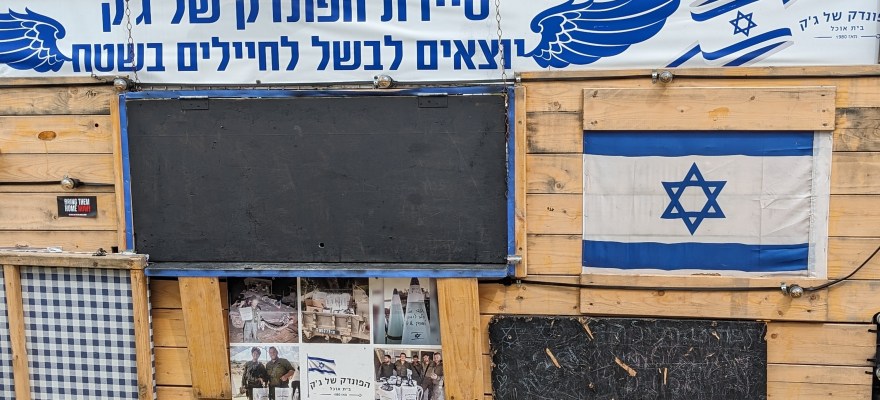
Two weeks ago, on Friday afternoon of the South Bay Solidarity Mission to Israel, we went to HaFundak shel Jack – “Jack’s Inn,” a well known home style restaurant at the entrance to Moshav Beit Nehemia in Shoham. We were there to pack up 450 meals for IDF soldiers out in the field.

After October 7, the owner of the restaurant, Meir, who was too old to be called up to the reserves, began providing daily hot food to families, soldiers, anyone in need.  He put out a call for volunteers. Within a short time, he had a list of 650 people who regularly come to cook, package, and deliver. They rely on donations to pay for all of the supplies.

After we finished packing everything up, I carried 250 meals out to the parking lot to load into a woman’s car. She had returned that morning from a trip to France, and now her job was to shuttle the meals to Kfar Saba, where another volunteer would pick them up and drive them to a brigade of soldiers in the lower Golan.

As I carried the boxes, I was thinking about logistics. By now, Jack’s Inn has served tens of thousands of meals. How do you organize something like this?

It started with just a guy with a restaurant who felt called to employ his skills to help people in a difficult time. What an inspiring example.

This morning’s Torah portion, Vayak’hel, includes a similar such example.

After cleaning up the mess of the Golden Calf, Moses unveils the project that was supposed to take place upon his descent from Mt. Sinai the first time: the building of the Mishkan, the Tabernacle.

First, he lists all of the raw materials that the Israelites need to collect: the precious metals, woods, animal hides, fabric and gems. Then, he puts the call out for those who have skills in a wide range of areas such as: carpentry, smithing, carving, sewing, and weaving. He appoints two chief artisans, Betzalel and Oholiav, to direct the project.

The Torah repeatedly indicates how inclusive this project is —men and women, tribal chieftains and those at the bottom rungs of Israelite society — everyone jumps to get involved. The people are so enthusiastic that, after not too long, the artisans report some surprising news to Moses. The Israelites responded so positively to the campaign, that they have are inundated with more supplies than they know what to do with.

Moses orders the Israelites to stop contributing. The Torah reports that “their efforts had been more than enough for all the tasks to be done.” (36:7) The first and only time that happened.

One of the places that we visited during the Israel Mission was the Tel Aviv Expo Center, which had been converted into ḤaMaL Tel AvivḤaMaL is an acronym for Cheder Milḥamah, or “war room.” It is a term taken from the military to refer to the command center of an operation. We spoke with Ronen, the volunteer director of the ḤaMaL Tel Aviv. Ronen has led a few startups, and still serves as a Reserve Officer in the Israeli Navy. 

The ḤaMaL Tel Aviv has been the central coordination center for the Israeli civil society’s response after October 7. “Civil society” is in contrast to the government. One of the recurring stories that we heard was about the government’s continued absence, not only in its lack of military readiness, but also in failing to respond quickly after the attack, to inform the public, coordinate defense, rescue, evacuation, and then provide for all of the social needs for those who became displaced.

In the government’s absence, Israeli civil society stepped up in a way that expresses the Jewish ethic of mutual responsibility and the Israeli ethos of “Startup Nation.”

To understand how the events played out, we need to go back a little over a year. When the government announced its judicial reform plans, a group of IDF reserve officers, fearing that the changes to the judiciary would lead to the erosion of Israeli democracy, started an organization called Aḥim Laneshek – “Brothers and Sisters in Arms.” This became one of the main organizations coordinating the anti judicial reform protests that lasted for months.

In the course of those political demonstrations, Aḥim Laneshek built an incredibly robust grassroots organizational network. It included many IDF reserve officers with significant leadership experience, as well as Israelis from the high tech sector who brought their own skillsets.

When Hamas attacked on October 7, Aḥim Laneshek immediately pivoted. They renamed their organization Aḥim v’Aḥayot L’Yisrael– “Brothers and Sisters for Israel,” and made three strategic decisions that would guide their actions over the coming months: 1. The IDF must win.  2. Support civilians who were hurt.  3. For the sake of unity, they would not do anything related to judicial reform.

By Sunday, October 8, they had already divided up the responsibilities. By Monday, computer programmers were building dashboards to organize the workflow. In less than a week, Aḥim v’Aḥayot L’Yisrael had built the back-end infrastructure to run a nation. There is now a ḥamal ezraḥi, a citizens coordination center, in every part of the country. 

Within four days, they set up a military-grade intelligence center to collect and analyze information, including going through photographs and videos from social media to identify hostages. When the IDF visited the site the following day, they acknowledged that they could not replicate it, so they turned over their own intelligence to the volunteers.

With Israelis in the South still hiding in safe rooms, Aḥim v’Aḥayot L’Yisrael organized volunteer rescue teams to go into places that the IDF still had not cleared to rescue families, elders, and children, and bring them to safety. In some cases, they sent out teams to search for bodies. 

It quickly became apparent that many of the IDF units, especially reservists, did not have all of the equipment they needed. The network went into action, ordering a large shipment of helmets and ceramic vests.

It was going to take weeks for the equipment to arrive, but they needed it now. So they put the call out to the network and quickly identiified a supply chain specialist, who was able to track down an airplane that was not being used and bring in the helmets and vests right away..

Aḥim v’Aḥayot L’Yisrael has continued to supply soldiers, police officers, and especially Civilian Readiness Units, which despite being outnumbered and underequipped, saved thousands of lives on October 7. They have also brought 7 planeloads full of medical supplies into the country.

By the following Saturday night, it had become apparent that tens of thousands of Israelis would need housing, and the government was not doing anything about it. Volunteers went to Eilat and the Dead Sea to determine hotel capacity and to identify the needs of evacuees and their children. Aḥim v’Aḥayot L’Yisrael were the only ones supporting those families for weeks. In the months since, they have opened 90 kindergartens in hotels.

People had to leave their homes quickly, and did not have time to gather their things, so Aḥim v’Aḥayot L’Yisrael put the call out for basic household supplies, clothing, toiletries, toys, and so on, for all of the dissplaced families. Think for a moment about what would would have to happen to effectively collect and distribute essential items across an entire country. In days, they set up the infrastructure to collect donations, sort them in warehouses, and efficiently distribute what was needed to those in need. This was 100% volunteer driven.

Just as when the Israelites built the Mishkan, the nation responded so enthusiastically that they eventually had to stop collecting supplies. “their efforts had been more than enough for all the tasks to be done.”

With the departure of most of the agricultural workers, Aḥim v’Aḥayot L’Yisrael organized thousands of volunteers to go out into the fields to harvest and plant crops.

Across the country, there are now 15,000 regular volunteers, coming from every segment of Israeli society, crossing social, religious, ethnic, and political lines.

Aḥim v’Aḥayot L’Yisrael, which was initially founded as a left-wing, political organization, has managed to bridge divisions with a number of the more right-wing communities they have been working with. “The mayors love us,” our presenter shared. 

Five months in to this war, the immediate needs have been met, and Aḥim v’Aḥayot L’Yisrael is transitioning to preparing communities to be able to return to their homes.

As we encountered this and other organizations and individuals, a few things occurred to me. First of all, the incredible selflessness demonstrated by so many regular people to do absolutely everything they could to help each other out. And Israel is not a homogenous society.

When I think about life here in the Bay Area, I cannot imagine such a widespread, grassroots, cross-cultural volunteer effort coming together.

Second was the attitude of “just get it done.” Israelis are not known for waiting for permission. There have been countless examples of people, recognizing a problem that needs a solution, and devoting oneself to gathering the resources, human and material, to solve that problem quickly.

Third, this is taking place in a traumatized society. In fact, within days of October 7, Israelis were already turning out in the tens of thousands to volunteer. Many of us might respond to trauma by shutting down, retreating from society. Israelis did the opposite, they jumped in, a far more effective response to trauma, I would imagine. 

One person we met, a retired career diplomat, the former Ambassador to France, who is now volunteering with the Hostages and Missing Families Forum, shared that this is the most meaningful work he has ever done in his life.

What are our duties as citizens? Here in America, we tend to not think of citizenship carrying with it many obligations, other than following the laws, paying our taxes, and possibly voting. 

Ronen, our guide at Aḥim v’Aḥayot L’Yisrael said that in the last year, he has learned that being citizenship is more than that: it includes a duty to give back. 

He considers what they have done, both before October 7 when they were protesting against the judicial reforms, and after, when they pivoted to supporting Israeli society, an expression of Zionism and patriotism.

That is surely something to aspire to.

The Women’s Mirrors – Vayakhel 5776

In this morning’s Torah portion, we read of the Israelites’ building of the Mishkan, the Tabernacle, along with all of its furnishings and the special clothing of the Priests.  This is one of two parashiyot that describe this.  And, this is after God has communicated all of these instructions to Moses on Mt. Sinai over the course of two previous parashiyot.  That the Torah takes so much time to describe the details not once, but two separate times is an indication of the important role of the mishkan in ancient Israelite religion.  The mishkan, the portable Temple that the Israelites carried with them for forty years in the wilderness, symbolically represents the permanent Temple that stood in Jerusalem for nearly one thousand years and served as the center of Jewish religious life.

Once the mishkan, and later the Temple, was put into service, there were very specific regulations about who could enter its precincts, as well as how close to the innermost chamber one could go.  Only the kohanim, the priests, could enter the inner sancta, and only the High Priest could enter the Holy of Holies, and just once a year.  Common Israelite males were allowed inside up to a certain point from which they could watch some of the rituals, but the furthest into the interior that women were allowed did not even provide a few of the priestly service.

It was believed that if a person transgressed the furthest boundary permitted to him or her, that person risked being struck down by heavenly fire.  This included, by the way, a priest who entered while not in a state of ritual purity.

With such rigid, restrictive access to the Temple, it is somewhat surprising that the construction of the mishkan was so democratic.  The Torah regularly emphasizes the involvement of all of the Israelites.  They brought voluntary donations of precious metals, stones, cloth, leather, and wood.  A half shekel tax was required of every Israelite male.  Most significantly, everyone was given the opportunity to be involved in the craftsmanship.  It was a meritocracy.  Whoever had the skills in weaving, building, metalwork, etc., was invited to participate, regardless of tribe, pedigree, or gender.

What stands out in particular are the numerous mentions of women’s contributions to the mishkan.  Over and over, the Torah makes sure to tell us about women’s involvement in the construction of the mishkan.  And not simply general statements.  We know about specific contributions that they made.

Because the texts that we have inherited reflect more patriarchal times, whenever the Torah does say something about a woman, either individually or as a class, we ought to pay close attention.  Sometimes, stories involving women are more fully developed.  On other occasions, we find oblique references which might hint at a more complete oral tradition that has been lost to us.

Towards the end of Parashat Vayakhel, we read about the kiyor nechoshet.  The bronze laver, or washing fountain.

וַיַּעַשׂ אֵת הַכִּיּוֹר נְחשֶׁת וְאֵת כַּנּוֹ נְחֹשֶׁת בְּמַרְאֹת הַצֹּבְאֹת אֲשֶׁר צָבְאוּ פֶּתַח אֹהֶל מוֹעֵד.

“He made the laver of bronze and its stand of bronze from the mirrors of the women who flocked to the entrance of the Tent of Meeting.”  (Exodus 38:8)

The fountain was used by the priests to ritually wash their hands and feet before entering the holy precincts and performing the rituals.  For some reason, the Torah wants us to take note that the metal used for constructing this laver came from melted down women’s mirrors.  In ancient times, a hand mirror was made out of a highly polished piece of bronze or other metal and was quite valuable.  Glass was not available.

Why this detail?  To further confuse matters, when Moses received instructions for how to build the fountain back in chapter 30, there was no indication of the source of the metal.  That detail appears only here.  We are left with questions.  Why was the fountain made out of these melted down mirrors?  Why are the women described in this unusual way:

הַצֹּבְאֹת אֲשֶׁר צָבְאוּ פֶּתַח אֹהֶל מוֹעֵד

– depending on the translation “the women who flocked / performed tasks / gathered together at the entrance to the Tent of Meeting?”  This expression appears here and in only one other place in the Bible.

The contemporary Bible scholar Nahum Sarna claims that these were women who “performed menial work” and that they were “at the bottom of the occupational and social scale.”  The Torah goes out of its way to record their donation of these personal items because they “displayed unselfish generosity and sacrificial devotion.” (JPS Bible Commentary, Exodus, p. 230)  Even the lowliest women gave up their most precious possessions to build the mishkan.

The thirteenth century Spanish commentator Ramban offers an explanation of the p’shat, the plain sense meaning, of the verse.  The women were so eager to participate in the building of the mishkan that they voluntary offered a very valuable, personal belonging.  The word tzov’ot is used because the women assembled like an army with their mirrors.  Tzava means army or host.  Tzov’ot conveys a sense of enthusiasm and excitement.  They rushed, like soldiers assembling for a muster.

The commentator Ibn Ezra offers a sober explanation.  (*You might not like this.)  The way of women, he says, is make themselves appear pretty by looking at their faces in metal or glass mirrors in order to arrange the hats on their heads.  There were some Israelite women who abandoned the vanities of the world, giving up their mirrors which they no longer needed.  They would come every day to the entrance of the Tent of Meeting to pray and hear the words of the mitzvot.

In a slight variation, the commentator Hizkuni says that the women assembled there daily to hear the praises and singing of the kohanim and leviim.  Another commentator, Sforno, claims that they came to hear the words of the Living God.

All three of these explanations set up a dichotomy between concern with female attention to physical appearance, on the one hand, and piety, on the other.

Rashi cites a midrash that offers a more colorful explanation.  When the Israelite women showed up with all of their mirrors, Moses was disgusted.  These objects that women use to adorn themselves serve the purposes of the yetzer hara, the evil inclination.  Moses wants to reject the gift.  But the Holy One sees something different.  God says to Moses: Accept them.  These mirrors are more precious to me than anything else!  When the Israelites were in Egypt, the men would be off working in the fields, too exhausted to even come home after work.  So their wives would bring food and drink out to them in the fields and feed them.  And they would bring their mirrors.  They would entice their men, looking together at their reflections and exclaiming, “look how much prettier I am than you.”  And they would awaken their husbands’ desires.  That is how the Israelite population flourished in Egypt.

The Torah describes the mirrors with the words b’marot hatzov’ot.  The Israelite women used these mirrors to create a host – an army – of children in Egypt.  The Talmud cites this midrash as one of several supports for the claim that the redemption of the Israelites from slavery took place due to the righteousness of women.

Why were these mirrors used specifically to make the bronze fountain?  Rashi explain that the fountain played a central role in subduing a jealous husband and restoring peace to the home.  The ritual of the sotah, the suspected adulteress, involved the use of water drawn from the bronze fountain.  A woman whose husband suspected her of cheating with another man would drink the water in order to prove her innocence.

In contrast to Ibn Ezra and the others, Rashi’s explanation integrates sexuality with pious intent.  In the midrash, Moses acts like a prude, but God sees something holy and life-affirming in these mirrors.

Yet all of these explanations reflect the age-old stereotype that women are vain and focused on their looks and must use their sexuality to succeed.  For Ibn Ezra and the others, it is a rejection of the mirror, a denial of their sexuality, that leads to piety.  For Rashi, it is the wives’ embrace of sexual desire during a particularly dark and depressing time in our history that prompts God’s praise.  For all of them, the fountain made from the women’s mirrors is the primary item in the Temple that restores the relationship between husband and wife when she is suspected of sexual impropriety.

Because our traditional texts so rarely describe women’s experiences, we must try to celebrate them where they occur, even though they may reflect a patriarchal worldview.  As society has become more egalitarian over the past two centuries, we have tried to include women in traditionally male aspects of religious life.  Perhaps we ought to consider seeing men in light of women’s traditional roles as well.

Even today, in 2016, in Northern California, we still fall into traditional patterns of gender stereotypes in so many ways.

I like the idea of God rebuking Moses, almost playfully, for his negative reaction to the women’s mirrors.  There is a wisdom and a piety expressed in the ability to integrate the physical with the spiritual.  It is the women who are aware of this.  It is Moses, and by extension the men, who are in the dark.  It seems that God wants to bring us into the light.

I’m Building a Cathedral – Vayakhel 5771

There once was a traveler who journeyed all over the globe in search of wisdom and enlightenment. In the midst of one French village, he came upon a great deal of noise, dust, and commotion. He could see that a great building project was underway.

He approached the nearest laborer and asked, “Excuse me, I’m not from this village. May I ask what you are doing?” The laborer replied curtly, “Can’t you see? I’m a stonemason. I’m making bricks.”

The traveler approached a second laborer and asked the same question. He replied, “Can’t you see? I’m a woodcarver. I’m carving benches.”

He next went to a third laborer and repeated his question. “I’m a glassmaker. I am putting together panes of glass to make a window.”

The traveler then approached an old lady in tattered clothing who was sweeping up shards of stone, woodchips, and broken glass. He asked her, somewhat hesitantly, “What are you doing?” With a broad smile and a gleam in her eye, the woman stopped her sweeping, gazed up, and proudly said: “Can’t you see? I’m building a cathedral for God.”

This story teaches that even though our individual actions may seem to be inconsequential, as simple perhaps as sweeping up the floor, our involvement in a bigger story, and a bigger purpose, has the potential to make those actions meaningful. The old lady’s ability to see that bigger story is what makes it possible for her to take pride in her involvement in building a cathedral.

There is a similar lesson to be found in the building of the mishkan, the Tabernacle. The Tabernacle, once it is inaugurated, serves several functions. It is where Moses goes to communicate with God. It is where God causes the Divine Presence to dwell in the sight of the Israelites. And it is also the place where Aaron the High Priest and his sons performed the sacrificial rituals on behalf of the nation.

We might be tempted to look back at the sacrificial system and see signs of elitism. That a priestly class, passed down from father to son, alone was permitted to perform the holy functions. And was entitled to receive certain benefits as well.

But there are ways in which every Israelite is involved in the Tabernacle and the priestly service. First of all, the materials for building everything are donated by the people. But not in the way that we might expect for a public works project like this one. There is no bond issued, or temporary sales tax increase. As we read this morning in Parshat Vayakhel, Moses puts the call out for “everyone whose heart so moves him” (Ex. 35:5) to bring gold, silver, precious metals, acacia wood, skins, spices, and all of the other materials that make up the mishkan.

Making it voluntary allows every member of the nation to put his or her heart into the Tabernacle. I can just imagine an Israelite walking by the finished product and thinking proudly “I donated the wool that is in those curtains.” Or, “it was my acacia wood that helped make the poles that hold up the tent.”

To build the mishkan, Moses brings in everyone with special skills, men and women. The parshah describes them as people who are chakham lev asher natan adonai chokhmah b’libo – wise of heart, whom God has endowed with skill.

These workers knew, as they were weaving cloth, hammering out gold, and sanding tent poles, that without their efforts, the mishkan could not be built, the Priests could not be ordained. Without them, the Tabernacle would not serve its purpose. I wonder, if a traveller had asked them what they were doing, how they would have answered. Perhaps someone would have said, “I am weaving this thread into cloth,” or “I am placing this precious stone in its setting.” But then again, he might have said “I am building a house for God to dwell among us.”

And although the Torah does not mention it, I bet there was an old lady out there in the wilderness whose job was to clean up the bits of cloth, and dust, and spilled paint. I bet she was enormously honored and proud to be involved in such a holy project.

The Tabernacle for our ancestors in the wilderness, just like the Cathedral for the French villagers, was God’s place on earth. It was where the people looked for hope and inspiration. To build such a place, it was necessary for the people that it served to feel involved in it. To feel that it represented them, that they had a stake in its building, and thus a stake in the mission that it was built to serve.

Let’s come back to the idea of what the Tabernacle, and later the Temple, represented. It was God’s place on earth, where the heavens and earth came together. It was the locus point where God’s immanent and transcendent nature came together. But there is another notion as well that states that the entire world is God’s place. A few weeks ago, I asked our religious school students about the meaning of the mem line in the Ashrei:

מַלְכוּתְךָ מַלְכוּת כָּל עוֹלָמִים, וּמֶמְשַׁלְתְּךָ בְּכָל דֹר וָדֹר:

Your kingdom is an everlasting kingdom, and your reign is for all generations.

“Where is God’s kingdom?” I asked. To which a fourth grader replied, “It’s all around us.”

To recognize this idea, that the entire world is God’s kingdom and is filled with the Divine Presence, is one of the major goals of Jewish prayer. It is a theme that can be found throughout the siddur, not just in the Ashrei. It is the reason why we recite blessings before eating food. It’s why we wear kippot. As Jews, we are constantly reminded that there is a vision of what the world ought to be like. It is a vision that we share with each other, with generations of Jews who have come before us, and with God. The Torah is our guide to making that vision a reality.

And so, each day when we set out on our tasks, we too are laborers building a cathedral to house the Divine Presence. Our goal is to make sure that the cathedral is one that is worthy of God. So what are the tasks that must be done to build a suitable dwelling-place?

We call them mitzvot. And they encompass every aspect of our lives. They tell us that we have a duty to build a just society, and how to do so. They tell us to conduct our business honestly, to support others who are experiencing difficulties, to live our lives in communities, to respect the members of our families, to make time sacred through by observing Shabbat and holidays. These are the tasks that we perform, as Jews, that contribute to preparing a world in which the shechinah can reside.

Each contribution to the building of the Tabernacle was valued. So too is each task that we perform, each mitzvah.

But doesn’t that seem a bit idealistic?

Life is busy. We rush, and rarely seem to have the time to pause and reflect. We live in a self-oriented world, where success and achievement is measured by an individual’s accomplishment, rather than a group’s. We tend not to take pride in other people’s achievements. We tend to not feel that our individual actions matter to the world. Modern society does not especially value minuscule contributions. The person who sweeps up the mess is replaceable.

A midrash teaches that the artisans who built the mishkan themselves learned their skills from no human teacher. The knowledge of their craft was planted in their hearts directly from God. If that was the case, then even the smallest little contribution would have been abundantly significant.

Is there anything in our lives that is so inspiring as building the mishkan? Do we feel that God is instilling in us a ruach chochmah, a spirit of wisdom, to engage in a holy task? What if we were so excited by an idea that we could see our involvement in its pursuit, even if it seemed insignificant, as profoundly meaningful?

When we go to work, do we think to ourselves, “I am making the world better”? When we schlep our kids to school, do we pause to consider, “I am helping make this child into a moral, responsible human being”? When we smile genuinely to another person, do we think “I could be lifting this person’s entire day”? This person, in whom God’s image resides.

Can we relate to our work as being an integral part of building a world that is worthy of God? Whether as a parent, or an engineer, or a teacher, or a repairperson, or especially the person who sweeps up the pieces that the rest of us leave behind. If we could maintain a consciousness that we are part of that Eternal building project, perhaps it might change not only how we view our work, but the kind of work that we do.