Camp Ramah: A Bubble of Peace – Pinchas 5784

Dana and I had the wonderful opportunity to be away last Shabbat, as I completed a week as the Rabbi in Residence at Camp Ramah Galim. Galim means “waves,” which is a fitting name, given that the camp lies on a beachfront campus outside of Watsonville.

I am honored to serve on the Board of Directors for the past year and a half. My week started with a Sunday Board meeting, and then I got to stay. I would like to share with you a bit of what I experienced while I was there. 

Ramah Galim is the only Jewish, Zionist, Shomer Shabbat, kosher camp in Northern California. The camp continues to grow — this current summer is the biggest yet; and we just signed a ten year lease with the Monterey Bay Academy, which hosts us.

Campers at Ramah Galim sign up for one of four specialty tracks, which they attend most mornings. Afternoons bring everyone together for activities with their edot (age groups), kevutzot (groups), and the entire camp.

One specialty track is Yam – “ocean”.  Campers focus on learning about marine ecology, in addition to boogie boarding, surfing and other water activities. Campers in Etgar — “challenge” — go mountain biking, hiking, rockclimbing, farming, and other outdoor activities. Those in Al HaBamah — “on the stage” — write, rehearse and perform an original musical over the course of a two week session. I don’t know how they do it.

In addition, for the second summer, Ramah Galim has hosted the Ramah Sports Academy, which offers intensive training for basketball and soccer athletes.

I could go on about all of the wonderful aspects of Ramah Galim, but I want to focus on a few key experiences.

I am proud to share that Congregation Sinai sends more kids to Ramah than any other synagogue. There are twenty Sinai chanichim, campers, attending session three alone. If we add up campers who were at the first two sessions, we are proably in the 30-35 range. I haven’t run the numbers, but I suspect that this is at least 1/3 of all of the kids in the shul. Plus, we have four Sinai young adults serving as madrichim, or counselors. 

We have a scholarship fund at Sinai. This year, we provided more scholarship money for more kids than we ever have before. And I would love to see this expand.

As Rabbi in Residence, I get recruited to a number of different activities. 

Harga’ah means relaxation. Before bedtime, I might meet with an edah or a kevutzah to tell a story or teach a song.

I attend Tefilah with different edot, sometimes as a participant, and sometimes to lead or teach.

On Shabbat afternoon, I led a program for all of Nitzanim and Kochavim – third through sixth graders.

And on Shabbat morning, I led a learning session with staff.

Beyond this, I have the opportunity to simply participate in camp, interacting with campers and counselors, learning about them and occasionally answering “rabbinic” questions. I was also glad to be able to support our Sinai kids, who get a thrill to see “their rabbi” at camp.

This summer, there were also about 30 Israeli chanichim. Many of them are from the northern border and have not been living in their homes for the last nine months. The Education Minister just announced that schools from the evacuation zone will not be reopening in the fall. So these campers will again be attending makeshift schools that have been cobbled together near the hotels to which they have been evacuated.

For the second summer, there is a contingent of Ukrainian campers at Ramah Galim, who are here through a partnership with Maccabi.

All of these kids and staff come together to have a Jewish camp experience. And it is so wonderful. What strikes me about Ramah is how supportive and positive it is for everyone. It is meant to be joyful, experiential Judaism. Chanichim and madrichim are challenged to try new things, take on leadership roles, and have fun. 

As I mentioned earlier, among its core values, Camp Ramah is a Zionist camp. This comes through in so many ways. There is a large mishlachat, or contingent of Israeli staff.

Israeli flags fly everywhere. Announcements are made in Hebrew, and modern Hebrew words and expressions are woven into the camp experience. One of the most popular activites at Ramah is Israeli dancing, which takes place before most dinners, and on the beach after Havdallah.

Yom Yisrael is a day devoted to learning about and celebrating Israeli history, culture, and life. This year, it took on more somber tones. 

More important and impactful than all of the formal programming is the opportunity for Jews from Israel, America, Ukraine, and other communities to live together, get to know each other, become friends, and establish personal relationships. This is the best way to convey the Jewish value of achdut – unity.

At the end of last week’s parashah, the Moabites send in women to lure the Israelite men into commiting idolatry during an event which became known as “The sin of Ba’al Peor.”

To stop the ensuing catastrohe, Pinchas, grandson of Aaron, takes a spear and stabs an Israelite leader and a Moabitess.

As this morning’s parashah opens, God explicitly approves of Pinchas’ initiative, which “turned back [Divine] wrath from the Israelites.” In response, God grants him God’s “covenant of peace,” a covenant of priesthood for him and his descendants after him for all time.

The language in the Torah is unambiguously praiseworthy of Pinchas’ zealous violence. All of the medieval commentators approve of Pinchas’ actions.

It is a moment of crisis. Many Israelites, including leaders, are committing apostasy with the Moabite women. Thousands are dying in a plague. God has just instructed Moses to have all of the ringleaders impaled to turn aside Divine wrath. Pinchas is the one who takes action, stopping the idolatry, ending the plague, and saving the Israelites. He is a hero.

Why does he need a covenant of peace? The Talmud records a legend that the elders wanted to excommunicate Pinchas for taking matters into his own hands rather than going through a judicial process. God’s message to Moses, thus, is a counter to that effort, stating that Pinchas’ zealousness exactly matched God’s zealousness.

The medieval commentators suggest that the covenant of shalom is a promise of Divine protection from the possibility of retribution by the families of the people whom Pinchas impaled, or even from his fellow Israelites.

Modern commentators offer more psychological explanations. Naphtali Tz’vi Yehudah Berlin, known as the Netziv, lived in nineteenth century Russia. He writes in HaEmek Davar, his commentary on the Torah, that

In reward for turning away the wrath of the Holy Blessed One, God blessed him with the attribute of peace, that he should not be quick-tempered or angry.  Since, it was only natural that such a deed as Phinehas’ should leave in his heart an intense emotional unrest afterward, the Divine blessing was designed to cope with this situation and promised peace and tranquility of soul

In other words, Pinchas did what needed to be done. It was unquestionably the right move. But, it took a toll. God’s granting him a covenant of peace is about settling his soul so that Pinchas does not carry the trauma, the PTSD, if you will, with him, nor pass it on to his children.

Camp Ramah, this summer in particular, is playing such a role, particularly for the young adult staff who are there.

In part of the Chadar Ochel, the dining hall, there are posters up of people who have been killed since Oct. 7, as well as of hostages. All of them are personal friends and family members of staff members. Poetry and artwork by campers decorates the walls.

Outside of the Nachshonim bunkhouse, where the oldest campers live, there is a large “Free Hersh Goldberg” banner.

While October 7 and its aftermath certainly hovers over camp this summer, it has not taken over. Quite the opposite, in fact. Nobody knew what to expect before the summer. As it turns out, for the staff in particular, camp has been a respite.

I spoke with Israelis who who have spent much of the past year serving in the military.  Some are 20, 21, 22 years old, and have just completed their mandatory service. Others have had to put their careers on hold to serve in milluim, reserve units. Some saw combat directly. Others had to wait at home while loved ones were called up, not knowing when or whether they would be coming home. Many lost friends and family members on October 7 and during the war that followed. 

One young soldier who spoke with the Board of Directors was sent with his unit on the afternoon of October 7 to battle Hamas terrorists who had taken over a base. He lost several of his fellow soldiers that day, including his commanding officer, who led the charge. He was in tears as he shared his story with us.

Dana and I met with a group of Sollelim kids, going into seventh and eighth grades.  We visited them at their campsite in Monterey during intersession to play music and sing songs.  I let some of them play my guitar. I asked one talented kid where he was from. “Germany,” was his answer.

But that is not where he is from. He is from Ukraine and has only lived in Germany for the past two years. There are a couple of dozen Ukrainian Jewish kids who are at Camp Ramah, getting a break from a disrupted childhood that I cannot even imagine. 

Some of the American college students came to Ramah having experienced a different kind of trauma on their campuses. They described Camp Ramah as a kind of bubble where they did not have to worry about being visibly identified as Jewish, or think twice about what route to take while walking to the dining hall.

Camp is always a kind of bubble from the outside world. Usually, it is a bubble of joyful Jewish experience. This summer, in particular, it is serving as a bubble of love and support in the midst of extremely chaotic and threatening times.

I feel very blessed to have been able to spend a week inside this bubble of peace. I only wish that the world could always be like camp.

Shabbat Shalom.
Unknown Departures and Journeys – Pekudei 5782

Don Isaac Abarbanel was one of the most prominent Jews who ever lived. Born in 1437, he was an accomplished Torah scholar from a young age. He knew Latin, Greek, philosophy, astronomy, and mathematics. He was extremely adept at finance, and in 1471 he became the royal treasurer of Portugal in the court of Alphonso V. He would later hold the same position in the Spanish court of Ferdinand and Isabella, where he tried, unsuccessfully, to prevent the expulsion of Jews from Spain. In exile, he was later drafted to serve in the court of the King of Naples.

Abarbanel was also a regular teacher in synagogue, and a book of his commentaries to the Bible is based on his public lectures. One of his personal causes was securing the release of Jews who had been taken captive and held for ransom. I would like to read a letter that he wrote in 1472 to a friend of his, Yehiel of Pisa, a wealthy Italian Jew known for his philanthropy. 

In his letter, Abarbanel was referring to Jews in Morocco who had been taken captive by Portuguese slave traders. Sadly, this was not a rare occurence for Jews. 

Dear Yechiel of Pisa,

I would like to tell you about events that have taken place among the Jews of our region.

The King, long may he live, gathered some ships and sailors to travel to Africa, where he conquered territories and fought in the city of Arzila. Thank God, no Jews died, but two hundred and fifty were captured – men, women and children – and they are hungry, thirsty, naked and much in need.

When we saw the children of Zion sold as slaves and servants, we, the leaders of the Jewish community of Portugal, decided to call for their freedom and pay the ransom for their release.

Like the twelve tribes of Israel, we sent twelve emissaries, myself included, from city to city and country to country to take the children of Israel out of “ Egypt” and collect money to pay for their ransom.

Thus far, we have ransomed two hundred and twenty of the captives for a large sum of money – ten thousand gold coins. As all their property has been stolen and they lack clothing and food, we must provide for all their needs.

We have thirty prisoners yet to ransom, who have fallen into the hands of very harsh masters.

This is a brief account of the events that we have been struggling with day and night.

On hearing this, all Jews will be outraged and profoundly moved.

Yitzhak Ben Yehuda Abarbanel 

Coming to the rescue of Jews in need, wherever in the world they happen to be living, has always been considered a central religious obligation. Maimonides wrote that “there is no commandment greater than the ransom of prisoners.”

I do not know for certain whether Yehiel of Pisa responded to Abarbanel’s appeal for assistance, but I suspect he came through. Yehiel died in 1492, and his fortune was spent aiding Jews who had been expelled from Spain that same year.

As a people, we know about being forced to leave our homes and journey to often unknown lands. Most of the people in this room have stories in your family history, if you yourself did not personally experience such upheaval. Such stories go back our foundations as a people.

The Book of Exodus concludes with this morning’s Torah portion, Pekudei, as the Israelites complete the building of the Tabernacle.  Everything is set up properly, the structure itself along with the Holy of Holies. All of the furniture is brought in and put in place.

Finally, when all is completed, “the cloud covered the Tent of Meeting, and the Presence of the Lord filled the Tabernacle.” We learn that whenever the cloud lifts, the Israelites know “to set out, on their various journeys.” But when it remains in place, it is an indication that they are to remain in place.

The final verse of the parashah, and the entire Book, summarizes this GPS – God Positioning System.

כִּי֩ עֲנַ֨ן יְהֹוָ֤ה עַֽל־הַמִּשְׁכָּן֙ יוֹמָ֔ם וְאֵ֕שׁ תִּהְיֶ֥ה לַ֖יְלָה בּ֑וֹ לְעֵינֵ֥י כׇל־בֵּֽית־יִשְׂרָאֵ֖ל בְּכׇל־מַסְעֵיהֶֽם׃ 

For over the Tabernacle a cloud of the Lord rested by day, and fire would appear in it by night, in the view of all the house of Israel throughout their journeys.

Exodus 40:37

Towards the end of the Book of Numbers, when the Israelites have nearly reached their final destination, Moses records all of the Israelites’ journeys over the previous forty years – specifying every stop along the way.

וַיִּכְתֹ֨ב מֹשֶׁ֜ה אֶת־מוֹצָאֵיהֶ֛ם לְמַסְעֵיהֶ֖ם עַל־פִּ֣י יְהוָֹ֑ה וְאֵ֥לֶּה מַסְעֵיהֶ֖ם לְמוֹצָאֵיהֶם: 

Moses recorded their departures for their journeys as directed by the Lord. And these are their journeys, according to their departures. 

Numbers 33:2

Notice that the word order of “departures” – motza’eihem – and “journeys” – mas’eihem – switches.

The sixteenth century Italian Rabbi, Seforno, comments on these journeys. He explains that “sometimes the starting points were good places and the points for which they set out were bad ones, sometimes the opposite; in either case, the Israelites had no advance knowledge of when and where they were to travel—yet they never refused to go.” Seforno then explains that setting forth on a new journey and arriving at a new place are each difficult actions in and of themselves, something that he may have had personal knowledge about, as he spent part of his own life poor and on the road.

How true that is. It is hard to begin a new journey, to leave the place that you have known. It is all the more difficult when the destination is unknown. And arrival at someplace new does not mean the end of difficulties. Anyone who has had to immigrate to a new land knows this from personal experience.

Seforno’s insight is that the Israelites, despite such difficulties, were always willing to follow where God’s Presence directed them. And we know how difficult it was for them. Perhaps he is glossing over some of those challenging moments in the Torah when the Israelites longed to return to slavery in Egypt rather than face a dangerous and uncertain fate in the wilderness.

They had difficulty adjusting to new lands, new cultures and people with different practices and beliefs.

We are right now witnessing a human tragedy unfold in Ukraine.  As we pray here this morning, more than one million civilians, mostly women and children, have already become refugees in less than two weeks.  The UN is expecting that number to continue to rise many times over. So far, other European countries are accepting them, but there are long lines at the borders as people fleeing for their lives wait for their requests for asylum to be processed.

Meanwhile, countries and organizations have mobilized to ship humanitarian aid, food, clothing, temporary shelters, and medical supplies for the millions of people who are unable to leave or who have chosen to stay.

Of course, as we know, there are many Jews living in Ukraine, who are among those faced with the choice of staying or leaving. Just yesterday, 120 Jewish orphans in Odessa were able to be evacuated to after a harrowing bus journey through Moldova, Hungary, Slovakia, and the Czech Republic on their way to Berlin.

Israel has already received over 1,500 refugees, around ten percent of whom are eligible for Israeli citizenship under the law of return. Ayelet Shaked, the Interior Minister, said that Israel is preparing to accept 100,000 refugees. And it has sent supplies and mobile hospital units.

If there is one mitzvah that the State of Israel embraces wholedheartedly, which brings together Jews of all political stripes and religious perspectives, it is the redemption of captive Jews. Indeed, this was one of the primary motivations that has and continues to drive Zionism.

We are far away, and it would be easy to not let this refugee crisis affect us. But I urge us not to ignore it. Kol Yisrael Arevim Zeh LaZeh – All of Israel are interdependent on one another.

The easiest way to help is exactly the same as what Abarbanel asked of Yechiel of Pisa. It is our religious duty to help fund the relief and rescue efforts. There are many ways to do so. The APJCC is collecting new items. There is a list, so please check it first. You can donate money to many organizations that are supporting or are actively working on the ground. Some include United Hatzalah, Israaid, The Schechter Institute, and others. 

We continue now with a prayer for peace.

1200 Years of Jews in Ukraine

I have been thinking a lot about my grandmother this week. Baba Fania, zikhra livracha, was born in a city called Kamenets-Podolsk, in Ukraine.  She moved with her family to Kremenchug when she was a girl.

Her father died when she was young, so she and her sisters were left to be raised by her mother, my great grandmother, Chana. It was the 1930’s and so she received a good Soviet education, in Yiddish. She came home one day and told her mother that there was no God. Her mother smacked her, and declared emphatically, “I don’t care what they are telling you out there.  In this house, there is a God.”

As I was eating challah last night, I was thinking of a story that she told.  At times, they could not get any eggs. In order to get the golden color, they would take used tea bags and brush them over the dough.

My Baba escaped from Ukraine in 1941, just before the Nazis came into town. Her sisters and mother did not make it out, and were murdered along with the rest of her family. Dana and I named our son after my grandmother’s cousin, who died in the Holocaust.

Over the last several days, as we have observed the tragedy unfolding in Russia’s invasion of Ukraine, I have been thinking a lot about my Baba Fania. I have never been to Ukraine, but it is has felt very personal to me. I know that I must have distant relatives there, who are surely fearing for their lives.  I do not know how far back my own family’s history extends, but for sure it is many centuries. 

The history of Jews in Ukraine is a long one, and has gone through dramatic ups and downs, often at the same time.

Jews first arrived in Ukraine in the eighth century as refugees fleeing from the Byzantine Empire, Persia, and Mesopotamia. The earliest written reference to Jews in Galicia, Western Ukraine, is from 1030 CE.

Some time in the centuries that followed, the territory that is today modern Ukraine was taken over by the Polish-Lithuanian Commonwealth. As part of their administration, they would settle wealthy Polish Catholic nobles in Ukraine, and then encourage Jews to immigrate and serve as merchants. Jewish life prospered financially and culturally, and the population grew.

As might be expected, the local Ukrainian population, which was Eastern Orthodox, was kept in serfdom.

Resentment grew until, in 1648, as the Kingdom faced growing internal and external threats, Bogdan Chmelnytsky launched a Cossack rebellion. This led in 1651 to the incorporation of Ukraine by the Russian Tsar as a protectorate.

The Chmelnytsky revolt was devastating. Blaming the Poles for selling them “as slaves into the hands of the accursed Jews,” the Ukrainian Cossacks and Crimean Tatars murdered between fifteen and thirty thousand Jews and destroyed three hundred Jewish communities. The population declined dramatically, as many more Jews fled as refugees or died of disease and starvation.

But within a few decades, the tide would turn. The early 18th century saw the birth of Yisrael ben Eliezer, otherwise known as the Baal Shem Tov, the founder of Chasidism. Heavily influenced by Kabbalah, Jewish mysticism, Chasidism was incredibly popular and spread through much of Eastern Europe, making a huge and lasting impact on Ashkenazi Jewry.

By the end of the 18th century, the Russian Empire had completely annexed Ukraine, which created a problem, as Jews were not permitted to live in Russia. This led Catherine the Great to create the Pale of Settlement, which encompassed, among other areas, all of present day Ukraine.

Jewish life thrived through the eighteen hundreds, with the population growing and Jewish religious and cultural life expanding. At the same time, antisemitism was brutal. In 1881, Jews were falsely blamed for the assassination of Tsar Alexander II. With the encouragement of the authorities, pogroms were launched against Jewish communities throughout the Pale of Settlement, including in Ukraine. 

Tsar Alexander III introduced the May Laws in 1882 that imposed systematic discrimination against Jews, establishing quotas for educational and professional positions. This led to even more widespread poverty and mass emigration. The 1886 edict of Expulsion forced the removal of Jews living in Kyiv.

Another intense wave of pogroms in 1905 led to another wave of emigration. Multiple blood libels cases occurred between 1911 and 1913.

For context, this is the time period of Fiddler on the Roof. A lot of new ideas were spreading through Europe at this time, and Jews were attracted to some of the new ideologies that suggested an answer to the problems they were facing, that seemed to never go away. Jewish thinkers and revolutionaries were attracted to ideals of the enlightenment and internationalism. Jewish revolutionaries embraced socialism and became Communists. Others embraced Zionism, with many making aliyah to Palestine.

After World War One, during a short time period of 1917 to 1921, while the Russian Revloution was taking place, the Ukrainian People’s Republic presented a hopeful, albeit short-lived, moment for Jews. It was an independent socialist state that emerged in the wake of the Bolshevik Revolution.  Yiddish was an official language, even appearing on currency. All government posts and institutions had Jewish members and all rights of Jewish culture were guaranteed. It was the first government to establish a Ministry for Jewish Affairs.

But the backlash was severe. Anti-communist Ukrainian nationalists went to war against the Soviets, and in the process killed approximately one hundred thousand Jews in pogroms between 1918 and 1921.

By 1921, Ukraine had been conquered by the Soviets, becoming one of its republics. The 1920’s saw brutal efforts to eliminate Jewish religion and leave it with only a secular cultural identity, explaining why my grandmother learned in Yiddish that there was no God.

The Holocaust was devastating. More than one million Jews were murdered by the Nazis and many Ukrainian collaborators.

In 1941, there were 2.7 million Jews living in Ukraine. In 1959, that number was 840,000. By 1989, there were less than 500,000 Jews living in Ukraine.

Ukraine gained its independence in 1991, and this led to continued changes in the situation for Jews living there. Hundreds of thousands of Jews emigrated, most making aliyah to Israel.

At the same time, throughout the 1990’s, Jewish life began to reemerge. There was a lot of interest from Jewish communities in Israel and the West to support Ukrainian Jews and help them come back. The government has returned dozens of old synagogues and other buildings to the Jewish community which had been confiscated by the Nazis and the Soviets.

While antisemitism seems to have declined in the past thirty years, there have certainly been many instances of antisemitic attacks.  A far right Ukrainian nationalist party gained more than ten percent of the popular vote in 2012. On the other hand, last year, in 2021, the Ukrainian Parliament adopted a new law defining antisemitism and providing compensation for victims.

Attempts to determine the number of Jews currently living in Ukraine are wildly varying. Questions of Jewish identity, after 70 years of Soviet suppression, make it difficult. A 2020 census estimated 43,000 self-identifying Jews, but 200,000 would qualify for aliyah under the Law of Return. The European Jewish Congress claims that there could be as many as four hundred thousand people with Jewish ancestry in Ukraine.

Most Jews live in the cities Kyiv, Dnipro, Kharkiv, and Odessa. Those who live in villages tend to be elderly, and extremely poor. There are multiple synagogues, Hebrew schools, day schools, mikvaot, kosher restaurants, and six Jewish community centers. There are Jewish summer camps, which were able to resume this past summer after closing for Covid restrictions.

Ten Jewish newspapers are published in Kyiv alone, four of which have circulations of more than ten thousand. A weekly television program, Yahad, is shown on state television.

Most of these Jewish institutions are run by Chabad-Lubavitch. The Reform movement is active in 20 cities.

The Conservative movement has also been active in Ukraine since independence. Through Masorti Olami, the global branch of the Conservative Movement, Ramah, and the Shechter Institute in Jerusalem, it runs programs supporting communities in multiple cities. It sponsors youth groups, and has been operated a Camp Ramah since the early 1990’s. There are several Masorti Rabbis serving Ukrainian communities.

Right now, some members of the Ukrainian Jewish community are fleeing to the West.  Others are staying where they are, praying for peace and trying to survive. Not surprisingly, the Jewish Agency is receiving many inquiries lately about making aliyah.

And of course, we must mention Volodymyr Zelensky, who was elected President of Ukraine in 2019 with 73% of the vote. Zelensky is Jewish and the descendant of Holocaust survivors. At the time of his election, the Prime Minister of Ukraine happened to be Volodymyr Groysman, who is also Jewish. For a few months, Ukraine was the only country in the world other than Israel with a Jewish President and Prime Minister.

I encourage you to watch President Zelensky’s passionate appeal for peace to the people of Russia right before the invasion. I also encourage you to watch the forty second selfie video that he took with other members of his government on the streets of Kyiv Friday night as the city was preparing for being attacked. He insisted that they are not going anywhere. If you have not seen them, I encourage you to do so. And keep in mind the long history of Jews in Ukraine. To see the Jewish President of Ukraine speaking so courageously on behalf of all Ukrainians is astounding. It gave me chills to watch it. After over a thousand years, with all of its ups and downs, to see this, someone courageously standing up in the face of brutality and such danger is incredible.

If you have the capacity to do so, there are organizations that are trying to support people in Ukraine who are fleeing, and there will certainly be a tremendous need to support refugees in the months ahead.

I made a donation yesterday to Masorti Olami. The immediate cause they were trying to support was a group of one hundred fifty children who had fled to Lviv, in Western Ukraine.

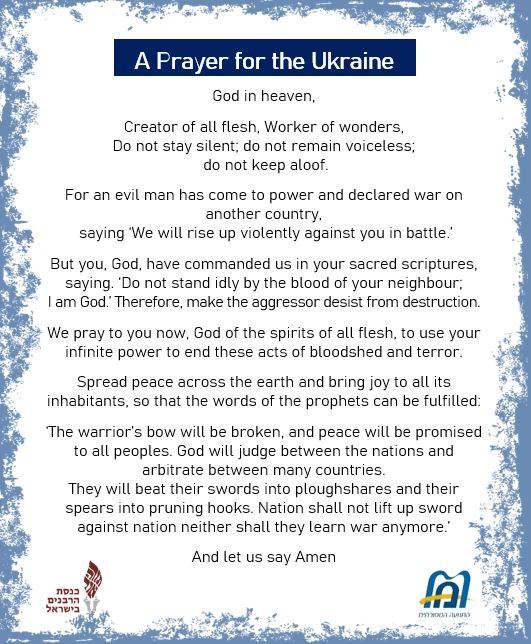
I would like to close with a prayer for peace that was delivered at a service hosted by the Masorti movement on Thursday night.