A Four-Fold Song – Rosh Hashanah 5785

God never promised it would be easy.

This morning’s Torah portion tells the story of the banishment of Hagar and Ishmael. Sarah recognizes something untoward in the way that Ishmael is playing with her son. She demands that Abraham send him out into the wilderness with his mother.

When their supplies run out, Hagar places her son underneath a bush so she does not have to watch him die. God hears the cry of the boy and sends an angel to Hagar with a prophecy.

Fear not, for God has heeded the cry of the boy where he is. Come, lift up the boy and hold him by the hand, for I will make a great nation of him.

Then the angel reveals a well of water, and they are saved.

A midrash (Tanchuma Vayetzei 5:2) describes a scene that transpires in heaven, just before this moment. When God commands the angel to reveal the well, the angel objects: “Master of the Universe, why do you bring forth a well for this wicked person who will ultimately waylay travelers and wayfarers?”

The Holy One, blessed be He, retorts: “What is he right now? Is he not righteous? I judge a person only according to the moment at which he stands before me.”

The midrash derives this response from the Torah’s language: God has heeded the cry of the boy ba’asher hu sham – “in the place where he is.”

Midrashim often put into words their authors’ struggles with the Sacred Text. In this case, we witness the tension between the suffering of a child, for which any human with a heart must feel compassion and pity; and tribal protectiveness. This struggle is personified through Sarah versus Hagar, Isaac versus Ishmael.

The angel’s objection captures our defensive instinct to close ranks and protect our own. God ‘s rebuke expresses the universalism which seeks to break down barriers between peoples and treat individuals as they are, human beings made in the Divine image.

God does not suffer from human parochialism.

It is a particularly poignant midrash for us this year, conveying this tension between tribalism and universalism. I ask myself, in this moment: “Do I resonate more with the angel, or with God?”

As we celebrate Rosh Hashanah, welcoming 5785, it is a time for us to reflect on the ways in which we value peoplehood and humanity. Or is it peoplehood versus humanity?

One of the most beautiful expressions of this was described by Rav Abraham Isaac Kook over one hundred years ago, at a time which bore certain similiarities to our own.

Rav Kook is considered to be be the founder of religious Zionism. He was born and grew up in Russia in the second half of the nineteenth century. In 1905, he moved to Yaffo, in Palestine, then controlled by the Ottoman Emprire.

At the outbreak of the first World War, Rav Kook happened to be in Germany, where he was interned as an alien. He managed to escape and lived for the remainder of the war in London, stuck in exile, unable to return to Palestine.

It was a tumultuous time, full of danger, uncertainty, and change. The world was at war. Empires fell while nationalist movements reared their heads. Russia was aflame in revolution. A global pandemic was incubating. It was during this time period that Rav Kook wrote Shir Meruba, A Four-Fold Song.

He imagines four ways that a person might see themself; might orient their life and find meaning. He describes each of these four ways as a kind of song: the song of the self, the song of the nation, the song of humanity, and the song of the universe.

There is one who sings the song of oneself, and in themself findseverything, full spiritual satisfaction in its entirety.

There is another who sings the song of one’s people. He leaves the circle of his own individual self, because he finds it without sufficient breadth, without an idealistic basis. He aspires toward the heights, and he cleaves with a gentle love to the whole community of Israel. Together with her he sings her songs. He feels grieved in her afflictions and delights in her hopes. He contemplates noble and pure thoughts about her past and her future, and probes with love and wisdom her innerspiritual essence.

There is another who reaches toward more distant realms, and going beyond the boundary of Israel to sing the song of humanity. Her spirit extends to the wider vistas of the majesty of humanity in general, and its noble essence…

Then there is one who rises toward even wider horizons, until he links himself with all existence, with all God’s creatures, with all worlds, and he sings his song with all of them…

As Rav Kook describes so evocatively, each of us sings one of these four songs. He describes them as reflecting wider and wider perspectives, ever-expanding concentric circles.

What is my primary area of concern? Who do I care about most? Where do I invest my emotional energy? Form which wellsprings do I draw meaning and purpose in life?

Do I wake up each day to advance myself? Am I devoted to the Jewish people? Do I work for humanity? Or is my concern even more global?

Which song do I sing most strongly?

Rav Kook suggests that most people primarily sing one of these four songs. It is tempting to restrict our perspective to the narrowest of the concentric circles. Perhaps that is the song that most of us sing, most of the time.

This is the drive for self-preservation, for placing self over others.  It evokes the most famous teaching of Hillel the Elder in Pirkei Avot: 

אִם אֵין אֲנִי לִי, מִי לִי. “If I am not for myself, who will be for me?”

The next part of Hillel’s teaching warns of the risk of only focusing on the self

וּכְשֶׁאֲנִי לְעַצְמִי, מָה אֲנִי. “But if I am (only) for myself, what am I?”

Hillel suggests that a self-focused life is incomplete. Meaning and worth must include a concern for and commitment to others. But his teaching does not go so far as to distinguish how far that concern should extend: just to the Jewish people, to humanity, or to all of creation.

As we look back at the past year, I fear that we may have placed too great a focus on the universal, and not enough on the particular. Maybe we did not emphasize enough to our children how important it is to form our structures of meaning specifically around the history, values, and traditions of the Jewish people. We did not sufficiently emphasize that it is not only ok but necessary to feel particular connection to our Jewish brothers and sisters around the world.

We are now being taught that lesson. The borders that surround us are pressing in.

We are four days away from the one-year anniversary of the October 7 massacre, which changed the way Jewish people everywhere view ourselves as individuals, as part of the Jewish people, and within the wider society of humankind. 

Within hours of that horrific event, antisemitism had already begun its surge.

This past year has seen the international double standard against the world’s only Jewish state laid bare. We are still praying for the return of 97 hostages.

Many university campuses became unwelcome places for Jewish college students. We felt the need to further harden the barriers around our houses of worship and Jewish institutions, increasing our stress and fear.

So many experienced abandonment by friends, who could not bear to even have a relationship with someone who supports the legitimacy of the State of Israel.

And some of us painfully faced the conflict between the song of the nation and the song of humanity within our own families.

How have these forces, pushing in against us, affected our song?

After October 7, so many of us sought out one another, to be together, shed tears, express our grief, find solidarity —to experience some measure of comfort.

Many of us were surprised to find ourselves feeling connected to the Jewish people more profoundly than ever before.

This amplification of our song has not only been reactive. We are experiencing renewed eagerness to embrace Jewish tradition and practice. Participation in Jewish life is rising all over the world. 

Membership at Congregation Sinai is at its all-time high, along with the number of children learning in our religious school. What began as a defensive reaction has evolved into an awakening curiosity and eagerness to explore and find meaning in Judaism’s rich history and culture.

As we gather as a people to observe the new year, what are we to make of this seeming dissonance between Jewish peoplehood and universalism?

Rosh Hashanah is not a particularly particularistic holiday. It does not have an historic or symbolic connection to the Exodus from Egypt. It does not mark any moment in the history of the Jewish people. 

We describe it as Yom Hadin, the Day of Judgment. Not judgment for the Jewish people – but rather, judgment for all humanity. Unetaneh Tokef describes how “all who live on earth shall pass before You like a flock of sheep.”

A few lines later, we sing “On Rosh Hashanah it is written and on the fast of Yom Kippur it is sealed.” The fate of every living person in the year ahead is determined.

Rosh Hashanah is said to take place on the sixth day, the day on which God completed all the works of creation by forming humanity in the Divine image.

It is the most universal of Jewish holidays. Perhaps Rosh Hashanah is a holiday for singing the song of humanity, or the song of the universe, rather than the song of our people.

Does it have to be either/or? Must concern for the Jewish people come at the expense of concern for humanity, or vice versa? Let us return to Rav Kook’s Four Fold Song, which continues from where we left it. He imagines the rare individual who harmonizes the four competing melodies

…into one ensemble, each joining their voices… lending vitality and life to one another. They are sounds of joy and gladness, sounds of jubilation and celebration, sounds of ecstasy and holiness.

The song of the self, the song of the people, the song of humanity, the song of the universe continuously merged…

Rav Kook describes this four-part harmony as a “song of holiness.” It is the song of Yisrael, which, with the first two letters switched, spells Shir El – the song of God.

Rav Kook challenges us to merge our various identities. We start by asking: Which song do I primarily sing? Has my song changed in the past year?

With Israel at war, and the Jewish people threatened, is there space left in my heart to maintain my commitment to myself and my people, as well as to humanity and creation?

Rav Kook would argue that I do not have a choice. Humanity’s mission is to strive towards wholeness and perfection. Israel, like other peoples, has a unique contribution to make.

From the beginning, when God first revealed Godself to Abraham, our challenge as a people has always been to be a blessing to the world, as a distinct people, and through our commitment to Torah. 

For humanity to rise higher, we must be able to sing both songs. Rav Kook wrote:. “The upright person must believe in their own life.” He also wrote “the Love of Israel requires the love of the whole of humanity.”

Even when segments of humanity do not behave so lovingingly towards us.

We celebrate our new year with complicated emotions. We pray that our brothers and sisters still held hostage will return to their families embrace. We pray for God to protect our people who are at war, and to deliver the brave souls fighting to defend them.

We pray that we be strengthened in our communities and drawn closer as a people. We pray for love, connection, and healing within our families.

We pray for all people, everywhere, to learn to recognize the Divine sparks in one another. We pray for unity in humanity’s collective striving for wholeness, for each person and nation to contribute their own blessings to our shared task.

May all of these prayers blend together to produce a glorious masterpiece, the song of God, the Song of Songs.
Passover 5784 – Two Open Doors

Usually, around this time, I am pretty focused on Passover cleaning, kashering, and shopping. I am sure that next week is going to be full of that.  This year, though, the question that is filling my thoughts is about how to mark this difficult time in which we find ourselves during the Passover Seder. 

How will this seder be different from all other seders?

I imagine we are all wondering the same thing.

Let’s keep in mind that Jews have been observing Passover for thousands of years, often in times of suffering and distress. Our ancestors found way to hold Seders in concentration camps, as crypto-Jews, and under the threat of blood libels.

The Seder is well-designed to respond to the moment in which we find ourselves. By its nature, it invites us to relate the ancient story of Exodus, of moving from slavery to freedom, in the context of our own lives and experiences. 

B’khol dor vador. In each and every generation, we are obligated to see ourselves as if we personally went out of Egypt.

The Seder is not just a bunch of ancient texts.  It involves actions, movement, performance, song, taste, and observation. Each of the traditional elements holds the promise of evoking something deeply personal and relevant in us.

That is what the questions are all about, after all. Something is happening tonight that is not usual. We notice and ask why.

I would invite those of us who are leading a seder this year to invite our guests to respond authentically and honestly to what strikes them. For those who are guests, bring it with you to the seder you are attending, even if the host does not explicitly invite it.

There are many resources available. The Hartman Institute published a Seder supplement called In Every Generation which you might find helpful. It offers a number of suggestions that could be meaningful to incorporate.  I’ll just share a couple.

When setting the table, set an extra seat dedicated to those who are still held hostage, unable to celebrate Pesach with their lived ones. They are, quite literally, in degradation.

The four cups of wine symbolize four acts of redemption performed by God on behalf of the Israelites. Dedicate the fourth cup in memory of those who were killed and kidnapped on October 7.

Kibbutzim have a long history of writing their own haggadot, which often reflect the backgrounds and experiences of the members themselves. The supplement includes writings out of Haggadot published by kibbutzim that were attacked.

Or, find something in the Seder that speaks to you, and introduce your own ritual or discussion. 

I am thinking about the two times during the Seder in which we open the door.  Once is early, and once is late. These two moments feel especially poignant this year. 

The first door opening comes at the beginning of maggid, before we have even begun to tell the story of the Exodus. We open the door and recite a poem in (mostly) Aramaic.

Ha lachma anya
This is the bread of affliction that our ancestors ate in the land of Egypt.
Let all who are hungry come and eat.
Let all who are in need come and celebrate Pesach.
This year, here, next year in the land of Israel.
This year, slaves, next year, free people.

Ha Lachma anya – is an invokation of peoplehood – we open the door to let anyone in who needs it. Nobody is allowed to go hungry. Nobody can be left out of celebrating Pesach.

The earliest record we have of this tradition is from the ninth century in Babylonia. But we can imagine an earlier scene. In Temple times and before, households gathered to slaughter a lamb, roast it, and eat it at night, hurriedly. One of the Torah’s requirements is that it must be entirely consumed by morning. Households that were too small to eat an entire lamb would have to join forces. That is to say, invite guests to join them.

Anachronistically, we picture people living in tents, roasting their meat, and actively welcoming their neighbors to join them.

When we open our doors now, who is it, exactly, that we are inviting? The invitations need to have already been offered. So this is more of a symbolic invitation.

I would suggest that it is a powerful statement of unity. We start by connecting our actions with those of our ancestors in Egypt. We eat the same bread of affliction that they ate. We invite anyone who needs it to join us. We proclaim that we will not leave anyone out. We declare that we are, this year, all of us, enslaved.  We share the hope, all of us, that next year we will become free.

What an incredibly powerful expression of unity!

And we need it. In many ways, Jews have become more united over these past six months.Yet our differences have also become grossly apparent. Ha lachma anya, and so many other sections of the Seder, emphasize our need to include everyone. Our table is incomplete if we do not have all four children sitting around it, after all.

A question that may challenge us is the extent to which we allow our empathy to spread. Is “let all who are hungry come and eat” limited to the Jewish people, or is it a universal invitation? As Leah Solomon writes, 

In years past, this was easier. Before October 7, although we knew that Jewish history has seen many tragedies, few of us alive today had experienced such a cataclysm. Never, until now, were we confronted with the excruciating task of holding another people’s suffering even as our own is so vast and raw, let alone doing so when the perpetrators of the atrocities against us are members of that very people, and when the suffering of that people is being inflicted in large part by our own.

In other words, can our empathy for human suffering extend to Palestinians in Gaza?

The second time we open the door at the Seder, of course, is near the end, after we have already completed three of the four cups of wine. We open the door, pour a cup for Elijah, and recite four biblical verses.

Shfokh Ḥamatkha. Pour out your fury on the nations that do not know you
upon the kingdoms that do not invoke Your name.
For they have devoured Jacob and desolated his home.

Pour out your wrath on them;
may your blazing anger overtake them.

Pursue them in wrath and destroy them
from under the heavens of Adonai.

This part of the Seder is actually two separate traditions that merged. Elijah had long been known as the herald of the Messiah. He is the prophet who did not die, destined to wander the earth in disguise, standing vigil for the time when the Messiah will come. Pesach, which is described as leil shimurim, the night of vigil, became a natural place to welcome Elijah’s presence, alongside the brit milah ceremony and the end of Shabbat. It is a night of transition from slavery to freedom, from suffering to redemption. Welcoming Elijah with a cup of wine is an expression of Messianic hope.

The first records of reciting shfokh ḥamat’kha appear in the eleventh century. In response to massacres of Jewish community in the lower Rhineland during the first crusades, these verses were introduced as a call to bring down vengeance. One of several medieval commentaries explains that the four verses represent four “cups of punishment” that God will one day give to the nations that once persecuted the Jewish people.

By the fifteenth century, the traditions of welcoming Elijah and reciting “Pour out your wrath” had merged, which makes sense, as both are messianic traditions, acknowledging that the world we live in now is filled with persecution and suffering. It is part of the narrative of “from slavery to freedom,” and “from degradation to praise.”

But it is dark, is it not? To me, Shfokh ḥamat’kha evokes feelings in opposition to Ha laḥma anya. The open door of welcome, unity, and compassion gives way to anger, rage, and vengeance. In the modern era, there are those of us who are uncomfortable calling down divine retribution on our enemies. 

In 1943, the Israeli poet Avraham Shlonsky composed a poem for Passover. He had recently read early reports about what the atrocities that the Nazis were commiting against the Jews of Europe. The poem was called Neder, meaning “Vow.” It is the same word as Kol Nidrei, that we recite at the beginnnig of Yom Kippur. In Kol Nidrei is an anullment of vows. We are proclaiming that if we make any vows in the coming year that we are unable to fulfill, we hereby declare them null and void. Shlonsky says the opposite. His poem is a neder which he refuses to ever abandon.

By my eyes that witnessed the slaughter
By my heart that was weighed down by cries for justice
By my compassion that taught me to pardon
Until the days came that were too terrible to forgive,
I have sworn: To remember it all,
To remember—to forget nothing!
Forget not one thing to the last generation
Until my indignation shall be extinguished
When the staff of my moral rebuke has struck until exhausted
A vow: Lest for nothing shall the night of terror have passed.
A vow: Lest for nothing shall I return to my wont
Without having learned anything, even this time.

This poem was printed in the 1956 Haggadah of Kibbutz Nahal Oz next to the text of “Pour out your wrath.” It was accompanied by a drawing of an olive branch and a sword. On October 7, more than sixty soldiers stationed at a base in Nahal Oz and more than a dozen members of the kibbutz were murdered, and many taken hostage.

“Pour out your wrath,” perhaps accompanied by Shlonsky’s poem, Neder, may have special resonance at the Seder this year.

These two open doors reflect the conflicting feelings and experiences that I am carrying in to Passover this year. I invite you to join me in finding traditions, both ancient and new, to fulfill our central task of rising from degradation into freedom.

And may all those who currently find themselves in actual places of narrowness find comfort and peace soon.

The Silver Platter and the Ḥaredi Draft – Shemini 5784

On November 29, 1947, the United Nations voted on the partition plan. Soon after, Chaim Weitzman, who would become the first President of Israel, stated: “The state will not be given to the Jewish people on a silver platter.”

A few days later, the Israeli poet Natan Alterman published his famous poem in response, Magash HaKesef — “The Silver Platter.”

The earth grows still.
The lurid sky slowly pales over smoking borders.
Heartsick but still living,
A people stand by
To greet the uniqueness
Of the miracle.
Readied, they wait beneath the moon,
Wrapped in awesome joy before the light.
Then soon,
A girl and boy step forward,
And slowly walk before the waiting nation;
In work clothes and heavy-shod
They climb In stillness
Wearing still the dress of battle, the grime
Of aching day and fired night
Unwashed, weary until death, not knowing rest,
But wearing youth like dewdrops in their hair.
— Silently the two approach
And stand.
Are they of the quick or of the dead?
Through wondering tears, the people stare.
“Who are you, the silent two?”
And they reply:
“We are the silver platter
Upon which the Jewish State was served to you.”
And speaking, fall in shadow at the nation’s feet.
Let the rest in Israel’s chronicles be told.

Magash HaKesef appeared on December 19, 1947 in the newspaper Davar. This was before the War of Independence broke out. Alterman, in the midst of the joy and excitement engendered by the UN vote, anticipated the heavy price that would have to be paid.

This poem continues to be read each year as part of observances for Yom Hazikaron and Yom Ha’atzmaut, Israel’s Memorial Day and Independence Day.

This poem tragically captures the contract that is made by Israelis. Parents send their children to serve in the IDF, knowing that the existence of the state itself depends on it, knowing as well that for some of them, the ultimate price will be paid.

The official Yizkor, memorial prayer of the IDF does not begin with the traditional opening. A traditional Yizkor begins Yizkor Elohim – “May God remember.”  But the prayer invoking the memory of those who fell defending the State of Israel begins Yizkor am Yisrael – “May the nation of Israel remember.” God’s name does not appear once.

It is ironic that of all the issues roiling Israeli politics right now, with so many different groups calling for the government to resign – for different reasons – one of the leading issues that could bring down the government has to do with service in the IDF. The Haredim, the most fervently observant Jews in Israel, have by and large avoided serving in the Israel Defense Forces.

When I observe the debate over the question of the Hardei draft, I do so as an outsider, as someone who does not have to face these existential questions. America does not demand a lot from us. 

This Haredi draft exemption goes back to the founding of the state in 1948. David Ben Gurion, seeking a compromise to ensure stability in the new government, made a bargain with the small Haredi community at the time to exempt the 400 brightest Torah scholars from military service, as long as they remained studying in yeshiva full time as their full-time activity.

This was after Haredi communities in Europe had been decimated in the Holocaust. The goal was to try to build something back out of the ashes. The program was called Torah Umanuto – “Torah is his profession,” an expression taken from the Talmud.

For the first several decades, the numbers remained fairly steady. But over the last forty years, as the Haredi communities have grown exponentially and become involved politically, the numbers of exemptions have ballooned.

In 1974, 2.4% of eligible people were receiving Torah Umanuto deferalls. By 2012, it was 15%. Today, there are 63,000 draft eligible students receiving exemptions.

Governments have been trying to deal with the issue for the past twenty five years, and it now appears to have reached a breaking point.

Most non-Haredim oppose the Haredi draft exemptions, claiming that they should share the burden of protecting the state. There have been many commissions and proposals over recent decades, none of which have produced results.

Should funds for community institutions be tied to military service. Should citizenship and the right to vote itself be connected to entering the draft? Should military service be required for government employees, including those serving under the auspices of the Chief Rabbinate? These questions or part of wider issues having to do with pluralism in Israeli society and the integration of Haredim into the nation.

Why are they so adamant about not serving? First is the claim that their Torah study guarantees God’s protection of the state. Learning in yeshivah is itself a form of national service. Another fear is that sending their young people to serve in the army will expose them to all sorts of secular, ‘non-kosher’ influences. It will take them away from the influence of their Rabbis. Apparently, on the shidduch market, (matchmaking), the rare bachelor who does choose to serve has a more difficult time finding a good match.

After October 7, with war in Gaza and in the North, the military says that it needs more soldiers. Such heavy reliance on reservists for six months and counting means pulling older citizens away from their families and their jobs. It is no longer tenable, many argue, to allow tens of thousands of young Haredim to continue to sit out from national service.

This past week, a court appointed deadline passed that legally ended the exemptions. The only legal way to extend the exemptions would be for the Knesset to pass a law, which is not politically feasible. The government must immediately stop funding as many as 1,500 yeshivot with students who are refusing to serve.

At the moment, the Haredi politial parties who are part of the government are indicating that they are not going to leave the coalition. In their calculations, new elections would not improve their situation.

Haredi communities have been staging protests against the draft, with counter-protests by Israelis who are tired of bearing the cost, in both blood and money, of their refusal. They are demanding that Haredim share the burden of protecting the state.

I am thinking of the poem, “The Silver Platter.” There is a cost to having a nation. For the Haredim who refuse to serve, the cost they are afraid to pay is not their lives. It is their way of life, which they fear would be lost if they were forced to participate in what they view as the secular project of the state.

I am also thinking of this week’s Torah portion, Shemini, which includes the tragic story of the deaths of the High Priest Aaron’s two eldest sons, Nadav and Avihu. At the moment of glory, when the Tabernacle has just been inaugurated and Aaron and his sons anointed as priests, something awful transpires.

Nadav and Avihu offer up incense before the Lord using a strange fire. Flame erupts from out of the Holy of Holies and consumes them in an instant. We are not going to talk about what it was that they did or did not do. Aaron’s response is what concerns us.  Vayidom Aharon – “And Aaron was silent.” (Num. 10:4)

Moses begins ordering Aaron, his remaining sons, and cousins around, making sure that they attend to Nadav and Avihu’s corpses properly, as well as complete the dedication of the Tabernacle. The mission must go on.

Thinking that they have made a mistake, Moses becomes angry and accosts Eleazar and Itamar, which pushes Aaron to his breaking point. He intervenes on their behalf. “See, this day they brought their sin offering and their burnt offering before the Lord, and such things have befallen me!” (10:19)

Aaron has paid the ultimate price – the deaths of his children. Why does he bear his grief with such stoicism? Perhaps he knows that he is part of something greater – a national project from which he cannot turn away – even in this moment when he should be mourning. His loss is part of the unspoken agreement.

600 soldiers, officers, and reservists, and 61 police officers have been killed since October 7. 256 of them have died in the course of the ground invasion into Gaza, sent to eliminate Hamas.

Most recently was Staff Sergeant Nadav Cohen, 20 years old, from Haifa, who was killed fighting in southern Gaza as part of the 7th Armored Brigade’s 77th Battalion.

Their lives are added to the silver platter. Yehi Zikhram Barukh. May their memories be a blessing.

The Rise of Civil Society – Vayakhel 5784

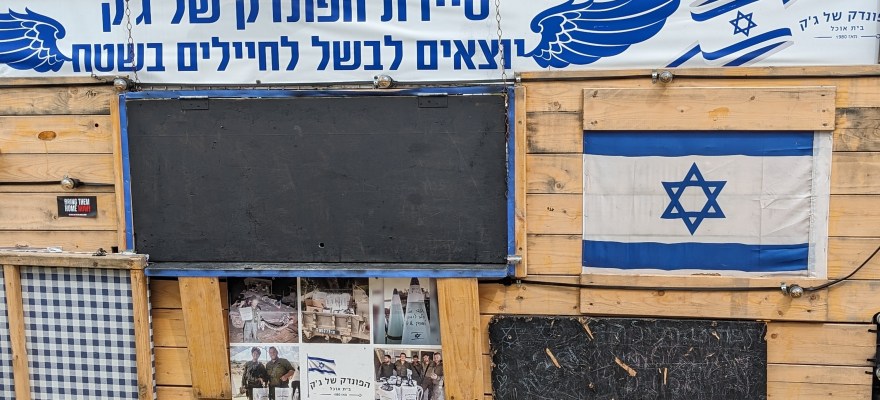
Two weeks ago, on Friday afternoon of the South Bay Solidarity Mission to Israel, we went to HaFundak shel Jack – “Jack’s Inn,” a well known home style restaurant at the entrance to Moshav Beit Nehemia in Shoham. We were there to pack up 450 meals for IDF soldiers out in the field.

After October 7, the owner of the restaurant, Meir, who was too old to be called up to the reserves, began providing daily hot food to families, soldiers, anyone in need.  He put out a call for volunteers. Within a short time, he had a list of 650 people who regularly come to cook, package, and deliver. They rely on donations to pay for all of the supplies.

After we finished packing everything up, I carried 250 meals out to the parking lot to load into a woman’s car. She had returned that morning from a trip to France, and now her job was to shuttle the meals to Kfar Saba, where another volunteer would pick them up and drive them to a brigade of soldiers in the lower Golan.

As I carried the boxes, I was thinking about logistics. By now, Jack’s Inn has served tens of thousands of meals. How do you organize something like this?

It started with just a guy with a restaurant who felt called to employ his skills to help people in a difficult time. What an inspiring example.

This morning’s Torah portion, Vayak’hel, includes a similar such example.

After cleaning up the mess of the Golden Calf, Moses unveils the project that was supposed to take place upon his descent from Mt. Sinai the first time: the building of the Mishkan, the Tabernacle.

First, he lists all of the raw materials that the Israelites need to collect: the precious metals, woods, animal hides, fabric and gems. Then, he puts the call out for those who have skills in a wide range of areas such as: carpentry, smithing, carving, sewing, and weaving. He appoints two chief artisans, Betzalel and Oholiav, to direct the project.

The Torah repeatedly indicates how inclusive this project is —men and women, tribal chieftains and those at the bottom rungs of Israelite society — everyone jumps to get involved. The people are so enthusiastic that, after not too long, the artisans report some surprising news to Moses. The Israelites responded so positively to the campaign, that they have are inundated with more supplies than they know what to do with.

Moses orders the Israelites to stop contributing. The Torah reports that “their efforts had been more than enough for all the tasks to be done.” (36:7) The first and only time that happened.

One of the places that we visited during the Israel Mission was the Tel Aviv Expo Center, which had been converted into ḤaMaL Tel AvivḤaMaL is an acronym for Cheder Milḥamah, or “war room.” It is a term taken from the military to refer to the command center of an operation. We spoke with Ronen, the volunteer director of the ḤaMaL Tel Aviv. Ronen has led a few startups, and still serves as a Reserve Officer in the Israeli Navy. 

The ḤaMaL Tel Aviv has been the central coordination center for the Israeli civil society’s response after October 7. “Civil society” is in contrast to the government. One of the recurring stories that we heard was about the government’s continued absence, not only in its lack of military readiness, but also in failing to respond quickly after the attack, to inform the public, coordinate defense, rescue, evacuation, and then provide for all of the social needs for those who became displaced.

In the government’s absence, Israeli civil society stepped up in a way that expresses the Jewish ethic of mutual responsibility and the Israeli ethos of “Startup Nation.”

To understand how the events played out, we need to go back a little over a year. When the government announced its judicial reform plans, a group of IDF reserve officers, fearing that the changes to the judiciary would lead to the erosion of Israeli democracy, started an organization called Aḥim Laneshek – “Brothers and Sisters in Arms.” This became one of the main organizations coordinating the anti judicial reform protests that lasted for months.

In the course of those political demonstrations, Aḥim Laneshek built an incredibly robust grassroots organizational network. It included many IDF reserve officers with significant leadership experience, as well as Israelis from the high tech sector who brought their own skillsets.

When Hamas attacked on October 7, Aḥim Laneshek immediately pivoted. They renamed their organization Aḥim v’Aḥayot L’Yisrael– “Brothers and Sisters for Israel,” and made three strategic decisions that would guide their actions over the coming months: 1. The IDF must win.  2. Support civilians who were hurt.  3. For the sake of unity, they would not do anything related to judicial reform.

By Sunday, October 8, they had already divided up the responsibilities. By Monday, computer programmers were building dashboards to organize the workflow. In less than a week, Aḥim v’Aḥayot L’Yisrael had built the back-end infrastructure to run a nation. There is now a ḥamal ezraḥi, a citizens coordination center, in every part of the country. 

Within four days, they set up a military-grade intelligence center to collect and analyze information, including going through photographs and videos from social media to identify hostages. When the IDF visited the site the following day, they acknowledged that they could not replicate it, so they turned over their own intelligence to the volunteers.

With Israelis in the South still hiding in safe rooms, Aḥim v’Aḥayot L’Yisrael organized volunteer rescue teams to go into places that the IDF still had not cleared to rescue families, elders, and children, and bring them to safety. In some cases, they sent out teams to search for bodies. 

It quickly became apparent that many of the IDF units, especially reservists, did not have all of the equipment they needed. The network went into action, ordering a large shipment of helmets and ceramic vests.

It was going to take weeks for the equipment to arrive, but they needed it now. So they put the call out to the network and quickly identiified a supply chain specialist, who was able to track down an airplane that was not being used and bring in the helmets and vests right away..

Aḥim v’Aḥayot L’Yisrael has continued to supply soldiers, police officers, and especially Civilian Readiness Units, which despite being outnumbered and underequipped, saved thousands of lives on October 7. They have also brought 7 planeloads full of medical supplies into the country.

By the following Saturday night, it had become apparent that tens of thousands of Israelis would need housing, and the government was not doing anything about it. Volunteers went to Eilat and the Dead Sea to determine hotel capacity and to identify the needs of evacuees and their children. Aḥim v’Aḥayot L’Yisrael were the only ones supporting those families for weeks. In the months since, they have opened 90 kindergartens in hotels.

People had to leave their homes quickly, and did not have time to gather their things, so Aḥim v’Aḥayot L’Yisrael put the call out for basic household supplies, clothing, toiletries, toys, and so on, for all of the dissplaced families. Think for a moment about what would would have to happen to effectively collect and distribute essential items across an entire country. In days, they set up the infrastructure to collect donations, sort them in warehouses, and efficiently distribute what was needed to those in need. This was 100% volunteer driven.

Just as when the Israelites built the Mishkan, the nation responded so enthusiastically that they eventually had to stop collecting supplies. “their efforts had been more than enough for all the tasks to be done.”

With the departure of most of the agricultural workers, Aḥim v’Aḥayot L’Yisrael organized thousands of volunteers to go out into the fields to harvest and plant crops.

Across the country, there are now 15,000 regular volunteers, coming from every segment of Israeli society, crossing social, religious, ethnic, and political lines.

Aḥim v’Aḥayot L’Yisrael, which was initially founded as a left-wing, political organization, has managed to bridge divisions with a number of the more right-wing communities they have been working with. “The mayors love us,” our presenter shared. 

Five months in to this war, the immediate needs have been met, and Aḥim v’Aḥayot L’Yisrael is transitioning to preparing communities to be able to return to their homes.

As we encountered this and other organizations and individuals, a few things occurred to me. First of all, the incredible selflessness demonstrated by so many regular people to do absolutely everything they could to help each other out. And Israel is not a homogenous society.

When I think about life here in the Bay Area, I cannot imagine such a widespread, grassroots, cross-cultural volunteer effort coming together.

Second was the attitude of “just get it done.” Israelis are not known for waiting for permission. There have been countless examples of people, recognizing a problem that needs a solution, and devoting oneself to gathering the resources, human and material, to solve that problem quickly.

Third, this is taking place in a traumatized society. In fact, within days of October 7, Israelis were already turning out in the tens of thousands to volunteer. Many of us might respond to trauma by shutting down, retreating from society. Israelis did the opposite, they jumped in, a far more effective response to trauma, I would imagine. 

One person we met, a retired career diplomat, the former Ambassador to France, who is now volunteering with the Hostages and Missing Families Forum, shared that this is the most meaningful work he has ever done in his life.

What are our duties as citizens? Here in America, we tend to not think of citizenship carrying with it many obligations, other than following the laws, paying our taxes, and possibly voting. 

Ronen, our guide at Aḥim v’Aḥayot L’Yisrael said that in the last year, he has learned that being citizenship is more than that: it includes a duty to give back. 

He considers what they have done, both before October 7 when they were protesting against the judicial reforms, and after, when they pivoted to supporting Israeli society, an expression of Zionism and patriotism.

That is surely something to aspire to.

Israel Needs Us – For the Future of Judaism Itself – Ki Tissa 5784

I returned on Sunday from the South Bay Solidarity Mission to Israel. Nineteen members of our community, including five from Sinai, spent a packed week filled with meaningful, important encounters to bear witness, console the mourners, and comfort the sick.

A week and a half ago, we visited Hostages Square in Tel Aviv. As we were about to board our bus to return to the hotel, a voice boomed from the loudspeakers.  Earlier that day, the far right Finance Minister Bezalel Smotrich had given an interview in which he said, rather smugly, that getting the hostages back was not as important as destroying Hamas.

An impromptu protest formed of relatives of hostages, who were, understandably, incensed.

Liri Albag, eighteen years old, has been held hostage in Gaza for 147 days. Her father, Eli Albag, cried out in the most gut-wrenching, tormented, angry voice that I have ever heard.

“Let them kidnap your children!” Calling out Smotrich by name, he shouted “Let them kidnap your children and I will shout in the street, ‘It’s not the most important thing!’”

“I’m talking to all citizens of Israel — whoever thinks that the citizens, the hostages are unimportant, let them kidnap your children and then you can speak!” 

“We have suffered for 137 days, day after day, minute by minute, we don’t sleep at night,” 

Referring to the Israeli cabinet, he continued, “It will not protect you… They are abandoning us above. They are laughing at us, dragging their feet, they are not going to negotiate. I say to you citizens, take to the streets because today it is us and tomorrow it will be you.”

This may have been the most painful thing I have ever heard another person say.

As someone who follows current events fairly closely, the week long trip was an eye-opening experience nonetheless. 

We met Israelis from many different backgrounds, gaining a sense of the complicated, conflicting ways in which social, economic, religious, and political differences play out in society.

One thing that was obvious was that the language and rhetoric that surrounds us here in America is very different from that which permeates Israeli society right now.

The most dominant issue we encountered, by far, was the chatufim, the hostages. From the moment one walks down the ramp to exit Ben Gurion airport, photos of each of those still in captivity are everywhere. On the sides of buildings, on café counters, in bank windows, on t-shirts, their faces are impossible to miss.

Alongside the photos, at least in Tel Aviv, are signs, grafitti, and billboards casting blame for October 7 on the government, and Benjamin Netanyahu in particular. One huge poster visible from the Ayalon Highway, covering the entire side of a building, has a photo of Bibi and the words Attah haRosh! Attah Ashem!“You are in charge!  You are guilty!”

Along with this are calls, everywhere, for the government to resign so that new elections can be held.

Most of the Israeli voices we heard did not express much concern for the things that fill our airwaves. There were few mentions of the Palestinians, a two state solution, or even the thousands of civilian deaths in Gaza.

The closest to calls for a ceasefire occurred within the context of “Bring the hostages home at any cost.” Even when we met with Achinoam Nini, one of Israel’s most famous singers and a peace activist for the past thirty years, she did not go so far as to call for an immediate ceasefire, although she did speak passionately about the need for a Palestinian state alongside Israel and the moral obligation to empathize with all human suffering.

Antisemitism came up, but usually in the context of Israelis being concerned about all the antisemitism that we are facing in the West. 

It should not really surprise us that the issues we are dealing with here are largely absent from the Israeli discussions. This is not to justify, but to explain. Israelis are still in trauma from October 7. They freely admit it. The fate of the hostages is front and center, with photos everywhere. The 134 who are still missing have become household names. I could not imagine being able to think of anything else if my child was in captivity.

Hundreds of thousands of Israelis are currently serving as active duty soldiers or reservists. When your child or spouse or brother or sister is fighting a war, it is hard to muster much emotional energy for those on the other side of the border.

And don’t forget the tens of thousands of Israelis who are displaced from their homes around the Gaza envelope and the northern border.

This past Saturday night, the first major anti-government protest since October 7 took place in Tel Aviv. We were there for the beginning of it. Tens of thousands of Israelis filled the streets. It was clear that there were a wide range of coalitions comprising the rally, ranging from families of hostages, relatives of victims of October 7, life-long Likud members, and pro-peace activists.

The messages were simple and clear: The government is responsible for the failures of October 7. They should resign and new elections should be held. The word achshav kept coming up as a chant. Achshav! “Now!” Israeli flags were everywhere.

A few weeks ago, we read Parashat Yitro, in which God’s Presence descends upon Mt. Sinai in revelation to the children of Israel, who are encamped below.

This moment is imagined by our tradition as a wedding. So let’s run with that metaphor a bit. We would say about a newlywed couple that they are “in love.” They only have eyes for one another. They do not see each other’s faults, and their only desire is to be together. 

Now here we are in Ki Tissa, a few Torah portions later. Moses has been on top of Mt. Sinai for forty days. He has literally gone up to heaven to speak with God. Meanwhile, back down on earth, what have the Israelites done?  They have built a golden calf.

The honeymoon is over. The rest of their time through the wilderness will be frought with misunderstandings, miscommunications, and disappointments, punctuated by occasional moments of bliss. 

This is a useful metaphor for us to consider with regard to our relationship with Israel as American Jews.

My parents and grandparents’ generations were around when Israel came into being in 1948 and in its early years. The Holocaust was a recent memory and the need for a Jewish homeland was clear. The exciting, miraculous fact of its existence, the ingathering of the exiles, and the pioneering Jews taking charge of their own destiny after 2,000 years as an opressed minority in the Diaspora was a source of pride.

After 1967, with another miraculous victory over its enemies in the Six Day War, Israel could do no wrong. 1967, by the way, is when Jews in America began to feel comfortable wearing Kippot out in public.

The 1973 Yom Kippur war began to chip away at this image of invincibility. Israel was shown to be vulnerable. This is when things started to get more complicated in the relationship. I was born in this post-1973 generation.  

Beginning with the war in Lebanon, which lasted nearly 30 years, and the first Intifada, Israel was now in a position in which it was unquestioningly the stronger military power. It was occupying land and was responsible for the Palestinians, who were not citizens of the state.  It now had to deal with a challenge that Jews had not faced for more than two thousand years: How do we use our power Jewishly?

Let’s come back to the marriage metaphor. Up until 1973, American Jews were in the honeymoon phase. We were “in-love” with Israel. The agreement was that we would buy trees through JNF, purchase Israel bonds on the High Holidays, and take pride in this growing, thriving, Jewish nation. And we would feel more safe and secure about our place in the Diaspora.

My generation began to develop a different relationship with Israel. Let’s call it “marriage.” The honeymoon is over. We are committed to each other, but we are starting to see the faults.

In the early 1990’s there was tremendous hope that the Oslo Accords would finally bring peace. Most American Jews were ecstatic, and the majority of Israelis were cautiously supportive.

The assassination of Yitzchak Rabin in 1995 by a right wing Jewish terrorist, followed by a string of terrorist attacks by Hamas, shattered that hope. This led to the third phase, comprised of young American Jews who claim that the Israel they know is not in alignment with the Jewish values they have been taught in our synagogues, Jewish schools, and summer camps.

Those of us from earlier generations can complain until we are blue in the face, but let’s consider for a moment that for someone who was born in the last thirty years, the only Israel they have experienced is one which has waged a near constant series of assymetrical wars.

They have seen ultra religious factions in Israel flexing their muscles in ways designed to deliberately suppress the liberal movements that they grew up in. They have seen a constant expansion of Jewish settlements in the West Bank, making the prospect of a two state solution seem more and more unlikely.

When it comes to Israel, what we are hearing from many young American Jews is simply “I want a divorce.”

This is tragic and frustrating. But if we, from the Honeymoon and Marriage generations, are to perform our duty of teaching our children of the Divorce generation, we have got to recognize where many of them actually are, and what they have experienced.

Congregation Sinai’s mission is to connect Jews to Judaism, each other, Israel, and the world.

What does it mean to be connected to Israel?

At the very least, it means recognizing that, as the home for half of the world’s Jews, our fates are connected in extremely tangible ways. Like it or not, what happens in Israel socially, religiously, and politically, impacts Judaism everywhere.

The current Israeli government is comprised of quite a few figures who embody what many of the anti-Zionists of the world say about Israel. Figures, like Smotrich, whose stated goal is to transform Israel into something resembling a messianic theocracy with all non-Jews holding a form of second class citizenship.

These are the people whose statements were brought by South Africa to the International Court of Justice in the Hague in its case accusing Israel of genocide.

The reality is, these extremists are extremely unpopular for most Israelis also. They are not, in fact, representative, but because of the particular nature of the Israeli political system, they enjoy a lot of power and influence right now. 

If their vision is realized in the Jewish homeland, the results for us here in the Diaspora will be terrifying. As one of our speakers claimed, the future of Judaism itself is at stake.

And so, it matters to us.

Lately, (and I myself am guilty of this) we have been using the expression kol Yisrael arevim zeh lazeh.  “All of Israel are responsible for one another.” We use this expression to describe the sense of deep connection we feel with our Jewish brothers and sisters around the world, particularly when they are under attack.

But the original use of this expression in the Talmud (BT Shevuot 39a) is a little different. If a Jew is about to sin, and I fail to intervene to steer them correctly, then my fate will be tied to their fate. We will all suffer the consequences of their wrong behavior. This expression is really about communal responsibility. I have to act.

We are being encouraged, by Israelis, to get involved in a more substantive way than we have been. Many of the people with whom we met begged us to be involved. What we saw is that there is tremendous diversity in what it means to be pro-Israel, to be a Zionist.

At its most basic level, Zionism is the belief that Jews should be able to determine our own destiny, and this can only happen if Jews are living in the Jewish homeland. Think about the final words of Hatikva – Lihyot am chofshi be’artzeinu: Eretz Tzion virushalim – To be a free nation in our land: the land of Zion and Jerusalem.

The conviction that we should be able to self identify and self actualize as a nation is the essence of Zionism.  The rest is commentary.

We have to participate in that commentary, not only for our own sake, but also for our children’s sake, and for the sake of Judaism itself.