It’s Impossible To Be Present Through A Lens – Ki Tissa 5775

I love going into the Nursery School.  It is always such a breath of fresh air.  These little human beings express themselves so honestly, without the inhibitions which they will acquire soon enough.

Every year, the nursery school celebrates the morning of Purim, and I get to join them for a visit.  I usually tell them the abridged story of the Megillah, and then join them in a Purim parade.  Loads of fun.

By the time I got to them this week though, they were out of control.  I walked into the social hall and they all jumped up and swarmed around me, announcing themselves and their costumes.

“Look at me!  Look at me!  I’m a firefighter.  I’m a princess.  I’m Darth Vader!  I’m Batman!  I’m Elsa!  I’m Elsa!  I’m Batman!  I’m Elsa!  I’m Batman!  I’m Elsa!”  There were a lot of Elsa’s and Batman’s this year.

I was really struck by their desire to be seen and recognized.  It was contagious.  Once one of them announced herself, the rest soon followed, and I was soon surrounded by a gaggle of screaming preschoolers.

In just a few years, they will not be shouting out “Look at me!  I’m Elsa!”  But that innate need to be acknowledged will not go away.  These kids will find other ways to call out for recognition, some constructive, some destructive.

It is a core human trait.  We want to know that we matter.  We want assurance that the people in our lives see us.  In religious terms, we want to know that God cares about us.

The Israelites want the same thing.  They want to know that they matter.  They want to know that Moses, their leader, sees them, and is not going to abandon them.  They want to know that God is with them.

As this morning’s Torah portion, Ki Tissa, opens, Moses has been up on Mt. Sinai for approximately forty days – depending on who is counting.  The children of Israel, encamped at the bottom, have been waiting patiently for their leader to finish talking to God, come back to them, and tell them what to do next.

But something goes wrong.  Day follows day.  Week follows week.  Still no Moses.  The people grow impatient.  Rashi explains that when Moses told the Israelites that he would be gone for forty days, he meant that they should start counting that night.  But the Israelites started counting right away, and so they were a day off.

In any event, the Israelites gather in front Aaron and ask him to make them a god to go before them, because “that man Moses, who brought us from the land of Egypt – we do not know what has happened to him.”  (Exodus 32:1)

Aaron gathers gold, melts it, and casts it into a mold, producing a golden calf.  The people, overjoyed, announce “This is your God, O Israel, who brought you out of the land of Egypt” (Exodus 32:4) and then plan a celebration for the next day.

This episode, the Sin of the Golden Calf, is usually depicted as one of the worst catastrophes in the Torah.  Right after leaving Egypt amidst signs and wonders and receiving the Ten Commandments at Mt. Sinai, the Israelites have already violated the fundamental mitzvah of not worshipping idols.

But let’s think about it from their perspective for a moment.  The Israelites do not know where they stand.  Moses is gone.  He had been unclear about precisely how long he would be away.  When he does not show up after the allotted time has passed, the Israelites feel abandoned.

And God?  God is terrifying.  Brings plagues, splits seas, and drowns armies.  Creates earthquakes and thunderstorms.  Invisible.

So it is understandable that the Israelites are feeling a bit lost by now.  They want something tangible that they can see and interact with to lead them on in their journey.  They want to know that they matter, and that they have not been forgotten and abandoned in this wasteland.

What better thing to reassure them than a shiny gold cute little baby cow.  Remember what they say after it comes out of the fire: “This is your God, O Israel, who brought you out of the land of Egypt.”  They are not worshipping another god.  To the Israelites, this is the Lord and Moses all rolled up into one.

But God is not sympathetic to the Israelites’ fears.  For making a statue, God wants to destroy them in an instant.  Moses talks God down, and then hurries to see what is going on.

Moses’ reaction to the Israelites seems almost feigned.  He already knows what they have done and has even spoken up on their behalf.  He waits until he is actually within sight of the Golden Calf before he turns on the anger and shatters the Tablets of the Covenant.

Perhaps Moses recognizes what the Israelites are going through at that moment.  Consider what he says to God afterwards when God threatens to wipe out all of the Israelites and start over with Moses.  Moses refuses point blank, instead delivering God an ultimatum:  “If you don’t forgive them, then You can erase me from Your book!”  Why would Moses go to bat for these people unless he empathizes with them?

What God does not seem to understand yet is that the Israelites are emotionally fragile.  They really do need to be reassured.  Moses gets it.  He understands that, as a Prophet, the intermediary between the Israelites and the Lord, it is up to him to teach God how to relate to the people.

After a bit of negotiating, Moses makes two important requests.  One, he asks God to reveal God’s self to Moses.  Moses wants to have a better understanding of with Whom he is dealing.  The second request is on behalf of the people.  “Unless You go in the lead,” Moses instructs God, “do not make us leave this place.”  (Exodus 33:15)  Moses knows that the Israelites need more recognition than God has given them so far.

God, scolded, agrees to both of Moses’ demands.

While no human can be exposed to God’s Presence and survive, God makes an accommodation.  God summons Moses up to Mt. Sinai once again, and instructs him to hide in the cleft of a rock.  The Divine Glory passes by, and Moses is able to see God’s back (whatever that means).

From then on, the Shechinah, the Divine Presence, travels with the Israelites through the wilderness as a cloud of smoke by day and a pillar of fire by night.

Thanks to Moses’ insight and boldness, the Israelites finally have the reassurance they seek.  They know that God is with them, because they see signs of God’s Presence.  They know that God speaks to their leader, Moses, on a regular basis, because Moses himself has been permanently changed by the experience.  Plus, God’s Presence descends upon the Tent of Meeting whenever Moses goes inside to commune.

In our world that is full of distractions, it can be difficult to be fully present.  Gone are the times when families and friends would have to talk with one another because there was literally nothing else to do.

Nowadays, we are surrounded by electronic devices, guaranteeing that we are never bored, and offering us excuses so that we never have to be fully present with another person.

But the need to be seen and acknowledged is buried deep inside of us.  It is a need that is not replaced by technology.  Indeed, technology provides a lot of distractions that interfere with our ability to see one another and to interact with the world.

As I prepare to depart with my family on my sabbatical in a little over a week, I have been thinking a lot about a particular electronic device which I expect will feature prominently in my experiences – a camera.  Nowadays, pretty much everybody has a camera in their pockets at all times.  We have the ability to record every moment of our lives – in high definition.

Think back to a vacation you once took.  Try and remember what happened.  The people you were with.  The sites you visited.  If you are like me, you have photographs of most of those memories.  It is because the photograph itself reinforces the experience.  We are far less likely to remember vacation experiences for which we do not have the pictures.

Why is that?  Is it that those experiences are less real, or less significant?

Not at all.  Cameras have changed our brains.  They have altered the ways that we store memories.

Don’t get me wrong.  I am a camera person.  I like to take pictures.  I think I have taken some pretty good ones.  The most practical class I took in high school was photography.

But for me, a camera often interferes with the experience itself.  I find it difficult, if not impossible, to be fully present through a camera lens.

I suppose that for some really talented photographers, a camera can actually become an extension of oneself.  When such an artist looks through the lens, he or she is indeed fully present with the subject.

But when I look through the lens, I am thinking about other things:  Do I have enough light?  What image do I want to focus on?  How much do I want to zoom in.  Is my subject backlit, or washed out?  The camera then becomes a barrier to being fully present and in the moment.

This is true if I am out in nature somewhere, looking out at a gorgeous valley.  It’s also true when I am with my kids.  I can interact with them, roll around on the floor, cheer them on at a sports game.  Or I can create a permanent record and view the experience through a glass lens.

While the camera may create a lasting image, it often comes at the forfeiture of genuine experience.

As I prepare to live in Israel for the next four months, I expect to take a lot of pictures.  But I also am reminding myself that the experiences that really matter in life are the ones in which we are fully present with our environment, and the people in it.

Judaism offers us many opportunities to be Present.  Right now, we are here together celebrating Shabbat.  One of the blessings of Shabbat is that it forces us to pay attention to one another.  To be Present, in this moment, and to not let the distractions of the week get in the way of our relationships.

Because whether it is Nursery School students clamoring for the Rabbi to acknowledge them in their Purim costumes, Israelites longing for a sign of God’s Presence to reassure them that they have not been abandoned, or our own quests for meaning in life, we human beings are hard-wired to seek opportunities to be Present.

It is those intangible moments when we truly connect with the essence of the other which matter most.  May we have the courage, and the privilege to see and be seen clearly.

Where is God? – Terumah 5775

Where is God?

I learned the answer when I went to Camp Gan Izzy, the Chabad Day Camp, in the summer before third grade.  Sing along if you know this one:

Hashem is here, Hashem is there,

Hashem is truly everywhere!

Up!  Up!  Down!  Down!

Right!  Left!  And all around!

Here!  There!  And everywhere!

That’s where He can be found!

Up!  Up!  Down!  Down!

Right!  Left!  And all around!

Here!  There!  And everywhere!

That’s where He can be found!

So there is the answer.  God is everywhere.

Once, Rabbi Menahem Mendl of Kotzk, the Kotzker Rebbe, walked up to a group of scholars and asked them a simple question:  Where is the dwelling of God?”

They laughed at him.  “What a silly question!  Is not the whole world filled with God’s glory?!”

To which the Kotzker answered his own question:  “God dwells wherever we let God in.”

Two diametrically opposed answers to the question of where God is:

The first answer:  Everywhere.  God is big!  Nothing can contain God’s Presence.  God fills all of Creation, and then some!

The second answer:  God is small and lonely.  God is outside, knocking on the doors of our hearts, waiting to be invited in.

The first King of Israel is Saul.  When he loses God’s favor, Samuel the Prophet is called upon to anoint his replacement, and so God sends him to Beit Lechem to find a man named Jesse, one of whose sons will be anointed as the next King of Israel.

Samuel arrives, and sees Eliav.  Tall, strong, and handsome, he is Jesse’s eldest.  Samuel takes one look at him and says to himself, “Surely this is the Lord’s anointed.”

But God has other plans.  “Pay no attention to his appearance or his stature, for I have rejected him.  For not as man sees [does the Lord see]; man sees only what is visible, but the Lord sees into the heart.”  (I Samuel 16:7)

So Jesse brings up his next son, Avinadav.  “Nope,” says the Lord.  Shammah.  “Next!”  And so on, down the line.

After rejecting seven sons, Samuel asks him, “You got any more?”

Jesse looks at him, shrugs, and says, “Well, there is my youngest son.  He’s out tending the flock.”

“Well hurry up, man” Samuel urges, “bring him to me.”

Samuel takes one look at the kid and hears the Divine voice saying “This is the one.”  So Samuel anoints David as the next king of Israel.

Where is God?

God peers into young David’s heart, and finds an opening.  We are told that after Samuel anointed him, “the spirt of the Lord gripped David from that day on.”  (I Samuel 16:13)

As this morning’s Torah portion, Parashat Terumah, opens, Moses is on top of Mount Sinai and the Israelites are encamped below.  God instructs Moses to launch a capital campaign to raise money for a new building.  This is in the days before money, so they are going to have to collect raw materials:  gold, silver, copper, wool, fabric. precious woods, animal skins, and so on.  The gifts start pouring in.  The people respond so enthusiastically to the fundraising campaign, that Moses has to end it early – before the big donors can even come forward.  The first – and last – time in history that has happened.

They are going to use all of these materials to build the Mishkan, the portable Tabernacle or Sanctuary, that the Israelites will take with them throughout their wanderings in the wilderness.

This and next week’s Torah portions are filled with detailed descriptions of how to build all of the furniture, make the clothing, and construct the building.  At the end of the Book of Exodus, the final two portions will repeat much of these details as Moses passes on the instructions and the Israelites build it.

This Mishkan will enable them to install the Priests who will perform all of the special sacrifices and rituals, thereby maintaining the relationship between God and the Israelites in its proper balance.  Moses will confer with God in the inner precincts of the Mishkan.  It will also serve as a physical location for God’s Presence among the Israelites – a cloud by day, a pillar of fire by night hovering to let the Israelites know that God is with them.

So where is God?

In the Mishkan, it would seem.

But, wait a second.  I thought God was everywhere, or waiting for hearts to open to be let in!  Now we are describing God’s Presence materializing in a physical location.

The truth is, God has no need whatsoever for a house.  God is way too big for that.  To suggest otherwise, that God’s Presence can somehow be contained in a physical space, is blasphemy bordering on idolatry.

It is we who need a Sanctuary.  Sefer Hachinukh teaches that it is the act of building the Mishkan which is transformative, not the building itself.  It is the journey, not the destination, which matters.

But why a Mishkan?  Why is it so important for the Israelites to build this thing in the first place?

Nachmanides, the 13th century Spanish Rabbi, connects the Mishkan to the Israelites’ encounter with God at Mount Sinai.  The Revelation at Sinai was a glorious, indescribable moment.  The challenge for the Israelites after such a supremely spiritual experience is what to do the day after, and the day after that, for the rest of their lives.  Everything else will be a let down after Mt. Sinai.  Nachmanides notices that there are a number of similarities between the Torah’s description of the Mishkan and the Revelation at Sinai.

God speaks to Israel through Moses from inside the Holy of Holies just as God spoke to Israel through Moses on top of the mountain.

The Tablet of the Covenant that the Israelites carry with them in the Mishkan was given on Mt. Sinai as a symbol of the covenant that was struck there.

The cloud of smoke created by the incense offering in the Tabernacle recalls the cloud that covered Mt. Sinai.

Similarly, the fire on the altar symbolizes the fire that descended on Mt. Sinai from the heavens.

The building of the Mishkan is meant to capture the essence of what happened to the Israelites at Mt. Sinai and enable them to take it with them on the road.  The Mishkan will serve as a kind of portable Mt. Sinai.

A Talmudic teaching (BT Sanhedrin 16b) takes it a step further.  The building of the Mishkan is not a one time project.  It is timeless.  We are to constantly build a Tabernacle in every generation.

So does that mean that we should launch another capital campaign tomorrow?  I think we might be able to get it to fit in the parking lot.

Just kidding.  Our tradition understands the Mishkan as a metaphor in and of itself.

God tells Moses, v’asu li mikdash, v’shachanti b’tocham.  These words appear in many, if not most synagogue, usually on donor plaques.  We have it in a beautiful mosaic right there in the foyer above the names of those who contributed significantly to the building of this sanctuary.

V’asu li mikdash, v’shachanti b’tocham.  “Make for me a Tabernacle, and I will dwell in… ” – finish the sentence. It should say b’tokho, “in it.”  But it doesn’t.  It says b’tokham, “in them.”

“Make for me a Tabernacle so that I can dwell within them.”  The Israelites build this beautiful, expensive building, and now God is not going to even move in?!

This leads many commentators to suggest that each human being corresponds to the Mishkan.  The eternal command to build the Tabernacle is as relevant to us in this moment as it was to our ancestors in the wilderness thousands of years ago.

The purpose of building the Mishkan is to transform those who are building it.

The 19th century commentary, the Malbim, teaches that “each one of us needs to build God a Tabernacle in the recesses of our hearts, by preparing to become a Sanctuary for God and a place for the dwelling of God’s glory.”

How do we transform ourselves into holy vessels worthy of God’s Presence?

The answer is quite straightforward: by doing mitzvot, we not only alter the world around us, we also transform our inner selves.  And then, God has a place in which to reside.

So where is God?

Everywhere? Waiting outside the door? Or in the mishkan?

The three answers merge.  The potential for God’s Presence to enter the mishkan of our hearts is with us at all time and in all places.  We return to the Kotzker Rebbe:  “God dwells wherever we let God in.”

But when we look inward, do we truly see ourselves in this way?  Are our hearts capable of becoming holy vessels that can house the Divine?  While these concepts are embraced in our tradition, notably by some of the Great Hassidic Masters, it seems to me that many of us struggle to see ourselves in this way, if we even consider it at all.

Our lives are so busy, our society and economy so material-driven, that the inner life is easily silenced and ignored.

Transforming the self into a holy vessel, a sanctuary for God, a Mishkan, requires kavannah, the intention to do so.

We approach an act with the mindset that its performance can open up our hearts, draw in sparks of holiness, and possibly even let God in.

We can introduce this kind of kavannah into our lives at any moment.  We just have to slow down, alter our perspective, and consider that our actions can have cosmic ripples beyond the physical world that we see around us.

The next time we give tzedakah, say a blessing before eating a meal, or study something, let us consider that what we are doing can transform our hearts in a profound way.

Right now, we are all here together in this physical sanctuary.  This is an opportune moment.  Let’s push the distractions aside, and make this an opportunity for holiness.  What better time and place is there than right here and right now?

The Origin of the Hebrew Calendar – Bo 5775

Parashat Bo continues the story of Moses and Aaron confronting Pharaoh, demanding that the King of Egypt allow the Israelites to go out into the wilderness to worship God.  As he refuses, they announce each calamity that God is about to bring upon the Egyptians.  The devastation wrought by the plagues on Egypt worsens, and Pharaoh’s stubbornness begins to show cracks.  He offers to let just the men go, but then he changes his mind.  Then he agrees that the children and the elderly can go as well, but he backtracks once again.  Finally, Moses announces that the entire nation is simply going to leave with all of their belongings.  Furthermore, Pharaoh himself will supply the cattle that will be used as offerings to God.

Moses declares the upcoming tenth plague, the death of all first born humans and animals in the land of Egypt, and then the Torah takes a break.

God speaks to Moses and Aaron, saying the following:

Hachodesh hazeh lakhem rosh chodashim, rishon hu lakhem l’chodshei hashanah

This chodesh shall be for you the head of the chodashim, it shall be first for you of the chodashim of the year.  (Exodus 12:2)

Our tradition understands this to be the first of the Torah’s 613 mitzvot.  Because of its position as number one, and because it interrupts this dramatic story, we can assume that it is telling us something highly significant.

Indeed, this verse is the origin of the Hebrew calendar.  The Rabbis do some very close reading to explain how the Hebrew calendar, which came into existence long before they came along, is rooted in the Torah.

Moses and Aaron are told that this chodesh will serve as the first chodesh of the year.  But what is a chodesh?

Chodesh is from the same root as chadash, meaning new.  The chodesh is something that is mitchadesh, that experiences renewal.

The appearance of the moon changes from one day to the next, such that it renews itself once per month.  The sun, on the other hand, appears the same each day.  Thus, the Rabbis of the Talmud (BT Megillah 5a) explain that we count the year by months, rather than by days.  The term chodshei hashanah, the months of the year, illustrate this requirement.  This is why our calendar is a lunar calendar, rather than a solar calendar.

But this leads to several problems.

A lunar month is 29 days, 12 hours, 44 minutes, and 2.976 seconds, approximately.  Twelve months is 354 days and a fraction.  This would make a lunar year about 11 days shorter than a solar year.  If we were to follow just a lunar system, the months, and the Jewish holidays, would float across the seasons, taking about 33 years to return full-circle to the season in which they started.  That is, in fact, how the Muslim calendar works.

Deuteronomy states shamor et chodesh ha-Aviv v’asita Pesach.  “Observe the month of Aviv and offer a passover sacrifice to the Lord your God, for it was in the month of Aviv, at night, that the Lord your God freed you from Egypt.”  (Deuteronomy 16:1).  Aviv is the only named month in the Torah.  It literally means “new ears of grain” because it is the month in which the ears of grain first appear.  If the calendar were to float over the course of the seasons, then we would not be observing Passover during Aviv.

Furthermore, with regard to Succot, the Torah says b’asaf’cha et ma’asecha min hasadeh – “when you bring in your produce from the field.”  This means that Succot must always take place at the time of the fall harvest.  Therefore, the Rabbis of the Talmud explain, we have to occasionally make an adjustment by adding a thirteenth month.  (BT Rosh Hashanah 7a)  In this way, we will be able to celebrate Passover and Succot in the appropriate seasons.

In ancient times, the adjustments would be made based on the observance of spring-like changes.  If the trees had not yet begun to blossom or barley had not yet started ripening, then the Sanhedrin, the ancient Jewish court that met in the Temple, would delay the beginning of the year by adding a thirteenth month.  The additional month, following Adar, we now refer to as Adar Bet.

Now that we have a fixed calendar, the addition of the extra month happens on a predetermined schedule, seven times out of every nineteen years.

But there is another problem.  When is the Jewish new year?

In the Mishnah, we read that there are actually four, or maybe even five new years, each marking something different.  Nisan is the New Year for counting holidays and for kings.  Tishrei is the new year for counting years, sabbatical and jubilee years, and for several other agricultural purposes. (Mishnah Rosh Hashanah 1:1)

The Talmud records an argument between two rabbis about when the creation of the world occurred.  One Rabbi says that it happened in Nisan.  The other says it happened in Tishrei.  So we seem to have some ambiguity.

In the Torah, the new year occurs on the first day of the month we know as Nisan.  This is the same month as the month of Aviv I just mentioned.  The Torah, indeed most of the Bible, does not have names for any of the months.  Instead, it references the month number, always referring back to the month in which the Israelites went out of Egypt.

For example, what we refer to as Rosh Hashanah, occurring on the first of Tishrei, is instead name Yom Teruah, a Day of Blasting, and takes place on the first day of the seventh month.  When the Israelites get to Mount Sinai and camp out around the base, preparing to receive the Ten Commandments, the Torah states:

On the third new moon after the Israelites had gone forth from the land of Egypt, on that very day, they entered the wilderness of Sinai.  (Exodus 19:1)

The Book of Numbers begins as follows:

On the first day of the second month, in the second year following the exodus from the land of Egypt, the Lord spoke to Moses in the wilderness of Sinai…  (Number 1:1)

Centuries later, the Bible continues to look back to this moment.

In the four hundred and eightieth year after the Israelites left the land of Egypt, in the month of Ziv―that is, the second month―in the fourth year of his reign over Israel, Solomon began to build the House of the Lord.  (I Kings 6:1)

Throughout the Bible, whenever dates are referenced, it is by a number counting back to the first of Nisan in the year in which the Israelites left Egypt.

What we know as the Hebrew months (Tishrei, Cheshvan, Kislev, Tevet…) do not appear until later books of the Bible, such as Esther.  In fact, the “Hebrew months” are in fact Persian names which were assimilated into the Jewish calendar at some point late in the Biblical era.

Why is all of this important?  Couldn’t the Israelites haves simply taken the Egyptian calendar with them, or adopted the Canaanite calendar?  Why did our ancient ancestors need to have a different calendar?  Why is it important for us to continue to keep a different calendar?

How we measure time is extremely important.  Having a Jewish calendar, and marking our years according to it, distinguishes us, especially when we are living in a society that counts time differently.

The twelfth century Torah commentator Rashbam explains that the calendar is oriented in this way so that we always have the Exodus from Egypt in our consciousness.  The Exodus is the formative moment of the Jewish people.  Its memory is supposed to have a profound effect on our lives, both individually and collectively.

As we read in the Haggadah for Passover, we are instructed to recall the Exodus all the days of our lives, and even the nights.  We mention it in our daily prayers.  We connect it to Shabbat by calling it zekher liztziat mitzrayim, a remembrance of the Exodus from Egypt, when we recite Kiddush.  And, our calendar itself also reminds us of that formative event.

Nachmanides points out that when the Torah states “this month shall be for you…” it puts things into a relative context that is particular to the Jewish people.  While Tishrei might be the universal month of creation, and the month from which we count the earth itself, we are also to think of time in its relationship to our particular story.  Our story began when our ancestors first became free.

Being conscious of Jewish time offers great meaning for our lives.  We count our week from Yom Rishon, the first day, up to Yom Shishi, the sixth day, keeping ourselves oriented towards the day of rest throughout the week.  We mark our months by the waxing and waning of the moon, and experience renewal every 29 or 30 days.  We remember our exodus from Egypt, and express our gratitude for freedom by caring for those who are suffering.  And we mark the yearly birthday of the world, marveling at the miracle of Creation and committing ourselves to do better and be more.

That is what it means to live in Jewish time.

Va’era 5775 – France Without Jews is not France

We are still in shock over the murders by Islamic terrorists a week and a half ago of Yoav Hattab, Yohan Cohen, Philippe Braham and François-Michel Saada as they were doing some last-minute shopping before Shabbat.  Those killings, along with the attacks at the offices of Charlie Hebdo have been a wake-up call.  Much soul-searching is taking place in France, and around the world.

It seems that some people outside of the Jewish community are finally recognizing that there is a connection between antisemitic attitudes and rhetoric and terrorism – that ignoring the former will invariably lead to the latter.

French Prime Minister Manuel Valls declared last week that “France without Jews is not France.”  To back up this sentiment, he announced on Monday that 10,000- military troops would be deployed to protect sensitive sites, and that 4,700 police officers would protect Jewish schools and synagogues.

At the rally in Paris last Sunday of a million and a half people, in addition to signs declaring “Je suis Charlie,” there were some that read “Je suis Juif.”  I am Jewish.

I imagine it must be at least somewhat reassuring to French Jews to have both the leaders of the country as well as some of its citizens taking their safety seriously and making commitments to protect them because they recognize that French Jews are citizens of the country who make up an important and integral part of the national fabric.

Not everyone is so hopeful.  On Sunday, Prime Minister Netanyahu, attending the rally in Paris, explicitly invited the Jews of France to move to Israel.  “Israel is your home,” he said.  This was not the first time that an Israeli leader urged French Jews to make aliyah.  In 2012, at a joint press conference with President Francois Hollande, Netanyahu said:  “In my role as Prime Minister of Israel, I always say to Jews, wherever they may be, I say to them: Come to Israel and make Israel your home.”

It has not only been Netanyahu.  At a ceremony in 2004 welcoming new immigrants from France, Prime Minister Ariel Sharon advised French Jews to “move immediately” to Israel to escape “the wildest antisemitism” in France.

The French were not pleased then either.

There is something of a rhetorical tug of war going on here between those who say that “France without Jews is not France,” and those who claim that there is no future for Judaism there.

This is not the first time the Jewish people have faced this question.  In this morning’s Torah portion, Va-era, there is also a tug of war over the future of the children of Israel.  At the opening of the parashah, they are enslaved in Egypt.  God has identified Moses as the prophet who will carry the message “Let my people go” to Pharaoh and lead the Israelites out of slavery and to the Promised Land.

Not everyone wants to see the Israelites leave, however.  Pharaoh and his court, certainly, do not want to see their enslaved workforce disappear.  The Israelites themselves are skeptical of Moses’ insistence that God is going to lead them away.  They prefer an enslaved life that they know to an uncertain life of freedom.

God knows, however, that there is no future for Israel in the land of Egypt.

God hears the groaning of the Israelites and remembers the commitment made to their ancestors generations before.  God promised Abraham, Isaac, and Jacob, that their offspring would be as numerous as the stars and would one day inherit the land of Israel.  They would be a blessing to the world.  This is a destiny that cannot be fulfilled by slaves in a foreign land.

God tells Moses:

Say… to the Israelite people…  I will free you from the labors of the Egyptians and deliver you from their bondage.  I will redeem you with an outstretched arm and through extraordinary chastisements.  And I will take you to be My people, and I will be your God.  (Exodus 6:6-7)

These four verbs – “I will free you, I will deliver you, I will redeem you, and I will take you” – are the four stages of redemption that our Passover Seder identifies as the basis of the four cups of wine.

In this redemption, freedom is only part of God’s promise.  God also means to build a covenantal relationship with the Jewish people.  Central to that covenant is the establishment of a Jewish society in the Promised Land.  Only then can the Jewish people become what God has intended for them to become.  Only then will they realize their potential and flourish.

This tug of war in the Torah between slavery and freedom, between Egypt and Israel, is black and white.  In the millennia since our ancestors first became free, the question of where the Jewish people can best flourish has been more complicated.  Maimonides, fleeing persecution in Spain and then Morocco, made his way to the land of Israel.  There, he found a backwards Jewish community in which he did not see a future.  So he kept going South and settled in the thriving Jewish community of Fustat, Egypt.

We are a people that is both rooted in our Promised Land, and capable of bringing our faith and identity with us wherever we go.  We have been successful at it, developing tight-knit communities whose members support one another and are a force for good in their surrounding environments.

Part of the importance of the State of Israel today is that it truly functions as the homeland of the Jewish people.  Robert Frost said “Home is the place where, if you have to go there, they have to take you in.”  Israel is that home for Jews, wherever we happen to be living right now.

Since the establishment of Israel in 1948, it has opened its doors to refugees from the Holocaust, masses of Jews fleeing pogroms in North Africa and the Middle East, Jews of the Former Soviet Union and Ethiopia.  “Welcome home,” Israel said.

So what of the Jews of France today?

The Jewish community in France is significant.  There are an estimated 500,000 Jews living in France.  The is the largest community in Europe and the third largest in the world.  It is a diverse, cosmopolitan community, comprised of Jews across the religious spectrum – from secular to ultra-Orthodox, and everything in between.

The last few years have seen a rise in acts of antisemitism.  This has led to increasing numbers of French Jews deciding to move to Israel.  Last year, nearly 7,000 French Jews made aliyah, more than double the previous year.  With continued anti-Jewish violence, that number is expected to be even higher this year, perhaps as many as 10,000.

When we consider the long history of Judaism in France, it is particularly sad that the community finds itself facing so much pressure now, because France has really come a long way.

The first Jews probably arrived about 2,000 years ago.  Attracted by economic opportunities, they did well in the early middle ages.  Charlemagne embraced the Jews, seeing them as a blessing to his kingdom.

The Crusades brought new attitudes across Europe.  Rulers stoked antisemitism, and peasants took out their frustrations on their vulnerable Jewish neighbors.

The persecutions began around the year 1000 CE.  Jewish communities were often confronted with the choice of conversion to Christianity, death, or exile.  Several waves of expulsions took place in 1182, 1306, and 1394.  Jews often had property and assets seized, or debt owed to them cancelled.  Blood libel accusations were frequent.

Don’t think, however, that it was all bad – that the middle ages were centuries upon centuries of pure suffering.  Also during this time, there were Jewish communities that thrived, enjoying prosperity and cultural flowering.  Some of the most important Jewish leaders and thinkers in history came from France.

Rabbi Shlomo ben Yitzchak, more commonly known as Rashi, is the most important commentator of the Torah and Talmud in Jewish history.  He lived and taught in Troyes, in Northern France in the eleventh century and gave rise to a school of innovative Jewish thinkers that flourished for several generations.

As the years passed, the Jews of France, as they were everywhere else in the world, were seen as other, and treated as second-class citizens, at best.

By the 1780’s there were approximately 40-50,000 Jews living in France.  They had legal status to be there, but with extremely limited rights.  They were basically restricted to the money-lending business.  Things were changing in Europe, however, especially in France.  The Enlightenment had taken hold, and there were finally some Christian voices that were calling for tolerance and acceptance of minorities.

The French Revolution of 1789, with its ideals of liberty, equality, and fraternity, introduced the notion that all residents of a nation could be considered citizens, regardless of their religious affiliation.

The change was sporadic and haphazard, as the chaos of the revolution proceeded and the Reign of Terror took hold, but the Jews of France recognized that something new was happening, and they were excited about the possibilities.  Jewish communities helped fund the revolution, and Jewish soldiers joined the Army of the Republic in its battles against other European countries.  Many Jews patriotically gave their lives for the sake of their French homeland.

When Napoleon came to power, he wanted to finally resolve the Jewish question.  In 1806, he convened the Assembly of Jewish Notables, naming it the Grand Sanhedrin.  Twelve questions were posed to it members, the answers to which would determine the future status of the Jews of France.  Those questions included:

• May a Jewess marry a Christian, or [May] a Jew [marry] a Christian woman? or does Jewish law order that the Jews should only intermarry among themselves?

• In the eyes of Jews, are Frenchmen not of the Jewish religion considered as brethren or strangers?

• Do the Jews born in France, and treated by the law as French citizens, acknowledge France as their country? Are they bound to defend it? Are they bound to obey the laws and follow the directions of the civil code?

• What kind of police jurisdiction do the rabbis exercise over the Jews? What judicial power do they exercise over them?

The answers the Assembly gave essentially declared Jews to be French citizens first, and Jews second.  Intermarriages would be considered binding.  French Jews would consider non-Jews to be their brethren.  Jews would consider France to be their fatherland, and would defend it when called upon, etc.

When asked if they wanted to be citizens, with all that it would entail, the Jews of France answered with a resounding “oui.”

In 1807, Napoleon added Judaism as an official religion of France.  As his armies moved across Europe, Napoleon liberated Jewish communities of other lands from the ghettos to which they had been restricted.

Emancipation was not yet complete, however.  In 1846, the Jews of France became fully equal when the French Supreme Court found the More Judaico, the Jewish oath, rooted in medieval antisemitism, to be unconstitutional.  Legally, the Jews of France were now fully French, with rights equal to Catholics and Protestants.

The social reality, however, was quite different.  Despite tremendous efforts by Jews to assimilate into French society, antisemitism was still widespread.  At the end of the nineteenth century, a traditionalist faction of army officers concocted a plot to frame a young Jewish Captain named Alfred Dreyfus for treason.  The subsequent trials were a major political scandal in France that lasted from 1894 – 1906 and that divided the country between the anticlerical, pro-republic Dreyfusards and the pro-army, mostly Catholic anti-Dreyfusards.

Theodore Herzl was a secular Jewish journalist who had grown up in antisemitic Austro-Hungary and moved to France due to what he perceived as its progressive, humanist values.  He was a strong proponent of Jewish assimilation into European culture as the solution to the Jewish problem, which had become “an obsession for him.”  (Dictionary of the Dreyfus affair, Nichol, p. 505.)  Herzl’s coverage of the Dreyfus Affair in 1895, however, led him to conclude that Jews would never be accepted by the non-Jewish world.  As much as Jews had given up to become citizens, they would never be seen as equals.

In his book, Der Judenstaat, Herzl writes:

If France – bastion of emancipation, progress and universal socialism – [can] get caught up in a maelstrom of antisemitism and let the Parisian crowd chant ‘Kill the Jews!’ Where can they be safe once again – if not in their own country? Assimilation does not solve the problem because the Gentile world will not allow it as the Dreyfus affair has so clearly demonstrated.

Herzl subsequently founded the First Zionist Congress in Basel, Switzerland, in 1897, creating Zionism as a political movement and laying the foundation for the reestablishment of a Jewish homeland in the land of Israel.  If the Gentile world is incapable of accepting Jews as equals, Jews will have to establish a land of their own where they constitute a majority and are free to determine their own fate.

At the beginning of World War Two, there were 350,000 Jews living in France, a number of them having fled Germany in the 1930’s.  During the Holocaust, one fifth of France’s Jewish population were murdered by the Nazis, often with the collaboration of French officials and citizens.  There were also many enlightened French who saved Jews.  France has the third highest number of people honored as Righteous Among the Nations among any country.

Between 1948 and 1967, France was a strong supporter of Israel, with close military ties.  The Israeli nuclear reactor in Dimona was built with significant assistance from the French government in the 1950’s and 1960’s.  Israeli Air Force pilots flew French fighter jets in the Six Day War in 1967.

By the end of the twentieth century, France’s population had among the most favorable attitudes towards Jews of any country in Europe.

The resurgence of anti-Semitism over the last fifteen years has come from a non-traditional  source.  While there are still antisemitic attitudes from those on the far right and the far left, the rise in anti-Jewish activity has been attributed mainly to increasing violence by people in the French Muslim community.  Flare-ups have tended to occur especially when there is political tension in the Israeli-Palestinian conflict.

In addition to the terrorist attack on the Hypercacher grocery store, there have been other murders, acts of vandalism, attacks against synagogues and Jewish-owned businesses, anti-Jewish demonstrations and chants, and more.

That is why French Jews are increasingly nervous, why French emigration is up, and why real estate prices in Israel are soaring.

I am not French, but I doubt that we are going to see a mass Exodus of the entire Jewish community of France to Israel.  I hope and pray that there is a thriving future for the Jews of France.

Like you, I am extremely concerned for our Jewish brothers and sisters who had to cancel Shabbat services at some synagogues last week and who require police and military presence at all of their institutions.  I hope that this wake-up call to the French people will lead to action, will help them realize that the Jewish people are the proverbial canary in the coal mine, because the Prime Minister is correct when he says “France without Jews is not France.”

Shemot 5775 – Rebellion to Tyrants is Obedience to God

When I was in college, I had an opportunity to attend a talk by the the famous Israeli author and peacenik, Amos Oz.  Something he said has stuck with me.  “I have never once in my life seen a fanatic with a sense of humor, nor have I ever seen a person with a sense of humor become a fanatic, unless he or she has lost that sense of humor.”

The wisdom captured by this insight was on display in France this week.  Islamic terrorists, upset about cartoons that insulted Muhammad attacked the offices of the French weekly magazine, Charlie Hebdo, murdering twelve people.

Ironically, it is the fanatic who is the funniest of all, and who most needs to be satirized.  It is the fanatic who most urgently needs to understand the joke, but on whom the punchline is lost.

Charlie Hebdo is a rude, satirical magazine that is an equal-opportunity insulter.  As Jews, we might get offended at how it depicts our coreligionists, but then again, when we consider that  Christians and Muslims receive the same treatment, perhaps there is something going on here other than antisemitism.

As we gather together this morning to pray, to celebrate Shabbat, to be together, and in a little while, to eat, we cannot help but also reflect on the terrible events of this week in France.  First, the murder of twelve souls at the offices of Charlie Hebdo.  Then the shooting of a police officer.  And right before Shabbat, the taking hostage and murder of Jewish shoppers in a kosher grocery store.

The sad thing is that we knew this was coming.  The Editor of Charlie Hebdo even had a bodyguard, who was among the victims.  The Muslim terrorists who committed these terrible acts received training by Al-Qaeda in Yemen and were heavily armed.  It seems that there was really no stopping this tragedy from happening.

Consider other recent events around the world, including the beheading of Western journalists in Syria and Iraq, the killing of 132 schoolchildren in Pakistan, the murder of a Canadian soldier in Ottawa, the taking hostage of diners in a cafe in Australia – all were committed by Islamic terrorists in the name of their religion.

ISIS, Al Qaeda, Hamas, Hizbullah, Taliban, Boko Haram, and the list goes on.  It is impossible to deny that we are facing a global epidemic of Islamic fundamentalists whose interpretation of religion compels them to fight anything to do with the West: democracy, women’s rights, freedom of the press, religious pluralism, the list goes on.

How is it possible that religious people could have such a perverse interpretation of what God wants from humanity?  It is mind-boggling.  Comical even.  ISIS would make a fantastic comic book villain if it was not real.

How does religion become totalitarian?  This phenomenon is so antithetical to how our Jewish tradition would have us see the world.

This morning, we begin reading the Book of Exodus.  Parashat Shemot introduces us to the major characters in this drama: the Israelites, Pharaoh, Moses, Aaron, Miriam, and of course, God.

The English title of the book captures what we usually think of as its major theme: Exodus.  In Hebrew, we refer to this event as Yetziat Mitzrayim, the leaving of Egypt.  This is our formative story as a people.  It is a story which is embedded into our consciousness individually and collectively.  We were once slaves.  God saved us with an outstretched arm.  Now we are free, and we are in a covenantal relationship with God that, among other things, requires us to care for the downtrodden.  We know this story well.  We tell it in our daily prayers.  We reexperience it every year during Passover.

It is not only our story.  Martin Luther King, Jr. used the story of the Exodus as a biblical paradigm BFranklinSealin the Civil Rights movement.  Abraham Lincoln turned to the Exodus for inspiration in the fight to end slavery.  Benjamin Franklin wanted the seal of the United States to depict the Israelites safely on the far side of the Sea of Reeds while the Egyptian army drowns in its depths.  The motto surrounding the seal would have read: “Rebellion to tyrants is obedience to God.”
That is the other message of the Book of Exodus.  Pharaoh is a tyrant.  He is a fanatic.  He has no sense of humor.  Just as God brings the Israelites into freedom to convey a universal concern for human freedom, God also set out to overthrow Pharaoh as a sign to the world that despotism is never to be tolerated.

God’s problem with Pharaoh is not that he is an idolater.  In fact, the Torah is ambivalent with regard to other nations’ religious beliefs and practices.  The Jewish people are never commanded to rid the world of idolatry or to force the rest of humanity to worship God.

Pharaoh’s sin is that he, a human, claims to be divine.  And further, he allows for no possibility of anything else.

At the beginning of Exodus, Pharaoh looks at his kingdom, sees the Israelites, and notices that they are different.  He cultivates a sense of fear among the Egyptian people, convincing them that the Israelites pose a threat to Egypt.  The regime of slavery begins, but Pharaoh’s paranoia only gets worse.  Still fearful of a rebellion, he orders the execution of all male Israelite children.

The Torah, in its wisdom, is articulating the steps of how a totalitarian dictator consolidates power by demonizing foreign elements.  It is setting the stage for God’s overthrow of a tyrant.

When Moses first comes to Pharaoh as God’s Prophet, he does not ask for freedom from slavery.  He asks only for a three day break so that the Israelites can go out into the wilderness and worship God.  Three days.  Pharaoh cannot tolerate even that.

What is he so worried about – three days of lost work?  No.  Pharaoh cannot accept that these lowly people refuse to acknowledge him as divine.  The worship of God is a threat to Pharaoh.  How does he respond – by increasing the workload.

This guy takes himself way too seriously.  Pharaoh has no sense of humor, no capacity to see things from another’s perspective.  He is so stubbornly fanatic that he brings his entire nation down to hell rather than give up an inch.

God has two objectives in Exodus.  One is to free the Israelites.  The other is to demonstrate to Pharaoh, the Egyptians, and the other nations of the world, that Pharaoh is Pharaoh and God is God.  God clearly is on the side against totalitarianism.

The Book of Exodus is about the preciousness of freedom and the evils of arrogance.

This is a message that is sorely needed today.

What we are facing today is not a war between Islam and the West.  What we are facing is a totalitarian fundamentalism rooted in the Islamic religion that seeks nothing less than total domination.

To be clear, Islam is not inherently violent.  There are plenty of peaceful, tolerant Muslims.  But let’s not be naive and pretend that the numerous terrorist attacks all over the world committed by Muslims in the name of their faith are not part of a broader trend.

Islamic fundamentalist groups are fighting to create societies that are governed by Sharia courts.  Infidels must convert, die, or in some cases live as second-class citizens.  Moderate Muslims must convert to this extreme brand of Islam.  It is why so much of the killing in recent years has targeted other Muslims.  If this was really about a war between East and West, why is there so much Muslim on Muslim killing?

There may not be anything that we can do to change the minds of those who have already committed to Islamic fanaticism.  Force may indeed be the only way to defend ourselves from people without a sense of humor.  In the Book of Exodus, Pharaoh is not capable of teshuvah.  The only outcome for this tyrant is total defeat.

But a ray of light emerged last week from a more contemporary Egyptian leader.  Egypt’s President, Abdel Fattah al-Sisi, delivered a speech at Cairo’s al-Azhar University on January 1, which on the Muslim calendar this year coincided with the birthday of Muhammad.  In the audience sat leading Egyptian Muslim clerics, as well as the Minister of Religious Appropriations.  President Al-Sisi made forceful, honest comments about Islam that are the kind of words that could get him killed.  Here is an excerpt from his speech:

It’s inconceivable that the thinking that we hold most sacred should cause the entire umma [Islamic world] to be a source of anxiety, danger, killing and destruction for the rest of the world.  Impossible!

That thinking—I am not saying “religion” but “thinking”—that corpus of texts and ideas that we have sacralized over the centuries, to the point that departing from them has become almost impossible, is antagonizing the entire world.   It’s antagonizing the entire world!

Is it possible that 1.6 billion people [Muslims] should want to kill the rest of the world’s inhabitants—that is 7 billion—so that they themselves may live? Impossible!

I am saying these words here at Al Azhar, before this assembly of scholars and ulema—Allah Almighty be witness to your truth on Judgment Day concerning that which I’m talking about now.

All this that I am telling you, you cannot feel it if you remain trapped within this mindset. You need to step outside of yourselves to be able to observe it and reflect on it from a more enlightened perspective.

I say and repeat again that we are in need of a religious revolution. You, imams, are responsible before Allah. The entire world, I say it again, the entire world is waiting for your next move… because this umma is being torn, it is being destroyed, it is being lost—and it is being lost by our own hands.

Notice a few things.  Al-Sisi specifies that it is not the Islamic religion itself that is so violent, but it is the way that it has been interpreted over the centuries that has caused so much destruction.

I agree.  Our Jewish texts have some brutal passages that, if taken literally, would make us fanatics as well.  But we have a more than two thousand year old interpretive tradition that has found ways to address those difficult passages.  Al-Sisi is calling for Islam to develop similar interpretive traditions.

Also, he does not claim that “Islam is a religion of peace,” nor does he state that the terrorists are not really Muslims.  Al-Sisi does not blame the West, or point his finger at colonialism.  He takes responsibility as a Muslim.

He calls for a change in the way that Islam is understood and practiced, and he acknowledges that it will not be easy.  Islam has been interpreted in fundamentalist, triumphalist ways for so long that those modes of thinking have become fully embedded.

But it does not have to continue that way.  Islam, he argues, is “in need of a religious revolution” that comes from within.  Who has to lead it?  Al-Sisi places responsibility where it belongs – on the Imams seated before him.  It is they who must take the lead on changing Islamic thinking about its role in the world.

Until that happens on a widespread and sustained global level, I fear, the clash between tyranny and freedom that our world is experiencing will continue, and this week’s events will be repeated somewhere else, sometime soon.

On this Shabbat, our prayers extend to the families and communities who lost loved ones this week.  We pray that more people in the world will embrace the core lessons of Exodus: that freedom is precious, and that tyranny is intolerable.  We pray for all those around the world who risk their lives to protect innocent people from terror.  And we pray for strength and offer solidarity to our Muslim brothers and sisters who are courageously raising their voices and calling for change from within.

Shelach Lekha 5774 – Making the Minyan

A man living in Jerusalem was saying the mourner’s kaddish for his mother.  That’s the prayer that Jews say for eleven months after the death of a parent.  In order to say it, however, one needs to be praying with a minyan, a quorum of ten Jewish adults over the age of Bar Mitzvah.

Every day, consistently, the man would go to a synagogue so that he could pray with a minyan, and thus be able to say the prayer.  One night, the man returns home really late, at 3 am.  He collapses into bed, exhausted.  As soon as he turns out the light, he bolts upright.  “Oh no!  I did not pray Arvit!” the evening prayer.  “I missed saying kaddish for my mother!”

With tremendous effort, he drags himself out of bed and starts to dress.

Where is he going to find a minyan at this hour?

No problem.  As anyone who lives in Jerusalem can tell you, day or night, you can always find a minyan at the Shteibelach— a building filled with a bunch of small synagogues in the Zichron Moshe neighborhood.  People gather in one of the rooms, and as soon as a minyan shows up, they start praying.  You can show up at pretty much any time of day and find a service about to begin.

But not at 3 am.  When the man gets to the shteibelach, it is empty.

He takes out his cell phone and dials the number for a taxi company.

“Hello! Can you please send six taxis to the Shteibelach in Zichron Moshe?”

Adoni (my dear sir)! It’s three o’clock in the morning! You think I have six taxis? What do you think I am, a magician? …I only have five.”

“Okay. So send five!”

He dials another number. “Hello, please send five taxis to Zichron Moshe…”

Atah meshugah! You’re crazy! I only have four!

“Fine.  I’ll take them.”

Within twenty minutes, there is a line of nine taxicabs parked neatly outside the Shteiblach.

Adoni,” says one of the drivers, “Why do you need nine taxis? There’s no wedding here, no Bar Mitzvah, nothing.”

“I want you all to turn your meters on and come inside with me. We are going to pray together the evening prayer — arvit.  I will pay each of you just as if you’re giving me a lift.”

These taxi drivers are not observant Jews.  Some of them have not been inside a synagogue since their Bar Mitzvah.  Although they are fluent in Hebrew, they have no idea how to pray: what and when to answer; when to speak aloud and when to stay quiet.

It takes them quite a while. But the kaddish man, shows them exactly what do do.  At 3:30 am in Jerusalem that night, he is able to say kaddish for his mother.

Afterwards, they all go outside to the taxis; the meters in the cars are pushing upwards of 90 shekels per car.  The man pulls out his wallet and starts to count out the approximately 800 shekels it is going to cost him.  That is more than two hundred dollars

“How much do I owe you?” he asks the first taxi driver in the line.

Adoni, what do you take me for? Do you honestly believe I would take money from you. who just gave me such an opportunity to help my fellow Jew say kaddish?”

He moves down the line to the second driver, who gives him the same answer.  “Do you know how long it is since I prayed?”

And the third and the fourth, all the way down the line to the ninth…

Not one takes a shekel.

And so they embrace and drive off to a new morning in the holy city of Jerusalem!


The name of the prayer the man said, the Kaddish, comes from the word Kadosh, meaning holy.  It is an ancient prayer in which we publicly proclaim the sanctity, or holiness, of God’s name.  A leader recites the words, and the congregation responds in certain places with various interjections: Amen, B’rikh Hu, or Y’hei Sh’mei Rabba m’vorach l’alam ul’almei almayah – May God’s great name be blessed throughout Eternity.  The Rabbis of the Talmud think it is so important that they declare that a person who responds to the Kaddish with enthusiasm is assured of a place in the world to come.

There are other important prayers that are also connected to this word.  The Kedushah is the special set of verses that we recite during the reader’s repetition of the Amidah.  In it, we act as if we are Divine Beings, blessing God like the angels.

In order to be able to recite both the Kaddish and the Kedushah, we are required to have a minyan.  A person praying alone, or in a group of less than ten Jewish adults, must skip over those sections of the service.

Why is that?

Our Rabbis of the Talmud teach that “Any words of holiness may not be recited with less than ten.”  (Babylonian Talmud, Megillah 23b)  In order to sanctify God’s name, that is to say, declare God’s holiness in a particularly special way, we must have a minyan.

In addition to reciting the Kaddish and the Kedushah, the Talmud identifies other religious actions which also require ten.   Chanting the Torah in public, invoking God during the introduction to the Grace After Meals, and forming a line away from a funeral to comfort the mourners are several more examples.

In ancient times, only Jewish males over the age of Bar Mitzvah were included to make up a minyan.  In recent years in the Conservative movement, we have expanded our interpretation of Jewish law to include Jewish females over the age of Bat Mitzvah as well.

Our tradition has always placed great value on communal prayer.  In Judaism, our prayers are said to reach higher into the heavenly chambers when we are together in a minyan as compared to when we pray alone.  The Talmud teaches, “Whenever ten pray together, the Shechinah (God’s Presence) is with them.”  (BT, Berachot 6a)  It seems to be taken almost as a given that minyan equals ten.

But there must be a reason.  Why ten?

Whenever I pose the question, I tend to receive several responses.

The first, and perhaps most obvious: ten fingers.

The second is from the Book of Genesis, when Abraham argues with God over the fate of wicked inhabitants of the cities of Sodom and Gomorrah.  He convinces God to save the cities if ten righteous individuals can be found.  Alas, ten cannot be found, and the cities are demolished.

But the reason that is offered by our ancient sources is different.

The Talmud identifies this morning’s Torah portion as the origin of the minyan.  It uses a particular kind of interpretational tool called a gezera shava.  A verbal analogy.  The way a gezera shava works is as follows.  We identify two completely separate biblical passages that have nothing to do with one another.  They do, however, share a word in common.  That word in common allows us to make an analogy between the two verses.  If something is true in one verse, it must also be true in the other verse.

The Tamud asks why is it the case that God’s name cannot be sanctified with less than a minyan of ten Jewish adults.  Now please bear with me for a minute.  This is kind of complicated.

Rabbenai, the brother of Rabbi Hiyya bar Abba, a Babylonian Sage from the third century, brings the answer, using a two step gezera shave.  (BT Berachot 21b)

Here is step one.  In this morning’s Torah portion, after the spies have given their report about the land of Israel and its inhabitants, sowing seeds of panic amongst the people, God becomes enraged.  Ad matai la-edah ha-ra’ah hazot asher hemah malinim alai – “How much longer shall that wicked community keep muttering against Me?”  (Numbers 14:27)  In next week’s portion, Moses and Aaron are facing a challenge from their cousin Korach and his followers.  Again, God becomes angry, and instruct Moses and Aaron to back off from the rebels so that God can cause the ground to swallow them alive.  Hibad’lu mitokh ha-edah ha-zot – “Separate yourselves from among this congregation!”  (Numbers 16:21)

Notice that the word edah, meaning “congregation,” appears in both passages.  In the first one, the story of the spies, we know exactly how many people are present.  There are twelve spies in total.  Joshua and Caleb bring a positive report.  That leaves ten remaining spies.  Therefore, we conclude, the word edah refers to a group of at least ten individuals.

Now for step two.  Back in Leviticus, God declares v’nikdashti b’tokh b’nei Yisrael – “And I will be sanctified among the children of Israel.”  (Leviticus 22:32)  Again we refer to the verse from next week’s Torah portion: hibad’lu mitokh ha-edah ha-zot – “Separate yourselves from among this congregation.”

Now we focus on the common word tokh – “among” – which appears in both passages.  If God is to be sanctified b’tokh – “among” – the children of Israel, exactly how many does that imply?  Well, since tokh and edah – “congregation” – appear together in the other verse, it must mean at least an edah‘s worth.  How many is an edah?  From the story of the spies, we know it is at least ten.

Therefore, to sanctify God’s name requires at least ten Jewish adults to come together.

Admittedly, this explanation seems convoluted, and perhaps a bit of a stretch.  It is quite possibly an after-the-fact justification of a long-accepted and widely-embraced tradition.  But there is a deeper message that goes beyond the linguistic gymnastics.

The whole concept of a minyan is quite positive.  It encourages community.  Jewish worship takes place not in a synagogue, but in any place where ten Jewish adults come together.  It is about the people, not the building.

For thousands of years, the idea of the minyan reinforced Jews’ motivation to live in close proximity to one another.  Jews needed to be able to pray together, support one another in times of loss, and celebrate holidays with community.  Even God is sanctified when Jews form a minyan. It is impossible to lead a complete Jewish existence by oneself.

But the origin of the number ten, we now learn, comes from what is perhaps the greatest sin committed by the Israelites in the entire Torah.  Believing the spies that they have no hope of defeating the Canaanites and conquering the Land of Israel is the sin that earns the Israelites forty years of wandering in the wilderness.  After all they have seen, the miracles in Egypt, the splitting of the Sea of Reeds, the Revelation at Mount Sinai, the Israelites lack the imagination and the faith to believe that God can deliver the land into their hands, as promised.

Rooting the minyan in this story of faithlessness is ironic.

Perhaps joining together in the same symbolic number gives us the opportunity to repent of our ancestors lack of faith.  Once upon a time, it was ten people who failed to sanctify God.  Now we come together as ten to sanctify God.

Perhaps another lesson is that things can go either way.  When we come together in community, things can go the way of the ten spies, in which one person’s fears spread to the entire group.  Or, we can inspire one another.  One person’s kavannah, spiritual focus, can help the other worshippers express what is in their hearts too.

In the story of the nine taxi drivers, one mourner’s kavannah to honor his mother by saying kaddish for a year inspired the rest of the minyan to connect to a ritual that they had not encountered for many years.  Surely, God’s Presence was among that edah, that holy congregation, at 3:30 am that morning in Jerusalem.

When we come together as a community, whether to worship here in the sanctuary on Shabbat, or to support someone during shiva, the week of mourning, our kavannah can be contagious.  We give each other strength: strength to connect with what is in our hearts, strength to express ourselves with honesty, strength to connect with each other, with our tradition, and with God.

In that way, God is truly sanctified amongst the People of Israel.

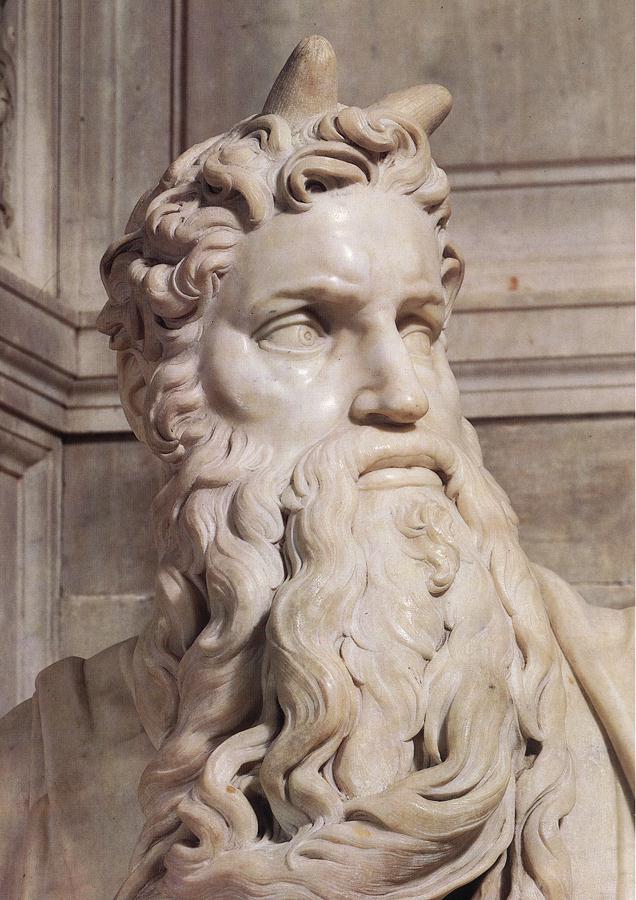
Ki Tissa 5774 – The Horns of Moses

In 1505, Pope Julius II commissioned the Renaissance artist Michelangelo to design and contruct his tomb in Rome.  In the course of his work, Michelangelo created one of the most famous statues in the world, known simply as the Moses.  Giorgio Vasari, a contemporary of Michelangelo, wrote a description of the statue:

Michelangelo's MosesMichelangelo finished the Moses in marble…, unequalled by any modern or ancient work. Seated in a serious attitude, he rests with one arm on the tables, and with the other holds his long glossy beard, the hairs, so difficult to render in sculpture, being so soft and downy that it seems as if the iron chisel must have become a brush. The beautiful face, like that of a saint and mighty prince, seems as one regards it to need the veil to cover it, so splendid and shining does it appear, and so well has the artist presented in the marble the divinity with which God had endowed that holy countenance. The draperies fall in graceful folds, the muscles of the arms and bones of the hands are of such beauty and perfection, as are the legs and knees, the feet being adorned with excellent shoes, that Moses may now be called the friend of God more than ever, since God has permitted his body to be prepared for the resurrection before the others by the hand of Michelangelo. The Jews still go every Saturday in troops to visit and adore it as a divine, not a human thing.  (Giorgio Vasari, Lives of the Artists Michelangelo Buonarotti of Florence, Painter, Sculptor and Architect)

Where did they come from?

This morning’s Torah portion, as it turns out.

After the disaster with the Golden Calf, God wants to wipe out the Israelites altogether and start over with a new nation descending from Moses.

Moses, in his role as God’s therapist, manages to talk God down and gets God to give the people a second chance.  Moses then descends the mountain to investigate the damage.  He breaks the tablets with the Ten Commandments on them, cleans house, and heads back up to the top of Mount Sinai to reestablish the relationship between God and Israel.

Moses is on a roll.  So he decides to strike while the iron is hot.  Now is the time to ask God the question that he has been saving for just the right moment:  “Show me Your glory.”

Moses wants to see God’s essence.  That, it turns out, is a bit too much even for someone like Moses to handle, so God agrees to shelter Moses in the cleft of a rock while the Divine Countenance is revealed.  Then, Moses will be able to catch a glimpse after God’s Presence has passed by.

Even that is pretty impressive.  When Moses comes down the mountain after forty days, everybody is excited for the reunion.  Moses has a shiny new set of Tablets, and the people are eager to have their leader back.  But as soon as they see him, the Israelites recoil in fear.

In his encounter with God, something has happened to Moses’ face.

The Torah describes it.  קָרַן עוֹר פָּנָיו (karan or panav) – Our Etz Hayim chumash translates it as “the skin of his face was radiant.” (Exodus 34:29) Robert Alter says, “the skin of his face glowed.”

In other words, Moses was radioactive.

But it is kind of a strange expression.  In fact, it is the only time in the entire Hebrew Bible that the verb karan appears.  The word means “to send out rays [of light]”

There are far more common words that would have conveyed the same image.  L’ha-ir, for example, is a common Hebrew word that means “to shine.”  Why didn’t the Torah use that word?  There must be something unique about this particular event that would explain the use of such a rare expression.

In the 4th century, Saint Jerome translated the Bible into Latin for the Catholic Church.  When he got to our word, he connected the verb karan to the noun keren, which is a common Hebrew word that means “horn.”  He translated it into the Latin cornuta, meaning “horns.”  The Latin translation would go something like this:  Moses had sprouted horns from the skin of his face.

It doesn’t really fit the context.  First of all, horns would grow from the head, not from the skin of the face, as the text describes.  Second, it makes a whole lot more sense that Moses would come away from his encounter with God reflecting some of the Divine fire that engulfed the mountain.

Jerome probably did not mean anything negative by attributing horns to Moses.  In the ancient world, horns were often associated with power.  The Babylonians and Egyptians had horned deities, and the Romans used horns to symbolize might, depicting horned statues of Jupiter.

The Septuagint, the Greek translation of the Bible, which Jerome certainly knew and understood, translated karan as “glorified.”  Jerome probably had something similar in mind.

But not everyone knew that.  It was in the 11th century that depictions of a horned Moses started appearing in Christian art.  The idea of Jews having horns also emerged around this time.  It was an especially pernicious accusation, possibly rooted in  a misunderstanding of Jerome’s translation.

In 1267, the Council of Vienna decreed that all Jews had to wear a special, pointed, horned hat.  Jews in other European communities over the following centuries were forced to wear other degrading symbols or items of clothing – often having something to do with horns.  (Joshua Trachtenberg, The Devil and the Jews, pp. 44-46.)

Why horns?

Horns were associated with the devil.  And so along with horns, Jews were also accused by medieveal European anti-Semites of having large, hooked noses, tails, goat-like beards, and cloven hooves.  It was a nasty rumor that persists to this day.  When my sister-in-law met her roommate upon first arriving at university, she asked her, in all sincerity, “where are your horns?”

What did Michelangelo mean by giving his Moses horns?  It’s hard to say.  There had been artistic renderings of Moses for hundereds of years, some with horns, and some without.  Some of those that depicted him with horns did so in a particularly evil light.

But there is no evidence that Michelangelo meant anything nasty by it in his Moses.  He was an artist, not a biblical scholar.  So he made Moses according to the words in his Bible: with horns coming out of his face.

But we still haven’t answered the question of why the Torah uses such an unusual word in Hebrew.  The Bible scholar Nahum Sarna suggests that the word karan “is probably a pointed allusion to the golden calf, for keren is the usual word for a horn.  It subtly emphasizes that the true mediator between God and Israel was not the fabricated, lifeless image of the horned animal, as the people thought, but the living Moses.” (Nahum Sarna, The JPS Torah Commentary: Exodus, p. 221.)

In other words, the Torah describes Moses’ glowing face with the word karan to emphasize that there can be no physical representations of God.  A horned calf made out of gold is a false god.  God cannot be encountered through an idol.  The Divine is not comprised of stone, wood, or precious metals, which are inanimate and lifeless.  God’s will is transmitted through human beings – through the Prophet Moses, and through the written and oral Torah that our tradition traces back to Moses’ intimate conversations with God.

After the people recoil from Moses’ glowing face, he gently urges them to come back.  “It’s ok.  It’s ok.  Everything will be fine.”

From then on, whenever he shares his conversations with God, the Israelites are illuminated by the Divine light reflecting off of Moses’ face.

And it is a conversation that continues to this day.  We have the records of Moses’ interactions with God, and the records of generation after generation of students and teachers trying to understand, apply, and extend those conversations to meet the evolving needs of contemporary life.  Whenever we engage in that conversation, we too are illuminated by the radiance that shone from the skin of Moses’ face.

Shut Up and Listen – Ki Tavo 5773

Ernesto Sirolli is an Italian aid worker. In a Ted talk, which is viewable online,*1* he tells the story of his first project in Africa, in the 1970’s. He was part of a group of Italians who decided to teach Zambian people how to grow food. So they went to Southern Zambia to a beautiful, fertile valley that led down into the Zambesi River, and they brought a bunch of Italian seeds, intending to teach the locals how to grow tomatoes and zucchini and so on.
The locals, of course, had absolutely no interest in doing that, so the Italians paid them to come and work. Sometimes they showed up. The Italians were amazed that, in such a fertile valley, there was no agriculture.
Instead of asking the Zambesi about it, the Italians said “Thank God we are here to save the Zambian people from starvation.”
Everything grew beautifully – better than in Italy, in fact. “Look how easy agriculture is,” they told the Zambians.
One night, when the tomatoes were big and ripe, two hundred hippos came up out of the river and ate every last vegetable that they had planted.
The Italians said to the Zambians: “My God! The hippos!”
And the Zambians said: “Yes. That’s why we have no agriculture here.”
“Why didn’t you tell us?”
“You never asked.”
Sometimes, it pays to listen.
It is the last day of Moses’ life, and he knows it. The Israelites are assembled before him in the Plains of Moab on the Eastern Side of the Jordan River. This is the next generation, the children of those who had left slavery in Egypt. They have all been born in the wilderness.
Now, they are poised to enter the land of Israel. Moses, knowing the end is near, has been giving a series of speeches to the people. He has reviewed the history of the Exodus. He has presented the laws, including those that will be applicable once they enter the Promised Land. And now, in this morning’s Parshah, he pronounces a series of blessings and curses which will befall them depending on how they uphold the terms of the covenant with God.
Moses turns to the people and says:
Hasket ush’ma yisrael
“Silence! Hear, O Israel!”*2*
This theme of listening has been a recurring one throughout the Book of Deuteronomy. Moses tells the people many to listen times. Our most famous prayer, the Shema, is from the Book of Deuteronomy. So it is not unusual that Moses tells the people to listen. What is unusual is that he tells them to shut up first. Hasket ush’ma. “Silence, and listen…” It is the only time in the entire Bible that the word hasket appears. When a word appears only once like this, scholars call it a hapax legomenon. As the medieval Rabbi and linguist Ibn Ezra comments, “its explanation is according to its context, for it has no parallels [in Scripture].”*3*
We are left with a question: If the idea of listening is so prevalent in Deuteronomy, why, on this single occasion, does Moses feel he needs to first tell the Israelites to be quiet? To answer that, let’s look at what he tells them to listen to this time:
hayom hazeh nih’yeta l’am ladonai elohekha
“Today you have become the people of the Lord your God.
Is this true? Is this day, at the end of the fortieth year of the Israelites’ wanderings, the day that they finally become God’s people? Didn’t that already happen a long time ago – at the time of the Exodus or at Mt. Sinai?
The great medieval commentator Rashi explains Moses’ instructions as follows: “You should consider every day as the day on which you entered into a covenant with [God].”*4*
Moses is not speaking just to the Israelites born in the wilderness. He speaks to all of us. He challenges all of us to treat “today” as the day on which we enter into a covenant with God.
Perhaps that explains why he tells the people to be quiet before he tells them to listen. Back at Sinai, they did not need to be told to shut up. There was a cacophonous sound and light show that overwhelmed the senses – earthquakes, thunder, lightning, fire, smoke, the sound of the shofar. Believe me, they were paying attention.
Forty years later, in Deuteronomy, there is no miraculous revelation by God. There are only words. In order to listen, to really listen, to what Moses is saying, the people must first stop talking. Only then can they, and we, open ourselves up to Torah and become the people of God.
“Shut up and listen!” he says. If we want to be a people of God, we have to stop making noise. We have to stop projecting ourselves and our egos out into the world.
In a world that is full of the noise of our own making, this is an important reminder. We tend to spend a lot more time talking than listening. When we do that, when we shut ourselves off from what the other has to say, we put up barriers. It is impossible to be in a relationship with someone to whom we do not listen.
I did a search online on the expression “Shut Up and Listen.” There were articles that advocated this approach for salespeople. We can be much more effective when we pause to listen to the customer say what the customer actually wants instead of telling the customer what he or she wants. Makes sense.
A self help column spoke about the importance of listening to criticism from other people. Rather than arguing back, it advocated simply saying “thank you,” and trying to really understand the critique. That is an important strategy that can help us learn about ourselves. Also makes sense.
And I found the story of the Italian aid worker in Zambia that I told earlier. The reason that more than one trillion dollars of Western aid money in Africa has done far more harm than good over the past fifty years is that most well-intentioned do-gooders don’t stop to ask people what they actually need. They would do well to shut up and listen.
While all of this may be true, that being quiet and listening may help us improve our sales numbers, or better ourselves, or help impoverished societies, Moses is getting at something deeper. He teaches us that the secret of being in an authentic relationship with another, whether it is a relationship with another human being, or a relationship with God, lies in our ability to shut up and listen.
Silence is more than just the absence of words. To be silent, we have to let go of our defense mechanisms. We have to stop acting as if “the world was created for me” and start acting like “I am but dust and ashes.” When we force down our ego, we create an open space that can be filled by another.
To be in a true relationship is to be in a covenantal relationship, which carries obligations.
The French Jewish philosopher Emanuel Levinas said that we encounter God when we truly look into another person’s face. Our self falls away and there is only the commanding Presence of the Other. Being in authentic relationship with another person is wrapped up with being in authentic relationship with God.
While there are many aspects of silence, it does come down to words. Words are our primary tools for projecting ourselves into the world. What if we only had a limited number of words that we could use each day?
The American poet Jeffrey McDaniel ponders this in his poem, The Quiet World.*5*

In an effort to get people to look
into each other’s eyes more,
and also to appease the mutes,
the government has decided
to allot each person exactly one hundred
and sixty-seven words, per day.

When the phone rings, I put it to my ear
without saying hello. In the restaurant
I point at chicken noodle soup.
I am adjusting well to the new way.

Late at night, I call my long distance lover,
proudly say I only used fifty-nine today.
I saved the rest for you.

When she doesn’t respond,
I know she’s used up all her words,
so I slowly whisper I love you
thirty-two and a third times.
After that, we just sit on the line
and listen to each other breathe.

Just imagine what it would be like.

*1*http://www.ted.com/talks/ernesto_sirolli_want_to_help_someone_shut_up_and_listen.html
*2*Deuteronomy 27:9
*3*Ibn Ezra on Deut. 27:9
*4*Rashi on Deut. 27:9
*5*Listen to author read the poem at: https://myspace.com/jeffreymcdaniel/music/album/the-forgiveness-parade-5886367

Inclusivity and Pesach Sheni: Be-Ha’alotekha 5773

Judaism is a religion of memory. All of our holidays, including Shabbat, have a central component that orients us back to some past event – whether the Creation of the World, the Exodus from Egypt, the wandering in the wilderness, the saving of our people in ancient Persia, the victory of the Maccabees and subsequent rededication of the Temple, the destruction of the Temples… and the list goes on. When we observe these holidays, we don’t just remember what happened once, a long time ago. It is always a reenactment. We continually re-experience the formative events of our predecessors. The ancient stories of our people become renewed through us.

This has two complimentary effects. The first effect is a (lower case “c”) conservative one. Our observance of Jewish holidays roots us in the history of our people. We perform the same traditions that our forebears have performed since ancient times. This establishes and strengthens our connection not just to the actual people who were redeemed from slavery in Egypt, but to every generation since that has remembered and re-enacted the Exodus since.

Alongside the conservatism implicit in an ancient tradition, we also innovate. In every generation, every single year, in fact, we have to be creative to make ancient traditions relevant to our lives today. That is why our holidays have layers of observance and meaning that have expanded over the centuries, and continue to expand today.

We see this conservatism and innovation expressed in the Torah from the very beginning. This morning’s parshah is set in the second year after the Israelites have left Egypt. On the fourteenth day of the first month, what we call the month of Nisan, the Israelites observe Passover. And what is remarkable is that only one year after the Exodus itself, they are already performing the ritual of remembrance. They are already making the transition into a people of memory.

But there are some folks, even then, who are left out of that first Passover after the Exodus. They had been in a state of ritual impurity, and the Torah says that in order to offer the Passover sacrifice, a person must be in a pure state. When everyone else is eating roast lamb with matzah and bitter herbs, they have to just watch.

This group of people is eager to celebrate Passover, and they are not content to sit on the sidelines. So they turn to Moses: “Yeah we’re impure, but why do we have to be left out?”

Moses does not have an answer for them, so he tells them: “Stand by, I’m going to ask God,” which he promptly does.

And God issues the ruling: “Anybody who can’t present the Passover offering because he is ritually impure or on a long journey should offer it exactly one month later, on the fourteenth day of the second month. But don’t think this is a free pass. A person who could have offered it at the right time but didn’t… is guilty.”

This has come to be known as Pesach Sheni – “Second Passover.” It is a rather unusual law in the Torah. Most of the Torah’s mitzvot are just given. This is one of only a handful of laws that comes as the result of a particular case.

One other example in particular, shares some similarities. Towards the end of the Book of Numbers, the five daughters of the deceased Zelophehad come to Moses. As in this morning’s case, the existing law leaves them out. The sisters point out that because only sons can inherit, their father’s land will be lost to their family. So they make the case that their father’s land should pass to them.

Again, Moses does not have an answer, so he turns to God. God affirms the sisters’ claim, and the law changes to allow daughters to inherit from their father when there is no male descendent.

Both stories, Pesach Sheni, and the daughters of Zelophehad, feature groups of people who are left out of the normative social structures. In the first, it’s a group of impure people who really want to celebrate Passover. In the second, it is women, who are ignored by the law.

They both make their case to the leader, Moses, who doesn’t know what to do. He understands what the law says, but he also knows that there are human beings in front of him. He turns to God. In both cases, God recognizes that the point is valid. These groups have been marginalized, left out, and so God changes the law to be more inclusive.

That these cases are codified in sacred scripture should tell us something. The Torah could have just presented the ruling. But it didn’t. It wanted us to know about the real, human situations behind the law. It wanted us to be aware that the rules of society in those particular times was excluding people.

It illustrates the tension between conservatism and innovation. Moses was lucky. He could just say: “Hold on a minute. Let me go ask God.” It’s not so easy for us. We are the ones who must negotiate often competing values. With an ancient tradition that is rooted in sacred scripture, but that also values inclusivity, how do we account for change?

This has been a constant tension in Judaism. To what extent do we preserve Jewish law and tradition as we have received it, on the one hand? And on the other hand, how much can we innovate to respond to new situations, new technologies, and new understandings of human experience.

This tension, between conservatism and innovation, is an identifying feature of Conservative Judaism: a movement that affirms halakhah, our commitment as individuals and communities to Jewish law; and a movement that also embraces the best of what modernity has to offer.

As for issues around inclusivity, this has meant that the Conservative movement has moved slower than some elements in the Jewish world, and faster than others.

Over the last century, the Conservative movement has embraced women’s equal involvement in religious life, it actively embraces Jews by choice, it has recently made greater efforts to reach out to intermarried families, and over the last decade has created new laws and traditions to welcome gay and lesbian Jews into mainstream Jewish life.

As in any established movement, the pace of change is slower than some would like, and faster than others would prefer.

But the overall direction in which we are moving is clear. We have made great strides in making our communities more welcoming to people who have been historically marginalized, whether due to gender, sexual orientation, wealth, ethnicity, etc. aBut we still have a long way to go to remove the walls that keep out those who would find a home in Jewish community.

I have learned that in many cases it is not enough to just say: “We are a friendly community. Everyone is welcome.”

At Sinai, we pride ourselves in being a fairly traditional, friendly, and heymish community – and that is by and large true for anyone who is courageous enough to walk through our doors. But with limited resources, we don’t do a whole lot to reach out beyond the walls of our synagogue.

It is one thing to say, “anyone who wants to join us is welcome.” It is something else to go out of our way to personally extend the invitation.

Our Torah, and our Jewish tradition, points us in the direction of inclusion. What can each of us do to make our community even more inclusive than it already is?

Terumah 5773 – Our Life Can Be The Spelling Of An Answer

In Parshat Terumah, God begins to give Moses the detailed blueprints for the mishkan, the Tabernacle, or portable sanctuary that the Israelites will build and carry with them in the wilderness. The section is introduced by a fundraising appeal, identifying all of the precious stones, metals, fabrics and other materials that will be used. Then, we read the famous line v’asu li mikdash v’shakhanti b’tokham. “Make for Me a sanctuary that I might dwell amongst them.”*1*

And then, a final instruction before the details:

“Exactly as I show you – the pattern of the Tabernacle and the pattern of all its furnishings – so shall you make it.”*2* v’khen ta’asu.

The commentator Rashi asks a question. Why, immediately after telling Moses “Make Me a sanctuary…” does God declare “…so shall you make it”?

The Torah is usually so conservative with words. Doesn’t this seem redundant?

To answer the question, Rashi cites the Talmud. It is not redundant, after all. In fact, it is a separate commandment, l’dorot, he explains, “for the generations.” If, God forbid, one of the numerous vessels or holy items that the Israelites are about to build becomes damaged or lost at some point in the future, these blueprints here in the Book of Exodus must be followed precisely, and in exactly the right sequence, when building the replacement.

The Chassidic master Rabbi Simchah Bunim takes this explanation in a different direction.  He applies the idea of following a process systematically, in the right order, to us today, even though we do not have a Tabernacle.

In every generation, when Jews set out to do holy work, we must do it systematically, recognizing that spiritual growth happens mi-madrega l’madrega, from one step to the next. There is no elevator. We can’t skip steps in the spiritual journey.

Even though Reb Bunim lived in early 19th century Poland, his comment is especially applicable today.

We live in a an increasingly impatient era. Things that used to take a long time now happen in an instant.

Until the invention of the telegraph, for example, if a person wanted to communicate with someone far away, he or she would have to hand write a letter and physically send it with another person. It could take months for a message to reach its recipient. Now, communication is instantaneous.

Until just the last two decades, if I wanted to learn something about an obscure topic, I had to go to the library and actually open books. Now, in the era of Google and Wikipedia, I have instant results in my pocket.

If I want to buy something, I don’t even have to go to the store any more. I can order a case of my favorite cereal at 3 o’clock in the morning.

Instant gratification certainly has its benefits. But I fear that we have also become a less patient society. Things are expected immediately, whether we are talking about work deadlines, a new purchase, or research.

But when it comes to serving God, patience is a virtue. Reb Bunim’s teaching reminds us that there is no such thing as instant gratification in the religious life. Rather, progress is slow as in the metaphor he uses of ascending one step after the next, in order. No skipping.

Despite the impatience of modern life, we still understand that reaching goals takes a lot of systematic effort.

If you want to become a good cook, you can’t just open a cookbook and create a gourmet meal. Learning to handle a knife, understanding how different flavors complement one another, and mastering sauces only comes through experience, and many failed attempts.

The same is true of learning to play a musical instrument. Nobody is going to pick up an instrument for the first time and be able to play the song in his mind that inspired him to pick it up in the first place.

What about starting an exercise regimen? Whether the goal is to lose weight, or increase strength and endurance, it is going to take serious commitment. It will take regular workouts, and lots of time.

Whenever we start something new, there will always be a gap between our goals and what it will take to reach them. Progress requires us to go in a certain order. It is impossible to master more difficult techniques before mastering the basics.

And so, we know and accept that anything worth mastering requires a serious commitment. So why would we expect this to be any different when it comes to religion?

Think back to Reb Bunim’s staircase. To get up to the next step requires a large expenditure of energy. Then, we plateau for a while. That is what happens for someone trying to master a skill, and it can also be true in the spiritual life. There are times when we don’t feel connected. When performing mitzvot does not feel like serving God. This can be discouraging. In an age of so much impatience, we are tempted to look for shortcuts.

I worry that organized religion today has succumbed to the era of instant gratification. We plan shul activities as if they are stand-alone events. When planning anything for the synagogue, I am always asking myself, “what is going to attract somebody to this program.” We have to think about marketing and advertising to attract people to religion. Shuls nowadays need to have slick websites, and Facebook pages. We have to be able to get our vision and mission out there, so that the general public will get what we are all about in five seconds or less.

The pressure is on for our religious services to be spiritually moving for everyone who walks through the door.

But spirituality is not something that we consume in single servings. Our innate human curiosity about what is out there, and where we come from, and what the purpose of our lives is, is not going to be answered in one program.

We are all spiritual beings. But to be engaged in these questions requires a lifelong commitment. It is like learning to master an instrument. The more we play, the more music we can create. And the more complicated the music we create, the more variables come into being.

Journeying down the spiritual path will only lead us to more questions. But they are precisely the questions that make our lives matter.

In Man is Not Alone, Rabbi Abraham Joshua Heschel writes “our life can be the spelling of an answer.”*3*  So we should not be discouraged. Whatever step each of us finds ourselves on, we can strive to reach the next step.

For someone, that may be learning how to read Hebrew to keep up in the service. For someone else, the next step might be taking some time to meditate on the meaning of certain prayers.  In other aspects of Jewish life, it might mean trying to increase the amount of charity that a person gives. Or it could mean finding opportunities to volunteer.  Maybe the step for someone is starting to introduce kashrut into his or her life. Maybe for someone else it is trying to cut back on gossip.

Notice that some of the examples I gave were in the ritual sphere, and some were more in the ethical sphere. Being on a spiritual journey requires us to recognize that everything we do has to do with God.

When the Israelites received the instructions to build the Tabernacle, they were given something special. It was not only at Mount Sinai that our ancestors could experience something spiritual. They were invited to be engaged with God wherever they went, at every moment.

And here we are thousands of years later, also invited to be engaged with the questions that matter, and to strive to have the patience to take the next step up the staircase.

*1*Exodus 25:8

*2*Exodus 25:9

*3*Abraham Joshua Heschel, Man Is Not Alone, p. 78.