Be An Organ Donor – Terumah 5776

This past Tuesday, I was on the panel for a program sponsored by our local Maimonides and Cardozo Societies – made up of Jewish physicians and lawyers, respectively.  I was the “Jewish Expert” on the panel.  The subject was based on a book written a few years ago called Larry’s Kidney: Being the True Story of How I Found Myself in China with My Black Sheep Cousin and His Mail-Order Bride, Skirting the Law to Get Him a Transplant–and Save His Life, by Daniel Asa Rose.  The author spoke for the first half of the program, so I was only able to touch the surface of the topic from a Jewish perspective.  It is a vitally important topic of life-and-death, and there are many misconceptions, so I would like to spend time this morning going into more depth.

In the United States, an average of 79 people receive an organ transplant every day.  Sounds good, right?  Also, on average, 22 people die every day waiting for a transplant.  That is more than 8,000 people per year whose lives could have potentially been saved if more organs had been available.  If more people in this country were registered organ donors, many more lives could be saved.

There are numerous complicated issues, both ethical and medical, when it comes to organ donation.  Let me try to summarize a few of them.

We can divide organ donation into four categories.  The first is live organ donations for which there is minimal risk to the donor.  Examples include blood, bone marrow, skin, and even kidney donations.  The second category is live organ donations for which there is risk to the donor.  Examples include liver lobe and lung lobe donations.  The third category is cadaver donations in which the organs can be harvested after the donor’s heart stops beating.  An example is a cornea.  The final category is a cadaver donation for which the cardiovascular system has to be kept working by artificial means until shortly before the organs are removed.  This is the case for heart, lung, and pancreas donations.

For each of these categories, the ethical and medical considerations are different.  How much risk is tolerable?  What is the definition of death?  At what point after the withdrawal of life support can organs be harvested?  What factors should be considered when determining which of multiple candidates should receive an organ?  Can live donors be paid for their donations?  Each of these questions is extremely complicated.  There is a vast body of writing from the perspective of medical and religious ethics that deals with every one of these issues.

Until fairly recently, Israel had an organ donation rate that was far below other developed countries.  Because there were so few Israelis willing to donate their own or their loved ones’ organs, “transplant tourism” became very popular.  Organ brokers would advertise their services on the radio and in newspapers.  Not only were there not any laws prohibiting Israelis from going abroad for organ transplants, but the national health insurance would even reimburse patients for their expenses.  So Israelis would travel to China, Brazil, and other countries to receive life-saving organ transplants.

Is there anything wrong with this?

The problem is that in many countries, there is little regulation and no transparency.  China, for example, has become a major center for organ transplants over the past twenty years, advertising their services to wealthy patients around the world.  Where do the organs come from?  China does not maintain a national organ donor database – so nobody really knows.

Over the years, there have been numerous allegations and investigations claiming that Chinese prisoners are being executed for their organs – and not just those imprisoned for violent crimes.  Also included are political prisoners, as well as tens of thousands of member of the Falun Gong religious sect.  With the vast amounts of money to be made, and the lack of oversight and transparency, it is no wonder that Chinese politicians, judges, and medical workers  up and down the system allow this to happen.

From the perspective of Judaism, this is absolutely wrong and immoral.  While I do not have to sacrifice myself to save another person, and I am permitted to protect myself if I am being attacked, under no circumstances can I kill another person to save my own life.

Which is why it is such a chilul hashem – a desecration of God’s name – that there have been numerous cases of Jews convicted for organ trafficking, in Israel and in the United States.  One of the factors contributing to this embarrassment is the low organ donor rate in Israel.

Why are so few Israelis willing to be organ donors?

There are several assumptions that people make about Jewish law.  First of all, we know that the body is considered to be sacred in Judaism.  When a person passes away, we treat the body with the utmost respect, cleaning and dressing it quickly, and returning it to the ground from which it came.  Autopsies are generally prohibited, as well as embalming.  The proper care of a body before burial is considered to be one of the greatest mitzvot that we can perform.

The removal of organs before burial, therefore, would seem to be a violation of Jewish law and custom.  Another complicating factor is the traditional belief in a future resurrection in the days of the Messiah.  If a person is buried without all of his or her organs, will he or she be resurrected whole in body?

Because of these beliefs, many Jews have been reluctant to register themselves or agree to donate their loved ones’ organs.  That is why the organ donor rates are so low in Israel.

But there is a competing principle which most halakhic authorities across denominations consider to be even more significant.  Pikuach nefesh, the saving of a life, is such an important value that it trumps even the special sanctity of the body.

The Torah states, lo ta’amod al dam re’echa.  Do not stand idly by the blood of your neighbor.  This means that if we have the ability to save the life of another person, we have an obligation to do so.  Halakhic codes stretch this concept to require us to spend our money, or even endure personal discomfort, to save the life of another person.

While organ donation was not a possibility at the time these laws developed, the principle is relevant.  So rather than ask “are Jews permitted to donate their organs?” the question really ought to be “Are there ever circumstances in which a Jew is not required to donate his or her organs?”

While some modern poskim, including Orthodox ones, today use the term mitzvah to refer to organ donation, it seems clear that they mean it not as an obligation, but rather as a midat chasidut, a particular pious act that is lifnim mishurat hadin – beyond the strict letter of the law.

So what can be done to increase organ donor rates and save more lives?

In the United States, we have an opt-in system.  Most states, including California, have recruited the DMV to register donors.  If you have a license you are probably familiar with this.  When you go to get your license, the DMV clerk asks you if you want to be an organ donor.  To be registered, you have to say yes.  An opt-out system automatically assumes that everyone is an organ donor except for those who explicitly state that they do not want to be.  Some countries have been successful with this.

While an opt-out system might seem to many Americans like a gross invasion of personal autonomy, it is defensible and maybe even preferable from a Jewish perspective.

In Judaism, there is a concept that I can perform an act or make a decision on behalf of another person without his or her knowledge, and potentially even against his or her will, if it causes that person benefit.  Some authorities apply that concept to organ donation.  Let’s say that my loved one is in a coma and is determined by doctors to be brain dead.  When I agree to donate the organs, my loved one gains the benefit of saving a life.

So a Jewish argument could definitely be made in favor of an opt-out organ donor system.

Another possibility is the solution that Israel enacted in 2008.  It made it illegal to travel abroad for an organ transplant, or to engage in organ trafficking.  It defined death as “brain death,” clarifying the circumstances under which cadaver donations can take place.  And it created an incentive system to encourage more donors.  Donors now receive reimbursement for all medical expenses related to the donation, as well as for lost work.  Live donors also receive preference if at some later time they find themselves in need of an organ.  In addition, if two people on a transplant waiting list are at the same tier of eligibility, the one who has been a registered organ donor will receive preference.  Finally, the immediate family members of a deceased person whose organs were donated will also receive preference.

The law is controversial, as it introduces non-medical factors for determining eligibility.  But it has caused organ donor rates to increase in Israel.

This morning’s Torah portion, parashat Terumah, offers us a fitting model for how we might understand organ donation.  In the opening statment, God instructs Moses:

 דַּבֵּר אֶל־בְּנֵי יִשְׂרָאֵל וְיִקְחוּ־לִי תְּרוּמָה מֵאֵת כָּל־אִישׁ אֲשֶׁר יִדְּבֶנּוּ לִבּוֹ תִּקְחוּ אֶת־תְּרוּמָתִי.

Tell the Israelite people to bring Me gifts; you shall accept gifts for Me from every person whose heart so moves him.  (Exodus 25:2)

The Hebrew word for donation is terumah.  The Israelites are being instructed to bring their donations for the construction of the mishkan, the Tabernacle.  Rashi asks, why does God specify v’yikchu li terumah.  “Take for me a donation?”  After all, God certainly does not have any physical needs.  Rashi answers with the word lishmi – for my sake.  In other words, these are to be purely selfless, altruistic donations.  There should be no personal motive.

But a passage in the Talmud states the opposite:  “If a person declares ‘this coin is for tzedakah so that my child should live, or so that I can earn a place in the world to come’ – such a person is a tzadik gamur – a totally righteous individual.”  (BT Rosh Hashanah 4a)  Commenting on this, Rashi explains im ragil b’kach – if the person is in the habit of giving tzedakah regularly.

So which is it, Rashi?  Are we supposed to give altruistically, without hope of personal benefit, or is a donor just as righteous if or she receives some advantage?

Is it the American system, which relies solely on altruistic donations, or the new Israeli system, which seeks to create positive incentives that cannot be harmfully manipulated?

Maybe the point is that it doesn’t matter.  Whatever the motivation, the end result of more organ donors is that more lives will be saved.  So if you are not already a registered organ donor, get on the list.  If, God forbid, we should ever find ourselves in the situation of having to make a decision about our own or a love one’s organs, let us please remember that Judaism has something to say about it.

And in so doing, in making the ultimate gift of saving the life of a human being made in God’s image, the terumah can surely be said to be lishmi, for God’s sake.

Theodor Herzl’s Menorah – Chanukah 5776

If you ask most Jewish kids in America what their favorite holiday is, they’ll say Chanukah.  From a religious standpoint, it is not really that important of a holiday.  In Israel, Chanukah is really not that big of a deal, certainly when compared to the other Jewish holidays.  It got to be this way here in America because of its proximity to a certain other non-Jewish holiday.  “The Jewish Christmas” and all that.

At least, that is the typical complaint made by Rabbis lamenting the over-commercialization of Chanukah.

But maybe this is not such a uniquely American experience.

I came across a story written over one hundred years ago at a transitional moment in Jewish history.  A story that is as relevant  today as it was then.

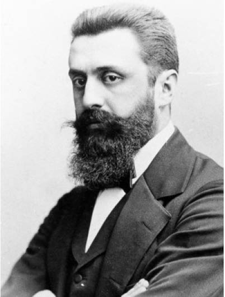
HerzlTheodor Herzl, who would later become the father of modern Zioinism, is a secular Jewish journalist from Austria.  He is putting the finishing touches on his book Der Judenstaat – The Jewish State, earning him some notoriety.  He has developed a relationship with the Chief Rabbi of Vienna, Moritz Gudemann, who has become a good friend and advisor.  One day Rabbi Gudemann comes to Herzl’s home to discuss the forthcoming publication.  Rabbi Gudemann is shocked by what he finds.  Later that day, Herzl writes about it in his journal.  It is December 24, 1895.

I was just lighting the Christmas tree for my children when Gudemann arrived. He seemed upset by the “Christian” custom. Well, I will not let myself be pressured!  But I don’t mind if they call it the Hannukah tree–or the winter solstice.

Two years later, Herzl is living in Paris and reporting on the Dreyfus Affair.  The rampant antisemitism shakes him to his core and leads him to abandon his earlier assimilationist positions.  Herzl concludes that the only solution for the Jewish people is to have a homeland of their own, along with a re-embracing of Judaism.  With this realization, Herzl convenes the First Zionist Congress, and modern Zionism is born.

In December 1897, Herzl writes a short story entitled “The Menorah” which appears in the journal Die Welt, a weekly newspaper that he has recently begun publishing to promote Zionism.  The following is a paraphrased summary of Herzl’s story, utilizing some of his language.  (The full text of the story can be read here.)

Deep in his soul, he began to feel the need to be a Jew.  His circumstances were not unsatisfactory; he enjoyed ample income and a profession that permitted him to do whatever his heart desired.  For he was an artist.

Of course, Herzl is writing about himself.  He goes on to describe a thoroughly assimilated European Jew of the late nineteenth century.  When antisemitism rears its head, this enlightened Jew assumes that it will fade just as quickly.  But it does not, and his soul begins to wear down.

He begins to think of his Judaism.  Despite its alienness, he begins to love it intensely.  Gradually, his yearning crystalizes into a conviction that he must return to Judaism.  His closest friends think he is crazy, ridiculing him behind his back and even laughing in his face.  But he is indifferent to their sneers.

As an artist of the modern school and a man of the senses, he has embraced many non-Jewish habits and ideas.  How can he reconcile this modernity with his return to Judaism?  Doubt plagues him.  Perhaps it is too late for his generation, which has become so heavily influenced by alien cultures.  But the next generation, if it is trained in the proper path, will be able to make the return.

Until then, the artist has allowed the holiday of the Maccabees to pass by unobserved.  Now, however, he makes this holiday an opportunity to prepare something beautiful which should be forever commemorated in the minds of his children.

… He buys a Menorah, and when he holds the nine-branched candlestick in his hands for the first time, a strange mood overcomes him.  He grows nostalgic and sad when he recalls the memory of burning lights in his father’s house.

But the tradition is neither cold nor dead, he realizes.  It has passed through the ages, one light kindling another.

The artist begins to think about where the shape of the Menorah came from.  He sees in it the form of a tree: branches emerging from a central trunk to the right and the left, all ending at the same height.  Then the ninth branch projects to the front to play the role of shamash, servant to the others.

What mysterious meanings have previous generations passed down to the next about this simple, natural shape.  He imagines that he might be able to water this withered tree and restore it to life.  He joyfully recites its name to his children – Menorah – and delights in hearing it repeated back to him out of their mouths.

He lights the candle on the first night and tells his children what little he knows about the origin of the holiday.  The wonderful incident of the lights that strangely remained burning so long, the story of the return from the Babylonian exile, the second Temple, the Maccabees – our friend tells his children all that he knows.  It is not very much, to be sure, but it serves.

The next night, with the second candle, the artist’s children repeat back to him the stories that he had told them the night before.  Even though the stories are the same, they seem to him to be new and beautiful.

Each subsequent night is brighter than the previous.  The artist muses on the little candles with his children until the profundity becomes too deep for him to share.

When he first resolved to return to his people, he thought simply that he was doing an honorable and rational thing.  He never dreamed that he would find something that satisfied his yearning for beauty.  Yet that is what he found.

After the holiday, he sketches out a plan for a new Menorah to present to his children the following year.  The artist is searching for living beauty, so he does not limit himself to the strict traditional form of the Menorah.  Yet his design still takes form as a tree with slender branches.

The following year, he lights the Menorah with his children, the light increasing.  On the eighth night, a great splendor streams from the Menorah.  The children’s eyes glisten.  For our friend, all this is the symbol of the kindling of a nation.  When there is but one light, all is still dark, and the solitary light looks melancholy.  Soon, it finds one companion, then another, and another.  The darkness must retreat.

The light comes first to the young and the poor – then others join them who love Justice, Truth, Liberty, Progress, Humanity, and Beauty.

When all the candles burn, then we must all stand and rejoice over the achievements.  And no office can be more blessed than that of a Servant – a shamash – of the Light.

What a change!  In just two years, Herzl is transformed from a father casually lighting up a Christmas tree for his children to a Jew finding profound beauty and meaning in the kindling of the Menorah.  Such a tremendous inspiration.  What a legacy he has left us!

Chag Urim Sameach.  Happy Festival of Lights.

Migrations – Lekh L’kha 5776

Lekh L’kha  Go forth!  Parashat Lekh Lekha is a parashah of migrations.  From beginning to end, its characters leave behind their past and set out for the unknown.  They are driven to do so by the same causes that lead people today to become immigrants: religion, culture, economic opportunity, famine, war, and persecution.

The story actually begins at the end of last week’s parashah, when we first encounter Avram.  (He has not yet had his name changed to Avraham).  His family hails from a place called Ur Kasdim.  We are not exactly sure where it is.  It is either the major city of Ur which is located in Southern Iraq on the coast of the Persian Gulf, or it is a smaller town in Upper Mesopotamia.

Avram’s father, Terach, moves the entire household – including Avram, his two brothers, and their respective households – intending to eventually settle in the Land of Canaan.  For some reason, they stop in a place called Haran.

Haran was a major station along the caravan route between Mesopotamia and the Mediterranean Sea.  It is located about ten miles North of the present border between Syria and Turkey.  The Torah does not tell us what prompted Terach to move the family from Ur Kasdim, nor do we know why they interrupt their migration in Haran.  We do know that the rest of Avram’s family remains in Haran.  Only he completes the journey that his father had begun.

This morning’s parashah begins with God’s revelation to seventy five year old Avram.  Lekh L’kha – “Go forth from your native land and from your father’s house to the land that I will show you.”  God has big plans for Avram.

Avram responds with alacrity, setting out with his wife Sarai, his nephew Lot, all of their possessions, and a rather large but unnamed retinue of followers that they managed to acquire while in Haran.  It is not a short journey, and Avram does not stop when he reaches the border.  Rather, he continues his migration until he arrives in Shechem (known today as Nablus).  This is the physical center of the land that God has promised his descendants as an inheritance.

Soon after arriving in Shechem and building an altar to God, Avram continues moving south for another 20 miles, pitching his tent in the hill country east of Beit El, where he builds another altar.  He then continues south by stages until he reaches the Negev, probably near Beer-Sheva.  By now, Avram has traversed the entire length of the Promised Land, from North to South.

How might we describe this migration?  What is Avram abandoning, and what is he hoping to find when he reaches his destination?  The Torah’s emphasis on leaving behind his native land and his father’s house suggests that there is something culturally or morally unsavory about his birthplace.  Although we know nothing about Avram’s first seventy five years of life in Haran, many midrashim fill in the gaps.  Legends abound describing Terach’s idolatry, the deviousness of the local King Nimrod, and the rampant idolatry of Babylonian culture.

Remaining in Haran will subject Avram and his progeny to bad influences which will prevent the realization of God’s blessing that his descendants will become a great nation.  To fulfill his destiny, Avram needs to make a clean break with his culture of origin.

We might describe this move as a religious migration.  But perhaps it also might be akin to moving to a better neighborhood, where Avram’s family will have access to higher quality schools, less crime, and a more cohesive communal environment.

It does not take long for a new situation to arise which will force Avram to pack up his tent and move his household once again.  The land is struck by a famine.  Israel is dependent on seasonal rains.  Several years of poor rainfall, therefore, are disastrous and result in famine.  In contrast, Egypt receives its water from the annual flooding of the Nile River, which is a much more reliable source.  While the text only mentions Avram, it is safe to assume that his household is just one of a deluge of refugees fleeing south to Egypt for food.

The typical experience of refugees is not a pleasant one.  They usually find discrimination in their host countries.  If refugees end up settling permanently in their new countries, it often takes several generations before full assimilation and acceptance is reached.

Avram somehow defies the usual pattern and acquires great wealth during his time in Egypt. In 1848, a Potato Famine prompted the massive immigration of nearly one million Irish to the United States.  In the mid 1980’s a massive famine and war in Ethiopia caused the deaths of over one million people.  Six hundred thousand fled Ethiopia for Sudan, where they remained in refugee camps for several years before finally returning home.

One of the factors in the current Syrian refugee crisis is a famine that has been exacerbated, or even perhaps caused by war.

When the famine ends, Avram returns with his family to his former home east of Beit El.  There, his situation seems to stabilize for a short time.  At this point, Avram has huge flocks.  His nephew Lot has also managed to become wealthy.  Both of them send their herds out into the surrounding fields each day.  Soon, their respective shepherds are quarreling with one another over access to grazing land.

Avram recognizes that the status quo cannot continue, so he offers his nephew a choice.  “This is a fertile land, with plenty of room for both of us.  We just can’t stay here in the same place.  Pick where you want to go,” he says.  “If you go right, I’ll go left.  If you go left, I’ll go right.”  Lot chooses to settle in Sodom, where he has access to the lush Jordan River plain.  Avram stays put.

This migration is not the result of a crisis.  Quite the opposite.  Avram and Lot have become too wealthy, and they need to expand their markets.  Lot moves so that he can have access to better economic opportunities.

God appears once again to Avram, reiterating the blessing.  Afterwards, Avram moves his tent to the terebinths of Mamre, near Hebron.  Again, the Torah does not give us a specific reason for Avram’s move, but like his original journey into the Land of Canaan, it seems to be a religious migration.

Lot, meanwhile, gets caught up in a war when the cities of the Jordan Valley, including Sodom, rebel against their vassal overlords to the east.  The rebel cities are defeated and the conquering armies plunder them and take their residents as spoils of war.  When Avram hears that Lot has been taken captive, he assembles a small army and launches a rescue mission.  His risky venture takes him all the way to Dan, which is located at the far northern point of the Land of Israel, on the slopes of Mount Hermon.  He then goes on a night raid to a location north of Damascus.

The mission is successful, and Avram manages to defeat the enemy armies and rescue his nephew, along with all of the other prisoners who have been forcibly removed from their homes.

We see in this story another kind of migration – one prompted by war.  In this case, residents are taken and enslaved by their conquerors.  As we are seeing vividly right now with the millions of Syrian refugees, people tend to flee from war-torn areas.

The final migration occurs towards the end of the parashahSarai is unable to get pregnant, and so she gives her handmaiden Hagar to Avram to bear a child in her name.  When Hagar gets pregnant, tensions rise in the household, and Sarai begins to treat Hagar harshly.  We don’t know how bad the mistreatment was, but it was enough to cause Hagar to flee.  She heads south, embarking on the Road to Shur, which leads eventually to Egypt.  Along the way, an angel of God appears to Hagar and reassures her that God will bless her son.  In the meantime, she should go back to Sarai and “submit to her harsh treatment.”

This is not an optimistic text, but it illustrates another cause of migration: persecution.  How many millions of Americans came to this country fleeing religious persecution?!  It is what brought the original Pilgrims.  The rise of modern Zionism came about when Theodore Herzl and the other early leaders realized that the persecution of the Jewish people in the Diaspora was not going to go away.  The Jewish people needed a homeland where Jews could immigrate.  Sadly, Herzl’s prediction that the reestablishment of Jewish autonomy in the land of Israel would eliminate antisemitism in the Diaspora has proved to be incorrect, and Jews continue to immigrate to Israel because of persecution.

The reasons that compel a person to leave his or her home and move to a strange new place have not changed in four thousand years.  We immigrate because we want better lives for ourselves and our families.  We want to provide our children with safer environments in which to learn and play.  We move to find better economic opportunities.  Sometimes, we flee dangerous situations like war and famine.  And we leave places in which we face discrimination in favor of communities that will accept us as we are.

All of these factors lead the characters in Parashat Lekh L’kha to become immigrants, just as they lead people in our world today to seek better lives in new lands.

While the reasons to immigrate may be the same, in our world, some of the barriers have changed.

Globalization and technology have made it much easier to travel from one place to another.  A journey that once might have taken an entire year can be accomplished in less than a day.  Images of drowned children vividly demonstrate how dangerous the world can be for someone who is fleeing their homeland in desperation.

While antagonism towards immigrants is certainly still with us, multicultural attitudes in many countries in the world allow for an easier welcome and integration than in earlier centuries.

And yet, legal bureaucracies and quotas place significant obstacles before immigrants.  I doubt Avram was asked to produce his passport and visa when he crossed the border into the Land of Canaan.

Let us each think about our own family history.  How did we get to this country?  On my father’s side, my family immigrated to the United States after surviving World War Two and the Holocaust.  My mother’s ancestors arrived a generation or two earlier with millions of other Jews from Eastern Europe who were fleeing persecution.  My parents migrated from Southern California to the Bay Area, to Atlanta, and finally to Seattle as they sought better economic opportunities and a healthy environment to raise my brother and I.

Illegal immigration is a serious challenge in our world.  There are currently over eleven million undocumented people in the United States.  European countries are facing hundred of thousands of Syrians crossing their borders.  Millions of Syrians have been displaced and are living in refugee camps in Jordan, Iraq, Turkey, and Lebanon.  Huge influxes of immigrants has the potential to be destabilizing for a country, especially when that country does not do a good job of assimilating the newcomers.  I don’t have answers to these challenges, but as a people whose founders are immigrants, we ought to approach the issue with compassion and understanding.

Please Let It Not Be Another Intifada – Noach 5776

The violence in Israel right now leaves me feeling worried and confused.  Everyone seems to be throwing up their hands trying to understand what is going on.

It would be one thing if it was a terrorist organization like Hamas, Islamic Jihad or the Al Aqsa Martyrs Brigade that was planning and carrying out these attacks.  Then, we could point to a particular group with its own ideology, and hold it accountable.  But that is not what has been happening.

What we are seeing is scarier.  Jerusalem, Tel Aviv, Hebron, Afula… These attacks have not been coordinated.  They are being carried out by boys and girls, men and women with knives and meat cleavers.  People with families.  People whom we would not expect to be violent.  A young girl.  A thirteen year old boy.  A perversion is taking place that is producing a kind of collective insanity, a national blood-lust.  What else could explain why two teenage cousins would go out into the street, and randomly stab a thirteen year old on a bicycle?

When a society goes astray like this, it is the leaders of that society that must step up and take responsibility for setting it back on course.  But there have been too few voices calling for calm.

What ostensibly set off this violence were claims by some Palestinians that Israel was planning to take the Temple Mount away from Muslims.  It is not true.

When Israel captured the Old City of Jerusalem during the Six Day War in 1967, an Israeli flag was quickly installed on top of the Dome of the Rock.  As soon as he found out about it, Defense Minister Moshe Dayan immediately ordered it removed.  Soon later, he gave authority over the site to the Muslim Waqf, which is charged with maintaining Muslim holy sites.  Jews were forbidden from praying on the Temple Mount.  That has been the status quo arrangement ever since.

Recently, rumors started spreading that Israel was planning to take over the Temple Mount.  Prime Minister Netanyahu immediately denied the rumors, and affirmed that the status quo would remain as it has been for nearly fifty years.

But nobody listened.  Even those who ought to know better have been fanning the flames of violence.  As the rumors were spreading last month, Palestinian Authority President Mahmoud Abbas said: “Every drop of blood spilled in Jerusalem is pure, every martyr will reach paradise, and every injured person will be rewarded by God.”  Then he declared that Jews “have no right to desecrate the mosque with their dirty feet.”  This week he also accused Israel of “executing” Palestinian children.

What does he think he is doing?

As Jeffrey Goldberg writes in The Atlantic, this is not the first time that false rumors of an impending Jewish takeover of the Temple Mount have led to widespread violence.  In 1928, Jews brought a wooden bench up to the Western Wall for elderly worshippers to sit along with a partition to separate men and women for prayer.  Local Muslim leaders stirred up popular anger by declaring that the Jews were planning to take over the Temple Mount.  Amin al-Husseini, the Mufti of Jerusalem, used the incident – the placement of a bench – as proof of a plot against Islam.  He incited Jerusalem Arabs to riot against the Jewish community.  Doctored photographs showing a defaced Dome of the Rock were distributed in Hebron to rile up the community.  In riots the following year, 133 Jews were murdered.

In 2000, the Second Intifada was launched when Ariel Sharon went up to the Temple Mount.  Granted, he took a large military presence with him.  But he had cleared it with Palestinian security officials in advance, who assured him that the situation would remain calm.  And he certainly did not go to pray.

After the visit, Palestinians began protesting, and the leader of the Waqf, on a loudspeaker, called on Palestinians to defend the Al Aqsa Mosque, which Sharon had not even entered.  The protests became violent, and it soon grew into the Second Intifada.  It later turned out that the uprising had been planned in advance by Arafat and other Palestinian leaders, but it was Sharon’s visit to the Temple Mount which was used as the pretext to incite Muslims to defend their holy place.

Today, there are many Arab leaders who are fanning the flames of violence, many even more blatantly than Abbas, but it does not seem to be a coordinated strategy.

And to be clear, it is not everyone.  Just three days ago, the Bedouin village of Zarzir, which my children passed through every day on their way to school, organized a public rally for peace.  They called it “We refuse to be Enemies.”  Many of our friends from Kibbutz Hanaton participated.  There were signs and posters in Hebrew, Arabic, and English.  Village leaders, wearing kafiyyehs and holding Israeli flags, spoke against violence and in support of the State of Israel.  But I did not read any news reports about it except for an article by Rabbi Yoav Ende, of Kibbutz Chanaton.

I saw a news clip of Arab news reporter, Lucy Aharish, speaking about as forcefully as a person could in condemning the violence and declaring that there is no justification whatsoever for committing terror.  She blasted Arab leaders for failing to come out and strongly condemn the violence.  That is where she placed the responsibility.

I do not claim that Israel has been perfect.  As you know, I have a lot of disagreements with decisions of the Israeli government over the years.  I think that Israel’s policies have contributed in part to feelings of hopelessness within Palestinian society.

While Israelis are understandably feeling scared, I think it is awful that some have responded to the terror with their own violence and discrimination.  It is inexcusable.

But nothing justifies stabbing a random stranger with a knife, or driving a car into a crowd of people waiting at a bus stop.  There is no moral equivalency when police, soldiers, or even civilians respond with violence to defend against a terrorist who is actively trying to kill an innocent person.  There is no excuse when the leaders of a society glorify a teen-ager who has committed a terrorist act, or fail to do everything they can to stop violence.

I do not have any suggestions for how to solve the chaos that ensues when a society that is not mine has lost its way.

In this morning’s Torah portion, Noach, we read of another society that has lost its way.

“The earth became corrupt before God; the earth was filled with lawlessness (chamas).  When God saw how corrupt the earth was, for all flesh had corrupted its ways on earth (hishchit kol basar et darko), God said to Noach, “I have decided to put an end to all flesh, for the earth is filled with lawlessness (chamas) because of them: I am about to destroy them with the earth.”

Ironically, the word that the Torah uses for “lawlessness” is chamas.  It is just a coincidence, but an ironic one.  Nahum Sarna defines chamas as the “flagrant subversion of the ordered processes of law.”    (JPS Torah Commentary: Genesis, p. 51)  There was no rule of law.  No respect for communal standards.

Then the Torah says ki hishchit kol basar et darko – “for all flesh had corrupted its ways on earth.”

God’s response is not to give them a warning, or a punishment, or to send a Prophet to urge them to change their ways.  God regrets having created humanity, and decides to wipe out all life on earth, saving only representative male and female samples of each species.

After the flood, humanity is just as wicked as before.  It is the same DNA.

But God makes two significant changes.

He tells Noach and his offspring that they must punish those who murder.  “Whoever sheds the blood of man, by man shall his blood be shed.”  This is retributive justice.  According to the theory of evolution, the strongest, most violent people ought to survive.  But God introduces an element to counter the morality of “survival of the fittest.”  Simply put, whatever you do to harm the body of another shall be done to you.  This is the basic premise of retributive justice.  Human societies have to protect their members by punishing those who commit violence.

The second change is a counter to the first.  God declares:  “Never again will I doom the earth because of man, since the devisings of man’s mind are evil from his youth; nor will I ever again destroy every living being, as I have done.”

God knows that human nature has not changed.  People will continue to have an urge to cross boundaries.  But retributive justice alone is not enough.  Forgiveness is also needed.  So even though God know that yetzer lev ha-adam ra mine’urav – “the devisings of man’s mind are evil from his youth,” God promises to not wipe out all life again – even though they may deserve it.  There are times when justice must be set aside in favor of mercy.

This is the challenge that God presents to the children of Noah.  Build societies that are anchored by justice and forgiveness.

Although it seems perpetually elusive, that is my prayer for Israel and Palestine.  One day, both societies will have leaders who take responsibility for their own actions, as well as for their respective people’s actions.  Neither society will tolerate the dehumanization of the other.  Both will recognize that justice cannot be administered selectively.  The two peoples will recognize and protect each others’ sacred places without feeling threatened.  And Israelis and Palestinians will one day be able to hear one another’s stories with a sense of compassion and forgiveness.

For now, as our brothers and sisters are living under the daily threat of terror, we can turn to God in prayer.

Shomer Yisrael — Guardian of Israel,

We pray not to wipe out haters but to banish hatred.

Not to destroy sinners but to lessen sin.

Our prayers are not for a perfect world but a better one

Where parents are not bereaved by the savagery of sudden attacks

Or children orphaned by blades glinting in a noonday sun.

Help us dear God, to have the courage to remain strong, to stand fast.

Spread your light on the dark hearts of the slayers

And your comfort to the bereaved hearts of families of the slain.

Let calm return Your city Jerusalem, and to Israel, Your blessed land.

We grieve with those wounded in body and spirit,

Pray for the fortitude of our sisters and brothers,

And ask you to awaken the world to our struggle and help us bring peace.

Know the Genre – Bereishit 5776

Imagine a space alien landing on earth and reading the headline of an article that I saw posted on Facebook earlier this week.  “Texas: 14-Year Old Virgin Falls Pregnant After Flu Shot.”  Our alien visitor, reading this article in an official sounding publication called World News Daily Report, might take it as accurate news reporting rather than satire.  A bit of digging would hopefully lead the alien to the truth.

One of the most important aspects that a reader must understand about what he or she is reading is its genre.  Usually, we understand genre inherently without needing to spend any time consciously considering the type of literature that we are reading.

If I open the front section of the newspaper, I know that I am reading current events articles about something going on right now in the world.  If I open up a book written by John Grisham, I know that I am probably reading a fictional novel that is in the sub-genre of legal thriller.  We run into trouble with genre sometimes online with fake news articles that are forwarded or posted on Facebook.  If I peruse an article published by the Onion, for example, hopefully I know that I am reading satire.  Otherwise, I could get into trouble.

Generally speaking, our brains know how to classify the various kinds of writing that we encounter on a daily basis.  We do this by comparing what we read to what is already familiar.

When we read literature from far away places and long ago times, however, we are at a similar, if not even a greater, disadvantage as our alien friend.

In high school, I had opportunity to read Thucydides’ History of the Peloponnesian War as well as Homer’s The Iliad and The Odyssey.  To properly understand these masterpieces, it is essential to be aware of their genre.  In the case of Thucydides, his book is one of the earliest examples of historical writing.  A political philosopher and general, he writes of the war between Athens and Sparta in the 5th century BCE.  He takes great effort to stick to facts, and his explanations do not include maneuverings and interventions by the gods in human affairs.  Someone who wants to learn about military history, or study that time period, must read this classic first-hand description.

In contrast, Homer’s telling of the Trojan War and the wanderings of Odysseus are not historical accounts.  Rather, human beings are mere tools manipulated by the gods in their grand feuds and struggles.  The Iliad and The Odyssey are epic poems containing myth and legend.  One should not read them to find out “what happened,” but one should look to them to understand the beliefs and values of Ancient Greece, to understand something about the human condition, as well as enjoy two of the most beautiful epic poems ever written.

Which author’s works are more “true” – Thucydides are Homer?  It is an absurd question.  Both are true, but in different ways.  Understanding genre is essential for knowing this.

The same is true when we read our Sacred Texts.  Today, we begin our annual cycle of weekly Torah reading and study.  Parashat Bereishit – the beginning.  The beginning of what?  Let’s leave that question aside for now and say simply that it is the beginning of the Torah.

So let’s talk about genre.  Our Bible, the Tanakh, is a huge, composite book composed over a span of about one thousand years by many people, with different life experiences, values, and concerns.  Within the Bible, and within the Torah specifically, there are many genres and sub-genres represented.  Let us name a few:

Law codes.  History.  Legend.  Satire.  Prophecy.  Poetry.  Prayer.  Theology.  Wisdom literature.  Mythology.  Propaganda.

If we are going to begin to understand our Bible, we have got to make an effort to understand what kind of literature it is that we are reading.

As our Sacred Scripture, we consider the text to be universal and timeless.  That does not mean that we can ignore the central questions about what the text is, or that we can ignore the cultural context in which it first appeared.

The first three chapters of the Torah tell the story of creation.  How does the Torah itself want us to read these stories?  How would someone living in the land of Israel nearly three thousand years ago have understood them?

A close reading of these three chapters reveals inconsistencies.  Chapter one through chapter two, verse 4a seems to tell one version of the creation story.  Chapter two, verse 4b through chapter three tells a different version.  The language in each version is different.  The character of God, as well as the nature of humanity and order of creation are also contradictory.  God even has a different name in these two narrativez.

Version one tells the story of six days of creation.  It is highly structured and organized.  God, referred to as Elohim, creates each element of the world at a specific time.  Human beings are created last, in the image of God, both male and female.  Then God rests on the seventh day.

In version two, God, referred to as Adonai Elohim, creates a man named Adam and then places him in the Garden of Eden.  Eventually, after lonely Adam cannot find a suitable companion amongst the animals, God removes one of Adam’s ribs and makes a woman.  Then, we read the story of the woman, the snake, and the Tree of Knowledge of Good and Evil.  The story results in humans being banished from the Garden of Eden and being forced to wander the earth, earning their living and bearing children through hard work and struggle.

Our interpretive tradition is typically uncomfortable with contradictions in the Sacred Text.  So it tries to find ways to settle those contradictions.  To explain what, on the surface, seems like alternative versions of creation, it describes the events in the Garden of Eden described in chapters two and three as all taking place on the sixth day.  But these explanations ignore many of the details.

In the twenty first century, many of us get stuck on what seems, on the surface, to be an incompatibility between Torah and science.  We are trained to be skeptical readers, to question the historical accuracy of what we hear, and to demand evidence and facts before we accept a proposition.

This comes up a lot for children, sometimes as early as second or third grade.  How do we respond to our kids when they say to us: “I don’t think that ever happened,” which sometimes leads to “I don’t want to be Jewish”?

First of all, I have no argument with someone who says that the Earth cannot have been created in six days.  I agree.  By the way, I do have an argument with someone who tries to fit the latest scientific theories of evolution or the Big Bang into the words of the Torah.  The Torah is not a science book.  We should not be tempted to turn it into one.

Just because it did not happen that way does not mean it is not true.  An answer, I believe, comes down to understanding the concept of genre.

This is not simply a postmodern approach to our Sacred Texts.  Although they used different terms, some of our greatest scholars understood the importance of recognizing genre and accepting the limitations of what the text is able to tell us.

The great thirteenth century Spanish Rabbi, Moshe ben Nachman, known as Nachmanides, was a great Torah scholar, philosopher, legalist, and kabbalist.  He wrote a commentary on the Torah.  In his opening comment, he explains that the process of creation is a deep mystery that cannot be understood from the verses, and it can only be known through the oral tradition going back to Moses, who received it from God on Mt. Sinai.  Then he adds that those who know it are obligated to keep it secret.

Nachmanides goes on to explain that all of the descriptions of creation: day one, day two etc., as well as Adam and Eve in the Garden of Eden, and the accounts of the generations leading up to the flood, the Tower of Babel, and so on – none of these events can actually be understood from the verses in the Torah.  Basically, he is saying that the first eleven chapters of Genesis are not reporting historical facts.

What, therefore, is the Torah’s purpose in describing the six days of creation?  Nachmanides offers the same answer as Rashi, which is based on a midrash (Genesis Rabbah 1:2).  According to the midrash, the Torah’s description of creation establishes the entire earth as belonging to God, its Creator.  Thus, God has the authority to grant land to one people, and then subsequently take it away and give it to another.

In reading Nachmanides’ commentary, we need to understand that he himself is writing in a particular time and place, with his own unique perspectives, assumptions, and interests.  His worldview does not necessarily align with our own, seven hundred years later.

What we call “science” today was not familiar to Nachmanides.  He did not know about the Big Bang Theory, evolution, or radio carbon dating.  We can only speculate how he would have reacted to those concepts, and how that knowledge might have affected his commentaries.  As someone who studied medicine and philosophy, he might have been open to science.  On the other hand, he opposed the extreme rationalism of Maimonides that downplayed the Torah’s descriptions of miracles by explaining them as metaphors, and he was a practicing kabbalist who accepted many of our tradition’s supernatural stories as historically true.

I find it reassuring to know that Nachmanides acknowledged that the Torah’s account of Creation is not science.  For him, the purpose is theological and political.  It justifies Israel’s claim to the land of Israel and counters charges by other nations that the Jews stole it unjustly.  (Sound familiar?)

While the secrets of how God actually created the universe are known to some, that knowledge is in the realm of mysticism, and is not intended for popular dissemination.  The concepts are either too esoteric, or difficult, or perhaps even dangerous to share with the general public, and so the Torah tells us nothing about how creation historically took place.

So let us take a step back and look at these stories with new eyes.  Or rather, let us try to look at them through the eyes of an Israelite nearly three thousand years ago.

What is the genre?  Both stories speak about origins.  The origin of the earth and the seas, the sun, moon, and stars, plants and trees, sea and land animals, birds, insects, and humans.

In today’s terms, what would we call a text that speaks about the origins of these things?  We would call it science.  So there is an inclination when we read the Torah to think that we are reading a scientific, historical account of how the world and life came into existence.

But that is an incorrect reading.  In science, when there are contradictions in the evidence, it generally means that there is something wrong with the theory.  The problem with reading the Torah as science or even history is that the text is not internally consistent, and it is often not consistent with what we know from extrenal sources.  As science, and often as history, the Bible is terrible literature.

But the Torah is neither a science nor a history book.  Science and history, as we know them, did not even exist when the Torah was written.  That is the wrong genre.

A better term to describe these stories is “myth.”  Confusingly, “myth” has two main definitions which are diametrically opposed to one another.

For decades, a book has been published every few years called Myths and Facts: A Guide to the Arab-Israeli Conflict.  I do not bring it up to talk about politics, but to illustrate how, colloquially, the word “myth” means the opposite of facts.  If something is a myth, it is not true, and might even be a deliberate lie.

But that is not the definition of myth that is used by anthropologists and sociologists.  Quite the opposite, a myth conveys something that is of ultimate truth, even if it is not historically accurate.  One classicist writes that myth is “a traditional tale with […] reference to something of collective importance.”  (Walter Burkett, Structure and History in Greek Mythology and Ritual, as quoted in Marc Zvi Bressler, How to Read the Jewish Bible, p. 39.)  Myths reveal the core beliefs of a people and help to explain the human condition.  Most cultures have a creation myth that explains how the world came into existence and how human beings fit into that existence.

Both of the Torah’s creation narratives fit that definition, although they convey different messages.

The first version is about God’s taming of the forces of chaos and evil.  In systematic fashion, God pushes aside the already-existing primordial waters to separate earth from sky, and land from water.  Each creative act of order is declared to be “good,” with humans, the final creation, described by God as “very good.”  Holding the forces of chaos at bay has been God’s preoccupation ever since.  The narrative ends with God observing Shabbat on the seventh day.

The second story has a different focus.  It is a far more anthropocentric story.  God first creates Adam and then makes the Garden of Eden, introducing plants and animals to serve the human.  As an origin story, it tells of the loss of human immortality and the gaining of sexual knowledge.  It describes the roles of men and women vis a vis each other in the ancient world.  It explains why it is so hard to earn a living, and why childbirth is so painful and dangerous.  Then, and now, these are some of the central aspects of human existence.

So while God did not create the earth in six days, and while two people named Adam and Eve never walked around naked in the Garden of Eden, each of these creation stories is true in a profound way.  Understanding how they are true makes them relevant and alive for us.

As we begin a new year of Torah study, let us come to these texts with open eyes and open hearts, with the presumption that Torah has something profound to teach us.  It is our task, through engaging with Torah, to discover what it is.

Saying Kaddish Reluctantly – Ha’azinu 5776

One of the most uncomfortable things that I do as a Rabbi is to lead the Kaddish Yatom, the Mourner’s Kaddish, during services.

The Mourner’s Kaddish is one of several variations on this ancient prayer.  There is also the Chatzi Kaddish – the Half Kaddish, the Kaddish Shalem – The Full Kaddish, the Kaddish D’Rabbanan – Rabbis’ Kaddish, and the less familiar Kaddish D’Itchadeta – Kaddish of the Unification of the Divine Name, which is recited at funerals and at a siyyum marking the completion of study of a Tractate of Talmud.

While these variations developed over many hundreds of years, the core section of the Kaddish is one of the most ancient non-biblical prayers in our liturgy.  It has its origins in the Second Temple, before the prayer service as we know it took shape.

In numerous places, the Talmud heaps praises on the person or community that responds appropriately and with kavanah – spiritual intention – with the words: Amen.  Y’hei sh’mei raba m’vorakh l’alam ul’almeh al’mayah – “Amen.  May [God’s] great name be praised for ever and ever and ever.”  It does not specify the words that prompt this response, but it most likely resembles what we know today as the Chatzi Kaddish.

The central line is quite simple.  It proclaims the sanctity of the Divine name for all Eternity.  It is a simple statement of faith.

It is not clear in which contexts Jews would recite the Kaddish.  Most likely, it was recited after Torah lessons.  The teacher would proclaim God’s holiness, and the assembled would respond appropriately.  Thus, the Kaddish was a kind of prayer of dismissal.

The Kaddish is in Aramaic, which was the language that Jews spoke in their daily interactions.  This means that whoever instituted this prayer wanted to be sure that people understood what they were saying.

A midrash collection on Deuteoronomy called Sifrei Devarim connects this congregational response to a verse in this morning’s Torah portion, Ha’azinu.  (Sifrei Devarim 306)  In his poem to the Israelites, Moshe exclaims: Ki shem Adonai ekra,” – For the name of the Lord do I call.  Havu godel l’eloheinu – “Hail greatness for our God.”  (Deuteronomy 32:3)  When we hear someone extolling the Divine Name, we must affirm it with the appropriate response, according to the midrash.

The Talmud considers it extremely meritorious for us to do so.  One Rabbi declares that a person who responds with the words: y’hei sh’mei raba…  is assured of a place in the World to Come.  Another Rabbi claims that the evil decree against such a person is canceled.  A third Rabbi says that one should interrupt whatever one is doing in order to respond Y’hei sh’mei… – even if one is in the middle of praying the silent Amidah.  A story in the Talmud describes how pleased and honored God feels whenever the words of a congregation reciting Y’hei sh;mei raba… the Heavenly court.

But nowhere in the Talmud or in other writings of the era is there a single reference to the Kaddish as a mourners’ prayer.

The earliest oblique mention appears in a story from a text called Masekhet Kallah, “Tractate Bride.”  It is part of what are known as the Minor Tractates of the Talmud, which were actually composed several centuries afterwards but eventually came to be published together.  Masekhet Kallah, from the seventh or eighth century in Babylonia, deals with rules for brides and for conjugal relations.  It contains the earliest known version of the following story:

Rabbi Akiva was once in a cemetery where he came upon a “man” (actually, a ghost) who was carrying a heavy burden on his shoulders and was having difficulty walking.  He was crying and sighing.  [Akiva] said to him: “What did you do?”

He said to him: “There was not a single prohibition that I did not violate in this world.  Now there are guards set upon me who do not leave me alone for a single sigh.”

Rabbi Akiva asked him:  “Did you leave behind a son?”

He said to him: “Don’t ask me.  I am afraid of the angels who are whipping me with lashes of fire and demanding me ‘Why don’t you walk faster?’  Don’t tell me ‘you should rest!'”

[But Rabbi Akiva insisted, so] he said to him: “I left behind a pregnant wife.”

Rabbi Akiva went to that land.  He asked [the locals], “Where is the son of so-and-so?”

They said to him: “May the memory be uprooted of that one who deserves for his bones to be ground up!”

He said to them: “Why?”

They said to him:  “That robber stole from people and caused many to suffer, and furthermore, he had relations with a girl who was betrothed to another on Yom Kippur.”

[Rabbi Akiva] went to [the man’s] home and found his pregnant wife.  He stayed with her until she gave birth.  Then he circumcised [the baby boy].  When [the lad] grew up, [Akiva] brought him to the synagogue to recite the blessing before the congregation.

After some time, Rabbi Akiva went back to [the cemetery].  He saw [the spirit of the wicked man] which said [to Akiva]: “May your mind be at ease for you have set my mind at ease.”  (Masekhet Kallah 2:9)

The story reveals several important beliefs and practices: first, the concept that the soul of a sinner is doomed to punishment; second, that the son of a sinner can do something to earn merit for his deceased father’s soul, thereby saving him from such punishments; and third, that those merits can be earned by leading a community in prayer.

Later versions in subsequent centuries expand the story and specify that the son recited bar’khu and y’hei sh’mei raba m’vorakh l’alam ul’almeh al’mayah.  

It seems that, over time, the recitation of the Kaddish came to be associated with mourning.  At first, it was recited at the end of the seven days of shiva that was observed for a Torah scholar.  On the seventh day, a learned discourse would take place in the home of the deceased.  This learning would culminate with a recitation of the Kaddish.

Apparently, some people felt left out.  Maybe there was someone whose family thought he was more of a Torah scholar than he actually was.  Maybe there was an outcry from the non-scholars who wanted equal treatment.  It is hard to tell, but the practice gradually expanded to include all deceased.

Similarly, a practice developed for sons who were mourning the loss of a parent to lead evening services on Saturday night after the conclusion of Shabbat.  I can only imagine the disputes that arose: opposing mourners fight over the right to lead, those who do not have the skill to lead but still want the opportunity to earn merits for their parents’ souls.  The need arose to provide more opportunities.

These various beliefs and practices eventually came together.  Instead of leading the entire service, a mourner could just recite the Kaddish at the end of the service, and it would be “as if” he had led the entire thing.  Plus, multiple mourners could have the opportunity to recite the Kaddish.  Finally, the practice spread from just the Saturday night service to every service.

In many traditional synagogues today, mourners do not all recite the Kaddish in unison.  Rather, each individual mourner stands up and says the words independently from his or her seat.  Other congregants respond with Y’hei sh’mei rabah… to the person who is closest to them.  The result is a cacophony of voices reciting these ancient words at different volumes and speeds.

The standard Jewish belief about what happens when we die goes like this:

The soul of a person who lived a totally righteous life goes straight to the Garden of Eden/the World to Come/God.  The soul of a person who lived a totally wicked life goes to hell/Sheol/non-existence.  For the in-between souls – which is pretty much all of us – our souls go to Gei Hinnom, or Gehenna.  This is what Christians refer to as Purgatory or Limbo.  It is assumed that our souls will have the residue of at least some sins still clinging to them.  This residue is removed while in Gehenna over the course of up to a year, and the soul is cleansed.  Then, it can move on to wherever it is that souls go.

Mourners recite the Kaddish as a way to earn merits on behalf of the soul of the deceased, shortening its period of purification before it returns to its Source.  That was the initial motivation for reciting Kaddish on behalf of one’s parent.  There are other things that we do to help our loved ones’ souls move on.  People learn Torah, give tzedakah, and perform other mitzvot with this specific intention.  It is a way of saying that our loved ones’ positive attributes are still alive and making an impact in this world.

The Kaddish has gained added significance as a way to ritually mark a person’s period of mourning, to offer the mourner something to do in the supportive presence of the community, and to identify the mourner to the community so that it can come to offer comfort.  People who recite Kaddish for a loved one often find it to be a deeply cathartic activity which helps them move through the stages of grieving at a time when their loss is still raw.

According to Jewish law, children recite Kaddish for a parent for eleven months.  Why eleven, and not twelve?  It is a mark of respect, a way of saying, “even though it can take up to a full year to purify a person’s soul, my parent only needed eleven months.”  Someone who has lost a spouse, sibling, or child recites Kaddish for thirty days.

Kaddish is then recited on the yahrzeit (anniversary) of the death of an immediate family member.  Those who are not in their periods of mourning or observing yarzheit, generally speaking, should not recite the Mourners’ Kaddish.

I am blessed to have both of my parents living and in good health.  Many of you have met them, as they visit our community several times a year.  They were just here for Rosh Hashanah.

While it is pretty standard in Conservative synagogues for the Rabbi to lead the Mourners’ Kaddish, every time I do, I feel a powerful dissonance between the words I am saying and the reality that it is not the time for me personally to be saying them.

As a Rabbi, I have justified saying the Kaddish for two reasons.  1. It is important for someone to provide leadership so that numerous mourners in the congregation can recite the words together at the same pace.  2. Some people find it difficult to recite the words of the Kaddish.  The Aramaic can be very difficult.  It is much easier when there is a leader reciting them loudly and at a steady pace.

I feel that the time has come for an adjustment to the way that we recite the Mourners’ Kaddish at Congregation Sinai so that I no longer have to say it.  Some communities invite all mourners to assemble at the front of the sanctuary to recite the Kaddish together.  If someone prefers to remain at his/her seat, it is, of course, perfectly acceptable for them to do so.  Other communities invite an individual mourner to step up to the podium to set the pace for all those who are in mourning or observing a yahrzeit.  These are both possibilities for us.  I will be engaging the Ritual Committee to identify a solution that works for Congregation Sinai and helps me to feel more comfortable.

This adjustment might feel awkward at first, but I believe it will ultimately strengthen the bonds between those who are in mourning and the rest of our community.  I appreciate that Sinai is a community that is open to change.  It means a lot to me to be the Rabbi of a community whose members are always supporting each other’s efforts to increase in our knowledge of Torah and our commitment to Judaism.

Who Shall I Say Is Calling – Kol Nidrei 5776

Who By Fire

By Leonard Cohen

And who by fire, who by water,

Who in the sunshine, who in the night time,

Who by high ordeal, who by common trial,

Who in your merry merry month of may,

Who by very slow decay,

And who shall I say is calling?

And who in her lonely slip, who by barbiturate,

Who in these realms of love, who by something blunt,

And who by avalanche, who by powder,

Who for his greed, who for his hunger,

And who shall I say is calling?

And who by brave assent, who by accident,

Who in solitude, who in this mirror,

Who by his lady’s command, who by his own hand,

Who in mortal chains, who in power,

And who shall I say is calling?

Leonard Cohen recorded this song in 1974.  The words are based on the prayer in Unetaneh Tokef, “On Rosh Hashanah it is written, and on Yom Kippur it is sealed, who shall live, and who shall die…”  The music is based upon the melody that he heard as a boy on Yom Kippur in Montreal.

In a 1979 interview, Leonard Cohen is asked about the last line:  “Who shall I say is calling?”  The interviewer asks:  “So who is calling?”

The artist answers: “Well, that is what makes the song into a prayer for me in my terms which is Who is it or What is it that determines who will live and who will die?”

In his ambiguity, Leonard Cohen captures many of our reactions to this prayer.

Who is calling?  God?  The Angel of Death?  Or is it we who determine who lives and who dies?

Maybe it is a cry of injustice, a rejection of a God who callously passes judgment on human beings like they are sheep.

Or maybe the answer is that no one is calling.  We are here all alone.

Is this not the fundamental question that humans have always asked – who shall I say is calling?  Is there someone or something out there?  Is there an order or purpose to the universe?  Are human beings, am I, here for any particular reason, or is it all just a random roll of the dice?  And if there is some Force or Being behind all of this, is there any rhyme or reason to the vicissitudes of life? Or is everything essentially arbitrary, and Divine justice a joke?

Today, more than any other day of the year, these are questions that come to the forefront of our consciousness.  Yom Kippur is the day when we face our own lives, our own mortality, face to face.  It is the day when, after a forty day process of teshuvah that began a month before Rosh Hashanah, our final fate for the coming year is locked in place.  It is the day, more than any other, when God takes interest in each of our lives, and resets our relationship for one more year.  And so it is a day of enormous tension, as our fates hang in the balance.

So who shall I say is calling?  Who is this God – if He or She or It even exists?

As we might expect, our tradition does not speak in a unified voice.  Dr. Ruth Calderon, of the Hartman Institute, points to three images of God that appear in our Yom Kippur texts, three radically different depictions of Who is calling and what is expected from us.  Usually, I refrain from using gendered pronouns to refer to God.  For these images, I need to use them to do them justice.

The first is from our mahzor.  It is the prayer that inspired Leonard Cohen’s song.  Unetaneh Tokef.  God is the Judge, presiding over the courtroom on the Day of Judgment.  He is the Prosecutor, the Expert, and the Witness.  God brings the case against us, listing all of the charges.  All evidence is on the table, written in the Book of Remembrance and sealed by our own hands.  There is no escape.

Then the Shofar sounds, and even the angels tremble in fear and terror, for they know that they too will be judged on this awesome day.

God then becomes a shepherd, inspecting each and every sheep.  Although softer than the judge metaphor, with the Shepherd taking interest in His flock, we are still very small.  As all of creation passes under His staff, the Divine Shepherd issues a verdict for the coming year.

Who will live, and who will die; who will live out his days, and whose days will be cut short; who by fire, and who by water, and so on.

This is a petrifying vision of God, and a scary depiction of Yom Kippur.  And, it is the dominant image in our mahzor.  A God of justice Who gives us exactly what we have coming to us, Who cannot be dissuaded, and to top it all off, Who does not even share the verdict with us.

How many of us have been terrified of this God, or allowed ourselves to be driven away by such a horrifying metaphor?

Who shall I say is calling?

The next image of God appears in the Mishnah for Yom Kippur (Yoma 8:8-9).  It begins with the standard theology of teshuvah.  Atonement is granted when we have conducted the proper steps of repentance.   Sincerity counts.  We seek forgiveness from each other for the wrongs we do to each other, and from God for the sins we commit against God.  That is the part of the Mishnah that Rabbis usually like to quote (including yours truly).

But then the Mishnah continues:

Rabbi Akiva said:  Happy are you, O Israel!  Before Whom are you made pure?  Who purifies you?  It is your Father who is in heaven, as it says: And I will sprinkle pure water on you and you will be purified. (Ezekiel 36:25)  And it says, Mikveh Yisrael Adonai.  God is the hope of Israel. (Jeremiah 17:13)

Mikveh in the passage means hope, but Akiva reads it differently.  He reads it as mikvah, a Jewish ritual immersion bath.  God is the mikvah of Israel.  “Just as the immersion bath purifies the impure, so the Holy One, blessed be He, purifies Israel.”

To go into a mikvah, a person must first prepare.  All clothes are taken off.  Nails are trimmed.  Hair is combed so that loose strands can be removed.  Makeup and jewelry are taken off.  Nothing can get between an immersant and the living waters of the mikvah.  In a spiritual sense, the person who emerges from the mikvah is not the same as the person who entered.

But in Akiva’s metaphor, it is not a physical bath, but rather a Transcendent God Who purifies us.  God is both distant and close.  By jumping in to the water, so to speak, our sins are washed from our souls.  We are completely surrounded by holiness.

It is an intimate, deeply personal relationship, strongly counterposed to the Divine Judge and Shepherd Who dominates the pages of our Mahzor.

Who shall I say is calling?

The third image of God appears in a story from the Talmud (BT Berachot 7a).  Rabbi Yishmael ben Elisha is a former High Priest.  He recounts what happened one year during Yom Kippur.

Once I entered into the Kodesh HaKodashim, the Holy of Holies, to burn incense in the Inner Innermost sanctum.  I saw Akatriel Yah Lord of Hosts sitting on a high and lofty throne of compassion.

He said to me:  ‘Yishmael my son, bless me!’

I said to him:  ‘Master of the Universe!  May it be Your will that Your mercy conquer Your anger, that Your mercy overcome Your sterner attributes, that You behave toward Your children with the attribute of mercy, and that for their sake, You go beyond the boundary of judgment.’

He nodded to me with His head.

The Talmud then derives a summary lesson from Yishmael’s story.

What does this come to teach us?  It teaches us never to underestimate the blessing offered by an ordinary person.

When we think about family members blessing one another, it is usually parents who are blessing their children.  But in this story, it is the child who blesses his Father.  What does this say about God?  If you were Yishmael, and God asked you for a blessing on Yom Kippur.  What would you say?  How would you bless your own flesh and blood parent?

In this story, God is Immanent.  Yishmael actually sees Him when he enters the Holy of Holies.  He is revealed as a parent in need of blessing – lonely, possibly insecure, and scared of what He might do.

When Yishmael offers his blessing for God’s kinder, gentler qualities to dominate, God nods in approval.  God wants that too, because He is scared that His stern, angry side will rule.  God is a lonely parent that needs our blessing, our help to become the God He wants to be.

Somehow, Yishmael knows exactly the right words to say.

These are three totally unique depictions of God on Yom Kippur.  Who shall I say is calling?  God is a stern, cold judge passing sentence on all of creation.  God is a purifying mikvah, able to cleanse the soul of any who approaches God with honesty.  God is a lonely, scared Parent who needs our help to be kind.

The Torah describes humans as created b’tzelem Elohim, in the image of the Divine.  Something about us resembles God.  But maybe it is the other way around.  Maybe it is we human beings who have created God in our image.

Most of the language that we use to talk about God is in human terms.  God feels anger, joy, sadness, and regret.  God speaks, forgives, goes to war, and remembers.  These are all finite, human terms that cannot capture that which is infinite.  The only way that we imperfect human beings can even attempt to understand God is from the vantage point of our own experience.  We use what we know as metaphors to convey that which we cannot fully understand.  When we speak about God, we are really talking about ourselves.

Let us explore these three Yom Kippur descriptions of God from the perspective of what we really want for ourselves.

God is a Judge and Shepherd, carrying out justice and issuing decrees that will determine our fate in the coming year.  We want to know that our actions matter.  We want to live in a moral universe in which those who do good are rewarded with long life, health, and prosperity, and those who do evil have their lives taken away from them.

This is the life that parents try to shape for their children.  We strive to maintain the illusion of a just world for as long as we can, but there inevitably comes a time when we have to admit to our kids that life is indeed not fair.

Even though it may not correspond to the world we experience, the idea of a God who is a King, Judge, and Shepherd is comforting.  It is how most of us wish the world operated.

At other times, what we want is not justice, but comfort.  We are lonely, and our souls are restless.  We want to know that God will be available to us if we seek Him, that when we strip off the exterior layers and lay bare our souls, a comforting Presence is there waiting for us.

Finally, we want to know that we matter to God.  That God needs us, is waiting for us.  That we make a difference to the world and will play a part in its redemption.

At the moment that the High Priest enters the Holy of Holies to plead for mercy, he finds instead of the terrifying Power that instantly strikes dead any human who risks a glance, a waiting Parent who needs His child’s help.

Perhaps when Yishmael blesses God with mercy overcoming strict justice, we are really blessing ourselves with the same message – that our world needs more compassion from us.  Just as God needs a blessing to be His best self, perhaps we do as well.

Yom Kippur has just begun.  We will spend the next twenty four hours in prayer and contemplation, hoping that by the end God will have accepted us and cleansed our souls for another year of blessing.

What kind of God are we seeking – a God of justice, a God of purifying waters, or a Lonely Parent Who is waiting for our blessing?

Who shall I say is calling?

Feeding the Wolf – Rosh Hashanah 5776

Every year, as I prepare for the High Holidays, I struggle with how to make our experience here together transformational in some way.  Because I know that, for myself, and probably most of us, we come back year after year with mostly the same sets of issues and concerns.  So I ask myself :  What can I, as a Rabbi on Rosh Hashanah, say that will help us to become the human beings we would like to see ourselves as?

The great prayer which the Cantor chants during the repetition of the Musaf Amidah, Unetaneh Tokef, creates an impression of human powerlessness.  We appear before God on Rosh Hashanah, described as Yom Hadin, the Day of Judgment.  God is judge, prosecutor. expert, and witness.  God knows all, every forgotten thing, reading it out of the Book of Remembrance.  The imagery shifts, and now God is a shepherd, and we are sheep, passing underneath the staff.  A final shift, and God is decreeing the fates of every living thing in the coming year.

These three scenes convey an impression of our utter lack of control.  There is nothing whatsoever that we can do to determine our destiny.  Everything is in the hand of God.

As frightening as this imagery might seem to many of us, it does convey a truth of human existence.  So much of who we are, our personality and characteristics, are pre-determined.  Whether by genetics or the family and community into which we were born, i.e. nature or nurture – we do not get to decide our core personalities, our innate strengths and weaknesses.

Even the ability to make choices is something of an illusion.  Much of our mental activity takes place on a subconscious level, determined by neurohormonal loops that regulate our emotions.  While it seems to us that we have free will and are making choices for ourselves, in reality the outcome is predetermined by our biochemical makeup.

Religious language that speaks of our utter lack of control over our fate and our total dependence on God would seem to reinforce this notion.  Drawing upon biblical imagery, our machzor describes human life as insignificant, using terms like “a broken shard, withering grass, a shriveled flower, a passing shadow, a fading cloud, a fleeting breeze, scattered dust, and a vanishing dream,” in contrast to God, who is “the sovereign, living God, ever-present.”  All that we can do is appeal to God to be loving and merciful with us.

We come into the new year wrestling with ourselves.  We have spent the past month inspecting our deeds, focusing on where we have gone off course, and striving to make amends with each other, with ourselves, and with God.  And it is hard work.  To approach someone we have wronged with openness and honesty takes tremendous courage.  Our tradition provides us this annual opportunity to face our imperfections.

However, even when we have bravely performed real teshuvah, there is little we can do to change our core personalities, to affect the neuropathways in our brains that regulate all behavior.  Pathways that we have spent a lifetime establishing.  It is not a simple thing to rewire the brain.

The fact that we return annually to recite the same prayers and make the same confessions would seem to reinforce the notion that from year to year, most of us are the exact same people, struggling with the exact same character flaws.

So how can we make the celebration of the new year personally transformational?

A Cherokee legend teaches of a boy who got in a fight.  His parents send him to go speak with his grandfather.  The two of them go for a walk on a path through the forest.  The leaves of the trees and the soft breeze protect them from the heat of the noonday sun.  The two walk in silence, holding hands.

After a time the grandfather interrupts the silence.  “Grandson, there are two wolves fighting in my heart.  One wolf is good and does no harm.  He lives in harmony with all around him, and does not take offense when no offense was intended.  He will only fight when it is right to do so, and in the right way.  But the other wolf!  Ah!  He is full of anger.  The littlest thing will set him into a fit of temper.  He fights everyone, all the time, for no reason.  He cannot think because his anger and hate are so great.  It is helpless anger, for his anger will change nothing.  Sometimes, it is hard to live with these two wolves inside me, for both of them try to dominate my spirit.”

Hearing the words of his grandfather the grandson is filled with fear.  With a tremor in his voice he asks, “Grandfather, which wolf will win the battle of your heart?”

To which he quietly responded, “The one I feed.”

We have Jewish terms that mirror these two wolves: the yetzer ha-tov and the yetzer ha-ra – the good inclination and the evil inclination.

A Talmudic sage teaches a similar lesson about what happens when we continue to feed our yetzer ha-ra.

Rabbi Yochanan ben Nuri taught:  A person who tears his clothing in anger, or who breaks his utensils in anger or who throws coins in anger – consider him like someone who worships idols, for such is the art of the yetzer ha-ra.  Today it says, “Go do this.”  And tomorrow, it says “Go do that.” until finally it says “Go worship idols,”  And he goes and worships them.  (BT Shabbat 105b)

For the Rabbis, idol worship is the paradigm of evil and immorality.  It is the ultimate sin towards which the yetzer ha-ra drives us.  This midrash draws a causal connection between simple, everyday expressions of anger and the ultimate descent into depravity.

Another midrash teaches that Adam and Eve were created today, on Rosh Hashanah.  The Torah describes this moment using the verb vayyitzer ha-adam.  (Genesis 2:7) “God formed Adam.”   A Rabbi in the Talmud noticed that that the word vayyitzer is written in the Torah with two letter yud‘s.  This hints at the creation of two yetzer‘s.  Two inclinations, one for good and one for evil.  (BT Berachot 61a)

Thus the two inclinations, the two wolves, are part of us.  In both the Cherokee legend and the Jewish concept of two yetzarim, we have outsourced agency.  It is not we who personally direct our behavior.  External forces, which happen to reside within our hearts, are at fault.  But those forces cannot be eliminated, for as soon as we did so, we would cease to be human.

A another midrash teaches that after forming humanity, God looks at all creation and declares v’hinei tov me-od.  “Behold, it is very good.”  “Good” refers to the the good inclination.  “Very good” refers to the evil inclination.  “How can this be?” asks the midrash.  Because without the yetzer ha-ra a person would not build a house, get married, have children, or engage in commerce.  (Genesis Rabbah 9:7)

From a Jewish perspective, our goal must be to harness and control our inclinations, not to destroy them.  We are not expected to deny who we are, to utterly eliminate aspects of ourselves.  Neither are we allowed to complacently say, “this is just how God made me.  There is nothing I can do about it.”

Short of brain damage or a lobotomy, we cannot ever banish parts of our core personality, but we can encourage certain traits and discourage others.  As the grandfather acknowledges, while both wolves are always with us, it is we who feed them.

Let’s carry this metaphor a little further.  For each one of us, our wolves have unique appetites.  Some of our evil wolves feed on anger.  We are quick to lose our temper, to shout at family members or friends, to swear at drivers who do not signal before merging, or to judge others harshly without first pausing to consider their perspectives and motivations.

Some of our wolves feed on jealousy.  We compare our lives to others, and hold ourselves to unrealistic external standards.  We want what our neighbors have: their homes, cars, families, bodies, full heads of hair.

Some of our wolves feed on low self-esteem.  We downplay our successes and dwell on our failures.  We strive too hard to be liked.

Some of our wolves feed on lust, or addiction, or greed.

What do our good wolves like to eat?

In the middle of Unetaneh Tokef, in just seven words, the Mahzor hints that our fates may not be quite as out of our control as we thought.  Uteshuvah, utefilah, utzedakah ma-avirin et roa ha-g’zeirah.  “But repentance, prayer, and tzedakah can turn aside the severity of the decree.”

Although the decree cannot be erased, it can be redirected.  Perhaps therein lies the answer to our quandary – three actions that feed the good wolf, that can encourage our yetzer ha-tov to take control and direct our yetzer ha-ra.

First:  Teshuvah, repentance.  The path of teshuvah begins with being self-reflective, being willing to admit our weaknesses without blaming others and do the work that is necessary to repair our brokenness.  Teshuvah is ultimately an expression of hope that our loves ones can take us back, and that God will allow us to return.

Second:  Tefilah.  Prayer, but I would suggest that it is really about humility.  We are asked to recognize that there is more to existence than our own egos, to acknowledge the typically ignored blessings in our lives with a sense of gratitude, to turn to God with a sense of wonder and awe at a world that is simultaneously both accessible and unfathomable.

Third:  Tzedakah.  Translated alternately as justice, righteousness, and charity.  We act with the knowledge that what we typically consider to be our possessions do not fully belong to us.  Tzedakah asks us to be generous to others with our time and our resources, to accept that we have obligations to one another, a duty to bring justice and righteousness into the world, and ultimately, to place the needs of others ahead of our own.

Teshuvah, Tefilah, and Tzedakah:  three feasts for the good wolf.

So although our personalities and characters may be sealed, our strengths and weaknesses determined for us by some complicated mixture of nature and nurture, even our fate in the coming year out of our control, our tradition teaches us that we have a say in the outcome of the battle taking place in our hearts.

It is about conditioning.  Through the small, seemingly insignificant choices from day to day, we in fact have the ability to train our characters.  We can cultivate qualities that make us better people and redirect qualities that separate us from each other and from God.

So as we celebrate Rosh Hashanah and enter the Aseret Y’mei Teshuvah, the Ten Days of Repentance leading up to Yom Kippur, let’s each ask ourselves: What do my wolves like to eat?  How have I been feeding them?  And what can I do in the year ahead to give the good wolf the upper hand in the battle for my heart?

Memory, Gratitude, and the Promised Land – Ki Tavo 5775

Imagine, for a moment, that you are an Israelite.  Your parents, along with their ancestors, were slaves in Egypt.  Nearly forty years ago, God freed them and brought them out into the wilderness.  You were born in that wilderness, and have spent your entire life living a precarious existence: in-between, dependent on God for food, water, and protection; no longer enslaved, but not truly in control of your destiny.

Finally, you are within striking distance of the final destination, the Land of Israel.  The Jordan River flows in front of you, and on the other side you can see hills rising up into the distance

Your leader, Moses, old and weathered, called the entire nation together to hear a series of final speeches, which you have been listening to for the past several days.  He reviewed the history of the previous forty years, taught about God, and listed commandment after commandment.

At this point, it’s enough already.  You’re exhausted.  You’re bored of eating manna for breakfast, lunch and dinner.  You’re sick of living a nomadic existence.  You want to settle down.  You’ve bean hearing about the Promised Land your entire life.  It’s time that someone made good on that promise.

This morning, you roll out of your tent to hear yet another speech.  But today, Moses shifts gears.  He leads you through a mental time travel journey.

‘Right now,’ he begins, ‘you are about to enter the land that God has promised you.  You will settle it, and you will begin to build your lives.  You will construct homes, and you will plant seeds.  When the first harvest comes in, you need to do something.  Gather samples of the first fruits from everything you plant and bring them in a basket to the Priest.  And then, recite the following speech:

My father was a fugitive Aramean. He went down to Egypt with meager numbers and sojourned there; but there he became a great and very populous nation. The Egyptians dealt harshly with us and oppressed us; they imposed heavy labor upon us . . . and the LORD heard our plea and saw our plight, our misery, and our oppression. The LORD freed us from Egypt . . . He brought us to this place and gave us this land, a land flowing with milk and honey. (Deut. 26: 5–10)

It looks like it’s finally about to happen.

Notice there are three distinct time periods in this narrative: the present, in which Moses is speaking to the assembled Israelite nation; the not-too-distant future, after the Israelites have settled the land and gathered their first harvest; and the distant past, beginning with the first Israelites who made their way down to Egypt and were enslaved.

Present, future, and past – all existing in a single moment.

In the current reality, the Israelites can imagine themselves in the Promised Land.  They can see it, just ahead – across a river and over the hills.

But Moses, who will not be joining them there, is not content to let them simply arrive.  In fact, he knows that if they just show up, the Promised Land will slip through their fingers.  Two more things are needed – memory and gratitude.

The Israelites will not be able to appreciate the full extent of what they have achieved unless they keep the memory of where they have come from alive.  They need to express that memory with gratitude.  Only then can the achievement of the Promised Land be real for them.  So Moses prescribes a thanksgiving offering of first fruits to be accompanied by the performance of a historical narrative.

And here we are, thousands of years later, in yet a fourth time period.

Let’s think about this in personal terms.  Our lives are comprised of a series of journeys with numerous destinations.  We have had struggles on our way.  Successes, failures, disappointments, and surprises.  But hopefully, we have managed to articulate goals for ourselves.  Some of them we achieve.  Others remain elusive.

There are the big life goals: Have close friends.  Fall in love.  Get married.  Have kids.  Have grandkids.  Get a degree.  Build a career.  And so on.

And there are character goals – Be a kind person.  Be a supportive friend.  Be generous.  Contribute positively to the world.  Develop expertise in something.

Often, when we finally get what we want, we find that it is not the same as what we have built up in our minds.  The hype overshadows the reality.  Or, we don’t give ourselves enough credit for our successes.  We are disappointed.

We are asked us to put ourselves into the sandals of our ancient Israelite ancestors.  Partially-redeemed, able to imagine a Promised Land that is full of blessing, but required to recall the past with gratitude before we can fully experience that future in a sustainable way.

Rosh Hashanah is just over a week away.  It is a time when we consider the journeys that we are on.  Where are we headed?  Do we need to perform a course-correction?

Let’s also consider where we have come from.  Who do we have to be thankful to?  What blessings that we had nothing to do with have made our lives and the lives of those who have come before us better.  What can we offer as an expression of gratitude?

Only by taking the time to remember where we have come from, and how truly blessed we are, can we fully appreciate what we have to gain in the future.

Pursuing Righteousness at Hanaton – Shoftim 5775

It is not possible for me to cover everything that I would like to share about the past five months in the next few minutes.  Expect it to come out in dribs and drabs over the course of the coming year.

This morning, I would like to describe a bit about the community in which my family and I lived for the majority of our time on sabbatical.

When trying to figure out where we would live, we initially thought of Jerusalem.  It soon became apparent that finding a school that would accept our children for only three months would pose a challenge.  So we started to think of alternatives.  In the course of asking around for suggestions, several people said, “Why don’t you check out Kibbutz Hanaton?”

Hanaton is located on a hill in the Lower Gallilee, about 30 minutes East of Haifa, a few kilometers from the Movil interchange.  It overlooks the Eshkol Reservoir, the major water reservoir serving the North.  It lies between the Bedouin village of Bir al-Mahsur and the Arab town of K’far Manda.

Dana and I had heard about Hanaton.  We knew that it was a Masorti kibbutz in the North.  Masorti is the name of the Conservative Movement in Israel.  It has a guest house that some USY Pilgrimage groups used to stay at for a few days, although neither of us had been there.  But we did not know anything beyond that.

So we started to inquire, including sending an email to a friend who had a friend who lived  part-time on Hanaton.  That friend of a friend sent an email to the Hanaton listserve, and before we knew it, people that we had never met were reaching out to us, offering to answer questions about life on Hanaton, school options, and living opportunities.

We lucked out in finding a basement apartment for rent, and then we started making our plans.

But let’s back up.  Eight years ago, Kibbutz Hanaton, which was founded in 1983 by a group of Olim from North America, was down to about three members, and had hundreds of thousands of shekels worth of debt.  It was on the verge of collapse.

Rabbi Yoav Ende was a recently ordained Masorti Rabbi who had a vision of building an inclusive, open, pluralistic religious community.  He recruited a small cohort of young families who were ready to take a risk and try something new.  In 2008, they moved to Hanaton and transformed it into a kibbutz mitchadesh – a revitalized kibbutz.

Hanaton is not what you are thinking of when you hear the word “kibbutz.”  Kids live with their parents.  Each family lives in its own home, owns its own belongings, and has its own car.  There is no community dining hall.

Collectively, the kibbutz owns a few businesses, the largest being a refet, or dairy farm, which is wisely located at the top of the hill, upwind from the housing area.  This ensures that kibbutz members have a constant olfactory reminder of the shared enterprise which is the kibbutz’s most profitable endeavor.  I like to call that reminder eau de refet.

There is a fantastic boutique winery called Jezreel Valley Winery, a hydroponic lettuce farm called Yarok al HaYam, a ceramics studio, and a horse therapy center.  Most kibbutz members work outside of the kibbutz in just about any profession you could imagine.  There are several nursery schools, and a group is actively trying to establish a grade school on Hanaton.

So in what way is Hanaton actually a kibbutz?  It’s collective in the sense that the people who live there have joined together to build a community founded on shared values of Judaism, pluralism, democracy, and egalitarianism.  Members come from diverse backgrounds: Masorti, Reform, Secular, and Orthodox.  They come from diverse political persuasions.  There are all sorts of family configurations living at Hanaton, including single parents and same sex families.

On Shabbat, the central streets of the kibbutz are closed to automobiles, although not every kibbutz member keeps Shabbat or kashrut.  If someone wants to use their car, they just park it outside the gate.  Friends who identify as secular explained to us that they want their children to grow up with a deep knowledge, learned from lived experience, of what it means to be a Jew.  Friends who identify as religious talk about wanting to raise their children in a pluralistic community.  There are nine Rabbis living on Hanaton, hailing from every single major movement in Judaism.

There is no Mara D’atra, or person who is in charge of making religious decision on behalf of the community.  Questions are dealt with somewhat collectively.

Tefilah on Shabbat feels a lot like here at Sinai – informal, participatory, child friendly, and non-judgmental.  Each week, a different family or group takes responsibility for Shabbat services, assigning services leaders and Torah readers, preparing the D’var Torah, and sponsoring the kiddush.

Now at 70 families and growing, Hanaton recently closed its debt and is continuing to attract members, construct new homes, and build new community facilities.  Because just about everyone there has moved in within the last seven years, the community is comprised mostly of young families, meaning there are kids everywhere.  They are free to roam unsupervised.  That took a little bit of adjustment for our family.  We knew our kids would be safe, because we knew that there would be an entire kibbutz of adults looking out for them.  Needless to say, it was great for them.

The Hanaton Educational Center, led by Rabbi Ende, is also doing fantastic things.  It just graduated its third Mechinah cohort.  Mechinah is kind of like a gap year for Israeli high school graduates before they begin their army or national service.  The Mechinistim come from all over the country.  Like the members of the kibbutz, they arrive from diverse backgrounds.  They take classes in which they discuss Judaism, philosophy, Israel, and Zionism.  They volunteer in the surrounding area.  They build connections with neighboring Arab communities.  And they are adopted by families from the kibbutz.  It is really touching to see how past graduates came back to be with their kibbutz families for Shavuot.

This year, the Educational Center is starting a gap year program for North American students as well.  Having lived there, and knowing Rabbi Ende and the other people who are running the program, I can tell you that it will be an incredible experience.  Let me know if you are interested.

And they have more plans for expansion as well.

Rabbi Ende explained to me that his motivation for rebuilding Hanaton and its Educational Center is Zionistic.  He wants to make a positive contribution to Israeli society, and he knows that the best way he can do this is by focusing not on national or international policy, but rather, on his own community.  He is trying to build a kibbutz that embraces values of Judaism, pluralism, and democracy, and that teaches those values to young Israelis before they begin their army service.  That way, they will bring their increased understanding with them when they defend their country.  The Educational Center also tries to pursue those values in the wider community through programming with neighboring villages, especially some of the nearby Arab communities.

Of course, as everywhere, Hanaton struggles over some decisions, and as a young community, is still figuring out how best to talk about controversial topics without dividing people.

So let me tell you about our first days in Israel, back in March.  We arrive at Ben Gurion Airport, spend our first couple of nights with Motti, Sinai’s High Holiday Cantor, and his family, and then drive up to the kibbutz.  We cannot get into our apartment, so we drop our bags off on the porch of someone who until now we have only met by email.  Then, we do what everyone around the world does when they move into a new home – we go to IKEA.

Wandering around IKEA, our phones start ringing and buzzing with calls and texts.  Apparently, there is a gaggle of third graders outside of our locked apartment, eager to meet the new boy and show him around the kibbutz.  What a welcome!  And that pretty much characterizes our experience for the next three and a half months.

Congregation Sinai is a really friendly community.  When someone new shows up in services, our members go out of their way to welcome them and help them settle in.  We found Hanaton to be very familiar in this regard.

This was not our experience at other synagogues we visited in Israel.  When we entered other communities, people did not generally come up to introduce themselves and find out who we were.  But the members of Hanaton went above and beyond.  People offered us furniture and cooking supplies.  Our kids were welcomed into after school chugim, activities.  We were invited to Shabbat meals.

Dana and I tried to help out wherever we could.  When they found out I played guitar, I was recruited to help out with tefilah in “Shishi Yehudi,” a supplementary religious school program that takes place on Friday mornings.  Dana helped prepare food for the Yom Ha’atzmaut celebration and chaperoned several class trips as the medic.  We helped out with Shabbat services.  It was great for us to be able to participate in community life.  It was also kind of nice, I have to admit, to arrive a little bit late to shul, and fall asleep in the back row.

At the end of our time, the same friend on whose porch we left our luggage hosted a goodbye party for us.  We are so grateful to the members of Kibbutz Hanaton for opening up their hearts to us when they knew that we were only going to be there for a limited time.

In Parashat Shoftim, Moshe presents detailed instructions about how the Israelites are to form functioning, thriving communities once they have entered the Promised Land.  As the opening words suggest, shoftim v’shotrim titen l’kha b’khol she’arekha.  “Judges and officers you shall appoint in all of your gates” – the overall emphasis is on justice, or righteousness.  Indeed, a few verses later, we read the famous words, tzedek, tzedek tirdof – Justice, justice shall you pursue.  From the appointment of judges, officials, and leaders, to the conduct of court cases, to rooting out immorality, to waging war against enemies, Parashat Shoftim  recognizes justice as a goal that must constantly pursued, even as absolute justice remains perpetually out of reach.  It also emphasizes that justice can only emerge when members of a society work together to make these ideals a reality in the messy real world.

This is what we found at Hanaton – a group of people who have moved their entire families into a community in order to pursue this vision of tzedek.  I often found myself thinking that Hanaton is what Sinai would be like if we all lived together in a small community.  It is a nice thought.  We are a community made of members who have come together to pursue righteousness.

Sinai has always been lay led, but it is not easy for a synagogue to function without its rabbi for five months.  From everything I have heard and seen, the Sinai community has thrived.  I am not surprised.  We have an incredible community of knowledgeable, talented, and dedicated members.  There was someone to deliver a d’rash, lead services, and chant Torah every week.  Education programs continued while I was gone.  A group of musicians worked together to lead Kabbalat Shabbat services.  Mourners received the care and comfort that they needed.

I am not going to list the names of the many volunteers and staff members who stepped up these past five months, but I do want to let you know how much my sabbatical enriched me.  It deepened my connection to Israel, and my Jewish identity.  And it was a great experience for my family.  Thank you for making it possible.

Todah Rabah.