The Silver Platter and the Ḥaredi Draft – Shemini 5784

On November 29, 1947, the United Nations voted on the partition plan. Soon after, Chaim Weitzman, who would become the first President of Israel, stated: “The state will not be given to the Jewish people on a silver platter.”

A few days later, the Israeli poet Natan Alterman published his famous poem in response, Magash HaKesef — “The Silver Platter.”

The earth grows still.
The lurid sky slowly pales over smoking borders.
Heartsick but still living,
A people stand by
To greet the uniqueness
Of the miracle.
Readied, they wait beneath the moon,
Wrapped in awesome joy before the light.
Then soon,
A girl and boy step forward,
And slowly walk before the waiting nation;
In work clothes and heavy-shod
They climb In stillness
Wearing still the dress of battle, the grime
Of aching day and fired night
Unwashed, weary until death, not knowing rest,
But wearing youth like dewdrops in their hair.
— Silently the two approach
And stand.
Are they of the quick or of the dead?
Through wondering tears, the people stare.
“Who are you, the silent two?”
And they reply:
“We are the silver platter
Upon which the Jewish State was served to you.”
And speaking, fall in shadow at the nation’s feet.
Let the rest in Israel’s chronicles be told.

Magash HaKesef appeared on December 19, 1947 in the newspaper Davar. This was before the War of Independence broke out. Alterman, in the midst of the joy and excitement engendered by the UN vote, anticipated the heavy price that would have to be paid.

This poem continues to be read each year as part of observances for Yom Hazikaron and Yom Ha’atzmaut, Israel’s Memorial Day and Independence Day.

This poem tragically captures the contract that is made by Israelis. Parents send their children to serve in the IDF, knowing that the existence of the state itself depends on it, knowing as well that for some of them, the ultimate price will be paid.

The official Yizkor, memorial prayer of the IDF does not begin with the traditional opening. A traditional Yizkor begins Yizkor Elohim – “May God remember.”  But the prayer invoking the memory of those who fell defending the State of Israel begins Yizkor am Yisrael – “May the nation of Israel remember.” God’s name does not appear once.

It is ironic that of all the issues roiling Israeli politics right now, with so many different groups calling for the government to resign – for different reasons – one of the leading issues that could bring down the government has to do with service in the IDF. The Haredim, the most fervently observant Jews in Israel, have by and large avoided serving in the Israel Defense Forces.

When I observe the debate over the question of the Hardei draft, I do so as an outsider, as someone who does not have to face these existential questions. America does not demand a lot from us. 

This Haredi draft exemption goes back to the founding of the state in 1948. David Ben Gurion, seeking a compromise to ensure stability in the new government, made a bargain with the small Haredi community at the time to exempt the 400 brightest Torah scholars from military service, as long as they remained studying in yeshiva full time as their full-time activity.

This was after Haredi communities in Europe had been decimated in the Holocaust. The goal was to try to build something back out of the ashes. The program was called Torah Umanuto – “Torah is his profession,” an expression taken from the Talmud.

For the first several decades, the numbers remained fairly steady. But over the last forty years, as the Haredi communities have grown exponentially and become involved politically, the numbers of exemptions have ballooned.

In 1974, 2.4% of eligible people were receiving Torah Umanuto deferalls. By 2012, it was 15%. Today, there are 63,000 draft eligible students receiving exemptions.

Governments have been trying to deal with the issue for the past twenty five years, and it now appears to have reached a breaking point.

Most non-Haredim oppose the Haredi draft exemptions, claiming that they should share the burden of protecting the state. There have been many commissions and proposals over recent decades, none of which have produced results.

Should funds for community institutions be tied to military service. Should citizenship and the right to vote itself be connected to entering the draft? Should military service be required for government employees, including those serving under the auspices of the Chief Rabbinate? These questions or part of wider issues having to do with pluralism in Israeli society and the integration of Haredim into the nation.

Why are they so adamant about not serving? First is the claim that their Torah study guarantees God’s protection of the state. Learning in yeshivah is itself a form of national service. Another fear is that sending their young people to serve in the army will expose them to all sorts of secular, ‘non-kosher’ influences. It will take them away from the influence of their Rabbis. Apparently, on the shidduch market, (matchmaking), the rare bachelor who does choose to serve has a more difficult time finding a good match.

After October 7, with war in Gaza and in the North, the military says that it needs more soldiers. Such heavy reliance on reservists for six months and counting means pulling older citizens away from their families and their jobs. It is no longer tenable, many argue, to allow tens of thousands of young Haredim to continue to sit out from national service.

This past week, a court appointed deadline passed that legally ended the exemptions. The only legal way to extend the exemptions would be for the Knesset to pass a law, which is not politically feasible. The government must immediately stop funding as many as 1,500 yeshivot with students who are refusing to serve.

At the moment, the Haredi politial parties who are part of the government are indicating that they are not going to leave the coalition. In their calculations, new elections would not improve their situation.

Haredi communities have been staging protests against the draft, with counter-protests by Israelis who are tired of bearing the cost, in both blood and money, of their refusal. They are demanding that Haredim share the burden of protecting the state.

I am thinking of the poem, “The Silver Platter.” There is a cost to having a nation. For the Haredim who refuse to serve, the cost they are afraid to pay is not their lives. It is their way of life, which they fear would be lost if they were forced to participate in what they view as the secular project of the state.

I am also thinking of this week’s Torah portion, Shemini, which includes the tragic story of the deaths of the High Priest Aaron’s two eldest sons, Nadav and Avihu. At the moment of glory, when the Tabernacle has just been inaugurated and Aaron and his sons anointed as priests, something awful transpires.

Nadav and Avihu offer up incense before the Lord using a strange fire. Flame erupts from out of the Holy of Holies and consumes them in an instant. We are not going to talk about what it was that they did or did not do. Aaron’s response is what concerns us.  Vayidom Aharon – “And Aaron was silent.” (Num. 10:4)

Moses begins ordering Aaron, his remaining sons, and cousins around, making sure that they attend to Nadav and Avihu’s corpses properly, as well as complete the dedication of the Tabernacle. The mission must go on.

Thinking that they have made a mistake, Moses becomes angry and accosts Eleazar and Itamar, which pushes Aaron to his breaking point. He intervenes on their behalf. “See, this day they brought their sin offering and their burnt offering before the Lord, and such things have befallen me!” (10:19)

Aaron has paid the ultimate price – the deaths of his children. Why does he bear his grief with such stoicism? Perhaps he knows that he is part of something greater – a national project from which he cannot turn away – even in this moment when he should be mourning. His loss is part of the unspoken agreement.

600 soldiers, officers, and reservists, and 61 police officers have been killed since October 7. 256 of them have died in the course of the ground invasion into Gaza, sent to eliminate Hamas.

Most recently was Staff Sergeant Nadav Cohen, 20 years old, from Haifa, who was killed fighting in southern Gaza as part of the 7th Armored Brigade’s 77th Battalion.

Their lives are added to the silver platter. Yehi Zikhram Barukh. May their memories be a blessing.
The Rise of Civil Society – Vayakhel 5784

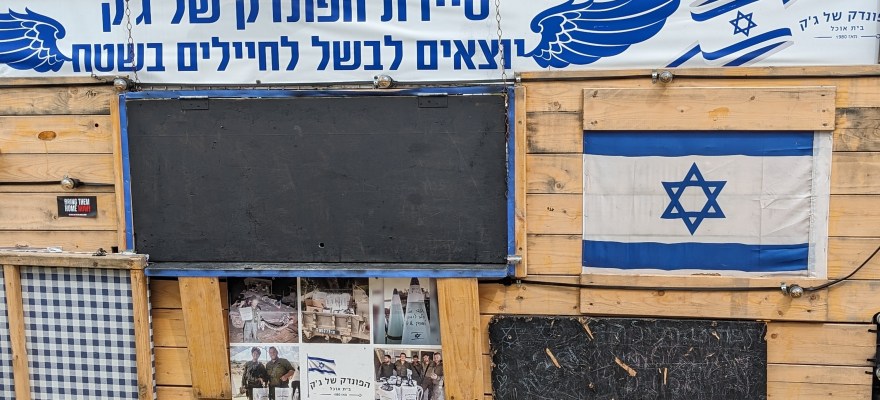
Two weeks ago, on Friday afternoon of the South Bay Solidarity Mission to Israel, we went to HaFundak shel Jack – “Jack’s Inn,” a well known home style restaurant at the entrance to Moshav Beit Nehemia in Shoham. We were there to pack up 450 meals for IDF soldiers out in the field.

After October 7, the owner of the restaurant, Meir, who was too old to be called up to the reserves, began providing daily hot food to families, soldiers, anyone in need.  He put out a call for volunteers. Within a short time, he had a list of 650 people who regularly come to cook, package, and deliver. They rely on donations to pay for all of the supplies.

After we finished packing everything up, I carried 250 meals out to the parking lot to load into a woman’s car. She had returned that morning from a trip to France, and now her job was to shuttle the meals to Kfar Saba, where another volunteer would pick them up and drive them to a brigade of soldiers in the lower Golan.

As I carried the boxes, I was thinking about logistics. By now, Jack’s Inn has served tens of thousands of meals. How do you organize something like this?

It started with just a guy with a restaurant who felt called to employ his skills to help people in a difficult time. What an inspiring example.

This morning’s Torah portion, Vayak’hel, includes a similar such example.

After cleaning up the mess of the Golden Calf, Moses unveils the project that was supposed to take place upon his descent from Mt. Sinai the first time: the building of the Mishkan, the Tabernacle.

First, he lists all of the raw materials that the Israelites need to collect: the precious metals, woods, animal hides, fabric and gems. Then, he puts the call out for those who have skills in a wide range of areas such as: carpentry, smithing, carving, sewing, and weaving. He appoints two chief artisans, Betzalel and Oholiav, to direct the project.

The Torah repeatedly indicates how inclusive this project is —men and women, tribal chieftains and those at the bottom rungs of Israelite society — everyone jumps to get involved. The people are so enthusiastic that, after not too long, the artisans report some surprising news to Moses. The Israelites responded so positively to the campaign, that they have are inundated with more supplies than they know what to do with.

Moses orders the Israelites to stop contributing. The Torah reports that “their efforts had been more than enough for all the tasks to be done.” (36:7) The first and only time that happened.

One of the places that we visited during the Israel Mission was the Tel Aviv Expo Center, which had been converted into ḤaMaL Tel AvivḤaMaL is an acronym for Cheder Milḥamah, or “war room.” It is a term taken from the military to refer to the command center of an operation. We spoke with Ronen, the volunteer director of the ḤaMaL Tel Aviv. Ronen has led a few startups, and still serves as a Reserve Officer in the Israeli Navy. 

The ḤaMaL Tel Aviv has been the central coordination center for the Israeli civil society’s response after October 7. “Civil society” is in contrast to the government. One of the recurring stories that we heard was about the government’s continued absence, not only in its lack of military readiness, but also in failing to respond quickly after the attack, to inform the public, coordinate defense, rescue, evacuation, and then provide for all of the social needs for those who became displaced.

In the government’s absence, Israeli civil society stepped up in a way that expresses the Jewish ethic of mutual responsibility and the Israeli ethos of “Startup Nation.”

To understand how the events played out, we need to go back a little over a year. When the government announced its judicial reform plans, a group of IDF reserve officers, fearing that the changes to the judiciary would lead to the erosion of Israeli democracy, started an organization called Aḥim Laneshek – “Brothers and Sisters in Arms.” This became one of the main organizations coordinating the anti judicial reform protests that lasted for months.

In the course of those political demonstrations, Aḥim Laneshek built an incredibly robust grassroots organizational network. It included many IDF reserve officers with significant leadership experience, as well as Israelis from the high tech sector who brought their own skillsets.

When Hamas attacked on October 7, Aḥim Laneshek immediately pivoted. They renamed their organization Aḥim v’Aḥayot L’Yisrael– “Brothers and Sisters for Israel,” and made three strategic decisions that would guide their actions over the coming months: 1. The IDF must win.  2. Support civilians who were hurt.  3. For the sake of unity, they would not do anything related to judicial reform.

By Sunday, October 8, they had already divided up the responsibilities. By Monday, computer programmers were building dashboards to organize the workflow. In less than a week, Aḥim v’Aḥayot L’Yisrael had built the back-end infrastructure to run a nation. There is now a ḥamal ezraḥi, a citizens coordination center, in every part of the country. 

Within four days, they set up a military-grade intelligence center to collect and analyze information, including going through photographs and videos from social media to identify hostages. When the IDF visited the site the following day, they acknowledged that they could not replicate it, so they turned over their own intelligence to the volunteers.

With Israelis in the South still hiding in safe rooms, Aḥim v’Aḥayot L’Yisrael organized volunteer rescue teams to go into places that the IDF still had not cleared to rescue families, elders, and children, and bring them to safety. In some cases, they sent out teams to search for bodies. 

It quickly became apparent that many of the IDF units, especially reservists, did not have all of the equipment they needed. The network went into action, ordering a large shipment of helmets and ceramic vests.

It was going to take weeks for the equipment to arrive, but they needed it now. So they put the call out to the network and quickly identiified a supply chain specialist, who was able to track down an airplane that was not being used and bring in the helmets and vests right away..

Aḥim v’Aḥayot L’Yisrael has continued to supply soldiers, police officers, and especially Civilian Readiness Units, which despite being outnumbered and underequipped, saved thousands of lives on October 7. They have also brought 7 planeloads full of medical supplies into the country.

By the following Saturday night, it had become apparent that tens of thousands of Israelis would need housing, and the government was not doing anything about it. Volunteers went to Eilat and the Dead Sea to determine hotel capacity and to identify the needs of evacuees and their children. Aḥim v’Aḥayot L’Yisrael were the only ones supporting those families for weeks. In the months since, they have opened 90 kindergartens in hotels.

People had to leave their homes quickly, and did not have time to gather their things, so Aḥim v’Aḥayot L’Yisrael put the call out for basic household supplies, clothing, toiletries, toys, and so on, for all of the dissplaced families. Think for a moment about what would would have to happen to effectively collect and distribute essential items across an entire country. In days, they set up the infrastructure to collect donations, sort them in warehouses, and efficiently distribute what was needed to those in need. This was 100% volunteer driven.

Just as when the Israelites built the Mishkan, the nation responded so enthusiastically that they eventually had to stop collecting supplies. “their efforts had been more than enough for all the tasks to be done.”

With the departure of most of the agricultural workers, Aḥim v’Aḥayot L’Yisrael organized thousands of volunteers to go out into the fields to harvest and plant crops.

Across the country, there are now 15,000 regular volunteers, coming from every segment of Israeli society, crossing social, religious, ethnic, and political lines.

Aḥim v’Aḥayot L’Yisrael, which was initially founded as a left-wing, political organization, has managed to bridge divisions with a number of the more right-wing communities they have been working with. “The mayors love us,” our presenter shared. 

Five months in to this war, the immediate needs have been met, and Aḥim v’Aḥayot L’Yisrael is transitioning to preparing communities to be able to return to their homes.

As we encountered this and other organizations and individuals, a few things occurred to me. First of all, the incredible selflessness demonstrated by so many regular people to do absolutely everything they could to help each other out. And Israel is not a homogenous society.

When I think about life here in the Bay Area, I cannot imagine such a widespread, grassroots, cross-cultural volunteer effort coming together.

Second was the attitude of “just get it done.” Israelis are not known for waiting for permission. There have been countless examples of people, recognizing a problem that needs a solution, and devoting oneself to gathering the resources, human and material, to solve that problem quickly.

Third, this is taking place in a traumatized society. In fact, within days of October 7, Israelis were already turning out in the tens of thousands to volunteer. Many of us might respond to trauma by shutting down, retreating from society. Israelis did the opposite, they jumped in, a far more effective response to trauma, I would imagine. 

One person we met, a retired career diplomat, the former Ambassador to France, who is now volunteering with the Hostages and Missing Families Forum, shared that this is the most meaningful work he has ever done in his life.

What are our duties as citizens? Here in America, we tend to not think of citizenship carrying with it many obligations, other than following the laws, paying our taxes, and possibly voting. 

Ronen, our guide at Aḥim v’Aḥayot L’Yisrael said that in the last year, he has learned that being citizenship is more than that: it includes a duty to give back. 

He considers what they have done, both before October 7 when they were protesting against the judicial reforms, and after, when they pivoted to supporting Israeli society, an expression of Zionism and patriotism.

That is surely something to aspire to.

Might and Peace – Noach 5784

My heart is still broken, broken for 1,400 Israelis who were killed and their families. We have been witnessing the funerals and the shiva and a nation that is still in the midst of trauma.

I am relieved for the release of mother and daughter Judith and Natalie Raanan yesterday, and praying for the 200 others who were taken hostage, particularly 30 children whose fate and whereabouts remain unknown.

Once again, we have in our Torah portion a fitting story to describe our current reality.

By the end of last week’s parashah, the humans, who were created in the image of God, whom God blessed and declared to be tov me’od, very good, have failed to meet expectations. After just ten generations, God sees “how great was man’s wickedness on earth, and how every plan devised by his mind was nothing but evil all the time.”

How sad. The creation that God declared to be “very good” is now “nothing but evil all the time.”

As this morning’s Torah portion, Noach, opens, the Divine displeasure continues. 

וַתִּשָּׁחֵ֥ת הָאָ֖רֶץ לִפְנֵ֣י הָֽאֱלֹקִ֑ים וַתִּמָּלֵ֥א הָאָ֖רֶץ חָמָֽס׃ 

The earth became corrupt before God; the earth was filled with ḥamas. When God saw how corrupt the earth was, for all flesh had corrupted its ways on earth, God said to Noah, “I have decided to put an end to all flesh, for the earth is filled with ḥamas because of them: I am about to destroy them with the earth.

Genesis 6:11-13

The irony is tempting. Ḥamas is the Hebrew word for lawlessness. It is a word that expresses the chaos and evil of the world before the flood, the complete lack of boundaries and respect for the divinity contained within every human being. 

God decides to wipe it all away, to allow the waters of chaos to undo all of the order and good that God had created. And God decides to give us another chance.

After the flood subsides, Noah offers a sacrifice. When God smells the pleasing odor, God says to Godself, “Never again will I doom the earth because of Adam, since the devisings of Adam’s mind are evil from his youth…”

Notice that human nature has not changed one bit. God uses nearly identical language to describe humanity’s proclivity for evil. But this time, God provides some instructions. Among them, one stands out in this moment. 

For your own life-blood I will require a reckoning… of every man for that of his fellow man! Whoever sheds the blood of man, by man shall his blood be shed, for in His did God make man.

Genesis 9:5-6

This verse, considered by our tradition to be the basis of one of the seven Noachide commandments, forbids murder, the wrongful taking of human life. And, it obligates human beings to punish the one who commits murder.

This is the foundational principle of justice. Human beings may not wrongfully harm one another, and society must have institutions in place both for protection, as well as for lawful adjudication and punishment.

In a world that is prone to chaos, this is the only way that we can hope to live together.

In the next passage, God makes a covenant with Noah and his children, establishing the rainbow in the clouds as a sign of God’s commitment to never destroy the earth by flood again.

We tend to think of the rainbow as a symbol of peace, but that is not quite right. In the language of the Torah, the rainbow is a sign only for God. For God, it is a sign of stepping back. It is a sign of God being resigned to the inherently selfish and violent qualities of humanity. The Torah does not say anything about what the rainbow is supposed to mean for us.

But implied by stepping back is that God is saying to us, “I cannot solve your problems for you. From now on it is your resonsibility. You may not allow the lawlessness that existed before the flood to persist.  You are created in My image, and that means you have an obligation to rise above your evil nature.”

From this perspective, to hold someone accountable for their evil actions is to treat them as a human being. When Hamas commits its atrocities, justice demands a response. 

When innocent civilians are taken hostage, every effort must be made to bring them home, and those who took them must be punished. Why? It is because every human is made in the image of God.

We know the problem. Hamas and its allies surround themselves with civilians. They hide in schools and mosques, and fire rockets from right next to hospitals.

This makes it impossible for Israel to target its enemies without harming civilians. I trust that the IDF, in its training, its policies, and in its wartime decision making, strives to abide by the ethics and laws of war. But war is messy, especially in the Middle East. I do not envy those who have to make the decisions.

While none of us can know what the future has in store, this war will likely go on for some time. It will be ugly. Many civilians will die, mostly Palestinians. The propaganda battle will be intense, and we can predict how it will play out. As time goes on, Israel will come under increasing pressure to agree to a cease-fire.

The reality is that from here in San Jose, there is a little that we can do to impact any of this, other than by sending money and continuing to reach out on the human level to friends and family in Israel and here at home.

For me personally, I worry about what this war will do to my ability to see the Divine in every human being.

When news of the Ahli Arab hospital explosion came out earlier this week, my first reaction was to feel ill, saying to myself something along the lines of “I hope it wasn’t an Israeli bomb.” 

When it appeared to have been caused by an errant Palestinian Islamic Jihad rocket, I felt relief and vindication… and also anger and frustration that for so many, the truth of which side’s explosives caused the damage does not matter.

What I did not feel and still do not feel so much of, is sadness for the deaths of people who were already injured and already seeking shelter from violence. For them, what difference does it make whose bomb caused the explosion? They are human beings, made in God’s image. We are supposed to fell a connection to that. In the midst of war, it is so easy for that fact to be smothered by our tribalism. 

This is what war does. It hardens our hearts, making it difficult to feel compassion, making it hard to see the Divine in my fellow human being who is on the other side of the battle line.

It should be possible for us to simultaneously hold on to our love and support for our Israeli brothers and sisters, to pray for the safe return of the hostages, and also feel empathy for Palestinian civilians.

We should be able to pray for the defeat of Hamas, while also mourning civilian deaths.

And I know that there are not a lot of voices within the Muslim world that are calling for that kind of nuance right now. I was there were.

Is that not the burden that God placed on the children of Noah after the flood? To treat all life as sacred, as well as to hold to account anyone who violates that sanctity.

We recite Psalm 29 twice on Shabbat, once during Kabbalat Shabbat, Friday night, right before Lekha Dodi, and then when we return the Torah to the ark. The final two verses may sound familiar. Especially the last verse, which is used as the last verse in Birkat Hamazon, the Grace After Meals.

יְ֭הֹוָה לַמַּבּ֣וּל יָשָׁ֑ב וַיֵּ֥שֶׁב יְ֝הֹוָ֗ה מֶ֣לֶךְ לְעוֹלָֽם׃ 

יְֽהֹוָ֗ה עֹ֭ז לְעַמּ֣וֹ יִתֵּ֑ן יְהֹוָ֓ה ׀ יְבָרֵ֖ךְ אֶת־עַמּ֣וֹ בַשָּׁלֽוֹם׃

The Lord sat enthroned at the flood, the Lord sits enthroned, King forever

May the Lord grant oz, might to His people, may the Lord bless His people with shalom.

Psalm 29:10-11

I never thought about it before, but this last verse might seem contradictory. Asking for might sounds pretty militaristic, the direct opposite of peace. But history has shown that in our imperfect world, strength is what often makes peace possible. This is a lesson that the State of Israel certainly knows well.

Does shalom in this context really mean “peace.” I cannot accept that when we say “peace,” we mean “the annihilation of Gaza.”

I suggest that shalom, paired with oz, might paired with shalom, means something like wholeness and balance. When we are blessed with might, we pray that we not lose ourselves, that we not fall from the divine image, nor lose the ability to see the divine image in others, including even our enemies.

If we can’t strive for that, what business do we have praying for shalom?

Staying Strong in Israel’s War against Hamas

This is a speech that I delivered at the Silicon Valley Solidarity Gathering for Israel on July 22, 2014.

The Jewish State of Israel distinguishes itself among the family of nations to the extent that it is governed by middot, the positive attributes of our Jewish tradition.  When we make decisions, as individuals and as a nation, that embody the values of our ancient faith, we bring light into the world.  Unfortunately, the world is not always ready to be enlightened.

In Pirkei Avot, we read Eizehu gibbor?  Hakovesh its yitzro.  Who is strong?  One who conquers one’s inclinations.  Usually, we use this teaching to emphasize that true strength is not about physical might, but rather the ability to control our passions.  While Israel has indeed demonstrated its physical prowess in the present war, we are strong in the fullest sense when we remain focused on our goals while maintaining our values.

When we see how our brave soldiers have comported themselves these last three weeks, we can only be proud of their strength, both in their success on the battlefield, and in maintaing their humanity while pursuing the military goals.

What are those goals?  Prime Minister Benjamin Netanyahu stated it clearly in an interview this past Saturday night: “…restoring quiet to Israel’s citizens for a prolonged period while inflicting a significant blow on the infrastructures of Hamas and the other terrorist organizations in Gaza,”

Specifically, that means eliminating the thousands of rockets and other weapons and destroying the network of tunnels that Hamas uses to transport arms and personnel.

But there is an ethical principle at play as well: to minimize civilian casualties – on both sides of the border.

While voices around the world shout about the massacre of innocent civilians, pointing to the discrepancy between Israeli and Palestinian deaths like a scorecard at a sports game, the truth is quite the opposite.  In every war, sadly, civilians are killed.  Did you know that, because of the IDF’s preoccupation with protecting innocents for decades, the ratio of civilians to militants killed has been lower by far than in any other conflict around the world.

How does Israel protect civilians?  On the Israeli side of the border: by building reinforced bomb shelters, by operating an incredibly sophisticated early warning system so that Israelis have time to find cover before the rockets fall, and by developing, with the United States, the Iron Dome, which has prevented most rockets from landing in populated areas with a remarkable 90% success rate.

Because every life is treasured as an olam kattan, a small world, we are committed to doing absolutely everything to keeping our people safe.  We see this in the outpouring of heartfelt emotion and loss whenever there is a death or injury.

But what is truly remarkable is the way that Israel has gone out of its way, at the expense of military success, to protect the people of Gaza.  The IDF calls cell phones and drops leaflets to warn civilians in advance before destroying a target.  Then it launches a small projectile to “knock” the roof of a building as a warning to get out before the real missile is launched.  Did you know that Israel has been providing Gaza with humanitarian supplies while the fighting is taking place, and that the IDF has set up a field hospital on the border to care for wounded Palestinians?

These life-saving acts are unique to the IDF.  No military force in history has gone to such measures to protect the civilians of its military opponent.

Let us not be so condescending as to expect the other side to be grateful.  After all, there have been more than 600 Palestinian deaths in the last few weeks, many of whom are innocent civilians.  I would expect them to blame Israel.  How could they not?

But who is really responsible for the suffering in Gaza?

Hamas deliberately places its rocket launchers and weapons in locations like schools, hospitals, private homes, mosques, and even UN facilities.  When Israel tells civilians to flee so they will not be harmed, Hamas orders them to stay, to serve as human shields.

So far in this war, there have been two calls for temporary cease-fires for humanitarian purposes.  Israel accepted both of them right away and stopped fighting.  Hamas used those temporary lulls to immediately launch more than 70 rockets against Israeli civilians.

Hamas has used many tons of concrete that Israel has allowed into the Gaza Strip not for the construction of buildings and infrastructure that will improve lives, but for underground tunnels to carry on its relentless pursuit of death.  Hamas commanders are now using those tunnels to hide, safe from attack.  But are the underground bunkers made available to civilians?  No.  They are left above ground to fend for themselves.

What does Hamas want?  Death.  The death of Israeli civilians, and the death of Palestinian civilians.  Because they know how those images are perceived around the world.

In 1969, Golda Meir said, “When peace comes, we will perhaps in time be able to forgive the Arabs for killing our sons, but it will be harder for us to forgive them for having forced us to kill their sons.”  What a perverse reality!

This is not a war that any of us want.  But while it continues, we pray for the safety of our brothers and sisters in Israel’s Defense Forces.  We pray for the millions of Israelis living under the constant fear of terror from above.  And we pray for all those who suffer in Gaza.  We mourn the deaths of the young soldiers who have been killed defending the Jewish people.  We mourn for the civilians, Israeli and Palestinian, Jewish and Muslim, who have died.  Our hearts go out to their families.

And we pray for both kinds of strength for Israel’s leaders, its soldiers, its people, and Jews everywhere: the strength to be victorious, and the strength to maintain our humanity in the face of chaos.