Where Was The Guardian Angel? – Mishpatim 5785

Parashat Mishpatim occupies a central place within God’s epic revelation to the Israelites at Mount Sinai. It opens with Sefer HaBrit, the Book of the Covenant, outlining the mitzvot that the Israelites will be expected to uphold. Their agreement is captured by an enthusiastic, two word response, na’aseh v’nishma, “We will do and we will listen.”

Among God’s commitments to the Israelites is a promise to send what is, in effect, a guardian angel to protect them.

I am sending a messenger before you to guard you on the way and to bring you to the place that I have made ready. Pay heed to him and obey him. Do not defy him, for he will not pardon your offenses, since My Name is in him; but if you obey him and do all that I say, I will be an enemy to your enemies and a foe to your foes.

Exodus 23:20-22

This angel will be a guide, a judge, as well as a protector and a champion for the Jewish people. Who is this angel? Many of our midrashim and commentators try to answer this question. One explanation in particular stands out to me. After citing several interpretations offered by others, Nachmanides, the 13th century Spanish Rabbi, shares his own. “The true understanding is that this angel whom they are promised is the mal’akh hago’el – ‘the redeeming angel’ of Genesis 48:16, who has God’s name ‘in him’…”

Nachmanides draws our attention to a particularly special moment.  Jacob is nearing the end of his life. He calls Joseph to his side, along with his grandsons, Ephraim and Menashe. Blessing, them, Jacob invokes the angel who has been with him, protecting him throughout his life.

Ha’mal’akh hago’el oti mi’kol ra—
The angel who has redeemed me from all harm—
Bless the lads.
In them may my name be recalled,
And the names of my fathers Abraham and Isaac,
And may they be teeming multitudes upon the earth.

Genesis 48:16

As Nachmanides develops the idea, he explains that this Redeeming Angel is in fact not an angel at all, but rather the aspect of God that watches over and governs the physical world in which we live.

Jacob, despite a life filled with adversity and danger, experiences God’s protection and blessing. This is what he wishes for his grandchildren. And this is what God invokes at Mount Sinai, promising to watch over the Jewish people through the adversity and danger that they will face in the generations to follow, up to and including our own.

This is what I was thinking of this week, as we witnessed the bodies of Ariel and Kfir Bibas returned to their families. With their bright red hair, Ariel and Kfir, just 4 years old and 9 months old when they were taken hostage by Hamas on October 7, 2023, became the symbolic faces of the entire war.

On the morning of October 7, Yarden and Shiri Bibas, with their two sons, Ariel and Kfir, hid as Hamas terrorists stormed through their Kibbutz, Nir Oz.  In an attempt to draw the terrorists away from his family, Yarden left the safe room and was captured. A little while later, Shiri and her children were also taken and brought, alive, into the Gaza Strip. Photographs of a terrified and bleeding mother and her crying children showed them alive in Khan Younis later that day. Shiri’s parents, Margit and Yossi Silberman, who also lived in Kibbutz Nir Oz, were among the more than 1,200 Israelis who were brutally murdered.

Since December 2023, Hamas claimed that Shiri, Ariel, and Kfir were killed by an Israeli attack. The IDF never confirmed what happened to them, and the family refused to give up hope until their bodies were returned home.

According to the terms of the current cease fire, Yarden was released on February 1, after nearly 500 days.  At the time of his release, he did not know that his wife and children had been murdered.

We now have a better idea about what they suffered. On Thursday of this week, as part of the terms of the cease fire, the bodies of Shiri, Ariel ,and Kfir were to be released, along with that of 83 year old Oded Lifshitz. In a cruel spectacle, similar to the Hamas propaganda that accompanied the previous releases, coffins were brought up on stage with celebratory music, taunting photographs and messages in Arabic, Hebrew, and English. This prompted widespread condemnation. Even the Chair of the UN Human Rights Commission condemned Hamas’ actions. “The parading of bodies in the manner seen this morning is abhorrent and cruel, and flies in the face of international law.”

As the coffins passed from Hamas to the Red Cross to the IDF, Israelis lined the streets and the squares of the nation in tears. The process of mourning, more than 500 days later, could finally begin. 

But the horrors were not over. Israeli forensic teams confirmed the identities of Ariel and Kfir, along with Oded Lifshitz. Physical evidence revealed that the children had been murdered by bare hands in cold blood in November 2023.The fourth body, it turned out, was not Shiri’s. As I was preparing my drash, Hamas had just released another body which they claimed was Shiri’s.

What are we supposed to feel at this moment? Anger, rage, sadness, grief, relief – so many swirling, conflicting emotions.

The Torah’s promise of mal’akh go’el – a Guardian Angel, rings hollow at a time like this.  Where was the Guardian angel while innocent children, Ariel and Kfir, were brutally taken, imprisoned and murdered?

I imagine the Israelites at the base of Mount Sinai may have had similar questions.  How many children were cruelly cast into the Nile by Pharaoh and his decree? Where was God when that was happening? Can they really count on God to protect them now?

Are there words that can adequately express what we are feeling?

There have been a lot of statements put out over the last two days expressinga lot of emotions. Several of them cited passages from our holy texts, in particular the Book of Psalms, to capture what we might want to say to God right now. From Psalm 91, which is traditionally recited while accompanying a body to its final resting place. It expresses faith in God’s justice and protection. 

For He will order His angels
to guard you wherever you go.

Psalm 91:11

Words that may ring hollow in this moment. Next is from Psalm 94, which we recite as the daily Psalm for Wednesday. It is a demand for an absent God of justice to take vengeance against those who commit evil.

God of retribution, LORD,
God of retribution, appear! 
Rise up, judge of the earth,
give the arrogant their deserts! 
How long shall the wicked, O LORD,
how long shall the wicked exult,

Psalm 94;1-3

A Psalm that does not appear in our regular liturgy is Psalm 83. Its words feel terribly fitting.

O God, do not be silent;
do not hold aloof;
do not be quiet, O God! 
For Your enemies rage,
Your foes assert themselves.
They plot craftily against Your people,
take counsel against Your treasured ones. 
They say, “Let us wipe them out as a nation;
Israel’s name will be mentioned no more.” 
Unanimous in their counsel
they have made an alliance against You— 
…May they be frustrated and terrified,
disgraced and doomed forever.

Psalm 83:2-6, 18

And finally, Psalm 147, which we recite every day of the year during Pesukei D’zimra. These words of comfort are perhaps what we need most of all. 

God heals the brokenhearted
and binds up their wounds.

Psalm 147:3 

May God grant comfort to the Bibas family, the whole House of Israel, and all who suffer in the world. May God heal those broken in body and spirit. May God restore to their families all of our hostages, and bring home the bodies of those who have been murdered so that their families can begin to mourn.
The Rise of Civil Society – Vayakhel 5784

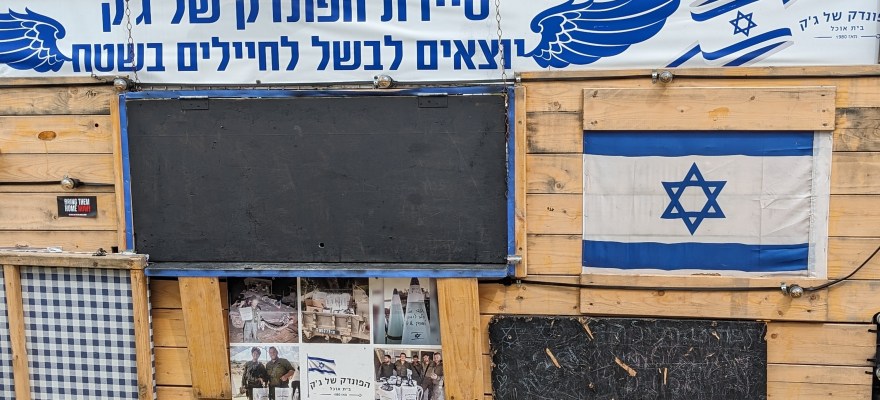
Two weeks ago, on Friday afternoon of the South Bay Solidarity Mission to Israel, we went to HaFundak shel Jack – “Jack’s Inn,” a well known home style restaurant at the entrance to Moshav Beit Nehemia in Shoham. We were there to pack up 450 meals for IDF soldiers out in the field.

After October 7, the owner of the restaurant, Meir, who was too old to be called up to the reserves, began providing daily hot food to families, soldiers, anyone in need.  He put out a call for volunteers. Within a short time, he had a list of 650 people who regularly come to cook, package, and deliver. They rely on donations to pay for all of the supplies.

After we finished packing everything up, I carried 250 meals out to the parking lot to load into a woman’s car. She had returned that morning from a trip to France, and now her job was to shuttle the meals to Kfar Saba, where another volunteer would pick them up and drive them to a brigade of soldiers in the lower Golan.

As I carried the boxes, I was thinking about logistics. By now, Jack’s Inn has served tens of thousands of meals. How do you organize something like this?

It started with just a guy with a restaurant who felt called to employ his skills to help people in a difficult time. What an inspiring example.

This morning’s Torah portion, Vayak’hel, includes a similar such example.

After cleaning up the mess of the Golden Calf, Moses unveils the project that was supposed to take place upon his descent from Mt. Sinai the first time: the building of the Mishkan, the Tabernacle.

First, he lists all of the raw materials that the Israelites need to collect: the precious metals, woods, animal hides, fabric and gems. Then, he puts the call out for those who have skills in a wide range of areas such as: carpentry, smithing, carving, sewing, and weaving. He appoints two chief artisans, Betzalel and Oholiav, to direct the project.

The Torah repeatedly indicates how inclusive this project is —men and women, tribal chieftains and those at the bottom rungs of Israelite society — everyone jumps to get involved. The people are so enthusiastic that, after not too long, the artisans report some surprising news to Moses. The Israelites responded so positively to the campaign, that they have are inundated with more supplies than they know what to do with.

Moses orders the Israelites to stop contributing. The Torah reports that “their efforts had been more than enough for all the tasks to be done.” (36:7) The first and only time that happened.

One of the places that we visited during the Israel Mission was the Tel Aviv Expo Center, which had been converted into ḤaMaL Tel AvivḤaMaL is an acronym for Cheder Milḥamah, or “war room.” It is a term taken from the military to refer to the command center of an operation. We spoke with Ronen, the volunteer director of the ḤaMaL Tel Aviv. Ronen has led a few startups, and still serves as a Reserve Officer in the Israeli Navy. 

The ḤaMaL Tel Aviv has been the central coordination center for the Israeli civil society’s response after October 7. “Civil society” is in contrast to the government. One of the recurring stories that we heard was about the government’s continued absence, not only in its lack of military readiness, but also in failing to respond quickly after the attack, to inform the public, coordinate defense, rescue, evacuation, and then provide for all of the social needs for those who became displaced.

In the government’s absence, Israeli civil society stepped up in a way that expresses the Jewish ethic of mutual responsibility and the Israeli ethos of “Startup Nation.”

To understand how the events played out, we need to go back a little over a year. When the government announced its judicial reform plans, a group of IDF reserve officers, fearing that the changes to the judiciary would lead to the erosion of Israeli democracy, started an organization called Aḥim Laneshek – “Brothers and Sisters in Arms.” This became one of the main organizations coordinating the anti judicial reform protests that lasted for months.

In the course of those political demonstrations, Aḥim Laneshek built an incredibly robust grassroots organizational network. It included many IDF reserve officers with significant leadership experience, as well as Israelis from the high tech sector who brought their own skillsets.

When Hamas attacked on October 7, Aḥim Laneshek immediately pivoted. They renamed their organization Aḥim v’Aḥayot L’Yisrael– “Brothers and Sisters for Israel,” and made three strategic decisions that would guide their actions over the coming months: 1. The IDF must win.  2. Support civilians who were hurt.  3. For the sake of unity, they would not do anything related to judicial reform.

By Sunday, October 8, they had already divided up the responsibilities. By Monday, computer programmers were building dashboards to organize the workflow. In less than a week, Aḥim v’Aḥayot L’Yisrael had built the back-end infrastructure to run a nation. There is now a ḥamal ezraḥi, a citizens coordination center, in every part of the country. 

Within four days, they set up a military-grade intelligence center to collect and analyze information, including going through photographs and videos from social media to identify hostages. When the IDF visited the site the following day, they acknowledged that they could not replicate it, so they turned over their own intelligence to the volunteers.

With Israelis in the South still hiding in safe rooms, Aḥim v’Aḥayot L’Yisrael organized volunteer rescue teams to go into places that the IDF still had not cleared to rescue families, elders, and children, and bring them to safety. In some cases, they sent out teams to search for bodies. 

It quickly became apparent that many of the IDF units, especially reservists, did not have all of the equipment they needed. The network went into action, ordering a large shipment of helmets and ceramic vests.

It was going to take weeks for the equipment to arrive, but they needed it now. So they put the call out to the network and quickly identiified a supply chain specialist, who was able to track down an airplane that was not being used and bring in the helmets and vests right away..

Aḥim v’Aḥayot L’Yisrael has continued to supply soldiers, police officers, and especially Civilian Readiness Units, which despite being outnumbered and underequipped, saved thousands of lives on October 7. They have also brought 7 planeloads full of medical supplies into the country.

By the following Saturday night, it had become apparent that tens of thousands of Israelis would need housing, and the government was not doing anything about it. Volunteers went to Eilat and the Dead Sea to determine hotel capacity and to identify the needs of evacuees and their children. Aḥim v’Aḥayot L’Yisrael were the only ones supporting those families for weeks. In the months since, they have opened 90 kindergartens in hotels.

People had to leave their homes quickly, and did not have time to gather their things, so Aḥim v’Aḥayot L’Yisrael put the call out for basic household supplies, clothing, toiletries, toys, and so on, for all of the dissplaced families. Think for a moment about what would would have to happen to effectively collect and distribute essential items across an entire country. In days, they set up the infrastructure to collect donations, sort them in warehouses, and efficiently distribute what was needed to those in need. This was 100% volunteer driven.

Just as when the Israelites built the Mishkan, the nation responded so enthusiastically that they eventually had to stop collecting supplies. “their efforts had been more than enough for all the tasks to be done.”

With the departure of most of the agricultural workers, Aḥim v’Aḥayot L’Yisrael organized thousands of volunteers to go out into the fields to harvest and plant crops.

Across the country, there are now 15,000 regular volunteers, coming from every segment of Israeli society, crossing social, religious, ethnic, and political lines.

Aḥim v’Aḥayot L’Yisrael, which was initially founded as a left-wing, political organization, has managed to bridge divisions with a number of the more right-wing communities they have been working with. “The mayors love us,” our presenter shared. 

Five months in to this war, the immediate needs have been met, and Aḥim v’Aḥayot L’Yisrael is transitioning to preparing communities to be able to return to their homes.

As we encountered this and other organizations and individuals, a few things occurred to me. First of all, the incredible selflessness demonstrated by so many regular people to do absolutely everything they could to help each other out. And Israel is not a homogenous society.

When I think about life here in the Bay Area, I cannot imagine such a widespread, grassroots, cross-cultural volunteer effort coming together.

Second was the attitude of “just get it done.” Israelis are not known for waiting for permission. There have been countless examples of people, recognizing a problem that needs a solution, and devoting oneself to gathering the resources, human and material, to solve that problem quickly.

Third, this is taking place in a traumatized society. In fact, within days of October 7, Israelis were already turning out in the tens of thousands to volunteer. Many of us might respond to trauma by shutting down, retreating from society. Israelis did the opposite, they jumped in, a far more effective response to trauma, I would imagine. 

One person we met, a retired career diplomat, the former Ambassador to France, who is now volunteering with the Hostages and Missing Families Forum, shared that this is the most meaningful work he has ever done in his life.

What are our duties as citizens? Here in America, we tend to not think of citizenship carrying with it many obligations, other than following the laws, paying our taxes, and possibly voting. 

Ronen, our guide at Aḥim v’Aḥayot L’Yisrael said that in the last year, he has learned that being citizenship is more than that: it includes a duty to give back. 

He considers what they have done, both before October 7 when they were protesting against the judicial reforms, and after, when they pivoted to supporting Israeli society, an expression of Zionism and patriotism.

That is surely something to aspire to.

Israel Needs Us – For the Future of Judaism Itself – Ki Tissa 5784

I returned on Sunday from the South Bay Solidarity Mission to Israel. Nineteen members of our community, including five from Sinai, spent a packed week filled with meaningful, important encounters to bear witness, console the mourners, and comfort the sick.

A week and a half ago, we visited Hostages Square in Tel Aviv. As we were about to board our bus to return to the hotel, a voice boomed from the loudspeakers.  Earlier that day, the far right Finance Minister Bezalel Smotrich had given an interview in which he said, rather smugly, that getting the hostages back was not as important as destroying Hamas.

An impromptu protest formed of relatives of hostages, who were, understandably, incensed.

Liri Albag, eighteen years old, has been held hostage in Gaza for 147 days. Her father, Eli Albag, cried out in the most gut-wrenching, tormented, angry voice that I have ever heard.

“Let them kidnap your children!” Calling out Smotrich by name, he shouted “Let them kidnap your children and I will shout in the street, ‘It’s not the most important thing!’”

“I’m talking to all citizens of Israel — whoever thinks that the citizens, the hostages are unimportant, let them kidnap your children and then you can speak!” 

“We have suffered for 137 days, day after day, minute by minute, we don’t sleep at night,” 

Referring to the Israeli cabinet, he continued, “It will not protect you… They are abandoning us above. They are laughing at us, dragging their feet, they are not going to negotiate. I say to you citizens, take to the streets because today it is us and tomorrow it will be you.”

This may have been the most painful thing I have ever heard another person say.

As someone who follows current events fairly closely, the week long trip was an eye-opening experience nonetheless. 

We met Israelis from many different backgrounds, gaining a sense of the complicated, conflicting ways in which social, economic, religious, and political differences play out in society.

One thing that was obvious was that the language and rhetoric that surrounds us here in America is very different from that which permeates Israeli society right now.

The most dominant issue we encountered, by far, was the chatufim, the hostages. From the moment one walks down the ramp to exit Ben Gurion airport, photos of each of those still in captivity are everywhere. On the sides of buildings, on café counters, in bank windows, on t-shirts, their faces are impossible to miss.

Alongside the photos, at least in Tel Aviv, are signs, grafitti, and billboards casting blame for October 7 on the government, and Benjamin Netanyahu in particular. One huge poster visible from the Ayalon Highway, covering the entire side of a building, has a photo of Bibi and the words Attah haRosh! Attah Ashem!“You are in charge!  You are guilty!”

Along with this are calls, everywhere, for the government to resign so that new elections can be held.

Most of the Israeli voices we heard did not express much concern for the things that fill our airwaves. There were few mentions of the Palestinians, a two state solution, or even the thousands of civilian deaths in Gaza.

The closest to calls for a ceasefire occurred within the context of “Bring the hostages home at any cost.” Even when we met with Achinoam Nini, one of Israel’s most famous singers and a peace activist for the past thirty years, she did not go so far as to call for an immediate ceasefire, although she did speak passionately about the need for a Palestinian state alongside Israel and the moral obligation to empathize with all human suffering.

Antisemitism came up, but usually in the context of Israelis being concerned about all the antisemitism that we are facing in the West. 

It should not really surprise us that the issues we are dealing with here are largely absent from the Israeli discussions. This is not to justify, but to explain. Israelis are still in trauma from October 7. They freely admit it. The fate of the hostages is front and center, with photos everywhere. The 134 who are still missing have become household names. I could not imagine being able to think of anything else if my child was in captivity.

Hundreds of thousands of Israelis are currently serving as active duty soldiers or reservists. When your child or spouse or brother or sister is fighting a war, it is hard to muster much emotional energy for those on the other side of the border.

And don’t forget the tens of thousands of Israelis who are displaced from their homes around the Gaza envelope and the northern border.

This past Saturday night, the first major anti-government protest since October 7 took place in Tel Aviv. We were there for the beginning of it. Tens of thousands of Israelis filled the streets. It was clear that there were a wide range of coalitions comprising the rally, ranging from families of hostages, relatives of victims of October 7, life-long Likud members, and pro-peace activists.

The messages were simple and clear: The government is responsible for the failures of October 7. They should resign and new elections should be held. The word achshav kept coming up as a chant. Achshav! “Now!” Israeli flags were everywhere.

A few weeks ago, we read Parashat Yitro, in which God’s Presence descends upon Mt. Sinai in revelation to the children of Israel, who are encamped below.

This moment is imagined by our tradition as a wedding. So let’s run with that metaphor a bit. We would say about a newlywed couple that they are “in love.” They only have eyes for one another. They do not see each other’s faults, and their only desire is to be together. 

Now here we are in Ki Tissa, a few Torah portions later. Moses has been on top of Mt. Sinai for forty days. He has literally gone up to heaven to speak with God. Meanwhile, back down on earth, what have the Israelites done?  They have built a golden calf.

The honeymoon is over. The rest of their time through the wilderness will be frought with misunderstandings, miscommunications, and disappointments, punctuated by occasional moments of bliss. 

This is a useful metaphor for us to consider with regard to our relationship with Israel as American Jews.

My parents and grandparents’ generations were around when Israel came into being in 1948 and in its early years. The Holocaust was a recent memory and the need for a Jewish homeland was clear. The exciting, miraculous fact of its existence, the ingathering of the exiles, and the pioneering Jews taking charge of their own destiny after 2,000 years as an opressed minority in the Diaspora was a source of pride.

After 1967, with another miraculous victory over its enemies in the Six Day War, Israel could do no wrong. 1967, by the way, is when Jews in America began to feel comfortable wearing Kippot out in public.

The 1973 Yom Kippur war began to chip away at this image of invincibility. Israel was shown to be vulnerable. This is when things started to get more complicated in the relationship. I was born in this post-1973 generation.  

Beginning with the war in Lebanon, which lasted nearly 30 years, and the first Intifada, Israel was now in a position in which it was unquestioningly the stronger military power. It was occupying land and was responsible for the Palestinians, who were not citizens of the state.  It now had to deal with a challenge that Jews had not faced for more than two thousand years: How do we use our power Jewishly?

Let’s come back to the marriage metaphor. Up until 1973, American Jews were in the honeymoon phase. We were “in-love” with Israel. The agreement was that we would buy trees through JNF, purchase Israel bonds on the High Holidays, and take pride in this growing, thriving, Jewish nation. And we would feel more safe and secure about our place in the Diaspora.

My generation began to develop a different relationship with Israel. Let’s call it “marriage.” The honeymoon is over. We are committed to each other, but we are starting to see the faults.

In the early 1990’s there was tremendous hope that the Oslo Accords would finally bring peace. Most American Jews were ecstatic, and the majority of Israelis were cautiously supportive.

The assassination of Yitzchak Rabin in 1995 by a right wing Jewish terrorist, followed by a string of terrorist attacks by Hamas, shattered that hope. This led to the third phase, comprised of young American Jews who claim that the Israel they know is not in alignment with the Jewish values they have been taught in our synagogues, Jewish schools, and summer camps.

Those of us from earlier generations can complain until we are blue in the face, but let’s consider for a moment that for someone who was born in the last thirty years, the only Israel they have experienced is one which has waged a near constant series of assymetrical wars.

They have seen ultra religious factions in Israel flexing their muscles in ways designed to deliberately suppress the liberal movements that they grew up in. They have seen a constant expansion of Jewish settlements in the West Bank, making the prospect of a two state solution seem more and more unlikely.

When it comes to Israel, what we are hearing from many young American Jews is simply “I want a divorce.”

This is tragic and frustrating. But if we, from the Honeymoon and Marriage generations, are to perform our duty of teaching our children of the Divorce generation, we have got to recognize where many of them actually are, and what they have experienced.

Congregation Sinai’s mission is to connect Jews to Judaism, each other, Israel, and the world.

What does it mean to be connected to Israel?

At the very least, it means recognizing that, as the home for half of the world’s Jews, our fates are connected in extremely tangible ways. Like it or not, what happens in Israel socially, religiously, and politically, impacts Judaism everywhere.

The current Israeli government is comprised of quite a few figures who embody what many of the anti-Zionists of the world say about Israel. Figures, like Smotrich, whose stated goal is to transform Israel into something resembling a messianic theocracy with all non-Jews holding a form of second class citizenship.

These are the people whose statements were brought by South Africa to the International Court of Justice in the Hague in its case accusing Israel of genocide.

The reality is, these extremists are extremely unpopular for most Israelis also. They are not, in fact, representative, but because of the particular nature of the Israeli political system, they enjoy a lot of power and influence right now. 

If their vision is realized in the Jewish homeland, the results for us here in the Diaspora will be terrifying. As one of our speakers claimed, the future of Judaism itself is at stake.

And so, it matters to us.

Lately, (and I myself am guilty of this) we have been using the expression kol Yisrael arevim zeh lazeh.  “All of Israel are responsible for one another.” We use this expression to describe the sense of deep connection we feel with our Jewish brothers and sisters around the world, particularly when they are under attack.

But the original use of this expression in the Talmud (BT Shevuot 39a) is a little different. If a Jew is about to sin, and I fail to intervene to steer them correctly, then my fate will be tied to their fate. We will all suffer the consequences of their wrong behavior. This expression is really about communal responsibility. I have to act.

We are being encouraged, by Israelis, to get involved in a more substantive way than we have been. Many of the people with whom we met begged us to be involved. What we saw is that there is tremendous diversity in what it means to be pro-Israel, to be a Zionist.

At its most basic level, Zionism is the belief that Jews should be able to determine our own destiny, and this can only happen if Jews are living in the Jewish homeland. Think about the final words of Hatikva – Lihyot am chofshi be’artzeinu: Eretz Tzion virushalim – To be a free nation in our land: the land of Zion and Jerusalem.

The conviction that we should be able to self identify and self actualize as a nation is the essence of Zionism.  The rest is commentary.

We have to participate in that commentary, not only for our own sake, but also for our children’s sake, and for the sake of Judaism itself. 

Don’t Make it Worse – Letter to San Jose Mayor and City Councilmembers

Groups have been pressuring city councils throughout the Bay Area to pass ceasefire resolutions on the war between Israel and Hamas. Not only do these resolutions tend to be extremely one-sided, the rhetoric that surrounds them often crosses the line into antisemitism.

The following is a letter that I sent to on December 8, 2023 to San Jose Mayor Matt Mahan and each of the ten city Councilmembers urging them not to take up a resolution on the war between Israel and Hamas.

December 8, 2023

200 E. Santa Clara St.
San José, CA 95113

Dear Mayor Mahan and San Jose City Councilmember,

I hope this letter finds you well. I am writing to you as the Rabbi of Congregation Sinai in San Jose, District 6, a position I have held for the past sixteen and a half years. As we approach the 70th anniversary of Congregation Sinai, I reflect on the active and proud role our congregation has played in the civic life of San Jose and Silicon Valley.

The purpose of this letter is to express my deep concerns about the current atmosphere of fear and uncertainty within our community following the terrorist attacks by Hamas on October 7. 

I was recently reflecting on the daily experiences of the approximately 40 children in the Sinai Nursery School when they come to school. Before they reach their classrooms to be lovingly greeted by their teachers, they must first pass by an armed security guard and be admitted through three locked doors. I suspect their situation is unique among the children in our city.

As you know, organized pro-Palestinian groups have been pushing local city councils in the Bay Area to pass resolutions calling for a ceasefire between Israel and Hamas. At the city council meeting on Tuesday, December 5, you already witnessed a sample of the anger and animosity which has characterized these meetings.

I am not writing to debate the merits of a ceasefire, but rather to share the lived experience of Jewish residents in San Jose. Over the past two months, we have been feeling unmoored in our beloved city. Members of my community are afraid to openly express their Jewish identity, and we have had to intensify the already substantial security measures at our synagogue. This not only incurs significant time and expense, but also exacerbates the feeling that we are under siege.

I respectfully implore you to refrain from introducing any resolutions concerning the Middle East conflict to the San Jose City Council. These resolutions have no impact on decisions made by the Israeli government, Hamas, and other involved parties. However, their local impact is tangible, fanning the flames of antisemitism in our community and increasinganimosity among residents of our shared city. Similar resolutions in Richmond, Oakland, and San Francisco have provided platforms for vitriolic antisemitism and explicit endorsement of terrorism.

My community is scared already. Please do not make it worse.

Please feel free to contact me if you have any questions. We would be happy to have you join us for for Shabbat (Sabbath) services.

L’Shalom,

Rabbi Josh Berkenwald

Pidyon Shvuyim – Bring Them Home – Lekh Lekha 5784

The Masorti Movement in Israel, along with the Conservative Movement here, has designated this Shabbat as Solidarity Shabbat. We stand with Israel and all the victims of the terrible attack against our brothers and sisters three weeks ago and the ongoing war. We unite in the face of hatred and proclaim our love and pride as Jews.

This Shabbat is also the fifth anniversary of the massacre at the Tree of Life Synagogue in Pittsburgh, the worst attack against Jews in the history of the United States. We remember the lives of those who were murdered then.

The massive increase in antisemitic and anti-Israel incidents in the United States, including some violence, are bringing up a lot of fear and anxiety here at home. We must always remain proud of being Jewish, proud of our tradition, and proud of our extended family. 

Parashat Lekh Lekha begins the story of the Jewish people. It is the story of a family struggling to find its place in the world. Avram and Sarai Follow the Divine command to a new land with a promise that it will one day become home to their descendants. They themselves are wanderers, struggling to find a place, to find peace.

Their situation is tenuous in the early years. They wander. They experience famine and become economic migrants. They eventually begin to prosper as nomads, but do not have access to sufficient land, forcing Avram and his nephew Lot to go separate ways. Lot pitches his tents outside the city of Sodom, in the verdant Jordan River valley, while Avram settles at the Terebinths of Mamre, near Hebron.

One day, a refugee comes to town with news that is of interest to Avram. A confederacy of Kings from the East came to attack five cities in the Jordan River valley, including S’dom. The leaders of those cities hid in caves, but the cities themselves were plundered, and Lot, his household, and all of his possessions were taken captive.

Without hesitation, Avram jumps into action, assembling a force comprised of 318 retainers from his own household. They travel a long distance, all the way to Dan, which is located in the northern Galilee, about 250 km away. Avram and his forces attack at night. They defeat the enemy, and pursue them for another 60 km or so, as far as Damascus, in order to rescue Lot, his household, all of his possessions, and the possessions that had been captured from the cities that were attacked. Afterwards, when he returns home with Lot and his family, Avram refuses to keep any of the plunder for himself, even when the kings of the towns offer him a reward: “not so much as a thread or a sandal strap.” All he wants is his nephew.

This is a story in which Avram puts absolutely everything on the line for his family. He puts his own life at risk, the lives of his entire household, and the Divine destiny which he has been following. There is no question, whatsoever, in Avram’s mind as to what he must do. Lot is family, and despite any differences they may have had in the past, he must be saved.

This story serves as the paradigm of the mitzvah of pidyon shvuyim, redeeming of captives. It is a religious obligation to every one of us to rescue our fellow Jew from captivity. Listen to how Maimonides describes this commandment.

The redemption of captives receives priority over sustaining the poor and providing them with clothing. [Indeed,] there is no greater mitzvah than the redemption of captives. For a captive is among those who are hungry, thirsty, and unclothed and he is in mortal peril.

To emphasize how significant redeeming captives is, Maimonides goes on to list all of the mitzvot that a person violates if they fail to act. First come the negative commandments:

If someone pays no attention to his redemption, he violates the negative commandments: “Do not harden your heart or close your hand” (Deuteronomy 15:7 , “Do not stand by when the blood of your neighbor is in danger” (Leviticus 19:16 , and “He shall not oppress him with exhausting work in your presence” (ibid. 25:53).

Next, Maimonides lists the positive commandments that a person violates if they fail to act:

And he has negated the observance of the positive commandments: “You shall certainly open up your hand to him” (Deuteronomy 15:8), “And your brother shall live with you” (ibid. 19:18), “Love your neighbor as yourself” (Leviticus 19:18), 

In total, Maimonides lists six distinct mitzvot from the Torah which all pertain to the obligation of redeeming our fellow Jews who are taken captive. Then, to put an exclamation on the matter, he concludes with a quote from Proverbs:

“Save those who are taken for death” (Proverbs 24:11) , and many other decrees of this nature. There is no mitzvah as great as the redemption of captives. 

Maimonides, Gifts to the Poor 8:10

Maimonides’ description of pidyon shvuyim feels personal. And we know that these are not mere words. Jewish history is filled with examples of communities setting absolutely everything aside to free their fellow Jews. Throughout the middle ages and into modern times, Jewish organizations were established to raise funds to ransom captured Jews. When sufficient local funds could not be raised, fundraisers were undertaken to collect money from Jews living abroad.

A 16th century French traveler expressed surprise that, during his travels throughout the Ottoman Empire, where slavery was legal, he never encountered any enslaved Jews. Explaining this surprising discovery, he wrote that Jewish solidarity “never permitted one of their people to remain in servitude.”

So it should not surprise any of us to witness how Jews all over the world, religious and secular, Israeli and non-Israeli, have mobilized to demand that the approximately 220 Israelis taken captive be brought home now. 

Sadly, terrorists know how personal it is for Jews, how hard we will work for the release of Jewish hostages, how high a price we will be willing to pay. For decades, they have taken hostages to further their aims.

Hamas and their ilk are a cult of death. They celebrate suicide bombers, use their own people as human shields, and rejoice over the murder, rape, and torture of civilians.

The commandment to redeem captives is indicative of how much Judaism values life. We cannot rest until captive Jews are freed.

Halakhah (Jewish law) on redeeming captives developed at a time when Jews were living as minorities without the capacity to rescue captives. So the Jewish laws deal mainly with paying ransoms, trying to walk the tightrope between rescuing Jews and not encouraging further hostage taking. But Avram offers us a more forceful example: a man who acted with conviction and purpose to rescue family. 

By now, I am sure you know all about the current situation. There are approximately 220 hostages, among them 30 children, even babies. Four hostages have been released. One of those who was taken is named Omer Neutra. Born and raised in the United States to parents from Israel, he celebrated his Bar Mtzvah at Midway Jewish Center in Syosset, New York. He went to Young Judea summer camp and was a counselor at Camp Ramah Day Camp in Nyack. Omer was the Regional President of METNY USY, and was captain of his soccer, volleyball and basketball teams at the Schechter School of Long Island. After high school, Omer took a gap year, and then decided to put off university and enlist in the IDF as a Lone Soldier. He became a tank commander.

Omer is believed to be one of the more than 220 souls taken captive by Hamas on October 7. Omer turned 22 two weeks ago. As is his family custom, his parents,  Orna and Ronen, and his brother Daniel, had a cake for Omer with 23 candles – 1 extra. They did not blow out the candles. They let them melt into the cake while they recited prayers for their son.

This Shabbat, we set a symbolic seat for Omer in our shul, and pray for his freedom and the freedom of all our brothers and sisters in captivity and distress.

Who we are, and whom we are meant to become – Bereishit 5784

All week I have been dreading this moment of having to say something in front of the congregation. We have all been struggling with disbelief and anger, grief, fear, our hearts ripped open; emotions too raw to express in words. 

And of all Torah portions to read this week, we have Bereishit. The beginning. This is a parashah which lays out the core aspects of what it means to be a human being. As a Rabbi, I turn to our tradition, our words.

Let’s look at five details, five snapshots that tell us who we are and what we are here for.

First comes creation. God spends six days making heaven and earth. As the Torah opens, we learn that the primordial state is one of chaos—tohu vavohu—with the spirit of God hovering over the deep. Reading on, the earth and sky form when God pushes out the watery chaos, the forces of evil and destruction. God divides them above and below, and from side to side. There, those waters, with their monsters and evil dragons, wait, eager to rush back in to reawaken the chaos. As the final creative act, God forms human, male and female, in the Divine image. God blesses them, us, and assigns us responsibility of dominion over the earth, the sea, and all they contain. Humanity is God’s partner, our duty unique among the rest of Creation. Our job is to keep those waters of chaos and evil at bay, to allow the rest of the world to flourish.

The next snapshot is in the Garden of Eden. God forms the first human out of the dust, and almost immediately declares lo tov heyot ha-adam levado – “It is not good for the human to be alone.” The solution is to divide the human into two, male and female, to serve as one another’s companions. We learn that humans are social creatures. We rely upon one another in the most fundamental ways. 

The third snapshot is also in the Garden of Eden. God had planted the Tree of Knowledge of Good and Evil, with instructions to not eat from its fruit. You know what happens. The woman and the man eat the fruit, and thereby gain moral knowledge. They experience something new: shame, as they hide their nakedness from one another, and from God. Their punishment is to be expelled from the Garden. 

The fourth snapshot is of their children: Cain and Abel. When God favors Abel’s sacrifice, Cain is overwhelmed with jealousy and anger. God warns, “Sin couches at the door. It’s urge is toward you, but you can be it’s master.”

Cain does not master his rage, and he murders his brother. 

“Where is your brother Abel?” God asks.

“Am I my brother’s keeper?” is Cain’s response. I believe his question is an honest one.

God does not answer the question with a simple yes or no, but with an expression of horror and disbelief. “What have you done? Hark, your brother’s blood cries out to Me from the ground!” Cain’s punishment is to wander the face of the earth, marked with the sign of a curse. 

The final snapshot: Zeh sefer toldot adam —“This is the book of the generations of Adam. When God created man, God make him in His likeness; male and female He created them.” What follows is a geneaology of the children of Adam and Eve, covering the ten generations to Noah. The Talmudic Sage Ben Azzai declares this verse to be the fundamental principle of the Torah. All human beings are descend from the same origin. All of us carry the divine image. All of us are brothers and sisters.

These five snapshots merge into a portrait of the human condition. We human beings are God’s partners in Creation. It is our responsibility to keep the waters of evil and chaos at bay. There is a moral purpose to the universe, and we play a critical part…

…and we are morally imperfect. We have the capacity to know the difference between good and evil. We have the capacity to overcome sin, but we are no longer living in Eden. “Am I my brother’s keeper?” Cain asks. It is the dominant moral question of the entire book of Genesis, perhaps even the Torah. The ultimate answer is “yes. I am my brother’s keeper.” But violence and bloodshed are a constant presence.

And despite this all human beings are brothers and sisters. And we are stuck in this world, outside of Eden, that is filled with love and hate, peace and violance, order and chaos, grief and joy. And we need each other. And God does not want us to be resigned. All of this from our Torah’s opening parashah.

We have been witness to all of these humanity this week. I simply do not have words to talk about Hamas’ murderous rampage one week ago, last Shabbat, the morning of Simchat Torah, other than to call it pure evil, the worst of what humanity is capable of. There have been those that have tried to say that “they are not humans. They are animals.” I disagree. They are humans, and we know all too well that humans are capable of such evil.

This is the forces of creation ripped apart by chaos. Human beings utterly shirking their obligation to be partners with God in creating order and goodness. The blood of our brothers and sisters still cries out from the ground. It demands our grief, and our response. 

We have also seen inspiring acts of human connection. Jews everywhere around the world experienced last week’s horrors deeply. Israelis immediately set aside their differences to come together in shared grief. They did everything imaginable to help victims, to protect and defend their fellow citizens. Jews around the world gathered in mourning and solidarity, demanding the freeing of our captive brothers and sisters. We have sent our financial support, and marshalled our political and social resources.

We have received outpourings of support from friends and allies around the world – those who rightly see the other as their brothers and sisters in shared humanity.

Astonishingly, there has been silence from too many, not to mention those who celebrate and cheer the torture, murder, and kidnapping of innocents.

Parashat Bereishit shows us exactly who we are, and it begs us to be who we are meant to become.

I have been thinking all week about how we are going to respond ritually to the demands of this moment.

This week has been filled with laments of grief, outpourings of rage, demands for vengeance, expressions of hope. Prayer helps us put what we are feeling into words. Prayer can sometimes be a statement of faith. Sometimes it is not a statement of faith but it is as a way of expressing ourselves when we cannot formulate the sounds on our own. It gives us the words when we do not have the words.

So, we are going to add prayers to our services. This morning, and probably for quite some time. This is what I could come up with for this morning. Our feelings and emotions may change in the weeks ahead and our prayers may change also.

Staying Strong in Israel’s War against Hamas

This is a speech that I delivered at the Silicon Valley Solidarity Gathering for Israel on July 22, 2014.

The Jewish State of Israel distinguishes itself among the family of nations to the extent that it is governed by middot, the positive attributes of our Jewish tradition.  When we make decisions, as individuals and as a nation, that embody the values of our ancient faith, we bring light into the world.  Unfortunately, the world is not always ready to be enlightened.

In Pirkei Avot, we read Eizehu gibbor?  Hakovesh its yitzro.  Who is strong?  One who conquers one’s inclinations.  Usually, we use this teaching to emphasize that true strength is not about physical might, but rather the ability to control our passions.  While Israel has indeed demonstrated its physical prowess in the present war, we are strong in the fullest sense when we remain focused on our goals while maintaining our values.

When we see how our brave soldiers have comported themselves these last three weeks, we can only be proud of their strength, both in their success on the battlefield, and in maintaing their humanity while pursuing the military goals.

What are those goals?  Prime Minister Benjamin Netanyahu stated it clearly in an interview this past Saturday night: “…restoring quiet to Israel’s citizens for a prolonged period while inflicting a significant blow on the infrastructures of Hamas and the other terrorist organizations in Gaza,”

Specifically, that means eliminating the thousands of rockets and other weapons and destroying the network of tunnels that Hamas uses to transport arms and personnel.

But there is an ethical principle at play as well: to minimize civilian casualties – on both sides of the border.

While voices around the world shout about the massacre of innocent civilians, pointing to the discrepancy between Israeli and Palestinian deaths like a scorecard at a sports game, the truth is quite the opposite.  In every war, sadly, civilians are killed.  Did you know that, because of the IDF’s preoccupation with protecting innocents for decades, the ratio of civilians to militants killed has been lower by far than in any other conflict around the world.

How does Israel protect civilians?  On the Israeli side of the border: by building reinforced bomb shelters, by operating an incredibly sophisticated early warning system so that Israelis have time to find cover before the rockets fall, and by developing, with the United States, the Iron Dome, which has prevented most rockets from landing in populated areas with a remarkable 90% success rate.

Because every life is treasured as an olam kattan, a small world, we are committed to doing absolutely everything to keeping our people safe.  We see this in the outpouring of heartfelt emotion and loss whenever there is a death or injury.

But what is truly remarkable is the way that Israel has gone out of its way, at the expense of military success, to protect the people of Gaza.  The IDF calls cell phones and drops leaflets to warn civilians in advance before destroying a target.  Then it launches a small projectile to “knock” the roof of a building as a warning to get out before the real missile is launched.  Did you know that Israel has been providing Gaza with humanitarian supplies while the fighting is taking place, and that the IDF has set up a field hospital on the border to care for wounded Palestinians?

These life-saving acts are unique to the IDF.  No military force in history has gone to such measures to protect the civilians of its military opponent.

Let us not be so condescending as to expect the other side to be grateful.  After all, there have been more than 600 Palestinian deaths in the last few weeks, many of whom are innocent civilians.  I would expect them to blame Israel.  How could they not?

But who is really responsible for the suffering in Gaza?

Hamas deliberately places its rocket launchers and weapons in locations like schools, hospitals, private homes, mosques, and even UN facilities.  When Israel tells civilians to flee so they will not be harmed, Hamas orders them to stay, to serve as human shields.

So far in this war, there have been two calls for temporary cease-fires for humanitarian purposes.  Israel accepted both of them right away and stopped fighting.  Hamas used those temporary lulls to immediately launch more than 70 rockets against Israeli civilians.

Hamas has used many tons of concrete that Israel has allowed into the Gaza Strip not for the construction of buildings and infrastructure that will improve lives, but for underground tunnels to carry on its relentless pursuit of death.  Hamas commanders are now using those tunnels to hide, safe from attack.  But are the underground bunkers made available to civilians?  No.  They are left above ground to fend for themselves.

What does Hamas want?  Death.  The death of Israeli civilians, and the death of Palestinian civilians.  Because they know how those images are perceived around the world.

In 1969, Golda Meir said, “When peace comes, we will perhaps in time be able to forgive the Arabs for killing our sons, but it will be harder for us to forgive them for having forced us to kill their sons.”  What a perverse reality!

This is not a war that any of us want.  But while it continues, we pray for the safety of our brothers and sisters in Israel’s Defense Forces.  We pray for the millions of Israelis living under the constant fear of terror from above.  And we pray for all those who suffer in Gaza.  We mourn the deaths of the young soldiers who have been killed defending the Jewish people.  We mourn for the civilians, Israeli and Palestinian, Jewish and Muslim, who have died.  Our hearts go out to their families.

And we pray for both kinds of strength for Israel’s leaders, its soldiers, its people, and Jews everywhere: the strength to be victorious, and the strength to maintain our humanity in the face of chaos.