Who we are, and whom we are meant to become – Bereishit 5784

All week I have been dreading this moment of having to say something in front of the congregation. We have all been struggling with disbelief and anger, grief, fear, our hearts ripped open; emotions too raw to express in words. 

And of all Torah portions to read this week, we have Bereishit. The beginning. This is a parashah which lays out the core aspects of what it means to be a human being. As a Rabbi, I turn to our tradition, our words.

Let’s look at five details, five snapshots that tell us who we are and what we are here for.

First comes creation. God spends six days making heaven and earth. As the Torah opens, we learn that the primordial state is one of chaos—tohu vavohu—with the spirit of God hovering over the deep. Reading on, the earth and sky form when God pushes out the watery chaos, the forces of evil and destruction. God divides them above and below, and from side to side. There, those waters, with their monsters and evil dragons, wait, eager to rush back in to reawaken the chaos. As the final creative act, God forms human, male and female, in the Divine image. God blesses them, us, and assigns us responsibility of dominion over the earth, the sea, and all they contain. Humanity is God’s partner, our duty unique among the rest of Creation. Our job is to keep those waters of chaos and evil at bay, to allow the rest of the world to flourish.

The next snapshot is in the Garden of Eden. God forms the first human out of the dust, and almost immediately declares lo tov heyot ha-adam levado – “It is not good for the human to be alone.” The solution is to divide the human into two, male and female, to serve as one another’s companions. We learn that humans are social creatures. We rely upon one another in the most fundamental ways. 

The third snapshot is also in the Garden of Eden. God had planted the Tree of Knowledge of Good and Evil, with instructions to not eat from its fruit. You know what happens. The woman and the man eat the fruit, and thereby gain moral knowledge. They experience something new: shame, as they hide their nakedness from one another, and from God. Their punishment is to be expelled from the Garden. 

The fourth snapshot is of their children: Cain and Abel. When God favors Abel’s sacrifice, Cain is overwhelmed with jealousy and anger. God warns, “Sin couches at the door. It’s urge is toward you, but you can be it’s master.”

Cain does not master his rage, and he murders his brother. 

“Where is your brother Abel?” God asks.

“Am I my brother’s keeper?” is Cain’s response. I believe his question is an honest one.

God does not answer the question with a simple yes or no, but with an expression of horror and disbelief. “What have you done? Hark, your brother’s blood cries out to Me from the ground!” Cain’s punishment is to wander the face of the earth, marked with the sign of a curse. 

The final snapshot: Zeh sefer toldot adam —“This is the book of the generations of Adam. When God created man, God make him in His likeness; male and female He created them.” What follows is a geneaology of the children of Adam and Eve, covering the ten generations to Noah. The Talmudic Sage Ben Azzai declares this verse to be the fundamental principle of the Torah. All human beings are descend from the same origin. All of us carry the divine image. All of us are brothers and sisters.

These five snapshots merge into a portrait of the human condition. We human beings are God’s partners in Creation. It is our responsibility to keep the waters of evil and chaos at bay. There is a moral purpose to the universe, and we play a critical part…

…and we are morally imperfect. We have the capacity to know the difference between good and evil. We have the capacity to overcome sin, but we are no longer living in Eden. “Am I my brother’s keeper?” Cain asks. It is the dominant moral question of the entire book of Genesis, perhaps even the Torah. The ultimate answer is “yes. I am my brother’s keeper.” But violence and bloodshed are a constant presence.

And despite this all human beings are brothers and sisters. And we are stuck in this world, outside of Eden, that is filled with love and hate, peace and violance, order and chaos, grief and joy. And we need each other. And God does not want us to be resigned. All of this from our Torah’s opening parashah.

We have been witness to all of these humanity this week. I simply do not have words to talk about Hamas’ murderous rampage one week ago, last Shabbat, the morning of Simchat Torah, other than to call it pure evil, the worst of what humanity is capable of. There have been those that have tried to say that “they are not humans. They are animals.” I disagree. They are humans, and we know all too well that humans are capable of such evil.

This is the forces of creation ripped apart by chaos. Human beings utterly shirking their obligation to be partners with God in creating order and goodness. The blood of our brothers and sisters still cries out from the ground. It demands our grief, and our response. 

We have also seen inspiring acts of human connection. Jews everywhere around the world experienced last week’s horrors deeply. Israelis immediately set aside their differences to come together in shared grief. They did everything imaginable to help victims, to protect and defend their fellow citizens. Jews around the world gathered in mourning and solidarity, demanding the freeing of our captive brothers and sisters. We have sent our financial support, and marshalled our political and social resources.

We have received outpourings of support from friends and allies around the world – those who rightly see the other as their brothers and sisters in shared humanity.

Astonishingly, there has been silence from too many, not to mention those who celebrate and cheer the torture, murder, and kidnapping of innocents.

Parashat Bereishit shows us exactly who we are, and it begs us to be who we are meant to become.

I have been thinking all week about how we are going to respond ritually to the demands of this moment.

This week has been filled with laments of grief, outpourings of rage, demands for vengeance, expressions of hope. Prayer helps us put what we are feeling into words. Prayer can sometimes be a statement of faith. Sometimes it is not a statement of faith but it is as a way of expressing ourselves when we cannot formulate the sounds on our own. It gives us the words when we do not have the words.

So, we are going to add prayers to our services. This morning, and probably for quite some time. This is what I could come up with for this morning. Our feelings and emotions may change in the weeks ahead and our prayers may change also.

Death and life are in the power of the tongue – Tazria-Metzora 5781

Underneath the surface, this week’s double Torah portion, Tazria-Metzora, is about the power of words.

On its surface, we cover a variety of topics relating to purity and impurity. Childbirth, scaly skin disease, plagues that erupt on clothing or houses, bodily discharges. All of these conditions have the potential to bear impurity.

Tzara’at is often, and misleadingly, translated as leprosy. Jacob Milgrom uses the term “scale disease, ” so that is how I will refer to it.

What are we dealing with? I have sometimes been guilty of referring to this as the Torah’s version of “public health.” There are many different forms that that tzaraat takes. It can appear on a person’s skin or scalp. It can be on clothing, fabric, or leather. Or, it can emerge on the walls of a building. The Torah describes the course of progression. There is a tremendous amount of detail.

But tzara’at does not resemble any skin affliction known to dermatology. What we are dealing with here is a spiritual condition, not a medical condition.

In chapters 13 and 14, the word tahor — pure — appears 36 times; tamei — impure — appears 30 times.  The word for healing, nirpa, appears just 4 times. 

Who performs the diagnosis – a wise person, a medicine man or woman, a prophet? No. It is the priests who are assigned this duty, the ones who are charged with maintaining separation between purity and impurity.

What is the remedy? The metzora must rend their clothes, bare their head, cover their upper lip, and call out “impure! impure!” as a warning to others to keep away. But we are not concerned with contagiousness of disease. We are worried about the contagiousness of impurity, which can be conveyed through touch or through being under the same roof.

Because the metzora has this status of impurity, they must dwell outside the community.

When the priest determines that the scale disease has run its course, he performs a ritual of purification on behalf of the Israelite who then must wait a week and bring sacrifices for expiation.

Tzara’at has little to do with medicine. The Torah’s treatment of it is ritual, not medical.

In the ancient world, death goes with impurity, life with purity.

In the Book of Numbers, Aaron and Miriam complain about their brother Moses on account of the Cushite woman that he has married. In response, God afflicts Miriam with “snow-white scales.” She become s a metzora’at.

Aaron turns to Moses. Pay close attention to how he describes what has happened. “O my Lord, account not to us the sin which we committed in our folly. Let her not be as one dead, who emerges from his mother’s womb with half his flesh eaten away.”

What have we learned about tzara’at?

1.  It is the result of sin.

2.  It makes Miriam look like a corpse, a stillbirth.

Moses intercedes with a prayer, but she still must remain outside of the camp for seven days during her period of ritual purification. There is nothing medical going on here. It is all about purity and impurity.

Our tradition must find religious meaning for these categories in a world in which there is no functioning priesthood. The Rabbis do not disappoint.

Already in the Torah, we found that tzara’at is associated with sin, impurity, and death.

The Rabbis run with that.

Noting that the word for a person afflicted with scale disease is called a metzora, they make a pun.  Metzora is an acronym for the expression motzi shem ra, which means literally “bring out a bad name.” It is the Hebrew expression for gossip in all of its forms.

The case of Miriam and Aaron proves the point. What sin did they commit to merit Miriam’s punishment? They were speaking ill of Moses, specifically concerning the ethnicity of his wife.

So it is not such a stretch for the Rabbis to make the connection between gossip and tzara’at.

A Talmudic Sage asks why the metzora is required to dwell outside the camp.  Why must they be ostracized from the community? The answer is that, through words, the metzora created separation between husband and wife, between neighbor and neighbor. And so, the punishment is to themselves be separated from the community. 

The Rabbis have transformed what in the Bible was a spiritual matter into a moral lesson. The person who destroys community through their words is themself removed from the community.  This could be seen as a punishment, or we might also see it as the natural consequence of speaking destructively.

The Torah begins with words. God speaks the universe into existence. From one day to the next, God declares, “Let there be light.” “Let there be an expanse in the midst of the water…” “Let the water below the sky be gathered into one area, that the dry land may appear…” 

And then comes life. “Let the earth sprout vegetation…” “Let the waters bring forth swarms of living creatures…” “Let the earth bring forth every kinds of living creature…” And finally, “Let us make humanity in our image…” Day after day, God creates through words.

What other kinds of words does God use in that opening week?  “God blessed them and said to them, ‘Be fruitful and multiply, fill the earth and master it…”

The universe begins with words. Words bring life and blessing. This is the side of purity and good. The opposite, of course, is death and curse, the side of impurity and evil. This too can be the result of words. 

The lesson of Tazria-Metzora is that our words have tremendous power. We can emulate God’s act of creation, using our words for good, for building one another up. For making the world better. For making life flourish. Or, when we use our words improperly, we destroy, we bring death. We separate ourselves from one another like the metzora banished to the edge of the camp.

The Rabbis point out that every act of lashon hara harms three people: the one who is spoken about, the one who is spoken to, and the one who does the speaking. The expulsion of the metzora from the camp is an appropriate metaphor for the potential of our words to destroy community. 

Proverbs gets it exactly right when it states “Death and life are in the power of the tongue.”  (Proverbs 18:21)

The corrosiveness of words is so evident and widespread in our world. I often feel powerless to avoid it. But if we remember the potential harm that words cause everyone involved, including ourselves, perhaps there is something we can do.

Before speaking, let’s ask, “Are the words that I am about to say more likely to build or to destroy? Will my speech promote peace or further division?” When listening, it is ok to say, “Can we discuss something else,” or “I prefer not to talk about someone who is not around.” Finally, and this is the hardest of all, take a break from the news, and stop checking the feed. It is not making the world any better, it is not bringing people together, and it certainly is not making your life any better.

“Death and life are in the power of the tongue.”  Let’s make it life.

BIBLIOGRAPHY

Rabbi Shai Held, The Heart of Torah, Volume 2, pp. 47-51

Jacob Milgrom, The Anchor Bible: Leviticus 1-16, pp. 816-824

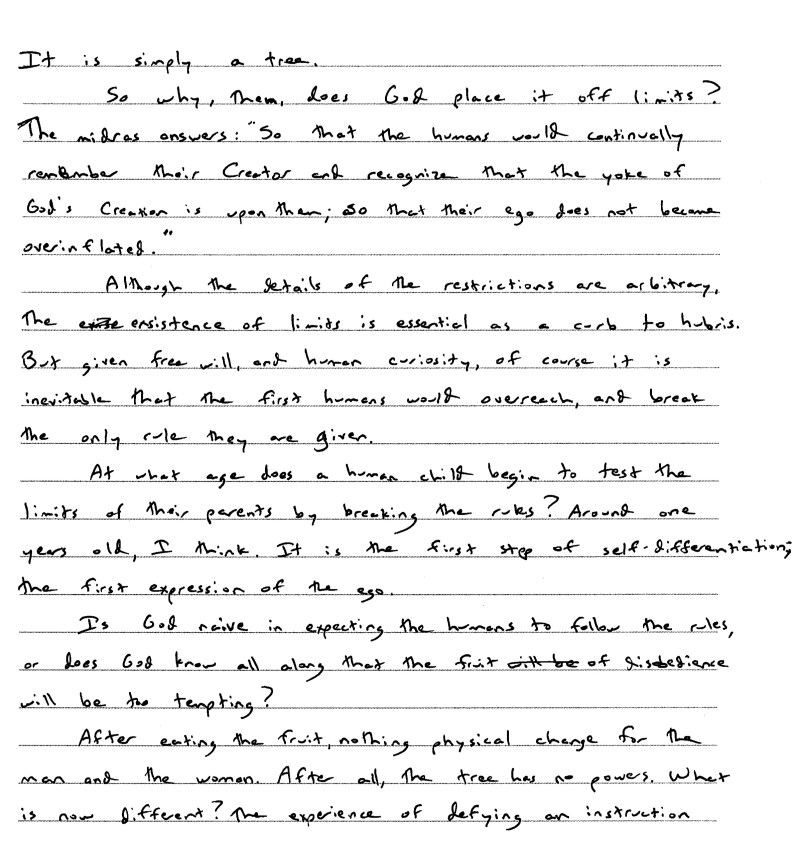
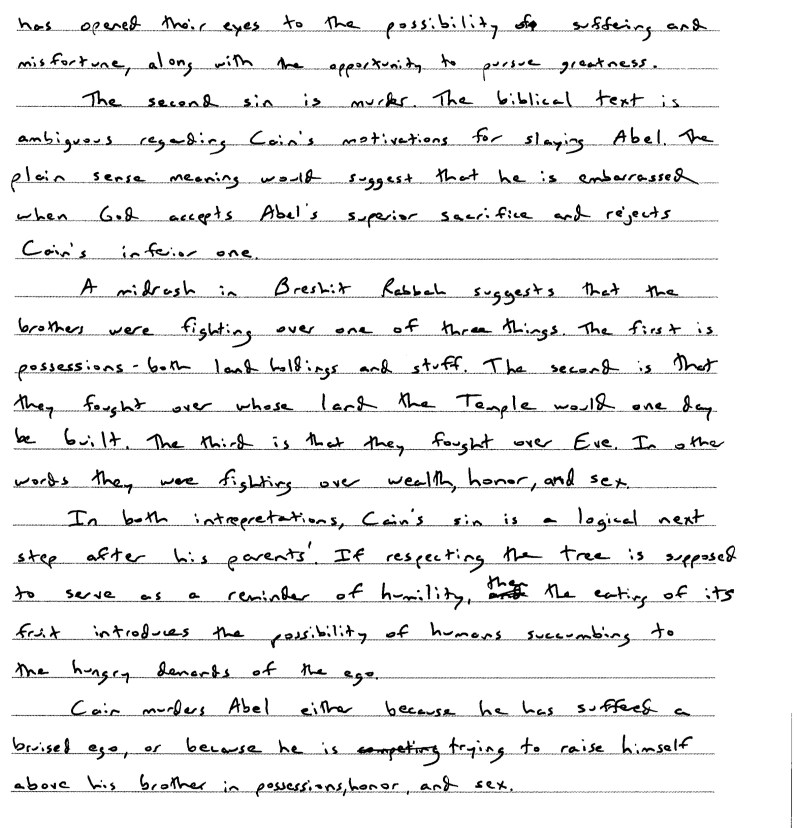
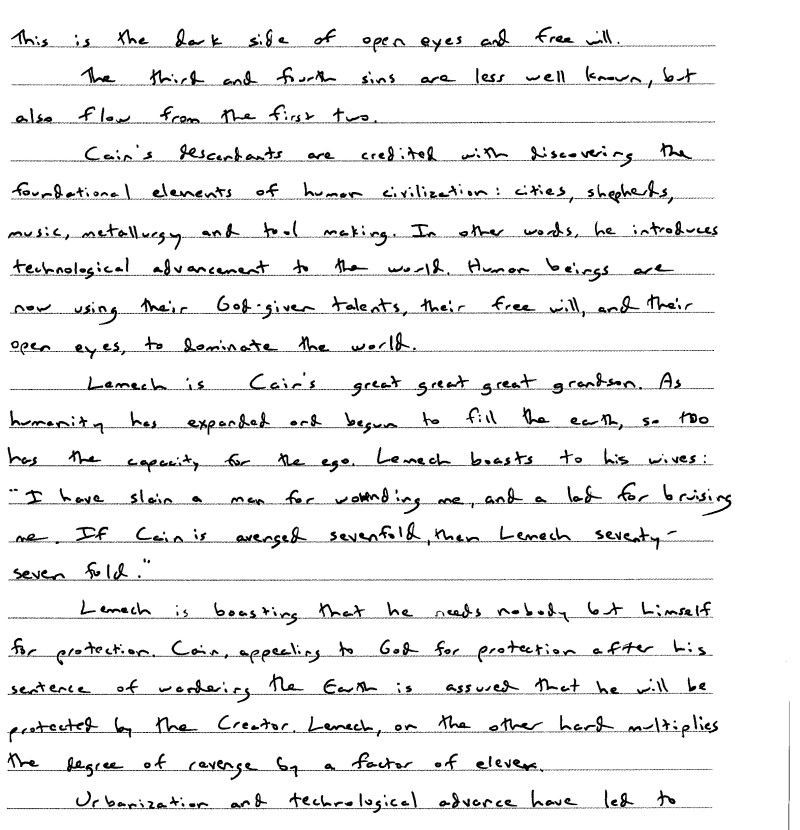
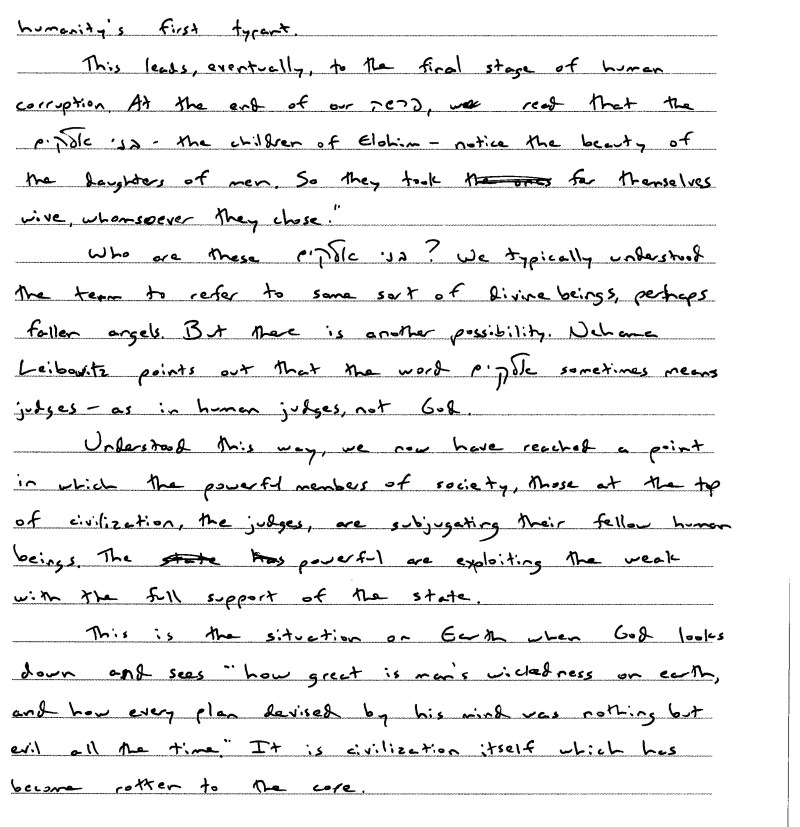
Bereishit 5777 – The Four Sins of Bereishit and the Expansion of the Human Ego

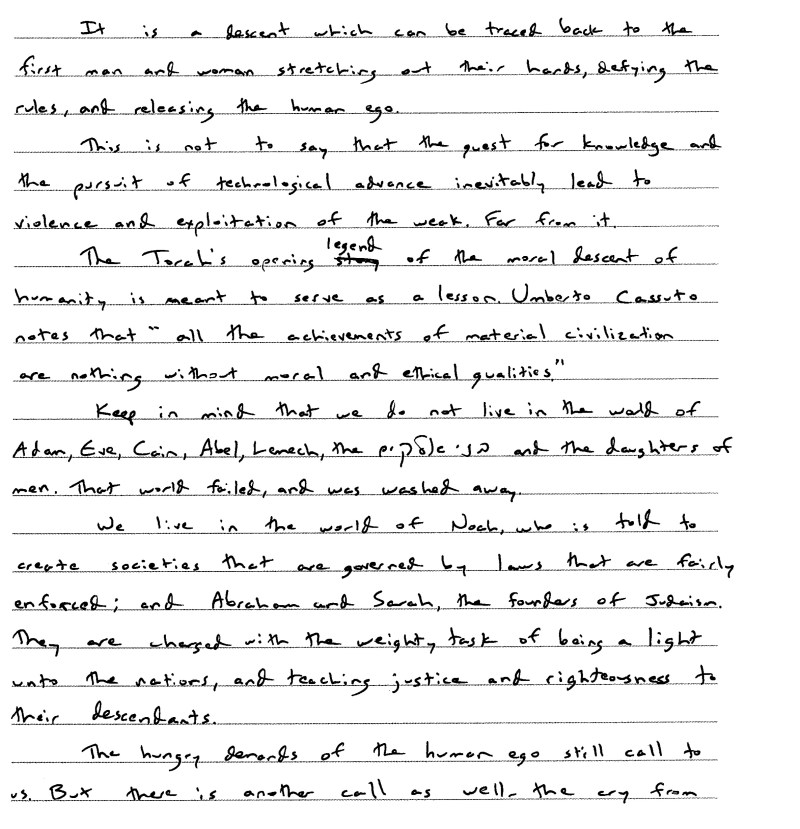
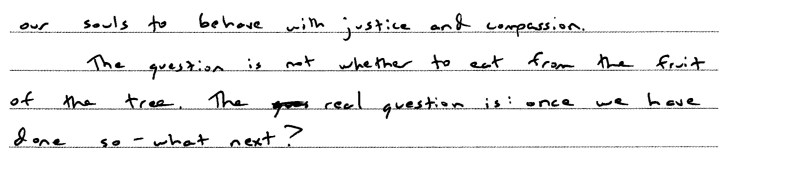
I have been feeling a bit addicted to technology lately, so I resolved to do something that I have not done in about two decades.  I wrote a sermon completely by hand, without using anything whatsoever with a screen for ideas or research.  I scanned it and am sharing the results below (I get the irony).  Sorry if you can’t read my handwriting.
bereishit-5777-the-four-sins-of-breishit1bereishit-5777-the-four-sins-of-breishit2bereishit-5777-the-four-sins-of-breishit3bereishit-5777-the-four-sins-of-breishit4bereishit-5777-the-four-sins-of-breishit5bereishit-5777-the-four-sins-of-breishit6bereishit-5777-the-four-sins-of-breishit7bereishit-5777-the-four-sins-of-breishit8

Know the Genre – Bereishit 5776

Imagine a space alien landing on earth and reading the headline of an article that I saw posted on Facebook earlier this week.  “Texas: 14-Year Old Virgin Falls Pregnant After Flu Shot.”  Our alien visitor, reading this article in an official sounding publication called World News Daily Report, might take it as accurate news reporting rather than satire.  A bit of digging would hopefully lead the alien to the truth.

One of the most important aspects that a reader must understand about what he or she is reading is its genre.  Usually, we understand genre inherently without needing to spend any time consciously considering the type of literature that we are reading.

If I open the front section of the newspaper, I know that I am reading current events articles about something going on right now in the world.  If I open up a book written by John Grisham, I know that I am probably reading a fictional novel that is in the sub-genre of legal thriller.  We run into trouble with genre sometimes online with fake news articles that are forwarded or posted on Facebook.  If I peruse an article published by the Onion, for example, hopefully I know that I am reading satire.  Otherwise, I could get into trouble.

Generally speaking, our brains know how to classify the various kinds of writing that we encounter on a daily basis.  We do this by comparing what we read to what is already familiar.

When we read literature from far away places and long ago times, however, we are at a similar, if not even a greater, disadvantage as our alien friend.

In high school, I had opportunity to read Thucydides’ History of the Peloponnesian War as well as Homer’s The Iliad and The Odyssey.  To properly understand these masterpieces, it is essential to be aware of their genre.  In the case of Thucydides, his book is one of the earliest examples of historical writing.  A political philosopher and general, he writes of the war between Athens and Sparta in the 5th century BCE.  He takes great effort to stick to facts, and his explanations do not include maneuverings and interventions by the gods in human affairs.  Someone who wants to learn about military history, or study that time period, must read this classic first-hand description.

In contrast, Homer’s telling of the Trojan War and the wanderings of Odysseus are not historical accounts.  Rather, human beings are mere tools manipulated by the gods in their grand feuds and struggles.  The Iliad and The Odyssey are epic poems containing myth and legend.  One should not read them to find out “what happened,” but one should look to them to understand the beliefs and values of Ancient Greece, to understand something about the human condition, as well as enjoy two of the most beautiful epic poems ever written.

Which author’s works are more “true” – Thucydides are Homer?  It is an absurd question.  Both are true, but in different ways.  Understanding genre is essential for knowing this.

The same is true when we read our Sacred Texts.  Today, we begin our annual cycle of weekly Torah reading and study.  Parashat Bereishit – the beginning.  The beginning of what?  Let’s leave that question aside for now and say simply that it is the beginning of the Torah.

So let’s talk about genre.  Our Bible, the Tanakh, is a huge, composite book composed over a span of about one thousand years by many people, with different life experiences, values, and concerns.  Within the Bible, and within the Torah specifically, there are many genres and sub-genres represented.  Let us name a few:

Law codes.  History.  Legend.  Satire.  Prophecy.  Poetry.  Prayer.  Theology.  Wisdom literature.  Mythology.  Propaganda.

If we are going to begin to understand our Bible, we have got to make an effort to understand what kind of literature it is that we are reading.

As our Sacred Scripture, we consider the text to be universal and timeless.  That does not mean that we can ignore the central questions about what the text is, or that we can ignore the cultural context in which it first appeared.

The first three chapters of the Torah tell the story of creation.  How does the Torah itself want us to read these stories?  How would someone living in the land of Israel nearly three thousand years ago have understood them?

A close reading of these three chapters reveals inconsistencies.  Chapter one through chapter two, verse 4a seems to tell one version of the creation story.  Chapter two, verse 4b through chapter three tells a different version.  The language in each version is different.  The character of God, as well as the nature of humanity and order of creation are also contradictory.  God even has a different name in these two narrativez.

Version one tells the story of six days of creation.  It is highly structured and organized.  God, referred to as Elohim, creates each element of the world at a specific time.  Human beings are created last, in the image of God, both male and female.  Then God rests on the seventh day.

In version two, God, referred to as Adonai Elohim, creates a man named Adam and then places him in the Garden of Eden.  Eventually, after lonely Adam cannot find a suitable companion amongst the animals, God removes one of Adam’s ribs and makes a woman.  Then, we read the story of the woman, the snake, and the Tree of Knowledge of Good and Evil.  The story results in humans being banished from the Garden of Eden and being forced to wander the earth, earning their living and bearing children through hard work and struggle.

Our interpretive tradition is typically uncomfortable with contradictions in the Sacred Text.  So it tries to find ways to settle those contradictions.  To explain what, on the surface, seems like alternative versions of creation, it describes the events in the Garden of Eden described in chapters two and three as all taking place on the sixth day.  But these explanations ignore many of the details.

In the twenty first century, many of us get stuck on what seems, on the surface, to be an incompatibility between Torah and science.  We are trained to be skeptical readers, to question the historical accuracy of what we hear, and to demand evidence and facts before we accept a proposition.

This comes up a lot for children, sometimes as early as second or third grade.  How do we respond to our kids when they say to us: “I don’t think that ever happened,” which sometimes leads to “I don’t want to be Jewish”?

First of all, I have no argument with someone who says that the Earth cannot have been created in six days.  I agree.  By the way, I do have an argument with someone who tries to fit the latest scientific theories of evolution or the Big Bang into the words of the Torah.  The Torah is not a science book.  We should not be tempted to turn it into one.

Just because it did not happen that way does not mean it is not true.  An answer, I believe, comes down to understanding the concept of genre.

This is not simply a postmodern approach to our Sacred Texts.  Although they used different terms, some of our greatest scholars understood the importance of recognizing genre and accepting the limitations of what the text is able to tell us.

The great thirteenth century Spanish Rabbi, Moshe ben Nachman, known as Nachmanides, was a great Torah scholar, philosopher, legalist, and kabbalist.  He wrote a commentary on the Torah.  In his opening comment, he explains that the process of creation is a deep mystery that cannot be understood from the verses, and it can only be known through the oral tradition going back to Moses, who received it from God on Mt. Sinai.  Then he adds that those who know it are obligated to keep it secret.

Nachmanides goes on to explain that all of the descriptions of creation: day one, day two etc., as well as Adam and Eve in the Garden of Eden, and the accounts of the generations leading up to the flood, the Tower of Babel, and so on – none of these events can actually be understood from the verses in the Torah.  Basically, he is saying that the first eleven chapters of Genesis are not reporting historical facts.

What, therefore, is the Torah’s purpose in describing the six days of creation?  Nachmanides offers the same answer as Rashi, which is based on a midrash (Genesis Rabbah 1:2).  According to the midrash, the Torah’s description of creation establishes the entire earth as belonging to God, its Creator.  Thus, God has the authority to grant land to one people, and then subsequently take it away and give it to another.

In reading Nachmanides’ commentary, we need to understand that he himself is writing in a particular time and place, with his own unique perspectives, assumptions, and interests.  His worldview does not necessarily align with our own, seven hundred years later.

What we call “science” today was not familiar to Nachmanides.  He did not know about the Big Bang Theory, evolution, or radio carbon dating.  We can only speculate how he would have reacted to those concepts, and how that knowledge might have affected his commentaries.  As someone who studied medicine and philosophy, he might have been open to science.  On the other hand, he opposed the extreme rationalism of Maimonides that downplayed the Torah’s descriptions of miracles by explaining them as metaphors, and he was a practicing kabbalist who accepted many of our tradition’s supernatural stories as historically true.

I find it reassuring to know that Nachmanides acknowledged that the Torah’s account of Creation is not science.  For him, the purpose is theological and political.  It justifies Israel’s claim to the land of Israel and counters charges by other nations that the Jews stole it unjustly.  (Sound familiar?)

While the secrets of how God actually created the universe are known to some, that knowledge is in the realm of mysticism, and is not intended for popular dissemination.  The concepts are either too esoteric, or difficult, or perhaps even dangerous to share with the general public, and so the Torah tells us nothing about how creation historically took place.

So let us take a step back and look at these stories with new eyes.  Or rather, let us try to look at them through the eyes of an Israelite nearly three thousand years ago.

What is the genre?  Both stories speak about origins.  The origin of the earth and the seas, the sun, moon, and stars, plants and trees, sea and land animals, birds, insects, and humans.

In today’s terms, what would we call a text that speaks about the origins of these things?  We would call it science.  So there is an inclination when we read the Torah to think that we are reading a scientific, historical account of how the world and life came into existence.

But that is an incorrect reading.  In science, when there are contradictions in the evidence, it generally means that there is something wrong with the theory.  The problem with reading the Torah as science or even history is that the text is not internally consistent, and it is often not consistent with what we know from extrenal sources.  As science, and often as history, the Bible is terrible literature.

But the Torah is neither a science nor a history book.  Science and history, as we know them, did not even exist when the Torah was written.  That is the wrong genre.

A better term to describe these stories is “myth.”  Confusingly, “myth” has two main definitions which are diametrically opposed to one another.

For decades, a book has been published every few years called Myths and Facts: A Guide to the Arab-Israeli Conflict.  I do not bring it up to talk about politics, but to illustrate how, colloquially, the word “myth” means the opposite of facts.  If something is a myth, it is not true, and might even be a deliberate lie.

But that is not the definition of myth that is used by anthropologists and sociologists.  Quite the opposite, a myth conveys something that is of ultimate truth, even if it is not historically accurate.  One classicist writes that myth is “a traditional tale with […] reference to something of collective importance.”  (Walter Burkett, Structure and History in Greek Mythology and Ritual, as quoted in Marc Zvi Bressler, How to Read the Jewish Bible, p. 39.)  Myths reveal the core beliefs of a people and help to explain the human condition.  Most cultures have a creation myth that explains how the world came into existence and how human beings fit into that existence.

Both of the Torah’s creation narratives fit that definition, although they convey different messages.

The first version is about God’s taming of the forces of chaos and evil.  In systematic fashion, God pushes aside the already-existing primordial waters to separate earth from sky, and land from water.  Each creative act of order is declared to be “good,” with humans, the final creation, described by God as “very good.”  Holding the forces of chaos at bay has been God’s preoccupation ever since.  The narrative ends with God observing Shabbat on the seventh day.

The second story has a different focus.  It is a far more anthropocentric story.  God first creates Adam and then makes the Garden of Eden, introducing plants and animals to serve the human.  As an origin story, it tells of the loss of human immortality and the gaining of sexual knowledge.  It describes the roles of men and women vis a vis each other in the ancient world.  It explains why it is so hard to earn a living, and why childbirth is so painful and dangerous.  Then, and now, these are some of the central aspects of human existence.

So while God did not create the earth in six days, and while two people named Adam and Eve never walked around naked in the Garden of Eden, each of these creation stories is true in a profound way.  Understanding how they are true makes them relevant and alive for us.

As we begin a new year of Torah study, let us come to these texts with open eyes and open hearts, with the presumption that Torah has something profound to teach us.  It is our task, through engaging with Torah, to discover what it is.