Shabbat Chazon 5785 – My Fear This Tisha B’Av

As Tisha B’Av approaches this year, I find myself feeling particularly anxious. I want to be open with you about what I am struggling with, with what I am feeling in this moment.

First, I’ll say something about the day itself.

Originally, Tisha B’Av, the ninth day of the month of Av marked the destruction of the First Temple by the Babylonians in 586 BCE. It is described by the Prophet Zechariah as one of four fast days that will be transformed into days of celebration when the Temple is rebuilt. For Zechariah, that prophecy was fulfilled by the establishment of the Second Temple.

When the Romans brutally crushed the Judean revolt, they destroyed the Second Temple on the same date in 70 CE.

Now twice cursed, the ninth of Av became the day into which all national suffering and tragedies of the Jewish people would be folded.

The second-century Rabbis of the Mishnah looked back and attributed to Tisha B’Av the sin of the spies in the wilderness, who brought back news to the Israelites that the Promised Land was inhabited by giants whom they stood no chance of defeating. Their lack of faith in God’s plan doomed this day for eternity, says the Mishnah.

That is why, they explain, God selected that day to destroy both Temples. They add, further, that Bar Kochba’s last holdout at Betar fell on this same day in 135 CE. One year later, Hadrian plowed over the city, built a pagan Temple on the site, and banned Jews from entering, except for one day a year.

To rub in their suffering, Jews would be allowed, for a fee, to visit the Temple Mount on the ninth of Av, where two statues of the Emperor Hadrian greeted them amidst the ruins.

For two thousand years, our observance of the fast of Tisha B’Ab centered on the mournful chanting of Megillat Eichah, the Book of Lamentations. Eichah depicts, in tearful detail, the suffering of our ancestors during the Babylonians’ destruction of Jerusalem. While chronicling a specific historical event, Eichah’s description of human misery applies to countless tragedies through the ages.

Added to this, over the centuries, were the addition of Kinot, mournful elegies. These poems describe other tragedies that befell our people, whether or not they occurred on this specific tragic day.

Many Kinot were written during the Crusades, which saw the slaughter of so many Jews and the destruction of countless thriving communities. Kinot mourn the burning of the Talmud in Paris in 1242, and the expulsion of the Jews from Spain in 1492.

Add to this the other expulsions and persecutions, the blood libels, the Chmielnicki Massacres, and the Holocaust. Tisha B’Av is the Memorial Day of the Jewish people. 

Already, and not surprisingly, the massacre of Oct. 7, 2023 is added to the list. I suspect that the plight of the hostages, for 665 days now, will also become part of our narrative of this tragic day. 

The liturgy of Tisha B’Av expresses three main ideas. The first is that the various tragedies that have befallen us are expressions of Divine anger. Punishments against the Jewish people for our sins.

The Rabbis attribute the fall of the First Temple to the sin of idolatry. Nebuchadnezzar was but a pawn, a tool wielded by God to administer judgment against our ancestors for failing to heed the message of the prophets.

The Second Temple fell as a result of the sin of Sin’at Chinam – senseless hatred of Jew against Jew.  Again, the Romans were mere instruments of Divine wrath.

This theological justification for our ancestors’ suffering leaves me feeling uncomfortable. It sounds like blaming the victim. But that is the dominant theology that the Rabbis express throughout the Talmud and midrashim, and that is picked up in the Kinot. “Oh, how these things have befallen us, we must have done something to deserve it.”

But then, we encounter another sentiment. The wailing and crying is turned against God, who surely must see our suffering and have compassion. We cry out against a God who has seemingly forgotten and abandoned us and shout, “Here we are! Don’t you see us?”

Some of the Kinot direct our rage against our oppressors, who make fun of us and mock God. They are not mere instruments of Divine wrath. It is their hatred and violence that caused our suffering. 

Finally, and importantly, Tisha B’Av contains elements of hope.  Most Kinot end on a hopeful note that God will remember us. We end our chanting of Eichah with the words: “Take us back, O Lord, to Yourself, And let us come back; Renew our days as of old.”

We sit on the floor during the evening and morning services. Then in the afternoon, the mood begins to change. We put on the Tallit and Tefillin that we neglected during Shacharit. It is said that the Messiah will be born on the ninth of Av. The seeds of redemption are sown in destruction.

The seven weeks after Tisha B’Av are referred to as Shiva D’nechemata – The seven weeks of consolation.  The Haftarot that we recite on those seven Shabbatot are filled with language of comfort, healing, and hope. 

The Talmud teaches, “Those who mourn for Jerusalem will merit to see its rejoicing…”

By concentrating all of our mourning into a single day, we make sure that it does not overwhelm us throughout the year.  During this day, we go through the three stages. First we look inward, and ask ourselves how we have gone astray. Next we look outward, to proclaim to God that our suffering is unreasonable, that it is our enemies who have wronged us. And then we look to the future, so that we can step back into the world after our mourning with hope.

This year, more than any in my lifetime, I find myself feeling increasingly worried as Tisha B’Av nears. Hatred of Jews and Israel has become more accepted in the world than at any time I can remember.

At the moment we find ourselves in, Israel, home to half of the world’s Jews, is becoming a pariah state. 

The images of starving children in Gaza, and the daily reports of civilian deaths, regardless of who is or is not at fault, take their toll. Perceptions of Israel and of Judaism around the globe are becoming increasingly negative.  This includes among our own people, especially younger generations of Jews.

We can complain about it. We can argue about whether it is misguided or naïve. We can point out how Hamas launched the war and has been stealing the food and supplies meant for Palestinian civilians, but those arguments are not working.

Pointing out how complicated it is cannot compete with a simplistic statement like “Stop the genocide.”

Explaining how Hamas hides underground, letting their people starve, instead of releasing the hostages, simply cannot compete with photos of children crying in a mass of people, pressed up against a metal grate in front of a food distribution center.

Declaring, “What about the millions of people facing war and starvation in the Congo, or Sudan, or the persecution of the Uighyers in China, or the Rohingya, or take your pick,” will never convince anyone.

Whether or not Israel’s War in Gaza is justified, and I do believe it is, anyone with a heart cannot but be moved by the suffering that is happening right now. Suffering which, by the way, is a lot like what we will be reading later tonight. Whether or not Israel is at fault, it is responsible to do everything it can to prevent starvation. I do believe that deep in my heart.

I don’t know what is actually happening on the ground. I read all of the same articles and accounts that you do, and I do not have any confidence in the actual situation. All I can say is that I hope that the IDF is operating according to its stated principles and is doing its best to prevent suffering.

I am afraid that the impact on attitudes about Israel and about Judaism and Jews is taking a hit that will take a long time to recover.

This will lead to continuing violence against Jews around the world, like we have seen recently in this country in D.C. and Colorado. It will be awful. But we know how to deal with that.  We have been doing it for thousands of years. That is why we have Tisha B’Av. We look inward. We look outward. We look forward to better times. 

What I am afraid of, and this is the first time I have voiced this in a sermon, is that a generation of Jews is going to decide, “It’s just not worth it,” and walk away from the Jewish people. And then that, too, will become part of the narrative of Tisha B’Av. That’s my fear.

I don’t have the secret formula to prevent this. But I suspect the remedy probably involves something along the lines of increasing our own commitment to Torah learning, Jewish practice, and living proudly as members of the Jewish people, despite the differences we have. 

I’ll add as well that living here in Silicon Valley, where there is such a large Israeli ex-pat community who have very different experiences of the war in Gaza, it is so important to be in open communication with that segment of the community.

I’ll add as well that programs like Camp Ramah, at which I was able to spend last week, is also critical. It is an explicitly Zionist camp. There is a large Israeli contingent. We are surrounding our kids with pride in Judaism, a love of who we are, and connections that last a lifetime.

Supporting kids within our synagogues who are surrounded by these kinds of experiences on a daily and weekly basis – that has to be part of the solution. We need to double down on that.

I hope my fear is unjustified. 

So I will end with the closing words of this morning’s Haftarah that we chanted just a few minutes ago.

וְאָשִׁ֤יבָה שֹׁפְטַ֙יִךְ֙ כְּבָרִ֣אשֹׁנָ֔ה
וְיֹעֲצַ֖יִךְ כְּבַתְּחִלָּ֑ה
אַֽחֲרֵי־כֵ֗ן יִקָּ֤רֵא לָךְ֙
עִ֣יר הַצֶּ֔דֶק קִרְיָ֖ה נֶאֱמָנָֽה׃ 

צִיּ֖וֹן בְּמִשְׁפָּ֣ט תִּפָּדֶ֑ה
וְשָׁבֶ֖יהָ בִּצְדָקָֽה׃

I will restore your magistrates as of old,
And your counselors as of yore.
After that you shall be called
City of Righteousness, Faithful City.” 

Zion shall be saved in the judgment;
Her repentant ones, in righteousness.
The Rise of Civil Society – Vayakhel 5784

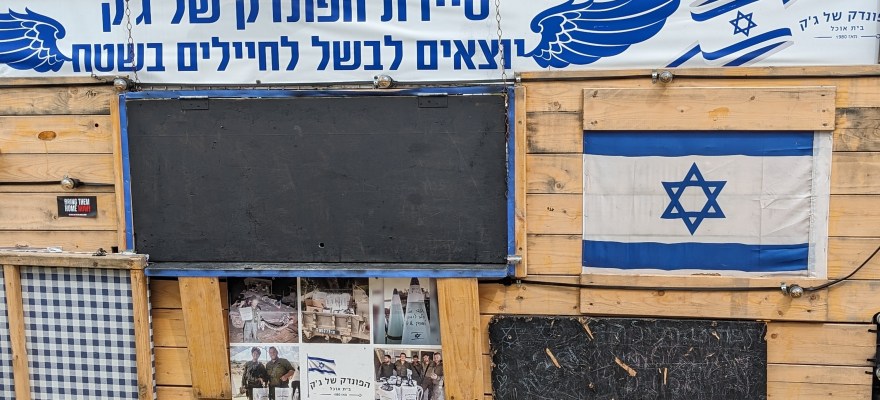
Two weeks ago, on Friday afternoon of the South Bay Solidarity Mission to Israel, we went to HaFundak shel Jack – “Jack’s Inn,” a well known home style restaurant at the entrance to Moshav Beit Nehemia in Shoham. We were there to pack up 450 meals for IDF soldiers out in the field.

After October 7, the owner of the restaurant, Meir, who was too old to be called up to the reserves, began providing daily hot food to families, soldiers, anyone in need.  He put out a call for volunteers. Within a short time, he had a list of 650 people who regularly come to cook, package, and deliver. They rely on donations to pay for all of the supplies.

After we finished packing everything up, I carried 250 meals out to the parking lot to load into a woman’s car. She had returned that morning from a trip to France, and now her job was to shuttle the meals to Kfar Saba, where another volunteer would pick them up and drive them to a brigade of soldiers in the lower Golan.

As I carried the boxes, I was thinking about logistics. By now, Jack’s Inn has served tens of thousands of meals. How do you organize something like this?

It started with just a guy with a restaurant who felt called to employ his skills to help people in a difficult time. What an inspiring example.

This morning’s Torah portion, Vayak’hel, includes a similar such example.

After cleaning up the mess of the Golden Calf, Moses unveils the project that was supposed to take place upon his descent from Mt. Sinai the first time: the building of the Mishkan, the Tabernacle.

First, he lists all of the raw materials that the Israelites need to collect: the precious metals, woods, animal hides, fabric and gems. Then, he puts the call out for those who have skills in a wide range of areas such as: carpentry, smithing, carving, sewing, and weaving. He appoints two chief artisans, Betzalel and Oholiav, to direct the project.

The Torah repeatedly indicates how inclusive this project is —men and women, tribal chieftains and those at the bottom rungs of Israelite society — everyone jumps to get involved. The people are so enthusiastic that, after not too long, the artisans report some surprising news to Moses. The Israelites responded so positively to the campaign, that they have are inundated with more supplies than they know what to do with.

Moses orders the Israelites to stop contributing. The Torah reports that “their efforts had been more than enough for all the tasks to be done.” (36:7) The first and only time that happened.

One of the places that we visited during the Israel Mission was the Tel Aviv Expo Center, which had been converted into ḤaMaL Tel AvivḤaMaL is an acronym for Cheder Milḥamah, or “war room.” It is a term taken from the military to refer to the command center of an operation. We spoke with Ronen, the volunteer director of the ḤaMaL Tel Aviv. Ronen has led a few startups, and still serves as a Reserve Officer in the Israeli Navy. 

The ḤaMaL Tel Aviv has been the central coordination center for the Israeli civil society’s response after October 7. “Civil society” is in contrast to the government. One of the recurring stories that we heard was about the government’s continued absence, not only in its lack of military readiness, but also in failing to respond quickly after the attack, to inform the public, coordinate defense, rescue, evacuation, and then provide for all of the social needs for those who became displaced.

In the government’s absence, Israeli civil society stepped up in a way that expresses the Jewish ethic of mutual responsibility and the Israeli ethos of “Startup Nation.”

To understand how the events played out, we need to go back a little over a year. When the government announced its judicial reform plans, a group of IDF reserve officers, fearing that the changes to the judiciary would lead to the erosion of Israeli democracy, started an organization called Aḥim Laneshek – “Brothers and Sisters in Arms.” This became one of the main organizations coordinating the anti judicial reform protests that lasted for months.

In the course of those political demonstrations, Aḥim Laneshek built an incredibly robust grassroots organizational network. It included many IDF reserve officers with significant leadership experience, as well as Israelis from the high tech sector who brought their own skillsets.

When Hamas attacked on October 7, Aḥim Laneshek immediately pivoted. They renamed their organization Aḥim v’Aḥayot L’Yisrael– “Brothers and Sisters for Israel,” and made three strategic decisions that would guide their actions over the coming months: 1. The IDF must win.  2. Support civilians who were hurt.  3. For the sake of unity, they would not do anything related to judicial reform.

By Sunday, October 8, they had already divided up the responsibilities. By Monday, computer programmers were building dashboards to organize the workflow. In less than a week, Aḥim v’Aḥayot L’Yisrael had built the back-end infrastructure to run a nation. There is now a ḥamal ezraḥi, a citizens coordination center, in every part of the country. 

Within four days, they set up a military-grade intelligence center to collect and analyze information, including going through photographs and videos from social media to identify hostages. When the IDF visited the site the following day, they acknowledged that they could not replicate it, so they turned over their own intelligence to the volunteers.

With Israelis in the South still hiding in safe rooms, Aḥim v’Aḥayot L’Yisrael organized volunteer rescue teams to go into places that the IDF still had not cleared to rescue families, elders, and children, and bring them to safety. In some cases, they sent out teams to search for bodies. 

It quickly became apparent that many of the IDF units, especially reservists, did not have all of the equipment they needed. The network went into action, ordering a large shipment of helmets and ceramic vests.

It was going to take weeks for the equipment to arrive, but they needed it now. So they put the call out to the network and quickly identiified a supply chain specialist, who was able to track down an airplane that was not being used and bring in the helmets and vests right away..

Aḥim v’Aḥayot L’Yisrael has continued to supply soldiers, police officers, and especially Civilian Readiness Units, which despite being outnumbered and underequipped, saved thousands of lives on October 7. They have also brought 7 planeloads full of medical supplies into the country.

By the following Saturday night, it had become apparent that tens of thousands of Israelis would need housing, and the government was not doing anything about it. Volunteers went to Eilat and the Dead Sea to determine hotel capacity and to identify the needs of evacuees and their children. Aḥim v’Aḥayot L’Yisrael were the only ones supporting those families for weeks. In the months since, they have opened 90 kindergartens in hotels.

People had to leave their homes quickly, and did not have time to gather their things, so Aḥim v’Aḥayot L’Yisrael put the call out for basic household supplies, clothing, toiletries, toys, and so on, for all of the dissplaced families. Think for a moment about what would would have to happen to effectively collect and distribute essential items across an entire country. In days, they set up the infrastructure to collect donations, sort them in warehouses, and efficiently distribute what was needed to those in need. This was 100% volunteer driven.

Just as when the Israelites built the Mishkan, the nation responded so enthusiastically that they eventually had to stop collecting supplies. “their efforts had been more than enough for all the tasks to be done.”

With the departure of most of the agricultural workers, Aḥim v’Aḥayot L’Yisrael organized thousands of volunteers to go out into the fields to harvest and plant crops.

Across the country, there are now 15,000 regular volunteers, coming from every segment of Israeli society, crossing social, religious, ethnic, and political lines.

Aḥim v’Aḥayot L’Yisrael, which was initially founded as a left-wing, political organization, has managed to bridge divisions with a number of the more right-wing communities they have been working with. “The mayors love us,” our presenter shared. 

Five months in to this war, the immediate needs have been met, and Aḥim v’Aḥayot L’Yisrael is transitioning to preparing communities to be able to return to their homes.

As we encountered this and other organizations and individuals, a few things occurred to me. First of all, the incredible selflessness demonstrated by so many regular people to do absolutely everything they could to help each other out. And Israel is not a homogenous society.

When I think about life here in the Bay Area, I cannot imagine such a widespread, grassroots, cross-cultural volunteer effort coming together.

Second was the attitude of “just get it done.” Israelis are not known for waiting for permission. There have been countless examples of people, recognizing a problem that needs a solution, and devoting oneself to gathering the resources, human and material, to solve that problem quickly.

Third, this is taking place in a traumatized society. In fact, within days of October 7, Israelis were already turning out in the tens of thousands to volunteer. Many of us might respond to trauma by shutting down, retreating from society. Israelis did the opposite, they jumped in, a far more effective response to trauma, I would imagine. 

One person we met, a retired career diplomat, the former Ambassador to France, who is now volunteering with the Hostages and Missing Families Forum, shared that this is the most meaningful work he has ever done in his life.

What are our duties as citizens? Here in America, we tend to not think of citizenship carrying with it many obligations, other than following the laws, paying our taxes, and possibly voting. 

Ronen, our guide at Aḥim v’Aḥayot L’Yisrael said that in the last year, he has learned that being citizenship is more than that: it includes a duty to give back. 

He considers what they have done, both before October 7 when they were protesting against the judicial reforms, and after, when they pivoted to supporting Israeli society, an expression of Zionism and patriotism.

That is surely something to aspire to.

Might and Peace – Noach 5784

My heart is still broken, broken for 1,400 Israelis who were killed and their families. We have been witnessing the funerals and the shiva and a nation that is still in the midst of trauma.

I am relieved for the release of mother and daughter Judith and Natalie Raanan yesterday, and praying for the 200 others who were taken hostage, particularly 30 children whose fate and whereabouts remain unknown.

Once again, we have in our Torah portion a fitting story to describe our current reality.

By the end of last week’s parashah, the humans, who were created in the image of God, whom God blessed and declared to be tov me’od, very good, have failed to meet expectations. After just ten generations, God sees “how great was man’s wickedness on earth, and how every plan devised by his mind was nothing but evil all the time.”

How sad. The creation that God declared to be “very good” is now “nothing but evil all the time.”

As this morning’s Torah portion, Noach, opens, the Divine displeasure continues. 

וַתִּשָּׁחֵ֥ת הָאָ֖רֶץ לִפְנֵ֣י הָֽאֱלֹקִ֑ים וַתִּמָּלֵ֥א הָאָ֖רֶץ חָמָֽס׃ 

The earth became corrupt before God; the earth was filled with ḥamas. When God saw how corrupt the earth was, for all flesh had corrupted its ways on earth, God said to Noah, “I have decided to put an end to all flesh, for the earth is filled with ḥamas because of them: I am about to destroy them with the earth.

Genesis 6:11-13

The irony is tempting. Ḥamas is the Hebrew word for lawlessness. It is a word that expresses the chaos and evil of the world before the flood, the complete lack of boundaries and respect for the divinity contained within every human being. 

God decides to wipe it all away, to allow the waters of chaos to undo all of the order and good that God had created. And God decides to give us another chance.

After the flood subsides, Noah offers a sacrifice. When God smells the pleasing odor, God says to Godself, “Never again will I doom the earth because of Adam, since the devisings of Adam’s mind are evil from his youth…”

Notice that human nature has not changed one bit. God uses nearly identical language to describe humanity’s proclivity for evil. But this time, God provides some instructions. Among them, one stands out in this moment. 

For your own life-blood I will require a reckoning… of every man for that of his fellow man! Whoever sheds the blood of man, by man shall his blood be shed, for in His did God make man.

Genesis 9:5-6

This verse, considered by our tradition to be the basis of one of the seven Noachide commandments, forbids murder, the wrongful taking of human life. And, it obligates human beings to punish the one who commits murder.

This is the foundational principle of justice. Human beings may not wrongfully harm one another, and society must have institutions in place both for protection, as well as for lawful adjudication and punishment.

In a world that is prone to chaos, this is the only way that we can hope to live together.

In the next passage, God makes a covenant with Noah and his children, establishing the rainbow in the clouds as a sign of God’s commitment to never destroy the earth by flood again.

We tend to think of the rainbow as a symbol of peace, but that is not quite right. In the language of the Torah, the rainbow is a sign only for God. For God, it is a sign of stepping back. It is a sign of God being resigned to the inherently selfish and violent qualities of humanity. The Torah does not say anything about what the rainbow is supposed to mean for us.

But implied by stepping back is that God is saying to us, “I cannot solve your problems for you. From now on it is your resonsibility. You may not allow the lawlessness that existed before the flood to persist.  You are created in My image, and that means you have an obligation to rise above your evil nature.”

From this perspective, to hold someone accountable for their evil actions is to treat them as a human being. When Hamas commits its atrocities, justice demands a response. 

When innocent civilians are taken hostage, every effort must be made to bring them home, and those who took them must be punished. Why? It is because every human is made in the image of God.

We know the problem. Hamas and its allies surround themselves with civilians. They hide in schools and mosques, and fire rockets from right next to hospitals.

This makes it impossible for Israel to target its enemies without harming civilians. I trust that the IDF, in its training, its policies, and in its wartime decision making, strives to abide by the ethics and laws of war. But war is messy, especially in the Middle East. I do not envy those who have to make the decisions.

While none of us can know what the future has in store, this war will likely go on for some time. It will be ugly. Many civilians will die, mostly Palestinians. The propaganda battle will be intense, and we can predict how it will play out. As time goes on, Israel will come under increasing pressure to agree to a cease-fire.

The reality is that from here in San Jose, there is a little that we can do to impact any of this, other than by sending money and continuing to reach out on the human level to friends and family in Israel and here at home.

For me personally, I worry about what this war will do to my ability to see the Divine in every human being.

When news of the Ahli Arab hospital explosion came out earlier this week, my first reaction was to feel ill, saying to myself something along the lines of “I hope it wasn’t an Israeli bomb.” 

When it appeared to have been caused by an errant Palestinian Islamic Jihad rocket, I felt relief and vindication… and also anger and frustration that for so many, the truth of which side’s explosives caused the damage does not matter.

What I did not feel and still do not feel so much of, is sadness for the deaths of people who were already injured and already seeking shelter from violence. For them, what difference does it make whose bomb caused the explosion? They are human beings, made in God’s image. We are supposed to fell a connection to that. In the midst of war, it is so easy for that fact to be smothered by our tribalism. 

This is what war does. It hardens our hearts, making it difficult to feel compassion, making it hard to see the Divine in my fellow human being who is on the other side of the battle line.

It should be possible for us to simultaneously hold on to our love and support for our Israeli brothers and sisters, to pray for the safe return of the hostages, and also feel empathy for Palestinian civilians.

We should be able to pray for the defeat of Hamas, while also mourning civilian deaths.

And I know that there are not a lot of voices within the Muslim world that are calling for that kind of nuance right now. I was there were.

Is that not the burden that God placed on the children of Noah after the flood? To treat all life as sacred, as well as to hold to account anyone who violates that sanctity.

We recite Psalm 29 twice on Shabbat, once during Kabbalat Shabbat, Friday night, right before Lekha Dodi, and then when we return the Torah to the ark. The final two verses may sound familiar. Especially the last verse, which is used as the last verse in Birkat Hamazon, the Grace After Meals.

יְ֭הֹוָה לַמַּבּ֣וּל יָשָׁ֑ב וַיֵּ֥שֶׁב יְ֝הֹוָ֗ה מֶ֣לֶךְ לְעוֹלָֽם׃ 

יְֽהֹוָ֗ה עֹ֭ז לְעַמּ֣וֹ יִתֵּ֑ן יְהֹוָ֓ה ׀ יְבָרֵ֖ךְ אֶת־עַמּ֣וֹ בַשָּׁלֽוֹם׃

The Lord sat enthroned at the flood, the Lord sits enthroned, King forever

May the Lord grant oz, might to His people, may the Lord bless His people with shalom.

Psalm 29:10-11

I never thought about it before, but this last verse might seem contradictory. Asking for might sounds pretty militaristic, the direct opposite of peace. But history has shown that in our imperfect world, strength is what often makes peace possible. This is a lesson that the State of Israel certainly knows well.

Does shalom in this context really mean “peace.” I cannot accept that when we say “peace,” we mean “the annihilation of Gaza.”

I suggest that shalom, paired with oz, might paired with shalom, means something like wholeness and balance. When we are blessed with might, we pray that we not lose ourselves, that we not fall from the divine image, nor lose the ability to see the divine image in others, including even our enemies.

If we can’t strive for that, what business do we have praying for shalom?

Shalom is a Vessel for Blessing – Naso 5781

In the middle of Parashat Nasso, we come upon some of the most well-known and beloved lines in the entire Torah. These words are so popular that they can be found on the oldest known writing of verses from the Torah, dating back to the first Temple Era.

In 1979, at an archaeological dig in the Hinom Valley in Jerusalem, two small silver amulets were found by a thirteen year old boy. They were dated to the sixth or seventh century, BCE, earlier than any existing manuscript of the Torah. Those amulets contained the words of the Priestly Blessing.

יְבָרֶכְךָ֥ יְ-הֹוָ֖ה וְיִשְׁמְרֶֽךָ׃

יָאֵ֨ר יְ-הֹוָ֧ה ׀ פָּנָ֛יו אֵלֶ֖יךָ וִֽיחֻנֶּֽךָּ׃ 

יִשָּׂ֨א יְ-הֹוָ֤ה ׀ פָּנָיו֙ אֵלֶ֔יךָ וְיָשֵׂ֥ם לְךָ֖ שָׁלֽוֹם׃

For thousands of years, these words have been used to invoke God’s blessings. In the Torah, Aaron and his sons are instructed to use these words to channel God’s blessings on to the people. We include them in the Amidah, reciting them out loud whenever there is a repetition. We follow the Ashkenazi tradition at Sinai of duchenning on Yom Tov. The priests come up to the bimah to bless the congregation during the Musaf service. Parents bless their children on Friday nights using these words, and the bride and groom receive this blessing under the chuppah. 

Our tradition refers to it as the brachah hameshuleshet – The Three Part Blessing. In other words, it is a single blessing comprised of three parts. Its very structure expresses balance and completeness.  It has three lines, each of which has two parts. The three lines are comprised of three, five, and seven words which are formed by fifteen, twenty, and twenty five letters, respectively. The opening phrase of the first line and the closing phrase of the last line each have seven syllables. Jacob Milgrom describes it as “a rising crescendo.” Scribes write the Priestly Blessing with unusual spacing, another indication of its specialness.

But what does this Threefold Blessing mean? Throwing up his hands, one commentator (Kli Yakar) declares: “Numerous ideas have emerged to explain the meaning of the blessings – each person explaining them according to his intellect.” I would like to look this morning at one particular interpretation offered by the nineteenth century author of the Torah commentary HaEmek Davar, Rabbi Naftali Zvi Yehudah Berlin, known as the Netziv. Based upon his interpretation, we will see that the Threefold Blessing is in fact a single blessing, each phrase building upon its predecessor in a kind of story.

Moses is told to instruct the High Priest Aaron and his sons: “Thus shall you bless the children of Israel. Say to them…” Note that the blessing is delivered collectively, not to individuals. Consider how we recite the priestly blessing on holidays when we duchen. The priests channel God’s blessing to the entire congregation. That seems to be how Second Temple Priests would use it. If you were visiting the Temple, you could grab a priest wandering by and ask him for a blessing.  He would then assemble a group and use these words.

But then, when we get to the words of the blessing itself, the grammar changes. Yevarekhekha. “May the Lord bless you” – singular. A priest, addressing a group, speaks to them in the second person singular.

The Netziv comments that this blessing is directed to each individual “whatever it is appropriate for that person to be blessed with.” He gives a couple of examples. For someone who is dedicated to Torah study, the blessing is for increased learning. For one engaged in business, the blessing is for financial success. And so on, a blessing of abundance for whatever is most valued by each person in the group being blessed. The second part of the first line is v’yishmerakha – “and protect you.” The Netziv points out that an abundance of blessing brings with it certain risks. V’yishmerekha asks that the blessing one receives does not become a stumbling block. A Torah scholar needs to be protected from pride. A wealthy person needs protection so that affluence does not lead to evil. And so on. A blessing, unchecked has the capacity to cause suffering. The first line, therefore, is concerned with you, the individual recipient of God’s blessing. May you have abundance in whatever you most need, and may that abundance not lead to suffering.

We continue with the second line. Ya’er Adonai panav elekha. “May the Lord cause God’s light to shine upon you.” The story of blessing progresses. Light figuratively shines from the recipient of blessing. Other people, observing such success, recognize that it comes from God. It is not a matter of mere luck. The end of the second line is vichuneka – “And be gracious to you.” The story continues. When other people see that God has blessed you, they will undoubtedly come to you to ask for you to pray for God’s blessing on their behalf. Vichuneka refers to God’s grace in answering the prayers of the petitioner on behalf of others. If the first line is focused on the recipient of blessing, the second line is about extending that blessing to other people. We are asked to share our blessings. To use the gifts we have received in a way that improves the world around us.

Yisa Adonai panav elekha – “May God lift up God’s face to you.” Does God have a face? What is a face? HaEmek Davar equates a face with a midot, personal qualities. Joy and anger are reflected on a person’s face. And so, this blessing, calling for God’s face to be lifted to you, is asking for God to direct Divine attributes such as kindness, mercy, and forgiveness, towards the recipient of blessing. V’yasem l’kha shalom – “And may God place upon you peace.”  This comes at the end, after all the other blessings. Shalom is the vessel that strengthens all other blessings, says the Netziv.  “Without peace, there can be no enjoyment of any blessing.” This completes the story. A person receives blessing, the particular success that is unique to that person’s talents and interests. The sucess does not become a curse. In fact, that success can be translated to spreading blessing and success to other people as well.  The final step is God’s Presence, expressed through the metaphor of God lifting up God’s face to you.

The ending, shalom, is the coda. No blessing can be fully enjoyed unless there is peace. Or more accurately, “wholeness.” We might understand this spiritually as the kind of equanimity and peace experienced by a person who is at one with God. 

Speaking more generally, when we have opporunities to develop and maximize our talents, and we use them in ways that leave the world around us better, that is the recipe for a life well lived. Such a person experiences God’s presence and knows shleimut, wholeness, in their life. Perhaps you know someone like that, or maybe you are someone like that.  As a parent, when I bless my children on Friday night, this is the blessing for them that I hold in my heart.

This blessing contains a theology for what makes for a meaningful life. It is not enough to selfishly enjoy my own blessings. I have to work to make it possible for others to experience blessings as well. But it also contains a recognition that managing one’s blessings can be difficult.

Shalom can refer to an individual, spiritual feeling of wholeness, but we might also see shalom in more tangible terms. Peace and stability in the world around me. Without that kind of shalom, it is impossible to fully experience blessing.

The ceasefire between Israel and Hamas began yesterday (5/21/21). To be clear, it is a ceasefire, not peace.  We are far from peace. As I said last week, we are very distant from Israel. I am reluctant to dictate what I think Israel should or should not be doing.

But when I look at recent events, it seems to me that Israel is still struggling with how to live with the blessing of Jewish power. Israel has achieved so much in such a short time. As Rabbi Donniel Hartman pointed out this week, every war Israel has fought since 1973 has been an assymetrical war. It has fought against enemies with less technology, less hardware, and less military advantage. Israel’s existence has not been at stake for nearly fifty years. Israel is not fighting for its survival, and this is a tremendous blessing.

This blessing creates other kinds of challenges. Israel wrestles with how to conduct itself morally in a world that is extremely complicated and morally ambiguous. World opinion is fickle, influenced by millenia of anti-semitism and by knee-jerk inclinations to automatically take the side of those with less power. Israel still struggles to deal with opponents, such as Hamas, Hezbollah, and Iran, that deny its right to exist, that – intentionally and strategically – put Israel in morally impossible situations by launching rockets from civilian areas to civilian areas. Jews are being attacked in Europe, in Canada, and here in America simply for being Jewish.

And – Palestinians in the West Bank continue to live under Israeli military occupation and under blockade by Israel and Egypt in the Gaza Strip. Regardless of where fault might lie, living conditions for Palestinians, especially in Gaza, are terrible and should evoke our compassion. Our hearts should break for the devastation that they are experiencing.

And – especially in recent years, Israel has behaved with a certain degree of triumphalism, passively allowing or even actively encouraging the continued building of Jewish settlements in the West Bank. It has allowed discrimination against Arab citizens in Israel to persist. Yes, they are citizens and they can vote, but that is not all there is to living in a democracy. 

There are no simple solutions to any of these problems. 

The Priestly Blessing suggests that the appropriate response to our own blessings is to share it with others.  It does not seem to me that we have honestly done this with the Palestinians. I am not naive. Israel faces very real and dangerous obstacles, including those who seek its destruction. Until we all fully recognize that everyone should be entitled to pursue lives of dignity, freedom, prosperity, and democracy, including Palestinians, true blessing will remain elusive.

Remember the story of the threefold blessing. It starts with abundance, and asks that our experience of abundance not lead to suffering. Then, it asks that our abundance be something that we can share, so that others can experience their own blessings as well. Only then does God raise God’s face to us. Only then do we experience true Shalom. A Shalom that serves as a vessel for all other blessing.

May that blessing come speedily in our days. 

Our Conveniently Dark Past – Masei 5774

Rabbi Dov Lior, Chief Rabbi of the Jewish settlement at Kiryat Arba, in Chevron in the West Bank, issued a halakhic ruling this past Sunday, July 20, with regard to the killing of civilians during war.  He was asked the following question.

…what is the halakhic position with regard to attacks against a civilian population that does not have a direct connection to the terrorists in the area?

Rabbi Lior begins his one page reponse with this:

The Torah of Israel guides us in all walks of life, private and public, on how to behave during war and also how to keep moral standards.

As a halakhic precedent, he cites the Maharal of Prague, from the 16th century.

The Maharal from Prague (Rabbi Judah Loew – A.K.), in his book Gur Arye, clearly writes that… in all wars the attacked people are allowed to attack fiercely the people from whom the attackers came from and they do not have to check if he personally belongs to the fighters.

He bases this on the story in Genesis in which Shimon and Levi massacre the entire town of Shechem, killing three hundred men, in retaliation for the rape of their sister Dinah by the chieftain’s son, Chamor.  Rabbi Lior concludes:

Therefore, during war the attacked people are allowed to punish the enemy population in any punishment it finds worthy, such as denying supplies or electricity and also to bomb the whole area according to the discretion of the army minister and not to just simply endanger soldier’s lives but to take crushing deterrence steps to exterminate the enemy.

In the case of Gaza, the Minister of Defense will be allowed to instruct even the destruction of Gaza so that the south will no longer suffer and to avoid harm to our people who have been suffering for so long from the surrounding enemies.”

Any kind of talk about humanism and consideration are moot when speaking of saving our brothers in the south and in the rest of the country and bringing back quiet to our country.

For the last several weeks, we in the American Jewish community have been praying for our brothers and sisters in Israel.  But not just in Israel.  We have seen protests in cities around the world, especially Europe, turn scarily to anti-semitism.

It has been so frustrating for us to observe media outlets that do not seem to understand or care about aspects of this war that have been so important to us.  Specifically, the great care that the Israel Defense Forces have given to minimizing civilian casualties in Gaza.

As Jews, we have been proud of the Israeli government, its soldiers, and its citizens for doing their best, amidst the chaos of war, to protect Palestinian civilians.

I have personally given several Divrei Torah and written an article adressing this over the past few weeks.  So that is not what you are going to hear from me today.

The legal ruling by Rabbi Lior points to minority attitude that exists amongst the Jewish people.  I would imagine that his endorsement for not just ignoring civilians, but even targeting them, might offend many, but he brings up somthing that we ought not ignore.

In this morning’s Torah portion, Parashat Masei, God provides some details for Moses to tell the Israelites regarding how they are to settle the Promised Land.

First, they are told to disposess all of its current inhabitants.  The Israelites must destroy every last trace of idolatry, including idols, figurines, and sacred shrines.  Then, the Israelites are to divide up the land amongst themeslves, apportioning tribal territories by lot.

God warns the Israelites that they had better clear out all of the current inhabitants, because any Canaanites who are left behind will continue to harrass them.

Next, God describes the borders of the country which the Israelites are about to invade.  The Bible has several different accounts of the boundaries of the Promised Land. Parashat Masei‘s version has the land of Israel extending south into the Negev, travelling up the entire Mediterranean coast (including Gaza, by the way) all the way through Lebanon and over to Damascus.  The Eastern border follows Lake Kineret down the Jordan River and the Dead Sea.

Imagine for a moment that you are an Israelite, hearing your aged leader Moses giving you these instructions after he has successfully led you through the wilderness for the past forty years.  What is he telling you to do?

The word used is l’horish, “to dispossess.”  The commentator Rashi explains that it means that the Israelites have to expel them from the land.

Deuteronomy is even more extreme.  It gives explicit instructions to utterly wipe out idolatrous towns, killing all of the inhabitants and burning their possessions.  The Israelites are not allowed to make peace with them or allow them to surrender.

In modern parlance, we would call this ethnic cleansing or genocide.

Does this sound like Judaism?  It certainly does not align well with the maxim of “love your neighbor as yourself” that we like to repeat so often.  But it is in the Torah, our holy book.  What are we to do with it?

When admitting out loud that our sacred scriptures advocate holy war, Jews today, myself included, typically explain why those texts do not reflect Jewish tradition.  Our Sages, even in ancient times, were uncomfortable with what the Torah seems to be saying.  It not only violates common moral sense, but it also seems to go against the spirit of so many other mitzvot mitzvot telling us to give tzedakah, to treat our employees properly, to care for the strangers living among us, to enforce the law fairly for both citizens and strangers.  When we talk about Jewish ethics, those are the kinds of ancient laws that we highlight.

So the Rabbis feel a strong obligation to do away with holy war.  It may have applied back then, when Joshua led the Israelites to conquer the land of Israel, but it is no longer relevant. Here are several justifications that are typically offered.

One.  They never actually did it.  It is apparent from later books in the Bible that the idolatrous nations of the land stayed right where they were, living side by side with the Israelites.  Of course, we did annihilate the Midianites in last week’s Torah portion.

Two.  The Torah is really concerned with the immoral influence of idolatry.  The only way to remove idolatry is to completely eliminate its practice in the land.

Three.  It is a practical warning that as long as the Canaanites remain in the land, they will continue to be a thorn in the side of the Israelites.

Four.  We have to understand the Torah in light of its historical context.  This is how war was conducted in the ancient world.  If it was written today, it would have been written differently.

For the fifth explanation, we turn to Maimonides.  He qualifies the Torah’s instructions by saying that, in fact, a pagan town must first be offered the choice of renouncing its paganism.  Only if it refuses must it then be destroyed.

Maimonides acknowledges that it is indeed obligatory to annihilate the seven Canaanite nations, and one who has an opportunity to kill a Canaanite but fails to do so has violated a commandment from the Torah.  It is a moot point, however, as Maimonides concludes, “but their memory has already been lost.”  (Mishneh Torah, Laws of Kings, 5:4)

He bases this on a passage in the Mishnah that declares that the Assyrian King Sennacherib came along at the turn of the seventh century b.c.e. and scattered all of the nations of the land of Canaan.  (Mishnah Yadayim 4:4)  Conveniently for Maimonides, and for us enlightened twenty-first century Jews, it is now impossible to fulfill the Torah’s command to commit genocide because the people we are supposed to kill on the spot do not exist any more.

The problem with all of these explanations is that none of them address the core moral issue.  We sit back, confident of our own uprightness, absolved of any responsibility for our the actions of an earlier generation.

We, in 2014, have an ancient connection to the land of Israel.  It was promised by God to Abraham four thousand years ago.  As a people, we inhabited the land autonomously for hundreds of years during the First Temple era.  In the Babylonian exile, we wept as we longed to return.  Then we built the Second Temple and inhabited the land for another five hundred years.  After it was destroyed by the Romans, we went into exile for nearly two millennia, always keeping Zion in our hearts.

But if we go back to the beginning, the entire notion of a Promised Land is founded upon a violent conquest that took place more than three thousand years ago.

Do we bear any responsibility?

What about the modern State of Israel?  In his new book My Promised Land, Israeli journalist Ari Shavit, a left wing journalist, writes with full honesty about the home that he loves.

He describes a well-known writer, Israel Zangwill, who travels to Palestine in 1897.  While most of the early Zionists see only a barren land devoid of inhabitants, Zangwill sees what is really there, and he speaks about it.  In 1905, Zangwill delivers a speech in New York City in which he reports that Palestine is populated.  Then he points out that no populated country has ever been won without the use of force.  Therefore, he tells his audience, the sons of Israel must be prepared to take action, “to drive out by sword the tribes in possession, as our forefathers did.”

Zangwill is rejected as a heretic by the Zionist establishment at the time, but his ideas persist.  A couple of decades later, he writes that “there is no particular reason for the Arabs to cling to these few kilometers. ‘To fold their tents and silently steal away’ is their proverbial habit: let them exemplify it now… We must gently persuade them to trek.”

According to Shavit, Ben Gurion and the rest of the leadership knew that for Israel to be viable, the majority of the Arab population would have to be relocated.  While there was no explicit policy of forced population transfer, there were numerous examples of Jewish forces encouraging Arab villagers to flee.

It seems that the legacy of the Torah’s commandment to our ancestors to conquer the land by force and eliminate the inhabitants is not as distant from us as we might like to think.

Let us not get embroiled in arguments about who is at fault or who has a more legitimate claim.  We all know it is complicated – and highly emotional.  I bring this up because I believe that it is important for us to be honest about our past.  We ought to at least acknowledge that the blessings we enjoy in our lives today sometimes come at a cost that was paid by innocent suffering extracted by others.

Today, we all benefit from the free, open, and prosperous society in the United States.  But how did we get here?  Our nation’s founders had to wage a brutal war of independence against Great Britain.  Before that, of course, European colonialists had dispossessed, by force, the former inhabitants of the land, killing 95% of them through war and disease, and shutting the rest up in reservations.  We must not forget that the Native Americans had come from somewhere as well, and fought their own wars againt rival nations.

As Israel Zangwill said in 1905, no populated country has ever been won without the use of force.  In a similar vein, Mao wrote in his Little Red Book that without violence, “it is impossible to accomplish any leap in social development.”  I fear that they may be right.  I challenge us to name a nation that was not formed by expelling or subjugating the local population and/or defeating the former rulers by force.

We have been doing this for hundreds of thousands of years, so it would seem to be inevitable.  If this is simply the way of the world, then what is wrong with Rabbi Dov Lior’s call to protect Jews by ending the restraint and demolishing Gaza?  After all, this is how human societies have protected themselves for hundreds of thousands of years.

The Torah challenges us to become holy by overcoming our DNA, and that is an incredibly difficult thing to do.  Our world is a messy, morally ambiguous place.  Good people are often forced into situations in which they have to make difficult decisions.

As justified as a young soldier may be in fighting to protect his family and his country, war leaves a permanent mark on a person’s soul.  I say this presumptuously, as someone who has thankfully never had to go into battle.

We are challenged in every aspect of our lives to be holy: in how we do business, in how we support members of our community, in how we eat, in how we love, and yes, in how we make war.  We honor those who have fought on our behalf in the past and who do so today when we open our eyes and admit that the things in our lives that we count as blessings sometimes have been accompanied by the suffering of innocents and the sometimes difficult moral struggles of people who tried their best to live good lives.

We must say to Rabbi Lior that what he advocates does not represent Judaism.  God asks more of us.  Although it is often not clear, may we discern the path of holiness in this difficult world, and may our striving to be holy one day soon bring us to peace.

A Covenant of Peace – We Must Not Give in to Rage – Pinchas 5774

These have been difficult days for our brothers and sisters in Israel, who as we speak, are experiencing war against Hamas in the Gaza Strip.  I have found myself this week checking the various news sources every few hours for updates on the situation.  I have also felt what I think many Jews in the Diaspora feel at times like this, a desire to be in Israel, to be with our people as they experience this terror.

Thank God that Israel has developed such effective ways of protecting its people from the indiscrimate launching of rockets at population centers, now reaching as far as Haifa.  The Iron Dome defense system has managed to successfully intercept ninety percent of the rockets it targets.  Israel’s siren warning system gives advance notice to Israelis so that they have time to reach a nearby bomb shelter.  The result has been an extremely low casualty rate thus far.  For this we must be grateful and pray that it continue.

Nevertheless, the terror and psychological trauma of living under constant threat is awful, especially for children.

The Israeli public is almost universally behind the military’s efforts to defend the population against hundreds of rockets that are being launched with the explicit goal of killing and terrorizing civilians.

The IDF has targeted Hamas’ military and command centers, taking great efforts to limit civilian casualties, including calling cell phones in advance to warn residents to evacuate.  Hamas, which deliberately locates its weapons in civilian areas, has issued calls for civilians to congregate at those sites so that they can be human shields.  That the Israeli military has destroyed more than 1,000 underground rocket launchers, smuggling tunnels, command centers, and other strategic locations with only 100 deaths is extraordinary, and suggests a concerted effort to limit harm to the Palestinian population.

Nevertheless, every life is precious.  Every human is created in the image of God, and we must never delight in the death and suffering of the innocent.  While I am glad for the low casualty rate in Israel, I find myself feeling terrible when think about what it must be like for someone trapped in Gaza.

Sadly, it feels like we have been here before.  In 2008, Israel invaded Gaza in reponse to rocket fire in Operation Cast Lead.  In 2010, Israel launched air strikes in reponse to Hamas rockets in Operation Pillar of Defense.  This track record suggests that violence might not bring about the goal that I think all reasonable people share: in the short term, the halting of rocket fire; amd in the long term, peace.

Indeed, violence so often begets more violence.  This current crisis has come about due to violent acts spiralling out of control.  First was the kidnapping and murder of the three Israeli teens: Naftali Frankel, Eyal Yifrach and Gilad Shaar, by three suspected terrorists from Hebron.  Then came the revenge murder of an Arab teenager, Mohammed Abu Khdeir, by three Jewish terrorists.  Since then, the violence has only escalated.

This morning’s Torah portion, Pinchas, shows us that there are threats that must be met with violence, but warns of the slippery slope towards which unchecked passion and vengeance can lead.

The Parashah continues a tale that began at the end of last week’s portion.

The Israelites, specifically the men, consort with Midianite (or in one reference, Moabite) women, who have been luring them to sacrifice to their foreign gods.  Predictably, this provokes God’s anger, and a plague results that indiscriminately strikes the innocent along with the guilty.

What is going on here is nothing less than an existential threat to the entire nation.  The idolatry of the Israelites threatens the moral integrity of the people, while the plague threatens their physical existence.

Something must be done to counter this threat.

Pinchas, the son of Eleazar the High Priest and Moses’ great nephew, takes immediate action.  He grabs a spear, and publicly impales an Israelite named Zimri and a Midianite named Cozbi.  This bold act stops the sinning in its tracks, calms God’s wrath, and ends the plague – but not before 24,000 Israelites have already been killed.

This morning’s Torah portion, named after Pinchas, continues the story with God’s enthusiastic approval and endorsement of the hero.  “Pinchas, son of Eleazar son of Aaron the Priest, has turned back My wrath from the Israelites by displaying among them his passion for Me…”  (Numbers 25:11)

God continues with a blessing for Pinchas and his future descendants.  “Behold I give to him b’riti shalom, ‘my covenant of peace.'” (Ibid. 25:13)

This glorification of Pinchas’ zealous actions does not sit well with our Sages.  A midrash in the Palestinian Talmud (Sanhedrin 9:7) describes how the elders of Israel disapprove of Pinchas taking matters into his own hands without first going through a judicial process.  They fear that permitting zealous actions is a recipe for disaster.  Without a trial, how can we distinguish between an impassioned believer carrying out God’s will and a fired-up individual acting out on his own whims and desires.  The purpose of a judicial system is to remove the passion and zeal which so often ends in violence and injustice.

The elders of Israel are so terrified of what Pinchas represents that they want to excommunicate him, but a heavenly spirit comes to overrule them, affirming that Pinchas’ zeal has been only for the sake of God.

Pinchas’ reward is a brit shalom, an everlasting covenant of peace.  On its surface, it is a promise that Pinchas need not fear revenge from the families of those he has just killed.  On a deeper level, God’s granting a covenant of peace is a warning.  Yes, passion for God is a good thing.  Stepping in boldly to avert a crisis or to combat evil is sometimes necessary.  But we have seen too many cases throughout history, up to and including the present time, of impassioned people acting out of their own selfish interests, claiming that it is God whom they serve.

This is the rhetoric of Hamas, and it is also the rhetoric of the three Jewish murderers of the innocent Arab teenager.

Rabbi Tzvi Yehuda Berlin, the nineteenth century principal of the Volozhin Yeshiva, explains that God’s promise to Pinchas of a brit shalom, a covenant of peace, is a blessing “that he should not be quick-tempered or angry.  Since, it was only natural that such a deed as Pinhas’ should leave in his heart an intense emotional unrest afterward, the Divine blessing was designed to cope with this situation and promised peace and tranquility of soul.”  (Rabbi Zvi Yehuda Berlin, Ha’amek Davar, in Nehama Leibowitz, Studies in Bamidbar, p. 331)

The brit shalom is a protection against the burning passion buried in each of our hearts that pushes us to violence and revenge, that causes us to gloat over the fall of our enemies, and that leads us to dehumanize the other.

At a time such as we now face, we need the blessing of a brit shalom more than ever.  As the Israel Defense Forces uses violence to legitimately combat Hamas and protect the citizens of Israel, the risk of us succumbing to our inner zeal rises.

I am heartened by the outpouring of anger and deeply-felt embarrassment by Jews across the religious and political spectrum at the evil murder of Mohammed Abu Khdeir.  In the last week, thousands of Israelis have paid condolence visits to the Abu Khdeir family.  It reassures me that we have not lost our moral compass.

Let us pray for a brit shalom, a covenenat of peace in our own hearts and the hearts of the Jewish people to always exercise restraint, to always treasure the sanctity of human life, whether a Jewish child hiding in a bomb shelter in Beer Sheva, or a Muslim child living in Gaza.  May we always have the sense to stop those among our own people who would act out on their rage and desire for vengeance.

Let us also pray for the other kind of brit shalom, a covenant of peace with human beings who today are our enemies, but who may one day, God willing may it be soon, become our friends.

Funds are being raised to support our brothers and sisters in Israel.  Click here to help out.