Who we are, and whom we are meant to become – Bereishit 5784

All week I have been dreading this moment of having to say something in front of the congregation. We have all been struggling with disbelief and anger, grief, fear, our hearts ripped open; emotions too raw to express in words. 

And of all Torah portions to read this week, we have Bereishit. The beginning. This is a parashah which lays out the core aspects of what it means to be a human being. As a Rabbi, I turn to our tradition, our words.

Let’s look at five details, five snapshots that tell us who we are and what we are here for.

First comes creation. God spends six days making heaven and earth. As the Torah opens, we learn that the primordial state is one of chaos—tohu vavohu—with the spirit of God hovering over the deep. Reading on, the earth and sky form when God pushes out the watery chaos, the forces of evil and destruction. God divides them above and below, and from side to side. There, those waters, with their monsters and evil dragons, wait, eager to rush back in to reawaken the chaos. As the final creative act, God forms human, male and female, in the Divine image. God blesses them, us, and assigns us responsibility of dominion over the earth, the sea, and all they contain. Humanity is God’s partner, our duty unique among the rest of Creation. Our job is to keep those waters of chaos and evil at bay, to allow the rest of the world to flourish.

The next snapshot is in the Garden of Eden. God forms the first human out of the dust, and almost immediately declares lo tov heyot ha-adam levado – “It is not good for the human to be alone.” The solution is to divide the human into two, male and female, to serve as one another’s companions. We learn that humans are social creatures. We rely upon one another in the most fundamental ways. 

The third snapshot is also in the Garden of Eden. God had planted the Tree of Knowledge of Good and Evil, with instructions to not eat from its fruit. You know what happens. The woman and the man eat the fruit, and thereby gain moral knowledge. They experience something new: shame, as they hide their nakedness from one another, and from God. Their punishment is to be expelled from the Garden. 

The fourth snapshot is of their children: Cain and Abel. When God favors Abel’s sacrifice, Cain is overwhelmed with jealousy and anger. God warns, “Sin couches at the door. It’s urge is toward you, but you can be it’s master.”

Cain does not master his rage, and he murders his brother. 

“Where is your brother Abel?” God asks.

“Am I my brother’s keeper?” is Cain’s response. I believe his question is an honest one.

God does not answer the question with a simple yes or no, but with an expression of horror and disbelief. “What have you done? Hark, your brother’s blood cries out to Me from the ground!” Cain’s punishment is to wander the face of the earth, marked with the sign of a curse. 

The final snapshot: Zeh sefer toldot adam —“This is the book of the generations of Adam. When God created man, God make him in His likeness; male and female He created them.” What follows is a geneaology of the children of Adam and Eve, covering the ten generations to Noah. The Talmudic Sage Ben Azzai declares this verse to be the fundamental principle of the Torah. All human beings are descend from the same origin. All of us carry the divine image. All of us are brothers and sisters.

These five snapshots merge into a portrait of the human condition. We human beings are God’s partners in Creation. It is our responsibility to keep the waters of evil and chaos at bay. There is a moral purpose to the universe, and we play a critical part…

…and we are morally imperfect. We have the capacity to know the difference between good and evil. We have the capacity to overcome sin, but we are no longer living in Eden. “Am I my brother’s keeper?” Cain asks. It is the dominant moral question of the entire book of Genesis, perhaps even the Torah. The ultimate answer is “yes. I am my brother’s keeper.” But violence and bloodshed are a constant presence.

And despite this all human beings are brothers and sisters. And we are stuck in this world, outside of Eden, that is filled with love and hate, peace and violance, order and chaos, grief and joy. And we need each other. And God does not want us to be resigned. All of this from our Torah’s opening parashah.

We have been witness to all of these humanity this week. I simply do not have words to talk about Hamas’ murderous rampage one week ago, last Shabbat, the morning of Simchat Torah, other than to call it pure evil, the worst of what humanity is capable of. There have been those that have tried to say that “they are not humans. They are animals.” I disagree. They are humans, and we know all too well that humans are capable of such evil.

This is the forces of creation ripped apart by chaos. Human beings utterly shirking their obligation to be partners with God in creating order and goodness. The blood of our brothers and sisters still cries out from the ground. It demands our grief, and our response. 

We have also seen inspiring acts of human connection. Jews everywhere around the world experienced last week’s horrors deeply. Israelis immediately set aside their differences to come together in shared grief. They did everything imaginable to help victims, to protect and defend their fellow citizens. Jews around the world gathered in mourning and solidarity, demanding the freeing of our captive brothers and sisters. We have sent our financial support, and marshalled our political and social resources.

We have received outpourings of support from friends and allies around the world – those who rightly see the other as their brothers and sisters in shared humanity.

Astonishingly, there has been silence from too many, not to mention those who celebrate and cheer the torture, murder, and kidnapping of innocents.

Parashat Bereishit shows us exactly who we are, and it begs us to be who we are meant to become.

I have been thinking all week about how we are going to respond ritually to the demands of this moment.

This week has been filled with laments of grief, outpourings of rage, demands for vengeance, expressions of hope. Prayer helps us put what we are feeling into words. Prayer can sometimes be a statement of faith. Sometimes it is not a statement of faith but it is as a way of expressing ourselves when we cannot formulate the sounds on our own. It gives us the words when we do not have the words.

So, we are going to add prayers to our services. This morning, and probably for quite some time. This is what I could come up with for this morning. Our feelings and emotions may change in the weeks ahead and our prayers may change also.

Jacoob’s Parting Message – Vayechi 5777

Two men had a dispute over a particular burial plot.   Each one claimed the piece of land for himself.   The men presented their arguments to the rabbi, and left the final decision up to him.

After a while, the rabbi said to them, “It is a very difficult case.    Each one of you has very good arguments.   Thus, I decree that whoever dies first will have the right to this burial place”.

From then on, they stopped fighting …

As we get older, it is fairly common to think about our final resting places.  As a Rabbi, I am often advising people about making arrangements.  Funeral directors call it “preplanning” – although that expression seems kind of redundant, doesn’t it?

Some folks are concerned that their specific wishes be carried out by their next of kin.  Others want to save their children the stress of having to make the arrangements at what will surely be an emotional time.  And some people want to lock in prices now before they go up.

This is not a new concern.  Cemeteries have been central institutions for Jewish communities for thousands of years.  The very first Jewish institution in San Jose, in fact, before there were any synagogues, was the Home of Peace Cemetery in Oak Hill Memorial Gardens.

But in addition to making the logistical arrangements, perhaps we also ought to be thinking about how to convey our values to those whom we leave behind.

The desire to arrange our funerals goes all the way back to the Bible.  When Sarah dies, Abraham enters into lengthy negotiations to purchase the Cave of Machpelah in Hebron to serve as a family burial plot.

In this morning’s Torah portion, Vayechi, Jacob, our Patriarch, does his preplanning.

He has spent the final seventeen years of his life living in Egypt, under the invitation and protection of his son Joseph, who is the second most powerful man in the Empire, second only to Pharaoh.  The entire family has left the land of Canaan to settle in the land of Goshen, located just to the East of the Nile Delta.

When he feels the end of his life approaching, Jacob calls Joseph to his bedside for a special request.  He wants to be buried in the land of Canaan, in the Cave of Machpelah.

… please do not bury me in Egypt.  When I lie down with my fathers, take me up from Egypt and bury me in their burial-place.  (Gen. 47:29-30)

Jacob is insistent.  He does not merely tell his son what he wants.  Jacob makes Joseph swear it.  Joseph initially resists committing himself by oath.  “I will do as you have spoken,” he agrees.

But Jacob will not back down.  “Swear to me,” he demands; and Joseph complies.

This is no small request.  It is a journey of approximately 400 km, most of it desert.  And this is in the Middle East, so it is hot.  We can only imagine the smell.

Plus, it is politically dangerous.  Joseph is the second in command to Pharaoh.  What is Pharaoh going to think when Joseph asks for permission to return to his ancestral homeland?  Can Pharaoh trust that Joseph will come back?

And furthermore, what will the Canaanites think when a large delegation arrives from Egypt?  Might they see it as a threat and muster for war?

On a personal note, Jacob’s request is totally audacious.  He acknowledges that when Rachel, Joseph’s mother died many years earlier, Jacob buried her on the side of the road.  She died in a place called Paddan-Aram, which was only a half day’s journey from the family tomb in the Cave of Machpelah.

Jacob could not be bothered to take even a small detour to bury Joseph’s mother.  Now he is requesting something that is almost impossible.  Kind of hypocritical, no?

A look beneath the surface of this request reveals Jacob’s wisdom.  In fact, his instructions contain a final lesson to his sons, the tribes of Israel, and future generations.

Why does Jacob insist that Joseph swear that he will fulfill his father’s dying request?  The clue emerges when Joseph asks Pharaoh for permission to leave.  Listen to what he says:

My father made me swear, saying ‘I am about to die.  Be sure to bury me in the grave which I made ready for myself in the land of Canaan.’  Now therefore let me go up and bury my father; then I shall return.  (Gen. 50:5)

Let’s pay attention to a few details.  First, notice that Joseph leads with the oath.  That gets Pharaoh’s attention.  He knows that an oath is no small thing.  Jacob insists so that Joseph will be able to fully convey the earnestness of the request.

Keep in mind also that the Egyptians were cultishly obsessed with death.  Notables would spend considerable resources – during their lifetimes – to arrange their burial chambers.  Just think of the pyramids.

When Joseph makes his request to Pharaoh, he does not mention his father’s wish to be buried with his fathers.  Rather, he tells a little white lie, claiming that Jacob had arranged the burial location for himself.  After all, that is something an Egyptian would do.  Joseph is also careful to say that he intends to come back.

Pharaoh is so impressed by Joseph’s request that he agrees immediately.

The delegation is significant.  Not only do Joseph and all of his brothers accompany the body on its final journey, all of the senior members of Pharaoh’s court, along with chariots and horsemen go as well.  The children and flocks are left behind.  Perhaps they are too young to make the journey.  Or, perhaps they are hostages to ensure that Joseph will return to Egypt.

But we still have not determined why, specifically, Jacob want to be buried in the family plot?

At the time of his death, Jacob’s family is thriving in Egypt.  They are the official shepherds for Pharaoh’s flocks.  They have land.  And their population has been growing.  Moreover, Joseph has achieved the second highest rank in the Empire.

According to the midrash, Jacob is worried that if his body remains in Egypt, his descendants will come to see Egypt as their home, rather than just a temporary residence.  Furthermore, he worries that the idolatrous Egyptians will begin to worship his remains, as the father of their beloved Joseph.

His desire to have his body returned to the Cave of Machpelah, therefore, is intended to remind his children that there are more important things than material success, and to underscore their connection to the Promised Land.

The final mystery has to do with Rachel’s burial location.  Why didn’t Jacob bury Rachel in the Cave of Machpelah, and why does he bring it up with Joseph now?

According to the commentator Rashi, Jacob is acknowledging Joseph’s anger.  It would not have been difficult to bury Rachel in the family tomb.  Joseph feels that his mother has been dishonored.  And now Jacob wants Joseph to bend over backwards to bury him.  So on one level, Jacob is feeling guilty, and knows that his request sounds hypocritical.

But Rashi also cites a midrash.  At the moment of Rachel’s death, God reveals to Jacob the future fate of his descendants.  One day, perhaps a thousand years later, they will be exiled from the land of Israel by the Babylonians.  Their tragic path out of Jerusalem will take them South, on the road to Beith Lechem.  They will pass by Rachel’s tomb, and her spirit will join them, weeping in exile.

She will pray to God on behalf of her children, asking for compassion, and God will grant it.  Thus, Jacob buries Rachel on the side of the road as a symbol of comfort and hope to his future descendants.

Looking at both of these midrashim, we find Jacob concerned about his children in the future.  In death, he seeks to leave a lasting legacy.

He does not want them to become so seduced with wealth and success in Egypt that they forget the nation they are supposed to become.  And, he knows that there will be times of devastation in the future, and he wants to leave them a legacy of hope and compassion.

Rather than an expression of selfishness and hypocrisy, we find that Jacob’s final instructions to have his body returned to the Land of Israel is a positive parting message to his children, and to us.

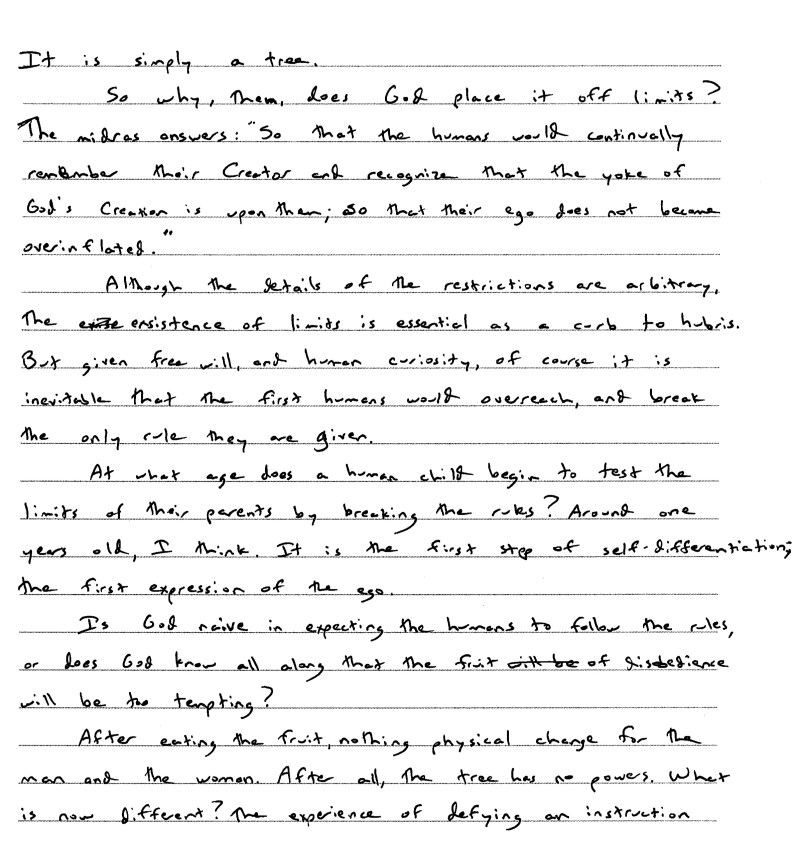
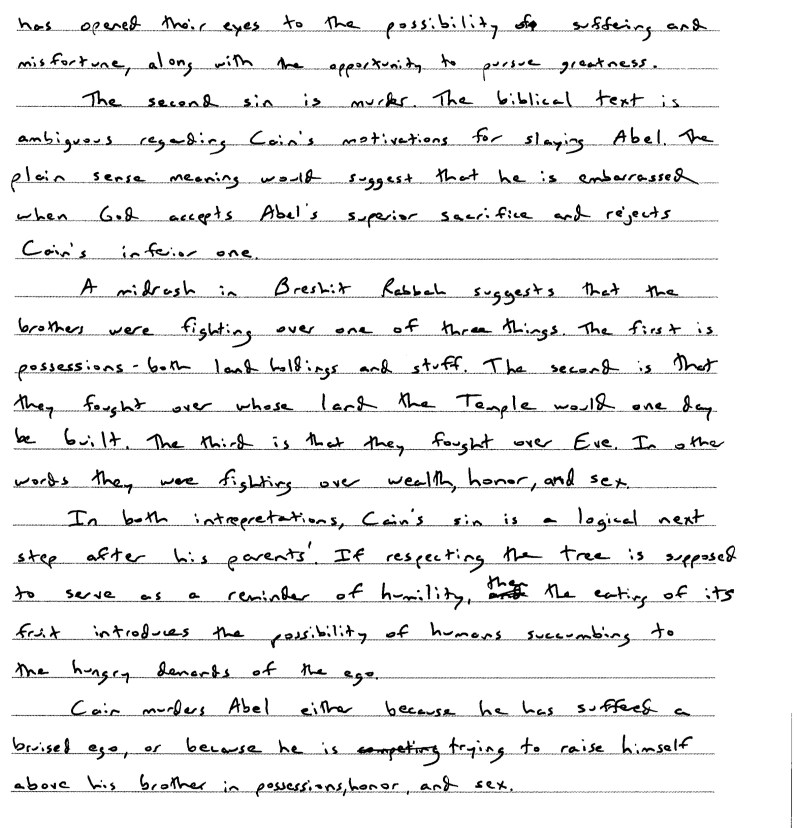
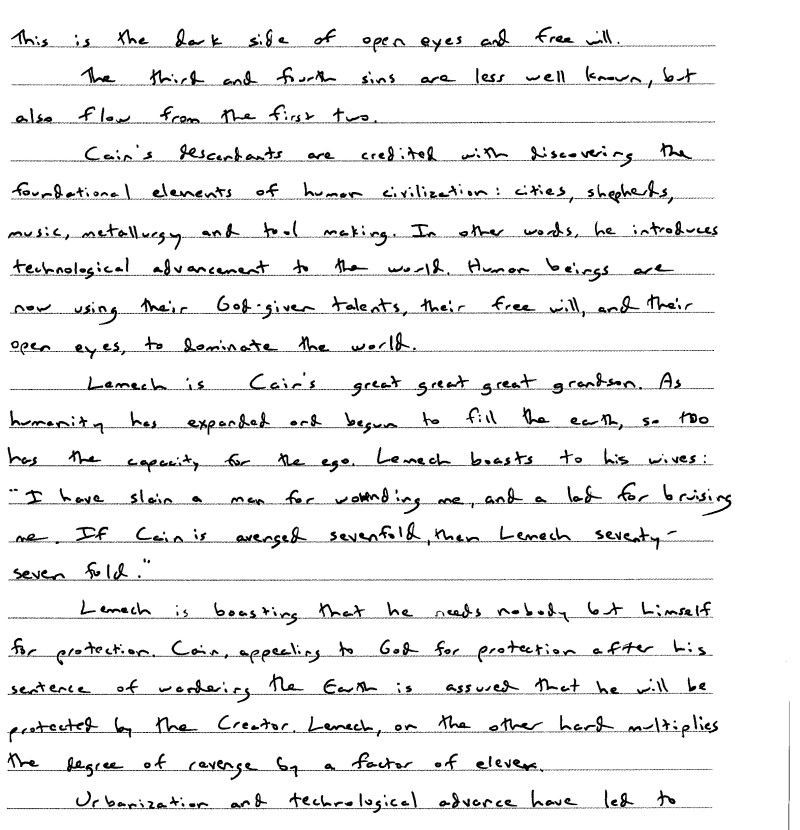
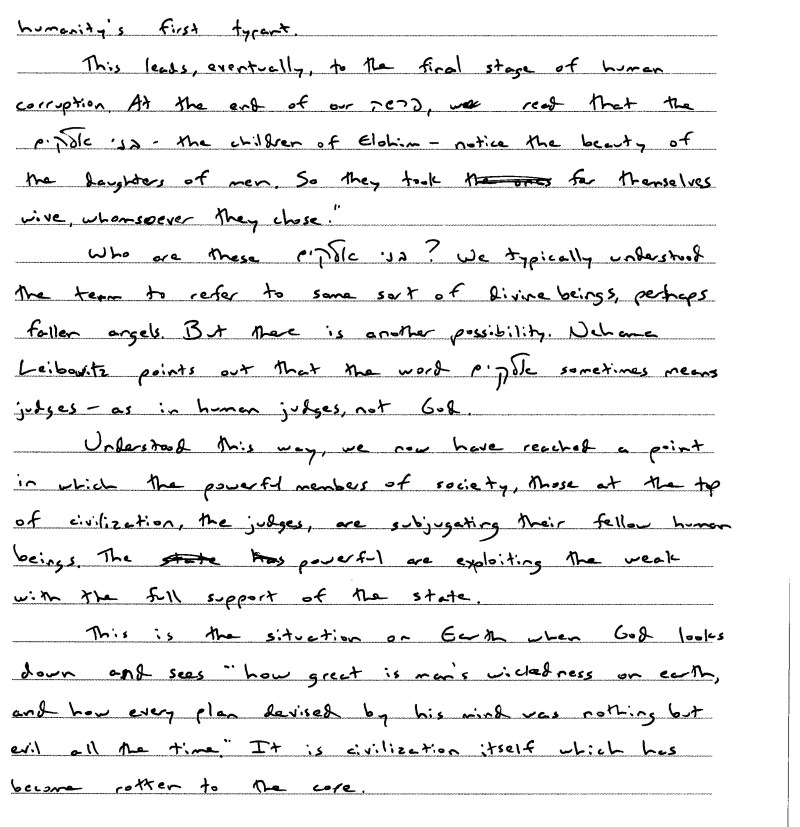
Bereishit 5777 – The Four Sins of Bereishit and the Expansion of the Human Ego

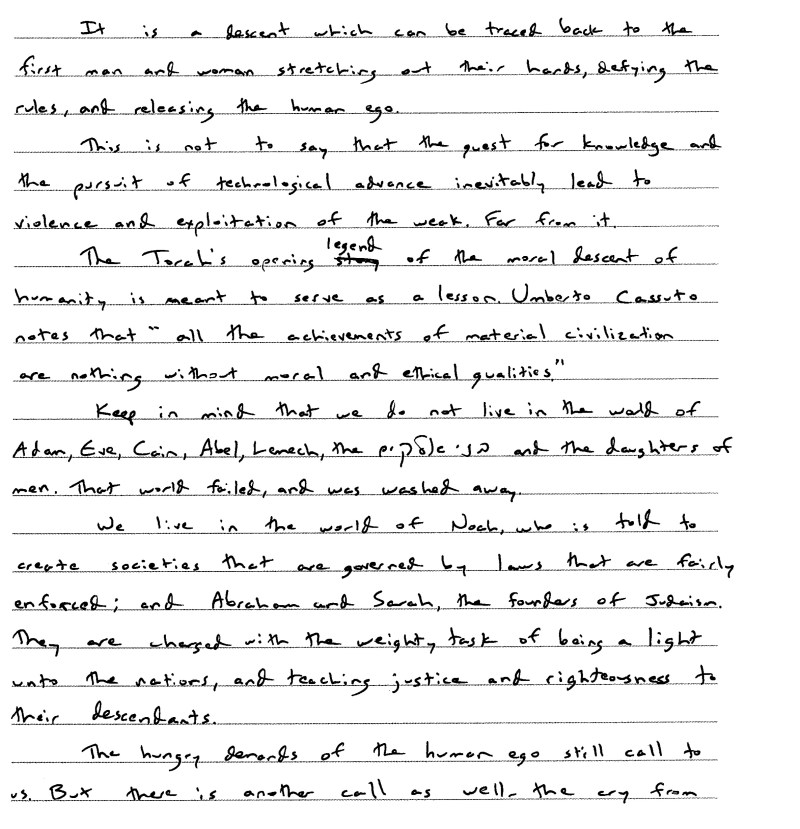
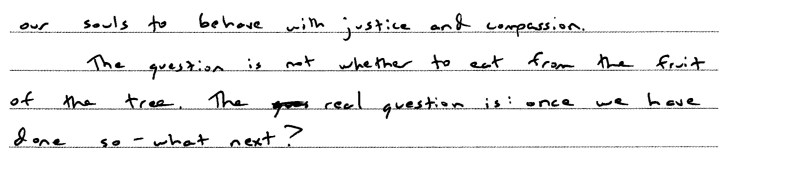
I have been feeling a bit addicted to technology lately, so I resolved to do something that I have not done in about two decades.  I wrote a sermon completely by hand, without using anything whatsoever with a screen for ideas or research.  I scanned it and am sharing the results below (I get the irony).  Sorry if you can’t read my handwriting.
bereishit-5777-the-four-sins-of-breishit1bereishit-5777-the-four-sins-of-breishit2bereishit-5777-the-four-sins-of-breishit3bereishit-5777-the-four-sins-of-breishit4bereishit-5777-the-four-sins-of-breishit5bereishit-5777-the-four-sins-of-breishit6bereishit-5777-the-four-sins-of-breishit7bereishit-5777-the-four-sins-of-breishit8