Shabbat Chazon 5785 – My Fear This Tisha B’Av

As Tisha B’Av approaches this year, I find myself feeling particularly anxious. I want to be open with you about what I am struggling with, with what I am feeling in this moment.

First, I’ll say something about the day itself.

Originally, Tisha B’Av, the ninth day of the month of Av marked the destruction of the First Temple by the Babylonians in 586 BCE. It is described by the Prophet Zechariah as one of four fast days that will be transformed into days of celebration when the Temple is rebuilt. For Zechariah, that prophecy was fulfilled by the establishment of the Second Temple.

When the Romans brutally crushed the Judean revolt, they destroyed the Second Temple on the same date in 70 CE.

Now twice cursed, the ninth of Av became the day into which all national suffering and tragedies of the Jewish people would be folded.

The second-century Rabbis of the Mishnah looked back and attributed to Tisha B’Av the sin of the spies in the wilderness, who brought back news to the Israelites that the Promised Land was inhabited by giants whom they stood no chance of defeating. Their lack of faith in God’s plan doomed this day for eternity, says the Mishnah.

That is why, they explain, God selected that day to destroy both Temples. They add, further, that Bar Kochba’s last holdout at Betar fell on this same day in 135 CE. One year later, Hadrian plowed over the city, built a pagan Temple on the site, and banned Jews from entering, except for one day a year.

To rub in their suffering, Jews would be allowed, for a fee, to visit the Temple Mount on the ninth of Av, where two statues of the Emperor Hadrian greeted them amidst the ruins.

For two thousand years, our observance of the fast of Tisha B’Ab centered on the mournful chanting of Megillat Eichah, the Book of Lamentations. Eichah depicts, in tearful detail, the suffering of our ancestors during the Babylonians’ destruction of Jerusalem. While chronicling a specific historical event, Eichah’s description of human misery applies to countless tragedies through the ages.

Added to this, over the centuries, were the addition of Kinot, mournful elegies. These poems describe other tragedies that befell our people, whether or not they occurred on this specific tragic day.

Many Kinot were written during the Crusades, which saw the slaughter of so many Jews and the destruction of countless thriving communities. Kinot mourn the burning of the Talmud in Paris in 1242, and the expulsion of the Jews from Spain in 1492.

Add to this the other expulsions and persecutions, the blood libels, the Chmielnicki Massacres, and the Holocaust. Tisha B’Av is the Memorial Day of the Jewish people. 

Already, and not surprisingly, the massacre of Oct. 7, 2023 is added to the list. I suspect that the plight of the hostages, for 665 days now, will also become part of our narrative of this tragic day. 

The liturgy of Tisha B’Av expresses three main ideas. The first is that the various tragedies that have befallen us are expressions of Divine anger. Punishments against the Jewish people for our sins.

The Rabbis attribute the fall of the First Temple to the sin of idolatry. Nebuchadnezzar was but a pawn, a tool wielded by God to administer judgment against our ancestors for failing to heed the message of the prophets.

The Second Temple fell as a result of the sin of Sin’at Chinam – senseless hatred of Jew against Jew.  Again, the Romans were mere instruments of Divine wrath.

This theological justification for our ancestors’ suffering leaves me feeling uncomfortable. It sounds like blaming the victim. But that is the dominant theology that the Rabbis express throughout the Talmud and midrashim, and that is picked up in the Kinot. “Oh, how these things have befallen us, we must have done something to deserve it.”

But then, we encounter another sentiment. The wailing and crying is turned against God, who surely must see our suffering and have compassion. We cry out against a God who has seemingly forgotten and abandoned us and shout, “Here we are! Don’t you see us?”

Some of the Kinot direct our rage against our oppressors, who make fun of us and mock God. They are not mere instruments of Divine wrath. It is their hatred and violence that caused our suffering. 

Finally, and importantly, Tisha B’Av contains elements of hope.  Most Kinot end on a hopeful note that God will remember us. We end our chanting of Eichah with the words: “Take us back, O Lord, to Yourself, And let us come back; Renew our days as of old.”

We sit on the floor during the evening and morning services. Then in the afternoon, the mood begins to change. We put on the Tallit and Tefillin that we neglected during Shacharit. It is said that the Messiah will be born on the ninth of Av. The seeds of redemption are sown in destruction.

The seven weeks after Tisha B’Av are referred to as Shiva D’nechemata – The seven weeks of consolation.  The Haftarot that we recite on those seven Shabbatot are filled with language of comfort, healing, and hope. 

The Talmud teaches, “Those who mourn for Jerusalem will merit to see its rejoicing…”

By concentrating all of our mourning into a single day, we make sure that it does not overwhelm us throughout the year.  During this day, we go through the three stages. First we look inward, and ask ourselves how we have gone astray. Next we look outward, to proclaim to God that our suffering is unreasonable, that it is our enemies who have wronged us. And then we look to the future, so that we can step back into the world after our mourning with hope.

This year, more than any in my lifetime, I find myself feeling increasingly worried as Tisha B’Av nears. Hatred of Jews and Israel has become more accepted in the world than at any time I can remember.

At the moment we find ourselves in, Israel, home to half of the world’s Jews, is becoming a pariah state. 

The images of starving children in Gaza, and the daily reports of civilian deaths, regardless of who is or is not at fault, take their toll. Perceptions of Israel and of Judaism around the globe are becoming increasingly negative.  This includes among our own people, especially younger generations of Jews.

We can complain about it. We can argue about whether it is misguided or naïve. We can point out how Hamas launched the war and has been stealing the food and supplies meant for Palestinian civilians, but those arguments are not working.

Pointing out how complicated it is cannot compete with a simplistic statement like “Stop the genocide.”

Explaining how Hamas hides underground, letting their people starve, instead of releasing the hostages, simply cannot compete with photos of children crying in a mass of people, pressed up against a metal grate in front of a food distribution center.

Declaring, “What about the millions of people facing war and starvation in the Congo, or Sudan, or the persecution of the Uighyers in China, or the Rohingya, or take your pick,” will never convince anyone.

Whether or not Israel’s War in Gaza is justified, and I do believe it is, anyone with a heart cannot but be moved by the suffering that is happening right now. Suffering which, by the way, is a lot like what we will be reading later tonight. Whether or not Israel is at fault, it is responsible to do everything it can to prevent starvation. I do believe that deep in my heart.

I don’t know what is actually happening on the ground. I read all of the same articles and accounts that you do, and I do not have any confidence in the actual situation. All I can say is that I hope that the IDF is operating according to its stated principles and is doing its best to prevent suffering.

I am afraid that the impact on attitudes about Israel and about Judaism and Jews is taking a hit that will take a long time to recover.

This will lead to continuing violence against Jews around the world, like we have seen recently in this country in D.C. and Colorado. It will be awful. But we know how to deal with that.  We have been doing it for thousands of years. That is why we have Tisha B’Av. We look inward. We look outward. We look forward to better times. 

What I am afraid of, and this is the first time I have voiced this in a sermon, is that a generation of Jews is going to decide, “It’s just not worth it,” and walk away from the Jewish people. And then that, too, will become part of the narrative of Tisha B’Av. That’s my fear.

I don’t have the secret formula to prevent this. But I suspect the remedy probably involves something along the lines of increasing our own commitment to Torah learning, Jewish practice, and living proudly as members of the Jewish people, despite the differences we have. 

I’ll add as well that living here in Silicon Valley, where there is such a large Israeli ex-pat community who have very different experiences of the war in Gaza, it is so important to be in open communication with that segment of the community.

I’ll add as well that programs like Camp Ramah, at which I was able to spend last week, is also critical. It is an explicitly Zionist camp. There is a large Israeli contingent. We are surrounding our kids with pride in Judaism, a love of who we are, and connections that last a lifetime.

Supporting kids within our synagogues who are surrounded by these kinds of experiences on a daily and weekly basis – that has to be part of the solution. We need to double down on that.

I hope my fear is unjustified. 

So I will end with the closing words of this morning’s Haftarah that we chanted just a few minutes ago.

וְאָשִׁ֤יבָה שֹׁפְטַ֙יִךְ֙ כְּבָרִ֣אשֹׁנָ֔ה
וְיֹעֲצַ֖יִךְ כְּבַתְּחִלָּ֑ה
אַֽחֲרֵי־כֵ֗ן יִקָּ֤רֵא לָךְ֙
עִ֣יר הַצֶּ֔דֶק קִרְיָ֖ה נֶאֱמָנָֽה׃ 

צִיּ֖וֹן בְּמִשְׁפָּ֣ט תִּפָּדֶ֑ה
וְשָׁבֶ֖יהָ בִּצְדָקָֽה׃

I will restore your magistrates as of old,
And your counselors as of yore.
After that you shall be called
City of Righteousness, Faithful City.” 

Zion shall be saved in the judgment;
Her repentant ones, in righteousness.

A Four-Fold Song – Rosh Hashanah 5785

God never promised it would be easy.

This morning’s Torah portion tells the story of the banishment of Hagar and Ishmael. Sarah recognizes something untoward in the way that Ishmael is playing with her son. She demands that Abraham send him out into the wilderness with his mother.

When their supplies run out, Hagar places her son underneath a bush so she does not have to watch him die. God hears the cry of the boy and sends an angel to Hagar with a prophecy.

Fear not, for God has heeded the cry of the boy where he is. Come, lift up the boy and hold him by the hand, for I will make a great nation of him.

Then the angel reveals a well of water, and they are saved.

A midrash (Tanchuma Vayetzei 5:2) describes a scene that transpires in heaven, just before this moment. When God commands the angel to reveal the well, the angel objects: “Master of the Universe, why do you bring forth a well for this wicked person who will ultimately waylay travelers and wayfarers?”

The Holy One, blessed be He, retorts: “What is he right now? Is he not righteous? I judge a person only according to the moment at which he stands before me.”

The midrash derives this response from the Torah’s language: God has heeded the cry of the boy ba’asher hu sham – “in the place where he is.”

Midrashim often put into words their authors’ struggles with the Sacred Text. In this case, we witness the tension between the suffering of a child, for which any human with a heart must feel compassion and pity; and tribal protectiveness. This struggle is personified through Sarah versus Hagar, Isaac versus Ishmael.

The angel’s objection captures our defensive instinct to close ranks and protect our own. God ‘s rebuke expresses the universalism which seeks to break down barriers between peoples and treat individuals as they are, human beings made in the Divine image.

God does not suffer from human parochialism.

It is a particularly poignant midrash for us this year, conveying this tension between tribalism and universalism. I ask myself, in this moment: “Do I resonate more with the angel, or with God?”

As we celebrate Rosh Hashanah, welcoming 5785, it is a time for us to reflect on the ways in which we value peoplehood and humanity. Or is it peoplehood versus humanity?

One of the most beautiful expressions of this was described by Rav Abraham Isaac Kook over one hundred years ago, at a time which bore certain similiarities to our own.

Rav Kook is considered to be be the founder of religious Zionism. He was born and grew up in Russia in the second half of the nineteenth century. In 1905, he moved to Yaffo, in Palestine, then controlled by the Ottoman Emprire.

At the outbreak of the first World War, Rav Kook happened to be in Germany, where he was interned as an alien. He managed to escape and lived for the remainder of the war in London, stuck in exile, unable to return to Palestine.

It was a tumultuous time, full of danger, uncertainty, and change. The world was at war. Empires fell while nationalist movements reared their heads. Russia was aflame in revolution. A global pandemic was incubating. It was during this time period that Rav Kook wrote Shir Meruba, A Four-Fold Song.

He imagines four ways that a person might see themself; might orient their life and find meaning. He describes each of these four ways as a kind of song: the song of the self, the song of the nation, the song of humanity, and the song of the universe.

There is one who sings the song of oneself, and in themself findseverything, full spiritual satisfaction in its entirety.

There is another who sings the song of one’s people. He leaves the circle of his own individual self, because he finds it without sufficient breadth, without an idealistic basis. He aspires toward the heights, and he cleaves with a gentle love to the whole community of Israel. Together with her he sings her songs. He feels grieved in her afflictions and delights in her hopes. He contemplates noble and pure thoughts about her past and her future, and probes with love and wisdom her innerspiritual essence.

There is another who reaches toward more distant realms, and going beyond the boundary of Israel to sing the song of humanity. Her spirit extends to the wider vistas of the majesty of humanity in general, and its noble essence…

Then there is one who rises toward even wider horizons, until he links himself with all existence, with all God’s creatures, with all worlds, and he sings his song with all of them…

As Rav Kook describes so evocatively, each of us sings one of these four songs. He describes them as reflecting wider and wider perspectives, ever-expanding concentric circles.

What is my primary area of concern? Who do I care about most? Where do I invest my emotional energy? Form which wellsprings do I draw meaning and purpose in life?

Do I wake up each day to advance myself? Am I devoted to the Jewish people? Do I work for humanity? Or is my concern even more global?

Which song do I sing most strongly?

Rav Kook suggests that most people primarily sing one of these four songs. It is tempting to restrict our perspective to the narrowest of the concentric circles. Perhaps that is the song that most of us sing, most of the time.

This is the drive for self-preservation, for placing self over others.  It evokes the most famous teaching of Hillel the Elder in Pirkei Avot: 

אִם אֵין אֲנִי לִי, מִי לִי. “If I am not for myself, who will be for me?”

The next part of Hillel’s teaching warns of the risk of only focusing on the self

וּכְשֶׁאֲנִי לְעַצְמִי, מָה אֲנִי. “But if I am (only) for myself, what am I?”

Hillel suggests that a self-focused life is incomplete. Meaning and worth must include a concern for and commitment to others. But his teaching does not go so far as to distinguish how far that concern should extend: just to the Jewish people, to humanity, or to all of creation.

As we look back at the past year, I fear that we may have placed too great a focus on the universal, and not enough on the particular. Maybe we did not emphasize enough to our children how important it is to form our structures of meaning specifically around the history, values, and traditions of the Jewish people. We did not sufficiently emphasize that it is not only ok but necessary to feel particular connection to our Jewish brothers and sisters around the world.

We are now being taught that lesson. The borders that surround us are pressing in.

We are four days away from the one-year anniversary of the October 7 massacre, which changed the way Jewish people everywhere view ourselves as individuals, as part of the Jewish people, and within the wider society of humankind. 

Within hours of that horrific event, antisemitism had already begun its surge.

This past year has seen the international double standard against the world’s only Jewish state laid bare. We are still praying for the return of 97 hostages.

Many university campuses became unwelcome places for Jewish college students. We felt the need to further harden the barriers around our houses of worship and Jewish institutions, increasing our stress and fear.

So many experienced abandonment by friends, who could not bear to even have a relationship with someone who supports the legitimacy of the State of Israel.

And some of us painfully faced the conflict between the song of the nation and the song of humanity within our own families.

How have these forces, pushing in against us, affected our song?

After October 7, so many of us sought out one another, to be together, shed tears, express our grief, find solidarity —to experience some measure of comfort.

Many of us were surprised to find ourselves feeling connected to the Jewish people more profoundly than ever before.

This amplification of our song has not only been reactive. We are experiencing renewed eagerness to embrace Jewish tradition and practice. Participation in Jewish life is rising all over the world. 

Membership at Congregation Sinai is at its all-time high, along with the number of children learning in our religious school. What began as a defensive reaction has evolved into an awakening curiosity and eagerness to explore and find meaning in Judaism’s rich history and culture.

As we gather as a people to observe the new year, what are we to make of this seeming dissonance between Jewish peoplehood and universalism?

Rosh Hashanah is not a particularly particularistic holiday. It does not have an historic or symbolic connection to the Exodus from Egypt. It does not mark any moment in the history of the Jewish people. 

We describe it as Yom Hadin, the Day of Judgment. Not judgment for the Jewish people – but rather, judgment for all humanity. Unetaneh Tokef describes how “all who live on earth shall pass before You like a flock of sheep.”

A few lines later, we sing “On Rosh Hashanah it is written and on the fast of Yom Kippur it is sealed.” The fate of every living person in the year ahead is determined.

Rosh Hashanah is said to take place on the sixth day, the day on which God completed all the works of creation by forming humanity in the Divine image.

It is the most universal of Jewish holidays. Perhaps Rosh Hashanah is a holiday for singing the song of humanity, or the song of the universe, rather than the song of our people.

Does it have to be either/or? Must concern for the Jewish people come at the expense of concern for humanity, or vice versa? Let us return to Rav Kook’s Four Fold Song, which continues from where we left it. He imagines the rare individual who harmonizes the four competing melodies

…into one ensemble, each joining their voices… lending vitality and life to one another. They are sounds of joy and gladness, sounds of jubilation and celebration, sounds of ecstasy and holiness.

The song of the self, the song of the people, the song of humanity, the song of the universe continuously merged…

Rav Kook describes this four-part harmony as a “song of holiness.” It is the song of Yisrael, which, with the first two letters switched, spells Shir El – the song of God.

Rav Kook challenges us to merge our various identities. We start by asking: Which song do I primarily sing? Has my song changed in the past year?

With Israel at war, and the Jewish people threatened, is there space left in my heart to maintain my commitment to myself and my people, as well as to humanity and creation?

Rav Kook would argue that I do not have a choice. Humanity’s mission is to strive towards wholeness and perfection. Israel, like other peoples, has a unique contribution to make.

From the beginning, when God first revealed Godself to Abraham, our challenge as a people has always been to be a blessing to the world, as a distinct people, and through our commitment to Torah. 

For humanity to rise higher, we must be able to sing both songs. Rav Kook wrote:. “The upright person must believe in their own life.” He also wrote “the Love of Israel requires the love of the whole of humanity.”

Even when segments of humanity do not behave so lovingingly towards us.

We celebrate our new year with complicated emotions. We pray that our brothers and sisters still held hostage will return to their families embrace. We pray for God to protect our people who are at war, and to deliver the brave souls fighting to defend them.

We pray that we be strengthened in our communities and drawn closer as a people. We pray for love, connection, and healing within our families.

We pray for all people, everywhere, to learn to recognize the Divine sparks in one another. We pray for unity in humanity’s collective striving for wholeness, for each person and nation to contribute their own blessings to our shared task.

May all of these prayers blend together to produce a glorious masterpiece, the song of God, the Song of Songs.

Camp Ramah: A Bubble of Peace – Pinchas 5784

Dana and I had the wonderful opportunity to be away last Shabbat, as I completed a week as the Rabbi in Residence at Camp Ramah Galim. Galim means “waves,” which is a fitting name, given that the camp lies on a beachfront campus outside of Watsonville.

I am honored to serve on the Board of Directors for the past year and a half. My week started with a Sunday Board meeting, and then I got to stay. I would like to share with you a bit of what I experienced while I was there. 

Ramah Galim is the only Jewish, Zionist, Shomer Shabbat, kosher camp in Northern California. The camp continues to grow — this current summer is the biggest yet; and we just signed a ten year lease with the Monterey Bay Academy, which hosts us.

Campers at Ramah Galim sign up for one of four specialty tracks, which they attend most mornings. Afternoons bring everyone together for activities with their edot (age groups), kevutzot (groups), and the entire camp.

One specialty track is Yam – “ocean”.  Campers focus on learning about marine ecology, in addition to boogie boarding, surfing and other water activities. Campers in Etgar — “challenge” — go mountain biking, hiking, rockclimbing, farming, and other outdoor activities. Those in Al HaBamah — “on the stage” — write, rehearse and perform an original musical over the course of a two week session. I don’t know how they do it.

In addition, for the second summer, Ramah Galim has hosted the Ramah Sports Academy, which offers intensive training for basketball and soccer athletes.

I could go on about all of the wonderful aspects of Ramah Galim, but I want to focus on a few key experiences.

I am proud to share that Congregation Sinai sends more kids to Ramah than any other synagogue. There are twenty Sinai chanichim, campers, attending session three alone. If we add up campers who were at the first two sessions, we are proably in the 30-35 range. I haven’t run the numbers, but I suspect that this is at least 1/3 of all of the kids in the shul. Plus, we have four Sinai young adults serving as madrichim, or counselors. 

We have a scholarship fund at Sinai. This year, we provided more scholarship money for more kids than we ever have before. And I would love to see this expand.

As Rabbi in Residence, I get recruited to a number of different activities. 

Harga’ah means relaxation. Before bedtime, I might meet with an edah or a kevutzah to tell a story or teach a song.

I attend Tefilah with different edot, sometimes as a participant, and sometimes to lead or teach.

On Shabbat afternoon, I led a program for all of Nitzanim and Kochavim – third through sixth graders.

And on Shabbat morning, I led a learning session with staff.

Beyond this, I have the opportunity to simply participate in camp, interacting with campers and counselors, learning about them and occasionally answering “rabbinic” questions. I was also glad to be able to support our Sinai kids, who get a thrill to see “their rabbi” at camp.

This summer, there were also about 30 Israeli chanichim. Many of them are from the northern border and have not been living in their homes for the last nine months. The Education Minister just announced that schools from the evacuation zone will not be reopening in the fall. So these campers will again be attending makeshift schools that have been cobbled together near the hotels to which they have been evacuated.

For the second summer, there is a contingent of Ukrainian campers at Ramah Galim, who are here through a partnership with Maccabi.

All of these kids and staff come together to have a Jewish camp experience. And it is so wonderful. What strikes me about Ramah is how supportive and positive it is for everyone. It is meant to be joyful, experiential Judaism. Chanichim and madrichim are challenged to try new things, take on leadership roles, and have fun. 

As I mentioned earlier, among its core values, Camp Ramah is a Zionist camp. This comes through in so many ways. There is a large mishlachat, or contingent of Israeli staff.

Israeli flags fly everywhere. Announcements are made in Hebrew, and modern Hebrew words and expressions are woven into the camp experience. One of the most popular activites at Ramah is Israeli dancing, which takes place before most dinners, and on the beach after Havdallah.

Yom Yisrael is a day devoted to learning about and celebrating Israeli history, culture, and life. This year, it took on more somber tones. 

More important and impactful than all of the formal programming is the opportunity for Jews from Israel, America, Ukraine, and other communities to live together, get to know each other, become friends, and establish personal relationships. This is the best way to convey the Jewish value of achdut – unity.

At the end of last week’s parashah, the Moabites send in women to lure the Israelite men into commiting idolatry during an event which became known as “The sin of Ba’al Peor.”

To stop the ensuing catastrohe, Pinchas, grandson of Aaron, takes a spear and stabs an Israelite leader and a Moabitess.

As this morning’s parashah opens, God explicitly approves of Pinchas’ initiative, which “turned back [Divine] wrath from the Israelites.” In response, God grants him God’s “covenant of peace,” a covenant of priesthood for him and his descendants after him for all time.

The language in the Torah is unambiguously praiseworthy of Pinchas’ zealous violence. All of the medieval commentators approve of Pinchas’ actions.

It is a moment of crisis. Many Israelites, including leaders, are committing apostasy with the Moabite women. Thousands are dying in a plague. God has just instructed Moses to have all of the ringleaders impaled to turn aside Divine wrath. Pinchas is the one who takes action, stopping the idolatry, ending the plague, and saving the Israelites. He is a hero.

Why does he need a covenant of peace? The Talmud records a legend that the elders wanted to excommunicate Pinchas for taking matters into his own hands rather than going through a judicial process. God’s message to Moses, thus, is a counter to that effort, stating that Pinchas’ zealousness exactly matched God’s zealousness.

The medieval commentators suggest that the covenant of shalom is a promise of Divine protection from the possibility of retribution by the families of the people whom Pinchas impaled, or even from his fellow Israelites.

Modern commentators offer more psychological explanations. Naphtali Tz’vi Yehudah Berlin, known as the Netziv, lived in nineteenth century Russia. He writes in HaEmek Davar, his commentary on the Torah, that

In reward for turning away the wrath of the Holy Blessed One, God blessed him with the attribute of peace, that he should not be quick-tempered or angry.  Since, it was only natural that such a deed as Phinehas’ should leave in his heart an intense emotional unrest afterward, the Divine blessing was designed to cope with this situation and promised peace and tranquility of soul

In other words, Pinchas did what needed to be done. It was unquestionably the right move. But, it took a toll. God’s granting him a covenant of peace is about settling his soul so that Pinchas does not carry the trauma, the PTSD, if you will, with him, nor pass it on to his children.

Camp Ramah, this summer in particular, is playing such a role, particularly for the young adult staff who are there.

In part of the Chadar Ochel, the dining hall, there are posters up of people who have been killed since Oct. 7, as well as of hostages. All of them are personal friends and family members of staff members. Poetry and artwork by campers decorates the walls.

Outside of the Nachshonim bunkhouse, where the oldest campers live, there is a large “Free Hersh Goldberg” banner.

While October 7 and its aftermath certainly hovers over camp this summer, it has not taken over. Quite the opposite, in fact. Nobody knew what to expect before the summer. As it turns out, for the staff in particular, camp has been a respite.

I spoke with Israelis who who have spent much of the past year serving in the military.  Some are 20, 21, 22 years old, and have just completed their mandatory service. Others have had to put their careers on hold to serve in milluim, reserve units. Some saw combat directly. Others had to wait at home while loved ones were called up, not knowing when or whether they would be coming home. Many lost friends and family members on October 7 and during the war that followed. 

One young soldier who spoke with the Board of Directors was sent with his unit on the afternoon of October 7 to battle Hamas terrorists who had taken over a base. He lost several of his fellow soldiers that day, including his commanding officer, who led the charge. He was in tears as he shared his story with us.

Dana and I met with a group of Sollelim kids, going into seventh and eighth grades.  We visited them at their campsite in Monterey during intersession to play music and sing songs.  I let some of them play my guitar. I asked one talented kid where he was from. “Germany,” was his answer.

But that is not where he is from. He is from Ukraine and has only lived in Germany for the past two years. There are a couple of dozen Ukrainian Jewish kids who are at Camp Ramah, getting a break from a disrupted childhood that I cannot even imagine. 

Some of the American college students came to Ramah having experienced a different kind of trauma on their campuses. They described Camp Ramah as a kind of bubble where they did not have to worry about being visibly identified as Jewish, or think twice about what route to take while walking to the dining hall.

Camp is always a kind of bubble from the outside world. Usually, it is a bubble of joyful Jewish experience. This summer, in particular, it is serving as a bubble of love and support in the midst of extremely chaotic and threatening times.

I feel very blessed to have been able to spend a week inside this bubble of peace. I only wish that the world could always be like camp.

Shabbat Shalom.

Israel Needs Us – For the Future of Judaism Itself – Ki Tissa 5784

I returned on Sunday from the South Bay Solidarity Mission to Israel. Nineteen members of our community, including five from Sinai, spent a packed week filled with meaningful, important encounters to bear witness, console the mourners, and comfort the sick.

A week and a half ago, we visited Hostages Square in Tel Aviv. As we were about to board our bus to return to the hotel, a voice boomed from the loudspeakers.  Earlier that day, the far right Finance Minister Bezalel Smotrich had given an interview in which he said, rather smugly, that getting the hostages back was not as important as destroying Hamas.

An impromptu protest formed of relatives of hostages, who were, understandably, incensed.

Liri Albag, eighteen years old, has been held hostage in Gaza for 147 days. Her father, Eli Albag, cried out in the most gut-wrenching, tormented, angry voice that I have ever heard.

“Let them kidnap your children!” Calling out Smotrich by name, he shouted “Let them kidnap your children and I will shout in the street, ‘It’s not the most important thing!’”

“I’m talking to all citizens of Israel — whoever thinks that the citizens, the hostages are unimportant, let them kidnap your children and then you can speak!” 

“We have suffered for 137 days, day after day, minute by minute, we don’t sleep at night,” 

Referring to the Israeli cabinet, he continued, “It will not protect you… They are abandoning us above. They are laughing at us, dragging their feet, they are not going to negotiate. I say to you citizens, take to the streets because today it is us and tomorrow it will be you.”

This may have been the most painful thing I have ever heard another person say.

As someone who follows current events fairly closely, the week long trip was an eye-opening experience nonetheless. 

We met Israelis from many different backgrounds, gaining a sense of the complicated, conflicting ways in which social, economic, religious, and political differences play out in society.

One thing that was obvious was that the language and rhetoric that surrounds us here in America is very different from that which permeates Israeli society right now.

The most dominant issue we encountered, by far, was the chatufim, the hostages. From the moment one walks down the ramp to exit Ben Gurion airport, photos of each of those still in captivity are everywhere. On the sides of buildings, on café counters, in bank windows, on t-shirts, their faces are impossible to miss.

Alongside the photos, at least in Tel Aviv, are signs, grafitti, and billboards casting blame for October 7 on the government, and Benjamin Netanyahu in particular. One huge poster visible from the Ayalon Highway, covering the entire side of a building, has a photo of Bibi and the words Attah haRosh! Attah Ashem!“You are in charge!  You are guilty!”

Along with this are calls, everywhere, for the government to resign so that new elections can be held.

Most of the Israeli voices we heard did not express much concern for the things that fill our airwaves. There were few mentions of the Palestinians, a two state solution, or even the thousands of civilian deaths in Gaza.

The closest to calls for a ceasefire occurred within the context of “Bring the hostages home at any cost.” Even when we met with Achinoam Nini, one of Israel’s most famous singers and a peace activist for the past thirty years, she did not go so far as to call for an immediate ceasefire, although she did speak passionately about the need for a Palestinian state alongside Israel and the moral obligation to empathize with all human suffering.

Antisemitism came up, but usually in the context of Israelis being concerned about all the antisemitism that we are facing in the West. 

It should not really surprise us that the issues we are dealing with here are largely absent from the Israeli discussions. This is not to justify, but to explain. Israelis are still in trauma from October 7. They freely admit it. The fate of the hostages is front and center, with photos everywhere. The 134 who are still missing have become household names. I could not imagine being able to think of anything else if my child was in captivity.

Hundreds of thousands of Israelis are currently serving as active duty soldiers or reservists. When your child or spouse or brother or sister is fighting a war, it is hard to muster much emotional energy for those on the other side of the border.

And don’t forget the tens of thousands of Israelis who are displaced from their homes around the Gaza envelope and the northern border.

This past Saturday night, the first major anti-government protest since October 7 took place in Tel Aviv. We were there for the beginning of it. Tens of thousands of Israelis filled the streets. It was clear that there were a wide range of coalitions comprising the rally, ranging from families of hostages, relatives of victims of October 7, life-long Likud members, and pro-peace activists.

The messages were simple and clear: The government is responsible for the failures of October 7. They should resign and new elections should be held. The word achshav kept coming up as a chant. Achshav! “Now!” Israeli flags were everywhere.

A few weeks ago, we read Parashat Yitro, in which God’s Presence descends upon Mt. Sinai in revelation to the children of Israel, who are encamped below.

This moment is imagined by our tradition as a wedding. So let’s run with that metaphor a bit. We would say about a newlywed couple that they are “in love.” They only have eyes for one another. They do not see each other’s faults, and their only desire is to be together. 

Now here we are in Ki Tissa, a few Torah portions later. Moses has been on top of Mt. Sinai for forty days. He has literally gone up to heaven to speak with God. Meanwhile, back down on earth, what have the Israelites done?  They have built a golden calf.

The honeymoon is over. The rest of their time through the wilderness will be frought with misunderstandings, miscommunications, and disappointments, punctuated by occasional moments of bliss. 

This is a useful metaphor for us to consider with regard to our relationship with Israel as American Jews.

My parents and grandparents’ generations were around when Israel came into being in 1948 and in its early years. The Holocaust was a recent memory and the need for a Jewish homeland was clear. The exciting, miraculous fact of its existence, the ingathering of the exiles, and the pioneering Jews taking charge of their own destiny after 2,000 years as an opressed minority in the Diaspora was a source of pride.

After 1967, with another miraculous victory over its enemies in the Six Day War, Israel could do no wrong. 1967, by the way, is when Jews in America began to feel comfortable wearing Kippot out in public.

The 1973 Yom Kippur war began to chip away at this image of invincibility. Israel was shown to be vulnerable. This is when things started to get more complicated in the relationship. I was born in this post-1973 generation.  

Beginning with the war in Lebanon, which lasted nearly 30 years, and the first Intifada, Israel was now in a position in which it was unquestioningly the stronger military power. It was occupying land and was responsible for the Palestinians, who were not citizens of the state.  It now had to deal with a challenge that Jews had not faced for more than two thousand years: How do we use our power Jewishly?

Let’s come back to the marriage metaphor. Up until 1973, American Jews were in the honeymoon phase. We were “in-love” with Israel. The agreement was that we would buy trees through JNF, purchase Israel bonds on the High Holidays, and take pride in this growing, thriving, Jewish nation. And we would feel more safe and secure about our place in the Diaspora.

My generation began to develop a different relationship with Israel. Let’s call it “marriage.” The honeymoon is over. We are committed to each other, but we are starting to see the faults.

In the early 1990’s there was tremendous hope that the Oslo Accords would finally bring peace. Most American Jews were ecstatic, and the majority of Israelis were cautiously supportive.

The assassination of Yitzchak Rabin in 1995 by a right wing Jewish terrorist, followed by a string of terrorist attacks by Hamas, shattered that hope. This led to the third phase, comprised of young American Jews who claim that the Israel they know is not in alignment with the Jewish values they have been taught in our synagogues, Jewish schools, and summer camps.

Those of us from earlier generations can complain until we are blue in the face, but let’s consider for a moment that for someone who was born in the last thirty years, the only Israel they have experienced is one which has waged a near constant series of assymetrical wars.

They have seen ultra religious factions in Israel flexing their muscles in ways designed to deliberately suppress the liberal movements that they grew up in. They have seen a constant expansion of Jewish settlements in the West Bank, making the prospect of a two state solution seem more and more unlikely.

When it comes to Israel, what we are hearing from many young American Jews is simply “I want a divorce.”

This is tragic and frustrating. But if we, from the Honeymoon and Marriage generations, are to perform our duty of teaching our children of the Divorce generation, we have got to recognize where many of them actually are, and what they have experienced.

Congregation Sinai’s mission is to connect Jews to Judaism, each other, Israel, and the world.

What does it mean to be connected to Israel?

At the very least, it means recognizing that, as the home for half of the world’s Jews, our fates are connected in extremely tangible ways. Like it or not, what happens in Israel socially, religiously, and politically, impacts Judaism everywhere.

The current Israeli government is comprised of quite a few figures who embody what many of the anti-Zionists of the world say about Israel. Figures, like Smotrich, whose stated goal is to transform Israel into something resembling a messianic theocracy with all non-Jews holding a form of second class citizenship.

These are the people whose statements were brought by South Africa to the International Court of Justice in the Hague in its case accusing Israel of genocide.

The reality is, these extremists are extremely unpopular for most Israelis also. They are not, in fact, representative, but because of the particular nature of the Israeli political system, they enjoy a lot of power and influence right now. 

If their vision is realized in the Jewish homeland, the results for us here in the Diaspora will be terrifying. As one of our speakers claimed, the future of Judaism itself is at stake.

And so, it matters to us.

Lately, (and I myself am guilty of this) we have been using the expression kol Yisrael arevim zeh lazeh.  “All of Israel are responsible for one another.” We use this expression to describe the sense of deep connection we feel with our Jewish brothers and sisters around the world, particularly when they are under attack.

But the original use of this expression in the Talmud (BT Shevuot 39a) is a little different. If a Jew is about to sin, and I fail to intervene to steer them correctly, then my fate will be tied to their fate. We will all suffer the consequences of their wrong behavior. This expression is really about communal responsibility. I have to act.

We are being encouraged, by Israelis, to get involved in a more substantive way than we have been. Many of the people with whom we met begged us to be involved. What we saw is that there is tremendous diversity in what it means to be pro-Israel, to be a Zionist.

At its most basic level, Zionism is the belief that Jews should be able to determine our own destiny, and this can only happen if Jews are living in the Jewish homeland. Think about the final words of Hatikva – Lihyot am chofshi be’artzeinu: Eretz Tzion virushalim – To be a free nation in our land: the land of Zion and Jerusalem.

The conviction that we should be able to self identify and self actualize as a nation is the essence of Zionism.  The rest is commentary.

We have to participate in that commentary, not only for our own sake, but also for our children’s sake, and for the sake of Judaism itself. 

Don’t Make it Worse – Letter to San Jose Mayor and City Councilmembers

Groups have been pressuring city councils throughout the Bay Area to pass ceasefire resolutions on the war between Israel and Hamas. Not only do these resolutions tend to be extremely one-sided, the rhetoric that surrounds them often crosses the line into antisemitism.

The following is a letter that I sent to on December 8, 2023 to San Jose Mayor Matt Mahan and each of the ten city Councilmembers urging them not to take up a resolution on the war between Israel and Hamas.

December 8, 2023

200 E. Santa Clara St.
San José, CA 95113

Dear Mayor Mahan and San Jose City Councilmember,

I hope this letter finds you well. I am writing to you as the Rabbi of Congregation Sinai in San Jose, District 6, a position I have held for the past sixteen and a half years. As we approach the 70th anniversary of Congregation Sinai, I reflect on the active and proud role our congregation has played in the civic life of San Jose and Silicon Valley.

The purpose of this letter is to express my deep concerns about the current atmosphere of fear and uncertainty within our community following the terrorist attacks by Hamas on October 7. 

I was recently reflecting on the daily experiences of the approximately 40 children in the Sinai Nursery School when they come to school. Before they reach their classrooms to be lovingly greeted by their teachers, they must first pass by an armed security guard and be admitted through three locked doors. I suspect their situation is unique among the children in our city.

As you know, organized pro-Palestinian groups have been pushing local city councils in the Bay Area to pass resolutions calling for a ceasefire between Israel and Hamas. At the city council meeting on Tuesday, December 5, you already witnessed a sample of the anger and animosity which has characterized these meetings.

I am not writing to debate the merits of a ceasefire, but rather to share the lived experience of Jewish residents in San Jose. Over the past two months, we have been feeling unmoored in our beloved city. Members of my community are afraid to openly express their Jewish identity, and we have had to intensify the already substantial security measures at our synagogue. This not only incurs significant time and expense, but also exacerbates the feeling that we are under siege.

I respectfully implore you to refrain from introducing any resolutions concerning the Middle East conflict to the San Jose City Council. These resolutions have no impact on decisions made by the Israeli government, Hamas, and other involved parties. However, their local impact is tangible, fanning the flames of antisemitism in our community and increasinganimosity among residents of our shared city. Similar resolutions in Richmond, Oakland, and San Francisco have provided platforms for vitriolic antisemitism and explicit endorsement of terrorism.

My community is scared already. Please do not make it worse.

Please feel free to contact me if you have any questions. We would be happy to have you join us for for Shabbat (Sabbath) services.

L’Shalom,

Rabbi Josh Berkenwald

1200 Years of Jews in Ukraine

I have been thinking a lot about my grandmother this week. Baba Fania, zikhra livracha, was born in a city called Kamenets-Podolsk, in Ukraine.  She moved with her family to Kremenchug when she was a girl.

Her father died when she was young, so she and her sisters were left to be raised by her mother, my great grandmother, Chana. It was the 1930’s and so she received a good Soviet education, in Yiddish. She came home one day and told her mother that there was no God. Her mother smacked her, and declared emphatically, “I don’t care what they are telling you out there.  In this house, there is a God.”

As I was eating challah last night, I was thinking of a story that she told.  At times, they could not get any eggs. In order to get the golden color, they would take used tea bags and brush them over the dough.

My Baba escaped from Ukraine in 1941, just before the Nazis came into town. Her sisters and mother did not make it out, and were murdered along with the rest of her family. Dana and I named our son after my grandmother’s cousin, who died in the Holocaust.

Over the last several days, as we have observed the tragedy unfolding in Russia’s invasion of Ukraine, I have been thinking a lot about my Baba Fania. I have never been to Ukraine, but it is has felt very personal to me. I know that I must have distant relatives there, who are surely fearing for their lives.  I do not know how far back my own family’s history extends, but for sure it is many centuries. 

The history of Jews in Ukraine is a long one, and has gone through dramatic ups and downs, often at the same time.

Jews first arrived in Ukraine in the eighth century as refugees fleeing from the Byzantine Empire, Persia, and Mesopotamia. The earliest written reference to Jews in Galicia, Western Ukraine, is from 1030 CE.

Some time in the centuries that followed, the territory that is today modern Ukraine was taken over by the Polish-Lithuanian Commonwealth. As part of their administration, they would settle wealthy Polish Catholic nobles in Ukraine, and then encourage Jews to immigrate and serve as merchants. Jewish life prospered financially and culturally, and the population grew.

As might be expected, the local Ukrainian population, which was Eastern Orthodox, was kept in serfdom.

Resentment grew until, in 1648, as the Kingdom faced growing internal and external threats, Bogdan Chmelnytsky launched a Cossack rebellion. This led in 1651 to the incorporation of Ukraine by the Russian Tsar as a protectorate.

The Chmelnytsky revolt was devastating. Blaming the Poles for selling them “as slaves into the hands of the accursed Jews,” the Ukrainian Cossacks and Crimean Tatars murdered between fifteen and thirty thousand Jews and destroyed three hundred Jewish communities. The population declined dramatically, as many more Jews fled as refugees or died of disease and starvation.

But within a few decades, the tide would turn. The early 18th century saw the birth of Yisrael ben Eliezer, otherwise known as the Baal Shem Tov, the founder of Chasidism. Heavily influenced by Kabbalah, Jewish mysticism, Chasidism was incredibly popular and spread through much of Eastern Europe, making a huge and lasting impact on Ashkenazi Jewry.

By the end of the 18th century, the Russian Empire had completely annexed Ukraine, which created a problem, as Jews were not permitted to live in Russia. This led Catherine the Great to create the Pale of Settlement, which encompassed, among other areas, all of present day Ukraine.

Jewish life thrived through the eighteen hundreds, with the population growing and Jewish religious and cultural life expanding. At the same time, antisemitism was brutal. In 1881, Jews were falsely blamed for the assassination of Tsar Alexander II. With the encouragement of the authorities, pogroms were launched against Jewish communities throughout the Pale of Settlement, including in Ukraine. 

Tsar Alexander III introduced the May Laws in 1882 that imposed systematic discrimination against Jews, establishing quotas for educational and professional positions. This led to even more widespread poverty and mass emigration. The 1886 edict of Expulsion forced the removal of Jews living in Kyiv.

Another intense wave of pogroms in 1905 led to another wave of emigration. Multiple blood libels cases occurred between 1911 and 1913.

For context, this is the time period of Fiddler on the Roof. A lot of new ideas were spreading through Europe at this time, and Jews were attracted to some of the new ideologies that suggested an answer to the problems they were facing, that seemed to never go away. Jewish thinkers and revolutionaries were attracted to ideals of the enlightenment and internationalism. Jewish revolutionaries embraced socialism and became Communists. Others embraced Zionism, with many making aliyah to Palestine.

After World War One, during a short time period of 1917 to 1921, while the Russian Revloution was taking place, the Ukrainian People’s Republic presented a hopeful, albeit short-lived, moment for Jews. It was an independent socialist state that emerged in the wake of the Bolshevik Revolution.  Yiddish was an official language, even appearing on currency. All government posts and institutions had Jewish members and all rights of Jewish culture were guaranteed. It was the first government to establish a Ministry for Jewish Affairs.

But the backlash was severe. Anti-communist Ukrainian nationalists went to war against the Soviets, and in the process killed approximately one hundred thousand Jews in pogroms between 1918 and 1921.

By 1921, Ukraine had been conquered by the Soviets, becoming one of its republics. The 1920’s saw brutal efforts to eliminate Jewish religion and leave it with only a secular cultural identity, explaining why my grandmother learned in Yiddish that there was no God.

The Holocaust was devastating. More than one million Jews were murdered by the Nazis and many Ukrainian collaborators.

In 1941, there were 2.7 million Jews living in Ukraine. In 1959, that number was 840,000. By 1989, there were less than 500,000 Jews living in Ukraine.

Ukraine gained its independence in 1991, and this led to continued changes in the situation for Jews living there. Hundreds of thousands of Jews emigrated, most making aliyah to Israel.

At the same time, throughout the 1990’s, Jewish life began to reemerge. There was a lot of interest from Jewish communities in Israel and the West to support Ukrainian Jews and help them come back. The government has returned dozens of old synagogues and other buildings to the Jewish community which had been confiscated by the Nazis and the Soviets.

While antisemitism seems to have declined in the past thirty years, there have certainly been many instances of antisemitic attacks.  A far right Ukrainian nationalist party gained more than ten percent of the popular vote in 2012. On the other hand, last year, in 2021, the Ukrainian Parliament adopted a new law defining antisemitism and providing compensation for victims.

Attempts to determine the number of Jews currently living in Ukraine are wildly varying. Questions of Jewish identity, after 70 years of Soviet suppression, make it difficult. A 2020 census estimated 43,000 self-identifying Jews, but 200,000 would qualify for aliyah under the Law of Return. The European Jewish Congress claims that there could be as many as four hundred thousand people with Jewish ancestry in Ukraine.

Most Jews live in the cities Kyiv, Dnipro, Kharkiv, and Odessa. Those who live in villages tend to be elderly, and extremely poor. There are multiple synagogues, Hebrew schools, day schools, mikvaot, kosher restaurants, and six Jewish community centers. There are Jewish summer camps, which were able to resume this past summer after closing for Covid restrictions.

Ten Jewish newspapers are published in Kyiv alone, four of which have circulations of more than ten thousand. A weekly television program, Yahad, is shown on state television.

Most of these Jewish institutions are run by Chabad-Lubavitch. The Reform movement is active in 20 cities.

The Conservative movement has also been active in Ukraine since independence. Through Masorti Olami, the global branch of the Conservative Movement, Ramah, and the Shechter Institute in Jerusalem, it runs programs supporting communities in multiple cities. It sponsors youth groups, and has been operated a Camp Ramah since the early 1990’s. There are several Masorti Rabbis serving Ukrainian communities.

Right now, some members of the Ukrainian Jewish community are fleeing to the West.  Others are staying where they are, praying for peace and trying to survive. Not surprisingly, the Jewish Agency is receiving many inquiries lately about making aliyah.

And of course, we must mention Volodymyr Zelensky, who was elected President of Ukraine in 2019 with 73% of the vote. Zelensky is Jewish and the descendant of Holocaust survivors. At the time of his election, the Prime Minister of Ukraine happened to be Volodymyr Groysman, who is also Jewish. For a few months, Ukraine was the only country in the world other than Israel with a Jewish President and Prime Minister.

I encourage you to watch President Zelensky’s passionate appeal for peace to the people of Russia right before the invasion. I also encourage you to watch the forty second selfie video that he took with other members of his government on the streets of Kyiv Friday night as the city was preparing for being attacked. He insisted that they are not going anywhere. If you have not seen them, I encourage you to do so. And keep in mind the long history of Jews in Ukraine. To see the Jewish President of Ukraine speaking so courageously on behalf of all Ukrainians is astounding. It gave me chills to watch it. After over a thousand years, with all of its ups and downs, to see this, someone courageously standing up in the face of brutality and such danger is incredible.

If you have the capacity to do so, there are organizations that are trying to support people in Ukraine who are fleeing, and there will certainly be a tremendous need to support refugees in the months ahead.

I made a donation yesterday to Masorti Olami. The immediate cause they were trying to support was a group of one hundred fifty children who had fled to Lviv, in Western Ukraine.

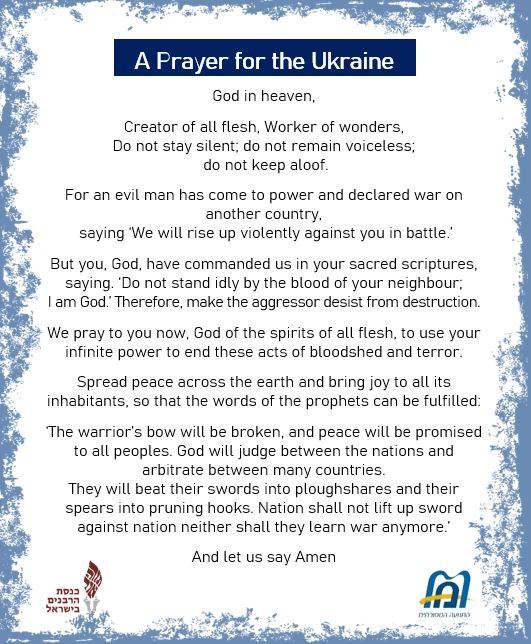
I would like to close with a prayer for peace that was delivered at a service hosted by the Masorti movement on Thursday night. 

Iron in the Shul (After Colleyville) – Yitro 5782

I had the opportunity to learn, earlier this week, from other Conservative Rabbis, which helped me process last week’s hostage taking at Congregation Beth Israel in Colleyville, Texas. Some of what I am going to say this morning was inspired by what I learned from my colleagues.

One thing that I want to say from the outset is that there are a lot of really smart and insightful people who have a lot to say about these specific attack, as well as larger trends in antisemitism here in the United States and around the world. I am sure that you have read and heard a lot that you have found to be educational and meaningful.

I cannot hope to match the expertise of others in our Jewish community who specialize in these areas, nor is that my goal. All I can do is speak from my one particular vantage point as the Rabbi of Congregation Sinai.

A hostage crisis during Shabbat services is just about the scariest thing that I can imagine. It is a horrible scenario that has occupied my mind on many occasions over the years. To hear about it happening last weekend, especially with the prominent, courageous role played by Rabbi Charlie Cytron-Walker, really hit home for me.

It makes me sad, scared, and angry that we have to deal with such things. I don’t think there are any faith groups in the United States that have had to institute such stringent security measures at their houses of worship. It is not something that we should have to do. Simply put, it is not fair, and the need to do so directly contradicts the purpose of a synagogue.

At the end of Parashat Yitro, God delivers a few more commandments to the Israelites through Moses. One stands out. Here is the translation from our Etz Hayim Chumash:

If you make for me an altar of stones, do not build it of hewn stones;

כִּי חַרְבְּךָ הֵנַפְתָּ עָלֶיהָ וַתְּחַלְלֶהָ

for by wielding your tool upon them you have profaned them.

Exodus 20:22

The actual Hebrew word that has been translated “tool” is charb’kha, which actually means “your sword.”

The Mekhilta, an ancient midrash collection, quotes Rabbi Shimon ben Elazar.

The altar was created to lengthen a person’s years, but iron to shorten them. [Iron is the material of weaponry and killing.] It is not appropriate for that which shortens life to be wielded upon that which lengthens life!

Rabbi Yochanan ben Zakai then draws a connection between the altar and peace.   In a passage parallel to our verse, Deuteronomy instructs

אֲבָנִ֤ים שְׁלֵמוֹת֙ תִּבְנֶ֔ה אֶת־מִזְבַּ֖ח ה’ אֱ-לֹהֶ֑יךָ

With whole stones shall you build the altar of the Lord your God.

Deuteronomy 27:6

Noting the word sheleimot – “whole,” Rabbi Yohanan ben Zakai states that these stones of the altar produce shalom – “peace.”  Then he takes it a step further. 

If these stones of the altar, which neither see, nor hear, nor speak, can create peace between the Jewish people and the Holy Blessed One, what about a person who fosters peace between a husband and wife, between one city and the next, between one nation and another, between one government and another government, between one family and another family – how much the more so will such a person not suffer adversity.

Mekhilta d’Rabbi Yishmael 20:22:1-2

It was during Yohanan ben Zakai’s lifetime that the synagogue replaced the altar as the central location for Jewish worship. But it retained the same essential function. The subject of all our prayers, at a fundamental level, is shalom – “peace,” or “wholeness.” It is what we gather in synagogue for, and it is what we should strive for in our personal lives.

The midrash recognizes that there is something symbolically perverse about mixing stone and iron. The altar, and its replacement, the synagogue, should not require the sword to perform its primary function of fostering peace.

But ideals meat reality. We have a security guard at the gate every Shabbat. Our synagogue courtyard is surrounded by black iron bars. We have a sophisticated CCTV system, panic buttons all over our campus, and fancy bulletproof films covering the windows. We hold an Emergency Preparedness Shabbat just about every year during which we actually evacuate the synagogue in the middle of services under the supervision of the San Jose Police Department.

Our synagogue, this house of peace, is not just figuratively hewn from iron, it is covered in it. To protect our sanctuary, we must profane it.

What a sad and unfortunate reality. This is not a subject in which I expected to gain expertise when I decided to become a Rabbi, nor is it one in which I received any training. But it is one which, by necessity, I —we all — have had to reluctantly embrace.  What a steep price we pay.  

Yes, there are financial costs, but the more significant price is spiritual. Nobody should have to fear for their physical safety when they come to shul to pray. Parents should not have to think twice about sending their children to Religious School.  

For years, when I come into this room, I think about escape routes. I look around and try to identify what I could use as a weapon. In a synagogue!

I am done with my harangue.

Rabbi Charlie Cytron-Walker did two really important things last Shabbat: he served tea, and he threw a chair.

You have probably heard the story by now. A man, apparently homeless, showed up on Shabbat morning a few minutes before the start of services. It was cold outside, and he seemed to be seeking a place to warm up. The Rabbi welcomed him warmly, made him a cup of tea, and introduced him to the President of the congregation. At the time, there was no evidence that he posed a threat.

As soon as services began, however, the stranger pulled out a gun, and thus began an eleven hour hostage ordeal.

Towards the end, as he became increasingly agitated, Rabbi Cytron-Walker saw an opportunity.  He indicated to the two other congregants who were being held that they should be ready to attempt an escape. At a moment when the hostage taker seemed distracted, he threw a chair at him and the three of them quickly escaped.

An act of compassion and kindness, and an act of courage and, frankly, violence. Both acts should inspire us. We can look to two biblical women, both non-Israelites, whose stories model similar behaviors.

In the Book of Ruth, after her husband, brother-in-law, and father-in-law all die, Ruth binds herself and her fate to Naomi, her mother-in-law.  They return from Moab to Bethlehem, arriving destitute at the beginning of the barley harvest.

As chapter two opens, Ruth informs Naomi, “I would like to go to the fields and glean among the ears of grain, behind someone who may show me kindness.”  (Ruth 2:2)

What does this simple statement reveal? That Ruth, a Moabitess, knows that this place, where she has never set foot, is one in which a poor, foreign woman can go harvest for herself on a field belonging to another. The Book of Ruth does not mention the Torah’s obligation to leave the corners of the fields unharvested, among other mitzvot pertaining to tzedakah.

The details of the laws are beside the point. What matters is reputation. These people of Bethlehem are known to practice kindness, so when Ruth declares her intention, Naomi responds “Yes, daughter, go.”

Being compassionate, opening up our doors to let the stranger in, makes us vulnerable. Letting a stranger into our shul is a risk. That is why behaving with compassion is an act of faith, but would we prefer a Judaism which did not welcome the stranger? What would we be if we put up barriers that kept everyone else out?

Of course, evil exists. We cannot be so naive as to think that there are not those who hate us simply for being Jews.  Last weekend was the third violent attack in a synagogue on Shabbat in America in just over three years.  There have been six deadly antisemitic attacks in the United States since 2016.

According to FBI statistics, over the last several years Jews have been the targets of around 12% of all hate crimes.  Nearly two thirds of religion-based hate crimes have targeted Jews.  And we are less than two percent of the overall population.

Antisemitism is real and growing. It is not confined to a particular political ideology. Those who hate us for being Jewish do not care whether we are Reform, Conservative, or Orthodox, Democrats or Republicans. Our preparation and readiness are not misplaced.

This brings us to our second non-Israelite heroine.

Last Shabbat, while our fellow Jews were being held hostage, we read in the Haftarah about Yael. The Canaanite King Jabin had subjugated the Israelites for the past twenty years, with Sisera serving as the commander of his troops. Under the spiritual guidance and encouragement of the Chieftain Deborah, Barak leads the Israelites into victorious battle against Sisera with his nine hundred iron chariots. 

The Canaanite General flees, seeking refuge in the tent of Yael, wife of Heber the Kenite.  She offers him hospitality, feeds him, gives him milk to drink, and covers him with blankets so that he can fall asleep. Then she takes a tent peg and drives it with a hammer through his skull into the ground. In her victory song, Deborah praises this heroine.

Most blessed of women be Jael,
Wife of Heber the Kenite,
Most blessed of women in tents.

He asked for water, she offered milk;
In a princely bowl she brought him curds.

Her [left] hand reached for the tent pin,
Her right for the workmen’s hammer.
She struck Sisera, crushed his head,
Smashed and pierced his temple.

At her feet he sank, lay outstretched,
At her feet he sank, lay still;
Where he sank, there he lay—destroyed.

Judges 5:24:27

Ours is not a tradition that would have us be passive when threatened or attacked. Judaism recognizes that evil exists, and that we have a duty to fight it, that there are those who hate us, and that we must defend ourselves. Sometimes that means we must use force.

This is the uncomfortable place in which we find ourselves. How do we embrace a message of hope and peace, of compassion and openness, while also protecting ourselves from the very real threats that exist?

We cannot afford to simplistically think that there is a satisfying answer out there, if only we can find it.  The Jewish people knows that the world is messy, that human beings are imperfect and often unreliable. That our loftiest ideals have a tendency to slam into disappointing reality.

I come back to our name as a people, the name given to Jacob after he wrestles with the unnamed angel.  Yisrael – for you have striven with beings Divine and human and stayed in the game. That is who we are, and who we must continue to be.

We pray for a time when we can tear down all of the walls, remove the panic buttons and cancel the evacuation drills. In the meantime, we are Yisrael – the people who struggle. We remain committed to each other, to acting with compassion and kindness, to keeping each other safe, and to pursuing shalom in our prayers and our deeds.

Think for a moment: what are the last two words that we recite at the end of every Shabbat morning service?

At the end of Adon Olam, which we typically invite our children to lead, the final words are v’lo ira, words are aspirational and declarative: “I will not be afraid.”

Why is Pharaoh’s Court Happy? – Vayigash 5782

Parashat Vayigash continues the story of Joseph and his brothers. While Joseph recognizes his brothers when they first appear in his court in Egypt, he only reveals himself to them after he is reassured by the sincerity of their teshuvah. It is Judah’s passionate appeal for Benjamin’s life that pushes Joseph over the edge.

In a bewildering scene, he cries out to his Egyptian advisors, “Clear the room!” Then he begins sobbing so loudly that the Egyptians, now outside his chambers, can hear him.  Word even reaches Pharaoh.

It is only then that Joseph speaks, “I am Joseph your brother. Is my father still alive.”  They are shocked into speechlessness, sSo Joseph continues talking, informing his brothers that he is not going to punish them. Instead, he invites them to move with the entire family down to Egypt, where he will take care of them. He then embraces Benjamin and the others. It is a moving, emotional scene.

But suddenlty, the scan shifts, and the turns to what is going on outside the chamber. “The news reached Pharaoh’s palace: ‘Joseph’s brothers have come.’ Pharaoh and his courtiers were pleased.” 

Why? Why should they be so thrilled about this family reunion? Could it be that they really love Joseph, and they are just so happy for him?

I don’t think so. The Egyptian court is full of intrigue and duplicity. Remember Joseph’s first encounter was with the court wine steward and baker, who after doing something to displease Pharaoh are sent to prison. This is a place of scheming and backstabbing.

In fact, even though we hear numerous times that Joseph is second in Egypt only to Pharaoh, he is himself in a particularly precarious position. Think back to the moment when Joseph first gains his position.  He has just interpreted Pharaoh’s dreams as foretelling seven years of plenty followed by seven years of famine. He suggests appointing someone to stockpile the excess produce so that their will be enough to last through the years of scarcity.

Pharaoh and his court immediately recognize both the accuracy of Joseph’s dream interpretation and the wisdom of his plan. Rather than appointing Joseph on the spot, however, Pharaoh turns to the rest of the court and asks, “Could we find another like him?”

Why should Pharaoh have to even ask? He is Pharaoh, after all.

Because Joseph is a foreigner and a slave. Pharaoh astutely realizes that for Joseph to have any authority, the rest of the Egyptian court must be involved in his appointment. So he arranges a pro forma confirmation hearing.

Then Pharaoh tries to raise Joseph’s status. He gives him his royal robes and his signet ring. He places him in charge of the entire court and the entire land. He changes Joseph’s name to an Egyptian one, Tzafenat Paneach, and he gives him a high born wife, Asenat, the daughter of an Egyptian priest.

But it seems that the Egyptians never forget who Joseph is and where he comes from.

This brings us back to our question. Why are Pharaoh and the court so pleased when they learn of Joseph’s reunion with his brothers?

Nachmanides, the thirteenth century Spanish Rabbi, suggests that this news answers the question about Joseph’s station. From the perspective of the Egyptian court, Joseph rose to his exalted position from the lowest rungs of Egyptian society. He was literally an imprisoned slave. It can’t get much worse than that. 

How can such a low class person even step foot in the courtroom, much less rule?

With the arrival of the brothers, however, they discover Joseph’s pedigree. He comes from an honorable, respected family. Such an aristocrat is surely fit to appear in the royal court. “We can take orders from this guy,” they must have been thinking.

Pharaoh is overjoyed because it helps solidify Joseph’s position.

Sforno, a sixteenth century Italian rabbi, sees a different kind of bigotry informing the Egyptians’ response.  Until this moment, Joseph is suspected of not being fully loyal. As a foreigner, he cannot be trusted to always have Egypt’s best interests at heart.

Now that he has been reunited with his brothers and has inititated plans to move the entire family down to Egypt, Pharaoh and his court see Joseph as a citizen whose first loyalty is to the nation. They can trust his motives now that he is establishing roots.

According to both interpretations, the appearance of Joseph’s brothers resolves lingering questions in the Egyptian court as to Joseph’s bona fides, whether his low social status or his foreign origins.

As the story develops, however, the bigotry reemerges. When a new Pharaoh arises several generations later. The Israelites are still perceived as “other,” having grown so numerous that they now fill the land.

This Pharaoh resurrects the charge of disloyalty. “In the event of war,” he tells the court, “they may join our enemies in fighting against us and rise from the ground.” (Ex. 1:10) This provides the pretext by which to enslave the Israelites, or I suppose we could say, re-enslave them. 

Charges that Jews have dual loyalty or are of subhuman status are among the classic antisemitic tropes that persist to this day. As we see in the story of Joseph, they are nothing new. But even if the Egyptians never get to a point where they fully trust and accept the Israelites living among them, the Israelites themselves manage to stay united. This is the first generation in which the family stays together.

Isaac and Ishmael, Jacob and Esau – they went their separate ways. But the twelve sons of Jacob stick together. I would suggest that it was Judah’s courage, and Joseph’s willingness to forgive that made it happen. For both of them, it came from a deep, sincere belief that change was possible and that things could be better.

We have inherited that sincere belief. That is why we are still here, thousands of years later. It is the Jewish people’s belief that things can get better, that we can improve, that relationships can be fixed, that the world can become worthy of being saved. We are a fundamentally hopeful people, despite the many challenges that we have and continue to face.

What is Judaism? – Legacy Shabbat 5780

What a difficult week it has been!  I would like to begin by remembering our brothers and sister who were murdered al kiddush hashem on Tuesday this week in the shooting at the Jewish grocery store in Jersey City. We remember veteran police officer Detective Joseph Seals, who bravely laid down his life in the line of duty, when he tried to stop the attackers.  He leaves behind a wife and five children. We mourn the deaths of 32 year old Mindy Ferencz, who co-owned the grocery store with her husband.  She leaves behind three children.  Moshe Deutsch was a 24 year old rabbinical student from Brooklyn.  Douglas Miguel Rodriguez was an employee at the grocery store.  49 years old, he immigrated from Ecuador and leaves behind a wife and two children.  These innocent civilians, may their memory be a blessing, were targeted for no reason other than that they were in a Jewish grocery store.

Sadly, these antisemitic acts of violence are becoming all too common.  This most recent attack reminds us that antisemitism exists in many different elements in society.  It is real, growing, and becoming more violent.  

Although the timing is coincidental, the next day, the President signed an Executive Order instructing federal agencies to apply the same prohibitions “against…forms of discrimination rooted in anti-Semitism” as it does to discrimination based on race, color or national origin.  The Executive Order is based on the bipartisan Anti-Semitism Awareness Act of 2019, which is still going through Congress.  There has been some confusion around what the Executive Order means, so I will try to explain what it actually says.  

Title VI of the Civil Rights Act of 1964 prohibits any program or activity that receives Federal funding from discriminating on the basis of race, color, or national origin.  Federal funds can be withheld if such discrimination is found to exist.  Title VI explicitly excludes religion from its list of protections.  The new Executive Order says that discrimination against Jews is to be included along with race, color, or national origin as a reason for withdrawing funding.

In other words, being Jewish is understood to be not just a religious identity.  This is pretty much the same approach that the Obama Administration used, by the way.  The new Executive Order differs substantively in just one way.  It orders the consideration of the International Holocaust Remembrance Alliance’s definition of antisemitism.  Both the E.U. and the U.N. have called upon all member nations to adopt this definition, and fourteen countries already have.

Criticism of Israel, of course, is not inherently antisemitic.  The IHRA definition of Antisemitism includes the specification of ways in which criticism of Israel crosses the line.  Examples include: the accusation that Jews have a dual loyalty, the use of classic antisemitic symbols to characterize Israel or Israelis, and “claiming that the existence of the State of Israel is a racist endeavor.”  These can be considered by federal agencies when investigating a Title VI complaint.  Pretty technical, and not clear whether it will result in any change in approach.   

The particular focus of the Order is to protect Jewish students on many college campuses, who are tragically on the front lines of antisemitism in America.  Those of us living in the suburbs are largely insulated.  The opening section of the Order notes:

the rise of anti-Semitism and anti-Semitic incidents in the United States and around the world. Anti-Semitic incidents have increased since 2013, and students, in particular, continue to face anti-Semitic harassment in schools and on university and college campuses.

https://www.scribd.com/document/439372691/Combating-Anti-Semitism-2019-Executive-Order#from_embed

The main purpose of the Executive Order is to enable federal funds to be withheld from colleges and universities that are not addressing antisemitism on campus.

What does it mean for Jewish identity to be included in the same category as “race, color, or national origin?”  It feels like it could result in unintended consequences, but I do not know how else secular law could define it

I am not going to get into all of the explosive questions that are raised. What I would like to share is that, whenever I am asked to make a presentation to non-Jewish groups about Judaism, there is a particular point that I always try to make.

Judaism is not a religion in the way that we typically think of religions.  If we polled our congregation, we would find significant numbers of members who would claim to be agnostic or atheist.  These are proud Jews; Jews who attend synagogue regularly; Jews who enthusiastically participate in the Passover Seder and tell the story of the Exodus as their personal story. I am not aware of any religion in which someone who explicitly denies the existence of  God can be considered to be a member.  Judaism is clearly more than just a religion.

Judaism is not a race or a skin color.  There are Jews from countries all over the world.  We welcome converts as full members of the Jewish community, no matter their origins. Judaism has aspects of ethnicity and national identity, but the level of diversity in Judaism far exceeds that of any other ethnic or national group.

The truth is, Jewish identity is unique, which is why it is so difficult to describe.  

Jews everywhere have shared history, embracing the same set of origin stories and myths.  We all look to the Torah as our Sacred Text, although it means different things to different people.  The religion of Judaism is an important part of Jewish identity, but not the only part.

The land of Israel has been a central focus for the Jewish people since Abraham, although its exact significance has always been open to interpretation.  History, beliefs, texts, land: all of these are woven together to create the Jewish people. It is such a strong identity that we feel kinship with Jews everywhere.  They are our brothers and sisters.  When something happens to a Jew, it is personal.  Whether in our own community, in New Jersey, in Israel, France, Russia, Argentina, or Uganda.  Jews are family.  

This is what I try to convey when I present Judaism 101.

Today, we are marking Legacy Shabbat.  I want to state, clearly, that I am uncomfortable with using fear to encourage financial support.  I prefer to focus on the countless positive reasons that make our institutions worthy of support.

I have tried to share how excited I get about the complicated question of how to define Judaism.  Being Jewish involves so many dimensions.  Both Sinai and Hillel are actively engaged in all aspects of Jewish identity on a daily basis.  We serve diverse populations of people from many different backgrounds who share a common Jewish identity.  

We are committed to embracing our shared history, providing for religious commitment and growth, deepening our connection to Israel, and cultivating solidarity with our Jewish brothers and sisters around the world.

We are here to make Judaism thrive.  That is why the Silicon Valley Jewish Community Legacy Project is so important.  It is a cooperative program among synagogues and Jewish agencies in the South Bay, including Congregation Sinai and Hillel of Silicon Valley.  This is how the program works.

First of all, let me say, “We should have good health and live to be 120.  Pooh, pooh, pooh.”

When the end comes, we are likely to leave assets behind.  The Legacy Project is a commitment to leave some portion of your estate to Congregation Sinai, Hillel, or any of the other Jewish institutions in the area.

There are a number of ways that you could set this up.

You could name Sinai as a beneficiary in your Will, Living Trust, IRA, Retirement Plan, or Life Insurance policy.  You could set it up so that Sinai would receive a specified amount of money, or a certain percentage.  You could bequest a real estate holding to Congregation Sinai.

The Silicon Valley Jewish Community Legacy Project is organized through the Federation.  All that it involves is filling out a single piece of paper—a “Declaration of Intent.”  This lets Sinai, Hillel, and any other organization that you have designated know that it has been named as a beneficiary.

Then, it is up to you to make the arrangements in your own Estate planning.

When Congregation Sinai or Hillel receives funds from a Legacy Gift—and it should be many years from now—it will add them to its Endowment Fund.  The principal will remain intact, and the interest will provide financial support every single year, indefinitely.  This will serve as your legacy to future generations.

Legacy giving by members and friends of Sinai is going to be the most important source of funds to cover the increasing costs of operating the synagogue.

If you want Congregation Sinai to be a place of worship, learning, and gathering for future generations, joining the Sinai Legacy Project is the single most effective thing that you can do. It is really quite simple, and will not cost you anything.

To those who have already made a Legacy commitment, “Todah Rabbah.” To those who have not, I am asking you straight up: “Will you make a Legacy Commitment to Congregation Sinai and to Hillel of Silicon Valley?  Will you do it in the next two and half weeks, before the end of 2019?”

I hope you will join Dana and I in making that commitment.  

The Kipah Belongs to Germany – Bechukoti 5779

I have worn a kippah for most of my teenage and adult life.  I started at the end of my sophomore year in public high school and, except for a few interludes, I have worn it ever since. Whenever I speak to non-Jewish groups about Judaism, someone inevitably asks about it.  I respond with a standard spiel.  It goes like this:

I stand five feet, five and a half inches tall.  Most of the time, however, I go about my daily business acting as if I am the center of the universe.  This is true for most of us.  We tend to be pretty self-centered. By wearing a kipah, I remind myself that my existence ends at exactly five feet, five and a half inches from the ground.  In fact, there is an entire universe above and around me, and a Creator of that universe Who places demands upon me.  A kipah should remind me to act accordingly, with humility.

In addition, wearing a kipah in public identifies me very clearly as a Jew.  That means that my actions in the world do not just reflect on me.  They reflect on the Jewish people, Judaism, the Torah, and God.  If I am paying proper attention, that awareness should affect my behavior. If I do something positive in public, it reflects positively on Judaism.  On the other hand, if I do something improper, it reflects negatively on the Jewish people.  Wearing a kipah raises the stakes on my actions and helps me to be a better person.

The word kipah means a “domed cover.”  A human head is roughly dome-shaped.  Anything that covers it, therefore, qualifies as a kipah.  The word yarmulke, by the way, is Yiddish.  The best explanation that I have heard about its meaning is that it is a contraction of the Armaic words Yirei Malka, which means “Those who fear the King.”

That is my spiel.

I have always felt safe wearing a kippah in San Jose.  Never once has anyone said anything inappropriate about it to me, which is reassuring.  

The kipah has been in the news this past week because of a recent comment by the Federal Government Commissioner for Jewish Life in Germany and the Fight against Anti-Semitism, Dr. Felix Klein.  It is a new position, having been created by the Bundestag last year over concerns of growing anti-semitism in Germany. In an interview published last Friday, Dr. Klein, who is not Jewish, said, “I cannot advise Jews to wear the kippah everywhere all the time in Germany.”  He added that he had “changed his mind (on the subject) compared to previously.”  He went on to describe the need to educate police officers, teachers, and officials about the nature of antisemitism and its dangers.

What happened next is what seems to happen a lot these days.  Everybody went nuts and took his comment out of context. The Jerusalem Posts’s headline was German Antisemitism Officer: Don’t Wear Kippot in Public.

That’s not what he actually said.  He pointed out that there are some places in Germany where it is not safe to be visibly identifiable as Jewish.  We already know this.  When I was traveling in Europe a few years ago, I did not wear my kippah for the same reason.

The fact that Dr. Klein’s government position exists is proof that the German government recognizes the rise in anti-semitism in Europe, and specifically in Germany, and is trying to take it seriously.

Parashat Bechukotai features one of two great tokhehkhot, rebukes, in the Torah.  They are presented as blessings and curses which are conditional to our faithfulness to the God’s mitzvot.

But more than just a carrot and stick, these blessings and curses tell a story of rising, falling, and rising again.  We start with blessings.  All the good stuff an ancient Israelites would want.  Rain in the right amounts at the right time, strength, peace, abundance.  The curses are the inverse of the blessings, although they are presented in much more grisly detail.

The story continues.  The land itself kicks us out and we are sent into exile, where those of us who manage to survive continue to suffer persecution under the oppression of our enemies.  We look back with nostalgia and regret for what we have lost, and the mistakes we have made.

But God does not forget, and the covenant remains in effect.  There will come a time when God will remember and restore us.

Yet, even then, when they are in the land of their enemies, I will not reject them or spurn them so as to destroy them, annulling My covenant with them: for I the Lord am their God. 

Leviticus 26:44

Already in the days of the Talmud, our Sages recognized the rising and falling cycle of Jewish history.  A baraitta interprets this verse as referring to God sending messengers to save the Jewish people from their under various oppressive regimes: Babylonia, Greece, Persia, and the Romans.

Our collective fate will continue to rise and fall.  But there is hope for the future.  Looking ahead, “I am the Lord your God,” predicts a time when no nation will be able to subjugate us.

We are a stubborn people.  For all of the mistakes and imperfections, we have remained faithful to our history and our covenant for thousands of years.  God is as stubborn as we are.  In the meantime, history continues in cyclical fashion.  We are now witnessing rising levels of antisemitism.  And it makes no sense.

Right wing antisemites attack Jews for being too liberal, allowing foreigners to infiltrate the country.  Left wing antisemites attack Jews for being racsists and declare Zionism to be white supremacy.  In Germany, the neo-Nazi party called The Right, endorses BDS, which is typically associated with the far left. The one thing that unites antisemites is that, whatever they think is wrong with the world, they all agree that it’s our (the Jews’) fault.

Reuven Rivlin, the President of Israel, issued this statement: “We acknowledge and appreciate the moral position of the German government, and its commitment to the Jewish community that lives there, but fears about the security of German Jews are a capitulation to anti-Semitism and an admission that, again, Jews are not safe on German soil.” 

Unfortunately, he is correct.  Anti-semitism is rising in Germany.  In 2018, there were 1,646 anti-Semitic crimes in Germany, which represented an increase of 10% over the previous year.  90% of those were classified as coming from neo-Nazi groups.  Anti-semitic crimes committed by Muslims in Germany are also rising.

Where will things go from here?  For better or worse, Dr. Klein’s provocative comment last week has created dialogue.  A few days later, he walked back his statement and issued this declaration:  “I call on all citizens in Berlin and everywhere in Germany to wear the kippa on Saturday, when people will agitate unbearably against Israel and against Jews on Al-Quds Day”

Al-Quds Day, was established by the Iranian government to coincide with the end of Ramadan.  Al-Quds is the Arabic word for Jerusalem.  It generally features parades with lots of Hezbollah flags and speakers demanding the destruction of Israel.  This year, German politicians are calling for large counter protests to oppose the hate-filled antisemitic demonstrations.

The Bild, Germany’s top-selling daily newspaper, put a make-your-own kippah on its front cover on Monday and published a front page commentary titled, The Kippah belongs to Germany.  Thanks to Miriam Leiseroff for translating the article from German, which I’d like to read in full.

Actually, we must be eternally grateful that Jewish life flourishes in Germany again.  We must resolutely defend what may be considered a historical miracle and gift to our country.

But the reality looks different and is expressed in the appalling (and unfortunately correct) warning of the Antisemitism Commissioner, who discouraged Jews from wearing a kippah all over the country.

Anyone who is a Jew still must hide this fact after seven decades since the Holocaust in order to be safe anywhere in Germany.

To this we have only one answer:  No, this cannot be!  If it is so and if it stays so, we fail before our own history.

Therefore the newspaper BILD is printing a kippah to cut out.  Assemble, dear reader, this Kippah.  Wear it so your friends and neighbors can see it.  Explain to your children what a Kippah is.  Post a photo with a Kippah on Facebook, Instagram, and Twitter.  Go out on to the street with your Kippah.

If only one person in our country cannot wear a Kippah without endangering himself, the answer can only be for all of us to wear a Kippah.

The Kippah belongs to Germany!  Die Kippa gehört zu Deutschland!

https://www.bild.de/politik/kolumnen/kolumne/kommentar-die-kippa-gehoert-zu-deutschland-62202206.bild.html

Actually, the kippah belongs to us.  But we can certainly appreciate the sentiment, and the support.  I cut out one of the kippot and made one for myself, which I am proud to wear.

We are blessed to live in safety, in a place where Judaism thrives openly.  May it continue to be so.  And may our brothers and sisters in Germany and around the world experience a day, soon, when it is possible to openly and proudly wear a kippah anywhere and everywhere.