Who we are, and whom we are meant to become – Bereishit 5784

All week I have been dreading this moment of having to say something in front of the congregation. We have all been struggling with disbelief and anger, grief, fear, our hearts ripped open; emotions too raw to express in words. 

And of all Torah portions to read this week, we have Bereishit. The beginning. This is a parashah which lays out the core aspects of what it means to be a human being. As a Rabbi, I turn to our tradition, our words.

Let’s look at five details, five snapshots that tell us who we are and what we are here for.

First comes creation. God spends six days making heaven and earth. As the Torah opens, we learn that the primordial state is one of chaos—tohu vavohu—with the spirit of God hovering over the deep. Reading on, the earth and sky form when God pushes out the watery chaos, the forces of evil and destruction. God divides them above and below, and from side to side. There, those waters, with their monsters and evil dragons, wait, eager to rush back in to reawaken the chaos. As the final creative act, God forms human, male and female, in the Divine image. God blesses them, us, and assigns us responsibility of dominion over the earth, the sea, and all they contain. Humanity is God’s partner, our duty unique among the rest of Creation. Our job is to keep those waters of chaos and evil at bay, to allow the rest of the world to flourish.

The next snapshot is in the Garden of Eden. God forms the first human out of the dust, and almost immediately declares lo tov heyot ha-adam levado – “It is not good for the human to be alone.” The solution is to divide the human into two, male and female, to serve as one another’s companions. We learn that humans are social creatures. We rely upon one another in the most fundamental ways. 

The third snapshot is also in the Garden of Eden. God had planted the Tree of Knowledge of Good and Evil, with instructions to not eat from its fruit. You know what happens. The woman and the man eat the fruit, and thereby gain moral knowledge. They experience something new: shame, as they hide their nakedness from one another, and from God. Their punishment is to be expelled from the Garden. 

The fourth snapshot is of their children: Cain and Abel. When God favors Abel’s sacrifice, Cain is overwhelmed with jealousy and anger. God warns, “Sin couches at the door. It’s urge is toward you, but you can be it’s master.”

Cain does not master his rage, and he murders his brother. 

“Where is your brother Abel?” God asks.

“Am I my brother’s keeper?” is Cain’s response. I believe his question is an honest one.

God does not answer the question with a simple yes or no, but with an expression of horror and disbelief. “What have you done? Hark, your brother’s blood cries out to Me from the ground!” Cain’s punishment is to wander the face of the earth, marked with the sign of a curse. 

The final snapshot: Zeh sefer toldot adam —“This is the book of the generations of Adam. When God created man, God make him in His likeness; male and female He created them.” What follows is a geneaology of the children of Adam and Eve, covering the ten generations to Noah. The Talmudic Sage Ben Azzai declares this verse to be the fundamental principle of the Torah. All human beings are descend from the same origin. All of us carry the divine image. All of us are brothers and sisters.

These five snapshots merge into a portrait of the human condition. We human beings are God’s partners in Creation. It is our responsibility to keep the waters of evil and chaos at bay. There is a moral purpose to the universe, and we play a critical part…

…and we are morally imperfect. We have the capacity to know the difference between good and evil. We have the capacity to overcome sin, but we are no longer living in Eden. “Am I my brother’s keeper?” Cain asks. It is the dominant moral question of the entire book of Genesis, perhaps even the Torah. The ultimate answer is “yes. I am my brother’s keeper.” But violence and bloodshed are a constant presence.

And despite this all human beings are brothers and sisters. And we are stuck in this world, outside of Eden, that is filled with love and hate, peace and violance, order and chaos, grief and joy. And we need each other. And God does not want us to be resigned. All of this from our Torah’s opening parashah.

We have been witness to all of these humanity this week. I simply do not have words to talk about Hamas’ murderous rampage one week ago, last Shabbat, the morning of Simchat Torah, other than to call it pure evil, the worst of what humanity is capable of. There have been those that have tried to say that “they are not humans. They are animals.” I disagree. They are humans, and we know all too well that humans are capable of such evil.

This is the forces of creation ripped apart by chaos. Human beings utterly shirking their obligation to be partners with God in creating order and goodness. The blood of our brothers and sisters still cries out from the ground. It demands our grief, and our response. 

We have also seen inspiring acts of human connection. Jews everywhere around the world experienced last week’s horrors deeply. Israelis immediately set aside their differences to come together in shared grief. They did everything imaginable to help victims, to protect and defend their fellow citizens. Jews around the world gathered in mourning and solidarity, demanding the freeing of our captive brothers and sisters. We have sent our financial support, and marshalled our political and social resources.

We have received outpourings of support from friends and allies around the world – those who rightly see the other as their brothers and sisters in shared humanity.

Astonishingly, there has been silence from too many, not to mention those who celebrate and cheer the torture, murder, and kidnapping of innocents.

Parashat Bereishit shows us exactly who we are, and it begs us to be who we are meant to become.

I have been thinking all week about how we are going to respond ritually to the demands of this moment.

This week has been filled with laments of grief, outpourings of rage, demands for vengeance, expressions of hope. Prayer helps us put what we are feeling into words. Prayer can sometimes be a statement of faith. Sometimes it is not a statement of faith but it is as a way of expressing ourselves when we cannot formulate the sounds on our own. It gives us the words when we do not have the words.

So, we are going to add prayers to our services. This morning, and probably for quite some time. This is what I could come up with for this morning. Our feelings and emotions may change in the weeks ahead and our prayers may change also.

Casting Truth to the Earth – Bereshit 5782

At the end of day six of creation, all but one thing has come into existence by the word of God.  And so God declares: 

נַֽעֲשֶׂ֥ה אָדָ֛ם בְּצַלְמֵ֖נוּ כִּדְמוּתֵ֑נוּ

“Shall we make humanity according to our form and likeness?”

Who is this “we?” Does God have a design committee?  Perhaps it is the “royal we?” The text is silent. So the midrash tells a story to answer the question.

When it comes time for the Holy Blessed One to create humanity, the ministering angels break off into factions and groupings.  Some of them say yibarei! Let humanity be created!  While others declare Al yibarei!  Don’t let them be created!

A verse in Psalms alludes to this epic argument:

חֶסֶד וֶאֱמֶת נִפְגָּשׁוּ צֶדֶק וְשָׁלוֹם נָשָׁקוּ

“Kindness and truth met, justice and peace kissed.” (Psalm 85:11)

But this was no meeting of friends, no kiss of love.  It was combat – pure and simple, with the fate of humanity in the balance.

Chesed, kindness, stands up and proclaims “Let humanity be created, for they will perform countless acts of gemilut chasadim, of lovingkindness.”

Then Emet, Truth, rises to object, “Don’t do it!  They will all be liars!”

Tzedek, Righteousness, takes his turn and declares “Let them be created, for they will give untold sums of tzedakah!”

Finally, Shalom, peace, steps forward and laments, “Let them not be created, for they will be full of violence!”

The arguments fly back and forth between the angels.  “Let them be created!”  “Don’t let them be created!” Nobody can convince the other.

So what does the Holy Blessed One do? God grabs Emet, Truth, and casts her to the ground.

Stunned, the angels look up at God and ask, “How can you treat your seal in this way?” For Truth is the seal of God.  “Let Truth rise back up from the ground!”

And then the angels turn back to each other, and the arguing breaks out again, even louder and more heated than before.

While they are otherwise engaged, God quietly sneaks out the back and creates the first human. God returns to the angels, shows them the new creation, and says “Why are you guys still arguing. Behold: humanity.”

According to this midrash, we should not read it as Na’aseh Adam (נַֽעֲשֶׂ֥ה אָדָ֛ם) – “Shall we make humanity?” but rather Na’asah Adam נַֽעֲשָׂה אָדָ֛ם – Humanity has been made in our form and our likeness.  It is not a question that God asks the angels.  It is a report, after the fact. A fait accomplis.

I love this midrash on so many levels.  It expresses the moral complexity of being human. We can be wonderful to each other, left one another up with kindness and restore each other’s dignity.  But we fight and argue. We deceive one another and behave as if we are always in competition. This is our struggle, as individuals and as a species.

The midrash also depicts a fight, a stalemate – in which nobody can convince each other of their point of view.  When we cannot agree on the truth, it is impossible to see things from another point of view, to compromise, to find common ground. To break the tie sometimes requires letting go of our need to be right. So God casts truth to the earth. It can sprout again, but only if it is fed by righteousness and kindness.

Finally, the image of God sneaking out the back to go create humanity while the angels fight is just wonderful. How often does our need to win hold us back from ever moving forward in positive direction?

Bereishit 5777 – The Four Sins of Bereishit and the Expansion of the Human Ego

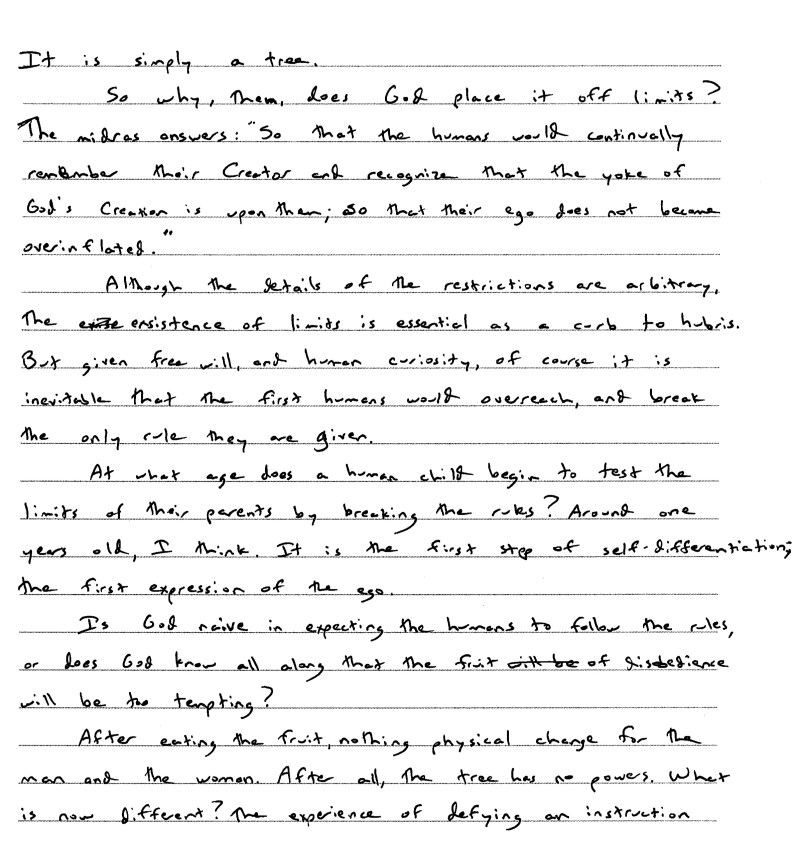
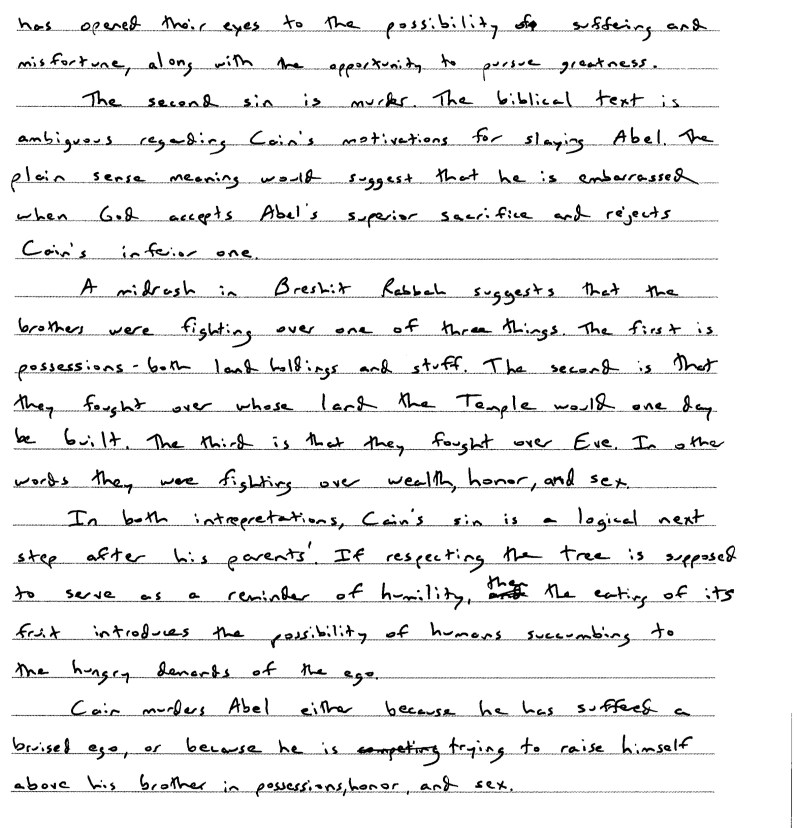
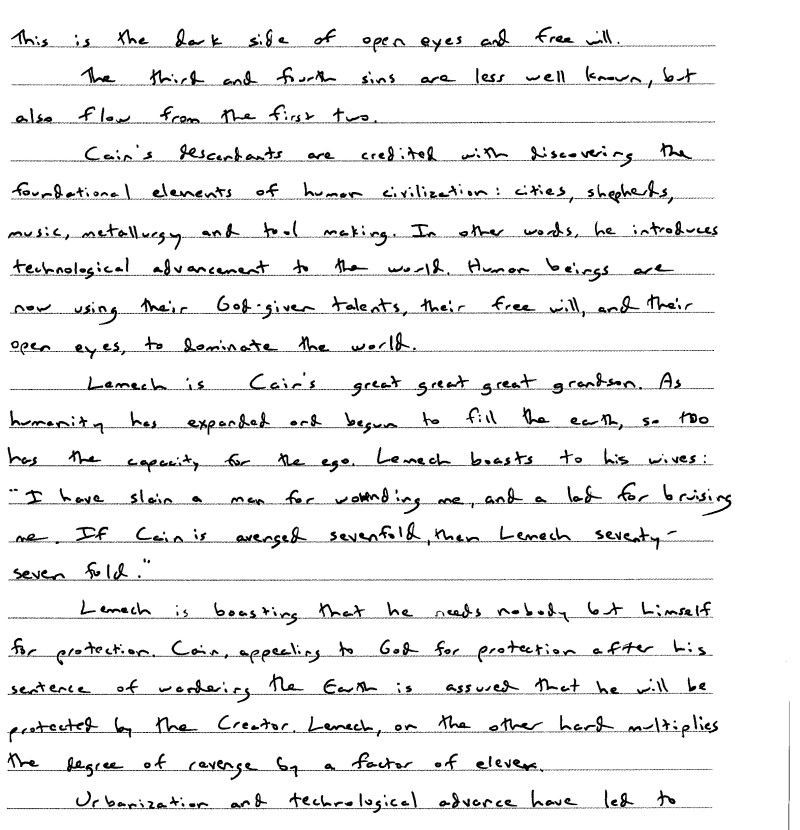
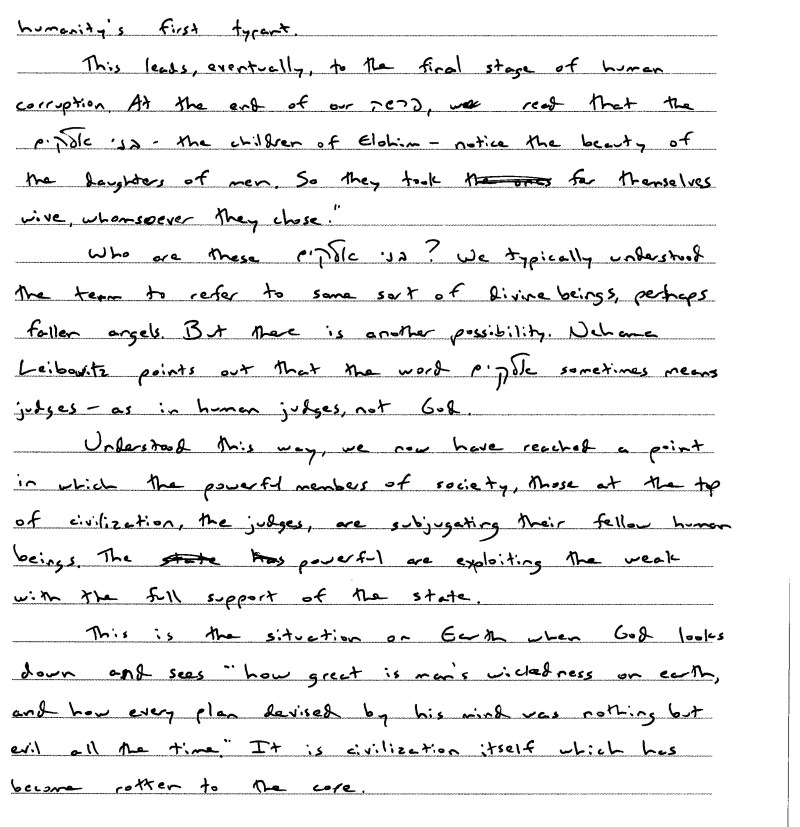
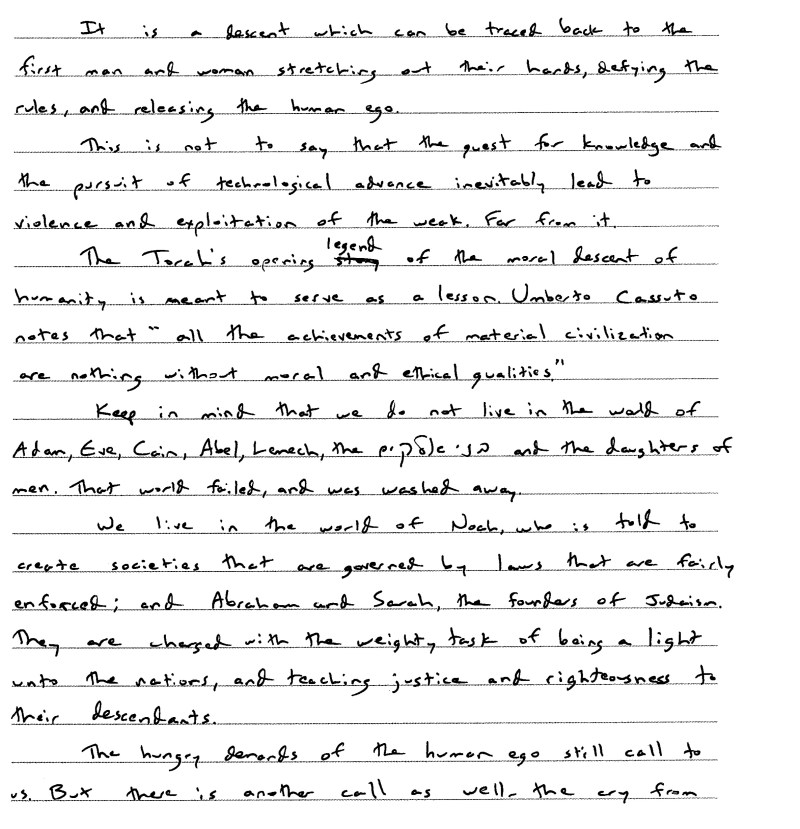
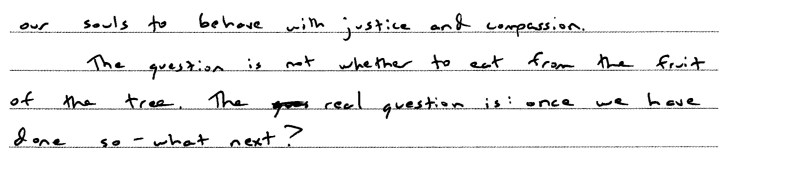
I have been feeling a bit addicted to technology lately, so I resolved to do something that I have not done in about two decades.  I wrote a sermon completely by hand, without using anything whatsoever with a screen for ideas or research.  I scanned it and am sharing the results below (I get the irony).  Sorry if you can’t read my handwriting.
bereishit-5777-the-four-sins-of-breishit1bereishit-5777-the-four-sins-of-breishit2bereishit-5777-the-four-sins-of-breishit3bereishit-5777-the-four-sins-of-breishit4bereishit-5777-the-four-sins-of-breishit5bereishit-5777-the-four-sins-of-breishit6bereishit-5777-the-four-sins-of-breishit7bereishit-5777-the-four-sins-of-breishit8

Let Us Make a Name for Ourselves – Noach 5775

According to the Torah, all human beings are descended from Adam and Eve.  Then, after humanity is wiped out in the flood, all humans are descended from Noah and his wife.  Why is it so important to specify that we all share a common ancestor?  According to the Mishnah, it is so that no one can say another, my father is better than yours.  We are all descended from the first Primordial Human, Adam, whom the Torah describes as created in God’s image.  (Mishnah Sanhedrin 4:5) Thus, equality and freedom are central concepts in our tradition.

Soon after creation, however, humanity starts to move away from this ideal.  Within ten generations, human society has become so corrupt and violent that God simply cannot take it any more.  God looks at all of the wickedness and violence, sees the way that human beings have corrupted the entire planet, and becomes sad and regretful for having ever made humanity.

So God brings a flood, appointing Noah and his family to be the sole human survivors, protectors of each animal species, and progenitors of human life in the new world that will follow.

What will change this time?  Presumably, things will be different in Creation 2.0.  Indeed, God plans ahead for the change, giving rules to humanity this time so that they do not repeat the same mistakes.

But has anything really changed?

God knows that Noah’s offspring will be no better than their ante-diluvian ancestors.

After Noah exits the ark, he offers a sacrifice.  That’s a good start.  God appreciates the gesture, and declares “Never again will I doom the earth because of man…”  (Genesis 8:21)

Fantastic!  Is it because God is so pleased with Noah’s piety?  Not exactly.

The Lord continues, “…since the devisings of man’s mind are evil from his youth.”  Nature or nurture?  It’s nature.  Humans have the same capacity for evil that they have always had.  It is part of our D.N.A.  Nevertheless, God makes a commitment to let the experiment continue, acknowledging that it an occasional intervention may be warranted.

Within a few generations, humanity seems to be heading down a familiar path.  The Torah introduces us to major characters in the generations following the flood and occasionally shares brief notes or stories about them.  We meet Nimrod, son of Cush, son of Ham, son of Noah.  Nimrod is described as “the first man of might on earth.  He was a mighty hunter before the Lord.”  (Genesis 10:8-9)  He built a kingdom in Shinar, otherwise known as Babylonia, otherwise known as Mesopotamia, otherwise known as present-day Iraq and Syria.

Tradition identifies Nimrod as the first King.  How does he ascend to that position?  The medieval commentator Abravanel points to Nimrod’s hunting prowess.  People see how powerful he is to be able to defeat lions and bears, and stand in awe of him.  When Nimrod turns his attention towards his fellow human beings, he easily vanquishes and conquers them, thus building the world’s first empire.  With empire comes progress.  The development of political life, technological innovation, human wisdom – all are made possible by civilization.

But Nimrod and his generation go astray, according to commentators, pursuing progress for its own sake, rather than as a means to a greater good.  Power begets power, as the saying goes.  Where the violence and oppression before the flood had been chaotic and random, now it is state-sponsored.

The Torah continues with the well-known story of the Tower of Babel.  At this time, we are told, everyone on earth speaks the same language and lives in the same place.  Humanity has gained the ability to control the environment in which it lives.  From their place in the lowlands, people figure out how to take mud, shape it, apply fire, and make bricks.  They now have the ability to make life better, safer, and more meaningful.  They can build structures to protect them from the elements, buildings to store food, schools to learn, libraries to store knowledge, and temples in which to worship.  So what do they do with this technological innovation, this amazing new ability?

“Come, let us build us a city, and a tower with its top in the sky…” they say to one another.  For what purpose?  Efficient apartment dwelling?  A university?  A hospital?  A town hall?  A sanctuary?  No.  Those are not what the people are interested in.  They are not going to use their technological abilities to serve a greater good.    Their aims are more self-centered.

V’na’aseh lanu shem.  “Let us build us a city, and a tower with its top in the sky to make a name for ourselves.”  (Genesis 11:4)

They want to build it as a timeless monument to human progress.

A midrash teaches that the tower gets to be so high that it takes a really long time and a lot of effort to travel from the bottom to the top.  Whenever a brick would fall, the workers would collapse to the ground and weep, “Woe is us.  When will another brick be hauled up to take its place?”  But when a person falls, nobody pays any attention.  (Pirkei D’Rabbi Eliezer 24)

Why do they build the tower?  Because they can.  This is the end result of what Nimrod introduces to the world.  It is a description of a totalitarian society in which the state is everything and the individual is nothing.  There is no God in such a situation.

God looks down at this rising edifice to human power and sees that something must change.  This is not what God had intended.  So God babbles their tongues, and they can no longer understand one another.  The building project grinds to a halt.  Then God scatters the people over the face of the earth.

On one level, The Tower of Babel is an origin story that explains why the earth contains so many people with different languages, cultures, and beliefs.  But it is also a story with lessons about human nature, politics, and equality.

Judaism is highly skeptical of political leaders.  The idea that power corrupts seems to be ingrained in the Torah.  Deuteronomy’s laws of Kings are all about limiting the powers and rights of the monarch.  Kings and societies are judged not by how much land they acquire or taxes they collect, but by how the most marginal people in society are treated.  Why are political leaders so suspect?  Because politics inevitably leads to inequality.  A subject, by definition, is not equal to the king.

In our democracy, ideally, the power of government is derived from the people, and there are checks and balances to prevent any one person or group from gaining too much power.  In reality, we know that American society has gross inequalities, whether in money, political power, educational opportunities, health care access, and so on.

The Tower of Babel suggests that the solution to the problem of too much power is diversity.  People and nations need to be free to pursue meaningful lives in different ways.  Our tradition recognizes this as ideal.

The Messianic future envisioned by Judaism does not imagine that all nations will one day unite and become a single people.  That has never been our vision.  In the Messianic Age, it is simply that all peoples on earth will recognize God as the Creator and ruler.  It is in this morning’s parashah that the Rabbis identify the seven Noachide commandments; seven laws given to all humanity that form the backbone of ethics.  As long as a people abides by those essential norms, it should be free and encouraged to go its own way, while respecting other peoples’ rights to do the same.

A thirteenth century Spanish commentator, Menachem Meiri, in considering the Christians and Muslims of his day, declares that as long as they are gedurim b’darchei hadat, bound by the laws of morality and justice, they are to be considered as equal to Jews in all respects.  That is a fairly remarkable position for that that time and place.

Elsewhere in our texts, we are taught that the righteous of all the nations earn a share in the world to come.  So you see, Judaism advocates a healthy respect for diversity.  There are other ways to worship God and other ways to organize societies other than the Jewish way, and that is a good thing.  This is a lesson from the Tower of Babel.

It is also good from a practical perspective.  A society’s embrace of diversity and pluralism serves as a check against oppression and violence.  It is why a country’s freedom is typically measured by factors like religious freedom, the fairness of elections, the existence of civil liberties, freedom of the press, and the absence of corruption.

In every age, there are Nimrod’s who seek to suppress freedom and deny equality.  Israel’s Defense Minister, Moshe Ya’alon, has been in Washington D.C. this week.  I heard an interview in which he was asked about ISIS.  He predicted that the Middle East is never going to return to what it was a few years ago.  The borders of countries like Iraq, Syria, and Iran, were drawn up arbitrarily after World War One.  The countries themselves were held together for almost a century by totalitarian dictators from minority tribes who forcefully imposed themselves on their populations, much like Nimrod thousands of years ago, who exercised power for the sake of power.  But these artificial nations were comprised of diverse peoples with different cultures, religions, and languages.  In order to maintain power, that diversity had to be suppressed.  The violence and terror we are witnessing today is driven by religiously-fueled zealots who also reject the value of diversity, deny equality, and subjugate all who come under their authority.

We have been watching in horror as ISIS and other militant Islamic groups fight to create a caliphate, an empire, that would oppress anyone who does not conform to their narrow belief system.  It is a scary, totalitarian ideology.  How ironic that the story of the Tower of Babel took place smack dab in the middle of the war zone!

If we learn one thing from the Tower of Babel, let it be that God wants diversity.  The Mishnah cited above regarding humanity’s shared common ancestor (Mishnah Sanhedrin 4:5) also teaches that when a person kills another, it is as if s/he has destroyed the entire world.  It goes on to explain that when people mint coins from a coin press, every single coin comes out exactly the same.  Not so with God, for God stamped each person with the seal of Adam, and yet no two people are alike.  Thus each person is obligated to say, “For my sake was the world created.”

People of faith would do well to remember this.