I have been feeling a bit addicted to technology lately, so I resolved to do something that I have not done in about two decades. I wrote a sermon completely by hand, without using anything whatsoever with a screen for ideas or research. I scanned it and am sharing the results below (I get the irony). Sorry if you can’t read my handwriting.


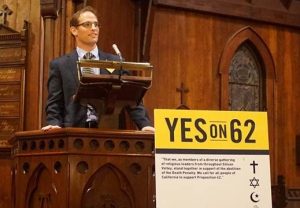
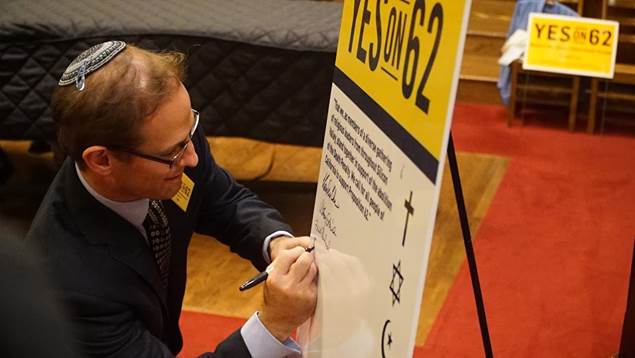
Yes on Proposition 62 – Abolish the death penalty in California
In arguing against the death penalty, I must represent our Jewish teachings honestly.
The Torah does not categorically oppose capital punishment. After the flood, God instructs the children of Noah, “He who sheds the blood of man, by man shall his blood be shed.” Human beings must build societies governed by fairly-enforced laws. This includes legal execution for the most heinous crimes.
At the same time, Jewish tradition has been so concerned with fairness and equity in administering the death penalty, that it developed extremely stringent standards.
For a guilty verdict, two valid witnesses must first warn a person that he is liable to be executed if he carries out the act. He must next verbally acknowledge his understanding and then carry out the crime regardless! With these requirements, it is nearly impossible to get a capital conviction.
The Torah recognizes that humans are by nature imperfect, and that we are influenced by deeply-held biases. The Book of Leviticus warns us:
לֹא־תַעֲשׂוּ עָוֶל בַּמִּשְׁפָּט
לֹא־תִשָּׂא פְנֵי־דָל וְלֹא תֶהְדַּר פְּנֵי גָדוֹל
בְּצֶדֶק תִּשְׁפֹּט עֲמִיתֶךָ:
You shall not render an unfair decision:
do not favor the poor or show deference to the rich;
judge your kinsman fairly. (Leviticus 19:15)
To exercise the death penalty, we Californians have an obligation to ensure that it is done with justice and equity: without discriminating based on the location of the crime, the skin color of the victim, or the income of the accused. Unless we can rise to this responsibility, it is a punishment method that we should forego.
Two of our greatest Sages, Rabbi Akiva and Rabbi Tarfon, worried so much that they might accidentally execute an innocent person that they famously declared: “if we had been members of the [court], no person would ever have been put to death.” (Mishnah Makkot 1:10)
We have had decades to figure this out in California, without success. The time has come to acknowledge the eternal imperfection of human justice. The best way to pursue righteousness and equity is by banning the death penalty.
On behalf of the Cantors and Rabbis of Greater San Jose, I urge us to approve Proposition 62 and reject Proposition 66.
May we have the wisdom to always see the Divine in each other. Amen.
Breaking the Stigma of Mental Illness – Yom Kippur 5777
There is a town in Belgium called Geel (Hyale), with a remarkable 700 year old custom of compassion.
Its origin lies in a legend about a seventh century Irish princess named Dymphna. When Dymphna’s mother died, her father went mad, insisting on marrying her. Dymphna fled to the continent. When he caught up to her in Geel, he beheaded her. Dymphna was sainted, and pilgrims began visiting the site of her martyrdom in search of miraculous cures, especially for mental illness.
A church was built in 1349, and later, an annex to house the visitors. Eventually, the townspeople began to welcome the mentally ill relatives of pilgrims into their homes as “boarders.” For the townspeople, it was an act of charity to open up their homes. “Boarders” stay with their hosts for long periods of time, as many as fifty, or even 80 years, becoming part of the family.
At its peak in the 1930’s, there were 4,000 boarders living amongst a local population of 16,000.
The residents do not use terms like “mentally ill,” “psychiatric,” or “patient.” Behavior that in any other part of the world would be considered odd or crazy, like people talking to themselves on the streets, is normalized in Geel.
This system does not take the place of medical treatment. There is a psychiatric hospital on the outskirts of town. What it does is treat people with dignity who would in any other community likely be hidden away or abandoned on the street.
Since the 19th century, Geel has been held up in psychiatric circles as the best way to address mental illness. It is an ideal model for integration and normalization within a supportive community.
Sadly, as the world has changed, Geel is changing along with it. As the result of the pressures of modern life, and the increasing medicalization of mental illness, there are today only 250-300 boarders left. But for the residents of Geel, this custom of compassion is an important part of their heritage.
Let’s try to imagine, for a moment, what it would be like if our community was so accepting and welcoming to those who do not conform to what we typically think of as normal behavior.
Psychiatric care in the United States used to center on institutionalization in asylums. People who were “crazy” were sent away to facilities that often had terrible conditions, where they received treatments that were often tantamount to torture. In 1972, the psychiatric hospitals began to close. This was supposed to be accompanied by investment of resources into community-based treatment centers. But the investment did not happen. As a result, many of those living with mental illness became homeless. This is a tragedy that persists to this day.
Unlike the example of Geel, there has been no normalization of mental illness. The mass shootings that we have seen over the past few years has prompted discussions of the need to invest more money and resources in mental health screening and treatment, but little has been done.
There is still so much fear and stigmatization. The truth is, members of our community live every day with mental illness, whether it affects them personally, or someone close to them.
But we don’t talk about it openly. We are scared of “strange” behavior. When someone exhibits signs of mental illness, we tend to back away.
Think about language that we toss around casually: crazy, cuckoo, nuts.
Mental illness is so much more widespread than we typically acknowledge. One out of every five adults in America experiences mental illness. One in twenty five live with a serious chronic condition.
1.1% of the adult population has a diagnosis of schizophrenia. 2.6% has bipolar disorder. 6.9% suffer from major depression. And 18.1% have an anxiety disorder.
Most signs of mental illness present themselves when we are young, with half of all chronic mental illness beginning by age fourteen.
We do not adequately treat mental illness. 60% of adults and 50% of youth aged 8-15 with mental illness did not receive mental health services in the last year.
There is a terrible price that we pay.
Depression is the leading cause of disability worldwide. It is estimated that serious mental illness costs America over 190 billion dollars per year in lost wages.
Suicide is the 10th leading cause of death in America overall, and the second leading cause among those aged 15-34. It is estimated that 90% of those who die by suicide suffer from depression. As much attention as there has been to the mass killings, twice as many people die in America by suicide than by murder.
Rabbis give lots of sermons this time of year about teshuvah, repentance. It is a wonderful concept – truly one of Judaism’s most insightful principles. Every year, we engage in cheshbon hanefesh―self-reflection―examining our lives, and identifying ways we can be better. We reach out to those we have wronged and seek to make amends. We turn to God, confess our sins, and ask for forgiveness.
But what if there is no getting better?
Many of us live with mental health conditions for which there is no “cure.” No amount of cheshbon hanefesh is going to enable us to “fix” ourselves.
But that does not make us failures. “Depression is a flaw of chemistry, not character,” reads a Manhattan billboard.

The field of human psychology is just over a century old. Our understanding of mental illness, and our ability to treat it, ha experienced a sea change in that time. But that does not mean that our ancestors did not have any appreciation or compassion for those whose behaviors did not conform to social norms.
In the Bible, the best depiction of a major character suffering from mental illness is King Saul. Listen to how the Bible describes the onset of his condition: “Now the spirit of the Lord had departed from Saul, and a ruach ra’ah – an evil spirit – from the Lord began to terrify him.” (I Sam 17:14) Saul’s courtiers do not know how to address their king’s new state of mind, so they suggest searching for a musician to soothe him whenever the ruach ra’ah manifests itself. A search leads to David, who, among other talents, is a skilled lyre player.
Saul’s ruach ra’ah comes and goes. He has episodes of paranoia and mania interspersed with periods of normal function. Some modern readers have suggested that he might have suffered from a bipolar disorder, although we should be cautious about making a diagnosis based on a three thousand year old text.
Some time later, David kills the Philistine Goliath and then has to flee from Saul’s wrath. He winds up in the court of King Achish of Gat, Goliath’s home town. To avoid arrest, David pretends to be insane, scratching marks on the doors and letting his saliva run down his beard. Achish, afraid of this behavior, scolds his attendants. “You see the man is raving; why bring him to me? Do I lack madmen that you have brought this fellow to rave for me? Should this fellow enter my house?” (I Sam. 21:15-16)
Many of the Psalms, traditionally attributed to King David and his court, express the anguish of a troubled mind.
My soul is in anguish, and You, O Lord―how long?
Turn, Lord, set my soul free; save me for the sake of Your love…
I am weary with my sighing.
Every night I drench my bed, I soak my couch with my tears.
My eye grows dim from grief, worn out because of all my foes… (Psalm 6)
These sound like the words of a person living with severe depression.
In Rabbinic texts, there is much discussion about mental illness. The term that is used to describe such a person is shoteh. The shoteh, along with the deaf-mute, is generally not granted much legal status, as they are assumed to not understand what is happening around them.
But what constitutes a shoteh?
A single talmudic passage offers an inconclusive definition. “Who is a shoteh? A person who goes out alone at night; sleeps in a cemetery; and tears one’s clothing.” (BT Chagigah 3b) One Rabbi explains that all three behaviors need to be exhibited, while another Rabbi argues that just one is needed. Then, the Talmud suggests that there could be rational reasons for a person would go out alone at night, sleep in a cemetery, or tear clothing. The question is left unresolved.
Nearly one thousand years later, Maimonides is discussing laws pertaining to who may serve as a witness in court. A shoteh, someone who is mentally or emotionally unstable, is not considered to be obligated in the mitzvot, and thus cannot serve as a witness, he says. But who is a shoteh? As a legal scholar, a physician, and a community judge and leader, Maimonides offers a more nuanced, and I would suggest compassionate, way of looking at the shoteh.
First he describes someone who is unable to understand basic matters or recognize simple contradictions. He is describing what we might call someone with an intellectual disability, or low IQ.
Maimonides then writes about emotional instability. He says that is is not merely someone who “goes around naked, destroys utensils, and throws stones. Instead, it applies to anyone whose mind is disturbed and continually confused when it comes to certain matters, although he can speak and ask questions to the point regarding other matters.”
But his final comment is the most poignant. “This matter is dependent on the judgment of the judge. It is impossible to describe the mental and emotional states of people in a text.” (Edut 9:9-10)
Every person is unique. Someone might be capable and functional in some aspects of his or her life, but troubled in other aspects. Emotional instability might come and go. We cannot make categorical assumptions without even getting to know a person. We have to take the time to listen.
Pretty progressive for the twelfth century.
Today, we know that mental illness is not a punishment from God, and it is not something that can be cured with sacrifice or prayer. Whereas it was once attributed to possession by a ruach ra’ah, we now understand mental illness as being caused by chemical and/or physical processes in the brain.
And, there is often treatment that can reduce symptoms of mental instability and make it possible for someone living with a mental illness to flourish in ways that would have been unimaginable in previous eras. Someone who once would have been considered a shoteh, and not held accountable for his or her actions, can now have a family and a successful career.
While not perfect, we do a pretty good job of accommodating the needs of people who live with physical disabilities. The Americans with Disabilities Act, signed into law in 1990, “prevents discrimination and guarantees that people with disabilities have the same opportunities as everyone else to participate in the mainstream of American life.”
It has changed such basic things as how we design buildings. When our synagogue was built ten years ago, for example, we included a ramp to enable someone who uses a wheelchair or walker to come up to the bimah. Earlier this year, we installed railings to make it easier to walk up the steps to the bimah.
We do a reasonably good job of ensuring that our synagogue is a welcoming home for anyone with a physical disability.
But what about for someone suffering from a psychiatric illness?
One of the most meaningful parts of our weekly Shabbat services is the Mi Sheberach L’cholim, the prayer for the sick. Our practice is to invite anyone who would like to include the name of someone who seeks healing to form a line. Each person has an opportunity to recite the names of those who are ill. It is one of the most personal parts of the service for many of us, including me.
I recognize many of the names that are recited, and I am familiar with the illnesses that many of them face: cancer, chronic conditions, acute sickness, dementia. But have we created a culture in which we would think to include someone struggling with mental illness in our prayers for healing?
Would someone who is him or herself experiencing depression feel welcome to include his or her own name?
It would certainly be appropriate to do so. The language of the prayer acknowledges that there are physical and spiritual dimensions to healing. We pray for r’fuat hanefesh ur’fuat haguf―healing of spirit and healing of body―in that order.
Prayer is not a treatment for mental illness. It is not a substitute for medications that address chemical imbalances in a person’s brain. But religion, and a religious community, ought to be an important component in healing. Where better for someone living with depression to turn for support and acceptance than a house of worship?
We need to do better. Congregation Sinai needs to be a community in which those suffering with a mental illness can be open about their struggles. We need to break the stigma that leads so many of us to keep our struggles inside.
If you feel comfortable sharing your struggles with someone else, please take the courageous step and do so. For someone who feels embarrassed or self-conscious about opening up, knowing that there are others who have shared similar experiences can make a huge difference. It sends the message that “you are not alone.”
I have an anxiety disorder and Adult ADHD, for which I take psychiatric medications.
Over the past ten years or so, I have experienced occasional panic attacks. I get dizzy. The world starts to spin. The edges of my eyesight get blurry, and I worry that I am going to pass out. On some particularly bad occasions, I feel like I am having a heart attack, or at least, what I imagine a heart attack would feel like.
Scariest of all is when I have a panic attack while behind the wheel of a car. One of my triggers is driving over tall bridges. A few years ago, I was driving over the Golden Gate Bridge with my brother-in-law in the passenger seat and our kids in the back. Halfway across the bridge, I could feel an attack coming on. “Keep an eye on me,” I told my brother-in-law. As soon as we got to the other side, I pulled over to the shoulder and gave him the wheel.
A couple of years ago, I had a panic attack in the middle of the night. I thought I was having a heart attack. I woke Dana up, and asked her to keep an eye on me. I was upset with myself. “What is wrong with me? I should be able to just get myself under control. After all, this is all just in my head.”
Dana, in her wisdom, responded, “Your brain is the most complex organ in your body. What makes you think that you can just get it under control?”
Looking back, I realize that I had succumbed to the stigma of mental illness. I felt guilty for not being able to control something “that was just in my head.”
It is not “just in my head.” It is “in my head,” and that is not something to take lightly.
While real to me, my struggles are minor inconveniences compared to the serious mental afflictions that impact some peoples’ lives. I do not know what it is like to live with schizophrenia or a bipolar disorder.
But I can hold someone’s hand and listen.
This year, I ask that we make it a priority that our synagogue become a place in which those living with mental illness can find compassion, acceptance, and healing. I will speak of it more explicitly from the bimah. From now on, when I lead the prayer for healing, I will change the way that I introduce it to something like the following:
I am now going to recite the Mi Sheberach L’cholim, the prayer for healing for those with physical and mental illness. If you would like to include someone, or if you yourself are in need of healing, please come up and form a line to my right.
I ask that we commit to being there for each other with open minds and open hearts.
We all bring our tzarot, our troubles, to shul. Especially on a day like Yom Kippur, with its focus on sin, repentance, atonement, and mortality.
Yom Kippur is really a day for spiritual healing. In the Temple, it was the day when the High Priest conducted the rituals that restored the spiritual relationship between God and the Jewish people. Today, our prayers and our fasting accomplish the same.
Let this day, this synagogue, and this community, offer healing and comfort to all those who have brought their tzarot with them.
I would like to close with this prayer composed by Rabbi Elliott Kukla, of the Bay Area Jewish Healing Center.
May the One who blessed our ancestors bless all who live with mental illness, our care-givers, families, and friends. May we walk in the footsteps of Jacob, King Saul, Miriam, Hannah, and Naomi, who struggled with dark moods, hopelessness, isolation, and terrors, but survived and led our people. Just as our father, Jacob, spent the night wrestling with an angel and prevailed, may all who live with mental illness be granted the endurance to wrestle with pain and prevail night upon night. Grace us with the faith to know that though, like Jacob, we may be wounded, shaped and renamed by this struggle, still we will live on to continue an ever unfolding, unpredictable path toward healing. May we not be alone on this path but accompanied by our families, friends, care-givers, ancestors, and the Divine presence. Surround us with loving-kindness, grace and companionship and spread over us a sukkat shalom, a shelter of peace and wholeness. And let us say: Amen.
G’mar Chatimah Tovah. May we all be inscribed and sealed in the Book of Life for a year of blessing and healing.
Self Absorption – Rosh Hashanah 5777
The story of the Akeidah, the Binding of Isaac, which we read every year on the second day of Rosh Hashanah, is so tantalizingly evocative, inspiring, and troubling. It is a carefully written literary masterpiece. Every year, we find new ways to read it.
“Some time afterward, God put Abraham to the test.”
What kind of test is this? Is it pass/fail? Is it a test for which God does not know the answer, or a test meant to impart some lesson?
Maybe it is like the test of the emergency broadcast system. “This is a test of the Emergency Broadcast System. Had the All-Powerful Supreme Ruler of the Universe actually wanted you to sacrifice your son, more information would have followed. This is only a test.”
Or, perhaps it is a test for us – the readers.
Of course, we know it is a test from the beginning. The actors in this drama have no such foreknowledge.
“Abraham.”
“Here I am.” Hineni.
“Take your son, your favored one, Isaac, whom you love, and go to the land of Moriah. V’ha’aleihu sham l’olah on one of the heights that I will point out to you.”
Abraham hears this as “offer him there as a burnt offering.”
Before we get too upset, keep in mind that child sacrifice was not such a far-fetched idea in Abraham’s day. It was a widespread practice throughout the Ancient world, including in the Land of Canaan. We have biblical and other ancient literary references, as well as archaeological remains. As far as humans in ancient times knew, the gods liked it when people offered up their children. It probably did not sound all that strange to Abraham. So he complies with the request.
Without a word, Abraham gets up early, saddles a donkey, enlists two servants and Isaac, and chops some wood to serve as fuel.
On the third day, Abraham looks up and sees the mountain. He tells the servants to wait at the bottom with the donkey. He gives Isaac the wood to carry, and they set off to climb the mountain. He himself carries the firestone and the cleaver.
Suddenly, we hear Isaac’s voice, the only time that the Torah records father and son speaking together.
“Father.”
“Here I am, my son.”
“Here is the fire and the wood; but where is the sheep for the offering?”
“God will see to the sheep for His offering, my son.”
And the two of them walk on together.
No more words are exchanged. They reach the top of the mountain. Abraham, methodically, goes about his business. He lays out an altar. He places the wood on it. He binds Isaac and places him on top of the wood.
He reaches out his hand and takes hold of the cleaver in order to slaughter his son.
And suddenly a voice cries out: “Abraham! Abraham!”
It is an angel of the Lord from the heavens.
“Here I am.” Hineni.
“Do not reach out your hand against the lad, and do nothing to him, for now I know that you fear God and you have not held back your son, your only one, from Me.”
Abraham raises his eyes and he looks and ‘Behold! A Ram!’
―with its horns caught in the thicket. And Abraham takes the ram and offers it up as a burnt offering in the place of his son.
Abraham barely speaks throughout this story, and never once to God. Rashi, citing a midrash, imagines that Abraham might have had a few questions that did not make the final edit.
“I will lay my complaint before you,” he begins. “You told me, (Genesis 21:12) ‘through Isaac shall your seed be acclaimed,’ and then you changed your mind and said, (Genesis 22:2) ‘Take, pray, your son.’ Now you tell me, ‘Do not reach out your hand against the lad!'”
Abraham is understandably confused. God has promised that Abraham will be the father of a great nation, descended specifically through Isaac. We read about in just the previous chapter, and we chanted it yesterday.
Then, God seems to change the plan by asking Abraham to offer Isaac up.
Through it all, Abraham goes along.
Now, having done everything God has asked of him, despite the contradictions, Abraham is told not to follow through!?
The Holy One, blessed be He, says to him, [You misunderstood me.] When I told you, ‘Take [your son…,] I did not tell you ‘slay him’ but rather ‘bring him up,’ for the sake of love did I say it to you. You have brought him up, in fulfillment of my words — now take him down.’ (Genesis Rabbah 56)
The miscommunication hinges on the phrase v’ha’aleihu sham l’olah. An olah is a burnt offering. That is how Abraham hears it.
But it also means “go up” or “ascend.” A person who moves to Israel makes aliyah. Someone who is given an honor in synagogue receives an aliyah. In the midrash, God means for Abraham to bring Isaac up to the top of the mountain as an expression of love, not to be a sacrifice.
How could Abraham have misunderstood?
To answer this, we must identify the role of the angel in this story.
Imagine the critical scene in your mind, when Abraham has grasped the blade in his hand, and the angel comes to intervene. Picture it. Where are Isaac, Abraham, and the angel situated?
In almost every work of art depicting the Binding of Isaac, the angel is reaching out a hand and grabbing Abraham to prevent him from slaughtering his son. That image of physical intervention has entered our consciousness.
But that is not what the text says. The only intervention that takes place is verbal. “Abraham. Abraham.”
“Here I am,” he responds.
It is Abraham who holds back his own hand.
There is a vein within the Jewish mystical tradition extending into mussar thinking that understands angels as inert forces in our world. They are unable to act. It is righteous human action, or expressions of will, that activates these inert Divine forces.
Mussar understands the expression of the human will as it acts in the world to be our yetzer. The yetzer can be tov – good, or it can be ra – evil.
When we allow it to flow out of us, the yetzer is tov. But when it is stopped up inside, it becomes ra.
To expand on this―when my focus is external; when my concern is for the other; when the question I ask myself about the person before me is “what does this person need from me?”―That is when my soul opens up, and my yetzer flows out.
But when I am self-absorbed; when I am concerned for my own needs; when I am wrapped up in my own suffering― then I am unable to recognize the needs of the person facing me. My soul is stopped up, and my yetzer works its evil, rotting inside of me.
All that God or the angel can do is speak. Only Abraham can act to change the course of events in this story.
In the beginning, God calls out to Abraham and asks him to raise up his son in love. But Abraham, in this moment self-absorbed in his devotion to a god who might just be a projection of his own ego, hears the message differently. The yetzer hara has taken hold. Can Abraham break out of his self-absorption and release his yetzer hatov?
Abraham has other moments of greatness, when his yetzer tov flows out into the world. When he runs out of his tent to welcome three angels disguised as travelers, when he argues with God on behalf of the people of Sodom and Gomorrah―these are moments when Abraham has set aside his own self-concern to serve others, and in so doing, to activate God’s Presence in the world.
In this story, however, Abraham’s yetzer is stopped up. He is not able to activate the Divine potential that lies dormant. He does not see the suffering of his son.
Something happens on top of the mountain. The angel calls out twice. Abraham looks up. Not only does he see the ram, he sees his son, perhaps for the first time. That is the test. And he passes. He saves his son, substituting the ram.
Only then does God bless him.
We live in an epidemic of self-absorption. In former times, people lived in close quarters. It was not uncommon for three generations to reside under the same roof. We were thrown against each other in such a way that it was nearly impossible to find privacy, even in our own homes. Facing each other’s needs was inevitable.
Now, we are so spread out. Most households today have just one or two generations living under the same roof. Plus, the distance between our homes has grown, so we are farther away from our neighbors.
The membership of our synagogue is spread out over many square miles. We’ve gone to the opposite extreme. We have so much private space that we now find ourselves alone much of the time. If we want to be with other people, we have to actively do something to make it happen.
The internet offers the promise of connecting with each other across the physical divide. But how do we use it?
I might snap a selfie, or post the silly thing that my kid said. I’ll take a picture of my lunch and share it with the world. And then I’ll check to see how many “likes” I’ve received. Is this really connecting with other people, or might this perhaps be a manifestation of my self-absorption?
There is an inverse relationship between the amount of time we spend “connecting” online and the amount of time we spend “connecting” in person. It is getting steadily worse as the number of screen devices in our lives increases.
Our tradition teaches us that holiness is encountered in the relationships between people. The three dimensional relationships. God, as a latent force, is activated when we care for another person, placing that other person’s needs before our own.
And believe it or not, quantity matters.
The question is asked―If I have a thousand gold coins to give away, is it better to give all thousand coins to one person, or should I give one coin each to a thousand people?
I might think that it does not make a difference. What matters is the bottom line. The tax deduction is the same either way. Or, I might say that one coin is not going to do anyone any good, but one thousand coins will surely make a difference in someone’s life.
But that is not what our tradition says. It is better for me to give a thousand coins to a thousand people. Why? Because of the impact of one thousand face-to-face interactions on me.
The word v’natnu, meaning “and you shall give” is the longest palindrome in the Torah―vav nun tav nun vav. This teaches us that the blessings of generosity flow forward to the receiver and backward to the giver.
What are those blessings? Increased consciousness of the other. Holiness. Awareness of God.
What will it take for us to be less self-absorbed? Deliberate effort. We have got to train ourselves if we want to be able to resist the forces that drive us towards increased alienation. And just like the thousand coins, quantity matters.
It is one of the reasons why our synagogue is so important. Involvement in a religious community offers many ways to break out of self-absorption and see the other: attending Shabbat services, where we pray side-by-side, and then share a meal together; learning together at a Limmud La-ad, Lifelong Jewish Learning, program; taking time out to comfort a mourner by attending a funeral or a shiva minyan; delivering a meal and visiting with someone in our community who is ill; helping to serve lunch at a homeless shelter.
In this new year, let us each identify individual actions that we can take that will change the question from “what do I want?” to “what does the person before me need?”
The accumulation of many such actions can eventually unstop our hearts, release our yetzer tov, connect us with others in a world of increasing alienation, and activate the Divine Presence in our world.
Like Abraham, who at the critical moment, heard the Divine Voice calling, and woke out of his narrow-minded self focus to see his bound son suffering before him – we too can wake up.
Shanah Tovah.
Thanks to Rabbi Ira Stone for providing ideas that went into this D’var Torah.
How to Disagree – Rosh Hashanah 5777
Resh Lakish and Rabbi Yochanan were the best of friends. Their lives were intertwined from the Study Hall, to the home, and to their graves. (BT Bava Metzia 84a)
Before they meet, Resh Lakish is an outlaw. One day, as he is walking next to the Jordan River, he sees what he thinks is a beautiful woman in the water. He enthusiastically removes his weapons and armor and jumps into the water. To his surprise, the bathing beauty turns out, upon closer inspection, to be none other than Rabbi Yohanan.
“You are too pretty to be a man,” Resh Lakish declares. “This beauty is wasted on you. You should be a woman.”
With a sly look at the highwayman, Rabbi Yohanan responds, “But I have a sister. And she is even more beautiful than I. If you will repent of your wicked past, you can marry her.”
Reish Lakish eagerly agrees. So Rabbi Yohanan brings him into the Beit Midrash and teaches him Torah and Mishnah, and transforms Resh Lakish into a great scholar.
They become brothers-in-law, study partners, and best friends.
One day, they are arguing a point of law in the study hall, and things get a little out of hand. In a moment of frustration, Rabbi Yohanan brings up Resh Lakish’s past as a brigand. The insults fly back and forth, and before they know it, they are refusing to speak with one another. Rabbi Yohanan’s anger and hurt swirls about, invoking the spiritual realm. As sometimes happens with holy men in Talmudic stories, this causes Resh Lakish to fall gravely ill.
Resh Lakish’s wife, Rabbi Yohanan’s sister, visits her brother in desperation, hoping his spiritual intervention might save her spouse. “Please, my brother, pray for my husband, if only for the sake of his children, your nephews.”
Yohanan refuses. “Your children can become orphans. God will provide for them.”
“If not for the children’s sake, then, save him for my sake. Don’t allow me to become a widow!”
“God takes care of widows,” he stubbornly insists.
Resh Lakish, without his friend to intercede on his behalf, dies.
Rabbi Yohanan, bereft of his friend, falls into a deep depression. The Rabbis from the Study Hall are so concerned that they send Rabbi Elazar, a mild-mannered scholar, to console him.
Elazar sits by Yohanan’s bedside, and they begin to study together. Every time Yohanan makes a statement, Elazar nods enthusiastically in agreement, and offers additional arguments to support him.
Yohanan is exasperated. “Whenever I used to make a statement to Resh Lakish, he would have twenty four objections to me, to which I would have twenty four responses. That is how we would deepen our knowledge of the law. And you tell me, ‘Oh, here is something that supports you.’ I don’t need you to tell me that. I already know that I am right!”
In despair, Rabbi Yohanan rends his garments in mourning and is overcome with weeping. “Where are you, O son of Lakish? Where are you?” He cannot be consoled.
Seeing that there is no remedy for his heartbreak, the Rabbis of the Study Hall pray to God for mercy, and Yohanan dies.
This rich and tragic Talmudic story conveys so well, with deep emotion, Jewish values of machloket, disagreement.
We, as individuals and as a society, are in deep need of guidance when it comes to dealing with those who think differently than us. Rosh Hashanah offers us an opportunity for taking stock of how we interact with one another in our homes and in our society. With an election looming, it is an especially important time for us seek productive ways to address disagreement. Perhaps our tradition can be a source of wisdom.
Let us be careful not to play the revisionist game and claim that there was a glorious time when human beings used to speak to each other with respect and honored opponents who held differing opinions. And let us not be so naive as to suggest that Jewish culture, in contrast to all other traditions, has always tolerated other ideas. It is simply not true.
But there is a well-developed idea within our intellectual history that portrays how human beings ought to treat those with whom we disagree.
The goal is not just the intellectual pursuit of Truth, but also the practical implementation of rules for society. How can we live together when we disagree so fundamentally about how we should live?
The pursuit of truth and peace is best achieved through a blend of vigorous disagreement and mutual respect. For us Jews, these are deeply held values that are the products of our own unique history.
For 2,000 years, we exercised our minds. We perfected the art of seeking theoretical analyses of Biblical passages. We debated the interpretations of the interpretations of the interpretations. In great depth, we studied laws that had not been implemented for hundreds of years, and for which there was no hope of actual implementation.
As a result, we Jews got really good at reading texts and arguing about ideas. Perhaps this was the result of our being an exiled people. Without political autonomy, and no ability to exercise power beyond the confines of our small communities, we turned inward. We expressed our power on the page and in the study hall.
If we could not fully implement our vision of what life ought to be in the world, we were at least free to develop a vision of the ideal in our minds. In so doing, we held on to four primary principles of machloket, argument.
1. Passionate argument is a good thing. It makes us sharper, and it brings us closer to the truth.
2. We must respect our opponents, even when we disagree with them.
3. We can only claim to be in pursuit of truth if we are willing to be convinced by our adversaries’ arguments.
4. Even when we cannot agree, we still need to find a way to live together.
If we could introduce these four principles into our current relationships, we would have a far more cohesive society.
The tragic story of Rabbi Yohanan and Resh Lakish introduces the issues with great humanity. The situation begins to decline in the Study Hall. In a moment of weakness, Rabbi Yohanan takes what, until that moment had been an intellectual disagreement, to heart. Instead of offering a logical counterargument or accepting defeat, he insults his friend. He knows exactly where to strike so that it will hurt the most. He drags up Resh Lakish’s sordid past.
Never mind that Resh Lakish has done teshuvah, that he has left that world long behind. In bringing it up, Rabbi Yohanan makes a power move, as if to say, “I may have lost this argument, but I am still more pious, holy, and wise than you.”
How often have we heard that?! Resorting to name calling? Dredging up personal attacks to avoid engaging with ideas?
Rabbi Yochanan holds the grudge, refusing to intervene to save his friend. Even his sister cannot break through his stubbornness.
Only when it is too late does Rabbi Yochanan discover what he has done. He realizes the value of argument. With Resh Lakish as his intellectual jousting partner, Yochanan was sharpened. He gained a deeper understanding of truth.
It is remarkable how relevant this ancient story is to our time.
At the extreme are ISIS and their ilk, who seek to create a world in which all who do not share their vision are killed or enslaved.
But there are plenty of other ways, permeating every layer of our civilization, in which we are becoming more polarized. Our openness to even hearing the opinions of those who disagree with us seems to be waning. This is a disturbing and dangerous trend.
The current presidential election campaign has been the most in-your-face example of this. But then again, isn’t every election ugly? This year is perhaps not an aberration, but a culmination of the building polarization of the past couple of decades.
We might point to the rise of certain consumer technology tools that have fed the flames of this divide. The popularity of Twitter, with its short, truncated format, lends itself to oversimplification and name-calling. The extreme ease of passing along internet memes through various forms of social media enables the ugliest characterizations and rumors to circumnavigate world with lightning-fast speed.
I do not mean to sound like a luddite, but there is a terribly harmful side to the miracle of instant communication.
Quite disturbing has been the trend over the past few years to suppress speech at, of all places, college campuses. There have been numerous efforts to disinvite speakers – many of which have won. Lecturers have been spat upon. Speakers have been shouted down to such a degree that they could not continue. Campus newspapers have been defunded. Universities have drafted speech codes, the violation of which can result in professors losing jobs or students being expelled.
The evidence reveals that it is perpetrated by both the left and the right, sometimes in response to one another. Students and professors have reported feeling that they have to self-suppress out of fear of repercussions.
These trends are creating pockets of like-minded thinkers who never have to face ideas that challenge them. In the tragic story, it is the replacement of the feisty Resh Lakish by the “yes man,” Rabbi Elazar, that – quite literally – kills Rabbi Yochanan. We should read it as a warning.
When we do permit ourselves to hear other perspectives, do we truly listen with open minds?
The next story is about the famous schools of Hillel and Shammai (BT Eruvin 13b). It teaches us about the importance of respecting our opponents.
Beit Shammai and Beit Hillel once got into an impassioned argument over a matter of Jewish law. One school says, “The law is in agreement with our view,” while the other claims, with equal certainty, “The law is in agreement with our view.”
Three years pass without any progress. One day, a Heavenly Voice suddenly booms across the study hall: Elu v’elu divrei Elohim chayim hen. “These and these are the words of the living God.” V’halakhah k’veit Hillel. “But the law is in agreement with the rulings of Beit Hillel.”
“But how can this be?” the Talmud asks. If “both are the words of the living God,” what entitles Beit Hillel to determine the law?
The Talmud answers, “Because they were kindly and modest, they studied their own rulings and those of Beit Shammai and were even so humble as to mention the opinions of Beit Shammai before their own.”
We draw two lessons from this remarkable story. The first, elu v’elu divrei Elohim chayim. “These and these are the words of the living God.” Strangely, the Talmud does not ask how it is possible that both Beit Hillel and Beit Shammai could be correct. It is a given.
This should remind us that, as sure as we might be of our rightness, someone else is just as sure of theirs. It’s not to say that there is no such thing as truth and everything is whatever a person says it is. But indeed, there is often more than one solution to a problem.
I learned this lesson from my tenth grade Algebra 3/Trigonometry teacher, Mr. Evanson. One would think that in a field like math, there is a right and a wrong answer. But Mr. Evanson was much more concerned with how we solved a problem than in the answer we came up with. What excited him was seeing different ways of approaching the challenge. I learned that, even in math, there is often more than one way to arrive at the truth.
So what made the difference? Not superior logic or better proofs. It was intellectual openness and respect for difference. That is why we follow Beit Hillel. Hillel taught his students to learn from and honor their adversaries. If I have to state my opponent’s arguments before my own, it means that I have to pay close attention and have an open mind.
Beit Hillel teaches us another lesson: we should always be willing to be proven wrong. A Mishnah begins Elu d’varim she’chazru Beit Hillel l’horot k’divrei Beit Shammai. “These are the matters about which Beit Hillel changed their minds and taught according to Beit Shammai.” And then the Mishnah goes on to list a number of laws. (Mishnah Eduyot 1:12)
The Mishnah does not need to tell us this. It could just state the outcome. Indeed, the Mishnah usually states the majority opinion, along with significant minority opinions. But to cite opinions that are later abandoned is unusual.
Maimonides explains that it is to be lesson for us. “For when these honored, pious, generous, and distinguished scholars of the School of Hillel saw that the view of those who disagreed with them was to be preferred to their own, and that others’ deliberations were more correct – they agreed with the others and retracted their view. How much more should other people, when they see that the truth lies with their opponent, incline to the truth and not be stubborn…”
And he goes on to say that “even if you are able to use proofs to buttress your position, but if you know your friend’s position is correct and that your proofs to the contrary are only due to his weakness in argument, or because you are able to pervert the truth, accept his version and forsake further argument.”
Maimonides nails it. How often is it that we hang on to a position out of stubbornness and ego?
Wouldn’t it be refreshing to occasionally hear a politician say, “My opponent is right. After considering all the facts and the arguments, I have concluded that my earlier position is wrong. And now I think differently.” A candidate who had the humility and the courage to say that would probably earn my vote.
But what about when there is no resolution – when two sides are firmly entrenched in their positions about how society should function?
A Mishnah tells how Beit Shammai and Beit Hillel disagree about several areas of personal status law. While it might not seem so today, in the ancient world, this was a huge deal. It could mean the difference between a child being legitimate or illegitimate, which could have life-long implications affecting marriage and social acceptance.
The two schools disagree with one another. Nevertheless, the Mishnah concludes, “even though the one invalidated and the other validated, Beit Shammai did not refrain from marrying women from Beit Hilllel, and Beit Hillel did not refrain from marrying women from Beit Shammai.” (Mishnah Eduyot 4:8)
As much as each side “knew” that it was correct, they shared a higher value. “We are one people. Even if we can’t come to an agreement, we will still find a way to live together.”
This is such a lovely example. Because the way the Mishnah finds to express their shared value is in the most intimate way possible. Beit Hillel and Beit Shammai joined their houses together. They intermarried with one another.
This would be like the Montague’s and the Capulet’s getting together to throw an engagement party for Romeo and Juliet.
While we may not be able to change the polarization that plagues our world, in this new year, we can begin to take small but significant steps in our own lives, drawing upon the ancient wisdom of our tradition.
Judaism treasures machloket. Vigorous questioning and challenging of each other offers us the surest path to truth.
In doing so, however, we must always maintain the dignity of our opponents, honoring them even when we disagree.
We also have to be open to being convinced. If we are not willing to change our minds, than we cannot claim to be seeking truth.
And finally, we have got to remain sincerely committed to living together in peace, despite our differences.
In this new year, may we have the courage and humility to argue, listen, and respect one another with open minds and open hearts.
Shanah Tovah.
Shimon Peres, z”l: Did I bring more good to the world today, or bad? – Nitzavim 5776
The entire world this week mourns the passing of Shimon Peres, alav hashalom, who died Wednesday at 93 years of age. Many obituaries have been written in the past few days about him, which I encourage all of us to read.
Peres was involved in the creation, building and flourishing of the State of Israel more than any other person. As a young man, Peres was active in the Haganah and became a close advisor and protege to David Ben Gurion. He was responsible for breaking the siege and acquiring military equipment in the War of Independence. Peres built up the military during the early years of the state. He led behind the scenes diplomacy with France leading up to the 1956 Suez war. Then, he was in charge of creating Israel’s nuclear program in the 1960’s.
In the years after the Six Day War, Peres encouraged Jewish settlement in the West Bank, although he eventually came to see it as an obstacle to peace. He, along with Yitzchak Rabin, was an architect of the Oslo Accords, for which he was awarded the Nobel Prize for Peace.
Peres was an early and constant promoter of technology. He saw economic growth and cooperation as the path towards closer relations and eventual peace with other nations, including Israel’s enemies.
Shimon Peres served in the Knesset for nearly five decades, and held every major position in government, including Prime Minister and President.
In his last public interview, conducted on August 31, Peres spoke about the exercise of power.
You have to decide either to be a giver or a taker. The biggest mistake is if you’ll use the power to take. The greatest wisdom is if you give.
That, he explains, has been the secret to America’s great success. And it is has driven his approach to building stronger connections between Israel and other nations. Peres shared a story in which he was recently meeting with Vladimir Putin, whom he described as a very good friend. Peres rebuked him for being a taker rather than a giver.
“You behave like a czar,” [he] said…
“What did the czars do? They developed two cities, St. Petersburg and Moscow, as a showcase. Whatever you want, you will find there. The rest of Russia is like Nigeria covered with snow. Your people are dying. You don’t give them life. You think they’ll forgive you?”
“Why is America great?” I asked him. “Because they were givers. Why is Europe in trouble? Because they are takers. America is giving; people think it’s because they are generous. I think it’s because they are wise. If you give, you create friends. The most beneficial investment is making friends.”
“America had the guts to take the Marshall Plan, a huge piece of their GNP that they gave to this dying Europe. And in this way, they have shown that this is the best investment in the world.”
A cultural Zionist, Shimon Peres nevertheless believed strongly that Zionism had to be rooted in timeless Jewish values, and felt that the current generation had gone off track from that ideal.
But Peres was always an optimist. Respected by everyone across the political spectrum, he has been Israel’s chief visionary for peace for the last two decades. It was a hope that he never gave up.
Peres recently reached out to meet with Micah Goodman, a philosopher and teacher at the Hartman Institute in Jerusalem. Goodman is the most prominent writer on Jewish philosophy in Israel today. A few years ago, he wrote a best-seller entitled The Secrets of the Guide for the Perplexed about Moses Maimonides. (Only in Israel would a book like that be a best seller.) It was recently translated into English as Maimonides and the Book that Changed Judaism.
Peres wanted to meet with Goodman, whom he described as his teacher, to discuss Maimonides.
“I find myself in his apartment in Tel Aviv,” Mr. Goodman recalled. “He is wearing his jeans. He wants to understand Maimonides.
“He told me that before he goes to sleep he thinks to himself, ‘Did I bring more good to the world today, or bad?’ He kept a balance sheet. He was like a 16-year-old idealist. At 93.”
That question, “Did I bring more good to the world today, or bad?” summarizes the entire theme of the High Holidays. For a 93 year old man to retain that sense of mission and responsibility is incredible. Shimon Peres’ entire life is evidence that this question has always driven him, from earlier times when he was building up Israel’s capacity to survive and thrive, to more recent times when it had achieved power and found itself in a position from which it could strive for peace.
I suspect that the teaching by Maimonides to which Peres is referring is from the Mishneh Torah, in his section on Teshuvah. (Hilchot Teshuvah 2:1,3-4) Maimonides writes:
Each and every person has merits and sins. A person whose merits exceed his sins is [termed] righteous. A person whose sins exceed his merits is [termed] wicked. If [his sins and merits] are equal, he is termed a Beinoni.
The same applies to an entire country. If the merits of all its inhabitants exceed their sins, it is [termed] righteous. If their sins are greater, it is [termed] wicked. The same applies to the entire world.
Just as a person’s merits and sins are weighed at the time of his death, so, too, the sins of every inhabitant of the world together with his merits are weighed on the festival of Rosh HaShanah. If one is found righteous, his [verdict] is sealed for life. If one is found wicked, his [verdict] is sealed for death. A Beinoni’s verdict remains tentative until Yom Kippur. If he repents, his [verdict] is sealed for life. If not, his [verdict] is sealed for death…
And this is the teaching which I believe Peres found so inspirational:
…Accordingly, throughout the entire year, a person should always look at himself as equally balanced between merit and sin and the world as equally balanced between merit and sin. If he performs one sin, he tips his balance and that of the entire world to the side of guilt and brings destruction upon himself.
And so Peres, to his dying day, asked himself, “Did I bring more good to the world today, or bad?”
Is this a question that each of us can ask ourselves? Maybe it is only a question for great individuals. The rest of us can be free to go about our lives day by day, just trying to get by.
This morning’s Torah portion, Parashat Nitzavim, would suggest otherwise. It opens with Moses leading the Israelites through a covenant ceremony. He begins:
Atem nitzavim hayom kulkhem lifnei Adonai Eloheikhem. You stand this day, all of you, before the Lord you God
It is important to note that Moses begins with the general – “all of you.”
He then specifies the leaders: “your tribal heads, your elders and your officials.”
But then, to underscore the point that this message is not reserved for the elites in society, Moses continues: “all the men of Israel, your children, your wives.”
Finally, even those at the bottom of the socio-economic ladder are included: “even the stranger within your camp, from woodchopper to water drawer.” (29:9-11)
Moses goes on to specify that it is not just the generation about to enter the Promised Land that stands there. Rather, all of their descendants, up to and including us, are present to affirm the Jewish people’s covenant with God.
Parashat Nitzavim is always read on the Shabbat before Rosh Hashanah. It is no accident. We are meant to hear this opening line. The word that stands out is hayom. Today. Moses’ instruction is delivered in the second person, in the present tense. He is addressing us, in this moment.
He then tells a story of sin, punishment, exile, and then return, invoking the word teshuvah seven times. The parashah ends with Moses’ exhortation to us: “I have put before you life and death, blessing and curse. Choose life…” (30:19)
The question that guided Shimon Peres’ life, “Did I bring more good to the world today, or bad?” can be traced back to Maimonides, and even further back to Moses in the Torah itself. It is a question not just for the great among us. But truly, it is a question that each of us must ask ourselves.
And not only as we approach the new year. It is a question for hayom. Today.
I wonder if we might take this lesson from the great Shimon Peres and make this a regular question that each one of us reflects on at the end of every day. “Did I bring more good to the world today, or bad?” Did I tip the scales of my own life towards merit, and thus save the world? When presented with the choice, did I choose life?
Shanah Tovah.
You May Not Hide Yourself – Ki Teitzei 5776
Rabbi Hanina ben Dosa was known as a very pious man – so pious indeed that miracles were performed on his behalf. He was also quite poor.
One day, his wife, let’s call her Mrs. Ben Dosa, found a a sack of chickens outside the front door of their house. Someone had clearly bought them in the marketplace, and then misplaced them on the way home.
Looking around and seeing that there was nobody nearby, she brought the sackful of chickens inside the house and released them into the yard. The birds started clucking away and pecking at the dirt, as chickens do.
When Rabbi Hanina found out, he instructed his wife, “don’t eat any of the chickens, they do not belong to us. We have to wait for the owner to come back for them.” But the owner did not come.
After a few days, the hens began laying eggs. Mrs. Ben Dosa was overjoyed. They could really use the extra food. But Hanina insisted, “The eggs do not belong to us. We must wait for the owner to return for them.”
Since the Ben Dosa’s could not eat them, the eggs eventually hatched. Time passed, and the chicks grew into hens and roosters. Pretty soon, the Ben Dosa home had become overrun with poultry.
Mrs. Ben Dosa was getting fed up, so she turned to her pious husband and demanded, “My darling husband, I was fine when you told me we couldn’t use the eggs. But this is getting ridiculous. You must do something about all of these chickens!”
So Rabbi Hanina took all of the fowl to the the marketplace, where he sold them. With the proceeds, he bought two baby goats, which he brought back to his house.
The goats grew. The goats begat more goats. Eventually, the Ben Dosa house became even more crowded, smelly, and loud than ever before. But Hanina insisted that they could not slaughter any of the goats, or drink any of the milk.
When she could not take it any more, Mrs. Ben Dosa stamped her foot and ordered her husband to do something about the goats.
So Hanina gathered up all of the animals and led them to the marketplace. He sold them, and with the proceeds, he bought a calf. The calf grew and grew until it had become a cow.
Some time later, there was a knock on the door. A man asked, “Hi. Some time back, I was coming home from the market with a sack of chickens. I set it down somewhere, but I forgot where. As I was passing by your home, it seemed familiar to me. I’m curious. Do you perhaps know what happened to the sack of chickens?”
Rabbi Hanina asked the man to describe the sack, which he did. “Wait here one second,” Rabbi Hanina told the man, and then went inside the house. “Here is your chicken,” Hanina declared, leading a healthy, full grown milk cow, “we tried to take care of it for you.”
“But, this is a cow!” the man declared.
Rabbi Hanina explained what happened, how the chickens became goats, which became a cow.
Overjoyed, the man exclaimed, “Rabbi Hanina, you are so kind. I have never met someone so careful about returning lost things. Thank you.”
When the man left, Hanina ducked his head back inside the house and shouted to his wife, “Honey, the guy came back for his chickens!”
“Thank God,” she declared, “but did he recognize them?” (from BT Taanit 25a and The Family Book of Midrash, by Barbara Diamond Goldin)
This is a story from the Talmud about how far a person might go to fulfill the mitzvah of hashevat aveidah, returning lost objects. The origin of this mitzvah appears in this morning’s Torah portion, Parashat Ki Teitzei.
If you see your fellow’s ox or sheep gone astray, do not ignore it; you must take it back to your fellow. If your fellow does not live near you or you do not know who he is, you shall bring it home and it shall remain with you until your fellow claims it; then you shall give it back to him. You shall do the same with his ass; you shall do the same with his garment; and so too shall you do with anything that your fellow loses and you find: you must not remain indifferent. (Deut. 22:1-3)
Jewish law has a lot to say about this mitzvah. If we find a lost object, our tradition teaches us that we are supposed to care for it, that we may not profit from it, and that we owe any earnings that accrue to the owner once it is restored.
As we might imagine, the tradition unpacks the issue, taking into account where an object is found, what constitutes an identifying mark, the reimbursement due to the finder for expenses incurred caring for the lost item, how long the item must be cared for before the finder can claim it, and so on.
On its surface, this mitzvah is about property. But the final phrase that the Torah uses suggests that there is something more at stake. Lo tukhal l’hit’alem. “You may not remain indifferent.” Or perhaps a better translation would be, “You may not hide yourself.”
Why does the Torah, which never uses superfluous language, add this extra phrase?
Bahya ibn Paquda, a medieval Spanish philosopher, suggests that the mitzvah of returning lost objects is related to the principle v’ahavta l’re’ekha kamokha – “love your neighbor as yourself.” (Lev. 19:18) Property is an extension of the person. So to care for another person’s lost possession is to care for that person.
There is a similar passage in Sefer Shemot, the Book of Exodus, but with a notable difference. Instead of instructing us to return our “fellow’s” lost item, we are told we must return even our “enemy’s” lost item.
Perhaps this might help us understand the significant of “You may not hide yourself.” It is so easy, when seeing another person experiencing hardship, to avert our eyes. To not step in to help. Getting involved takes time and effort. It distracts us from our own interests, and keeps us away from taking care of our own needs.
For many people, the natural instinct is to turn away. So the Torah tells us that when we find something that is lost, we can’t ignore it. Even if it belongs to our enemy. Keep in mind that if it is lost, the owner is not around. It is so easy to hide ourselves, or to simply claim the item as our own. Finders Keepers. After all, no one will know. But God will know. And we, ourselves, will know.
Rabbi Aharon of Barcelona, the author of Sefer HaChinuch, says that the mitzvah of returning lost objects benefits everyone in society, and indeed the social order itself. After all, we all lose things from time to time. Goats, donkeys, chickens, car keys, cell phones.
Wouldn’t it be great to live in a society in which we knew that our fellows, even those whom we don’t get along so well with, took care of one another’s things, and one another, as an expression of love?
Egypt the Bogeyman – Ekev 5776
The entire Book of Deuteronomy is a series of speeches by Moses to the Israelites on the Eastern banks of the Jordan River. Moses knows he is going to die, and that he will not be able to lead them into the Promised Land. This is his final opportunity to set his people on a course that will ensure their survival for generations to come. Moses uses every trick at his disposal to direct the children of Israel to the path of God and Torah.
In Parashat Ekev, he goes back and forth in his language, alternately praising and then criticizing the Israelites. ‘God desired you, and chose you amongst all the nations to give you the Promised Land. God will make you prosper. The nations of the world will bless themselves by you.’
And then he tells them, ‘don’t think that you are getting all of this because you are so great. In fact, you have been a pain in the neck for forty years. You have been ungrateful and have repeatedly lost faith.’
Moses’ desperation jumps out of the text. He is pulling out all the stops because he knows that the Israelites are going to have to continue on without him. He is profoundly aware that his message is going to have to carry across the generations.
One of the rhetorical tools that Moses utilizes in this parashah is a contrasting of the anticipated life in Israel to the remembered life in Egypt. The Israelites can look forward to a place which is fundamentally different from everything they have known, he emphasizes repeatedly.
This is ironic. Keep in mind that whenever the Israelites complained during their forty years of wandering in the wilderness, they asked to go back to Egypt, where there was plenty of food and water. Now, Moses is telling them that a return to Egypt, both spiritually and physically, is the last thing thing they should hope for.
For his first comparison, Moses states “[The Lord] will not bring upon you any of the dreadful diseases of Egypt, about which you know, but will inflict them upon all your enemies.” (7:15)
What are these dreadful Egyptian maladies? It could be a reference to some of the plagues that God sent against the Egyptians, and which spared the Israelites.
Alternatively, there were certain illnesses in the ancient world that were especially associated with Egypt, such as elephantiases, ophthalmia, and dysentery. The Roman historian Pliny referred to Egypt as the mother of skin diseases and referred to elephantiasis as “the particular Egyptian disease.” (Tigay, JPS Torah Commentary: Deuteronomy, p. 89)
In any event, the implication is that Israel will be a healthy place to live.
Next, Moses offers a pep talk to the Israelites, telling them that they do not need to be afraid of the larger, more powerful nations that they are coming up against. All they have to do is remember what God did to Pharaoh and the Egyptians when they came out of slavery. There were wondrous acts, plagues, miracles, and splitting seas. The Israelites just need to remember that God is amongst them, fighting for them. (7:18)
Once again, Moses invokes the Israelites’ memory of leaving Egypt to reassure them that they will be able to overcome the larger numbers and more powerful armies of the Canaanite nations that they are about to face. If God could defeat the Egyptian forces and lead the Israelites out of slavery, then no threat is impossible as long as the Israelites keep faith.
The third reference to Egypt is one that has appeared many times in the Torah. “You too must befriend the stranger, for you were strangers in the land of Egypt” (10:19)
It is not just the land of Egypt that they have left behind. The Israelites have also left behind the experience of being strangers. It is an experience that any normal person would probably want to forget.
But Moses does not want them to forget it. Here, as in numerous places in the Torah, we are instructed to remember the feelings of strangeness – of being dislocated and foreign. That memory is supposed to lead to compassion.
The Israelites are to look around them, and specifically notice the strangers among them. Then they are to care for them, to show compassion, fairness, and justice.
The implication, of course, is that the Egyptians did not show them any compassion, fairness, and justice. Moses’ contrast here is a moral one. Egyptian society was bigoted, selfish, and elitist. They must learn from that bad experience and create a morally worthy society.
Moses’ final contrast with Egypt has to do with water and agriculture.
For the land that you are about to enter and possess is not like the land of Egypt from which you have come. There the grain you sowed had to be watered by your own labors, like a vegetable garden; but the land you are about to cross into and possess, a land of hills and valleys, soaks up its water from the rains of heaven. It is a land which the Lord your God looks after, on which the Lord your God always keeps His eye, from year’s beginning to year’s end. (11:10-12)
Is this a good thing? Not clear. Let’s see if we can understand this. Egypt does not receive much rain. Instead, life there is dependent on the annual flooding of the Nile River. In order to farm, human beings must physically transport water from the river to their fields and gardens. They did this through the construction of canals and reservoirs, so that they would be able to continue to water the fields after the Nile receded. But the regular flooding of the Nile was a given. It was a sure thing that could be relied upon.
In the Promised Land, however, such a system would not work. It is a land of mountains, hills, and valleys, rather than flat fields. People’s livelihood depends on receiving rain in the proper time. And for that, they are dependent on God. As Rashi describes, this is so that God will be able “to see what it needs, and to keep issuing decrees with regard to it – sometimes for the better, and sometimes for the worse.”
So which is better?
One might think that Egypt is better. After all, there is less uncertainty. The flooding of the Nile can be counted upon, while rain is more fickle, as we can certainly attest here in California.
In the theology of Deuteronomy, as long as the people stick to the covenant – living by the Torah and constructing a society built on kindness and compassion towards one another and faith in God – nothing will stop them. They will be healthy. They will not have to fear other nations. They will have a prosperous land.
And when the Israelites have all of that, there is no question about whether it is better to live in Egypt or Israel. Moses’ overall message is that a life with God’s blessing in the land of Israel is better than any lingering rosy memories of Egypt.
Moses rhetorically paints Egypt as the mythic bad place that we came from and to which we never want to return. It is a place of disease, brutal military might, inhospitability to foreigners, and ironically, reliable water sources. It is kind of a bogeyman. Ironically, it was, at the time, also the most prosperous and powerful Empire in the world.
But better than that is the Land of Israel, which for the Jewish people is a place of tremendous potential for living in covenantal harmony with God. But only if Israel does its part.
We are surrounded by potential. We have access to unprecedented wealth, science, medicine, and physical delights that no previous generation enjoyed. Will this bounty be a blessing for us? Moses’ message still rings true. By following the path of Torah, compassion for those around us, and faith in God, the future is wide open.
Starting At Home – Naso 5776
This morning’s Torah portion, Naso, introduces the peculiar ordeal of the Sotah, the suspected adulteress. Before I explain it, I urge all of us to temporarily suspend our standard assumptions about justice, morality, and biochemistry.
In Jewish law, adultery occurs when a married woman has sexual relations with a man who is not her husband. In a clear-cut case of adultery, both parties are considered guilty, and the punishment is death.
The ritual of Sotah is introduced to deal with a situation in which a husband suspects his wife of cheating, but does not have any witnesses.
The woman is brought to a priest. The priest takes sacred water in an earthen vessel, and adds some dirt from the floor of the Tabernacle. The priest writes down a curse on a piece of parchment, and recites the words out loud. The woman responds by saying “Amen, amen!”
The curse basically says that if she is guilty, her thigh will sag and her belly will distend, which probably means that she will become infertile. If she is innocent, than nothing will happen. The priest then places the parchment in the vessel so that the ink, with the words of the curse and God’s name on it, dissolves in the water. The priest then makes her drink the water.
If she is guilty, her thigh sags and her belly distends, and she becomes a curse amongst the people. If she is innocent, she is unharmed.
Before getting too upset, keep in mind that this is a three thousand year old ritual. “Trials by ordeal” like this one have been a part of human justice systems throughout history. It was practiced in Europe into the Enlightenment. There are some societies to this day which conduct similar rites.
The medieval Spanish commentator, Nachmanides, notes that this is the only mitzvah in the entire Torah which depends upon a miracle. For this legal procedure to work, God has to actively intervene. It is quite remarkable. We must wonder why, of all cases, does this one rely upon a miracle. And why are there not others?
Nachmanides refers to the Mishnah in Sotah which reports that “when the adulterers proliferated, the bitter waters ceased…” (M. Sotah 9:9) In other words, at some point during the Second Temple era, more than two thousand years ago, the priests stopped administering the ritual. The Rabbis tend to understand this to mean that the Sotah ritual would only work in a case when the husband was himself free of sin.
Nachmanides expands upon this explanation. It is not just the guilt or innocence of the husband which is responsible for the cancellation of the Sotah ritual. It is “the deterioration in the moral climate of the people [that] makes the Sotah ordeal meaningless,” as Dr. Aviva Zornberg explains. Only in a society in which adultery is “an unequivocal taboo” does the ritual have meaning. But “where the taboo has lost its force, an exquisite attunement to holiness has been lost and the ordeal’s high import likewise becomes underappreciated.” (Aviva Gottlieb Zornberg, Bewilderments, p. 37)
If society does not take the sin of adultery seriously, then God will have no part in this ritual. Society’s moral indifference drives God away, leaving us human beings on our own to figure out what is just.
In two thousand years, our situation has not changed much. We still live in an ethically confused world without clear-cut morals.
Over the past few weeks, there has been widespread controversy over the lenient verdict that was issued in the Stanford Rape Case. If you have been following the story, you know the basic details. In January 2015, a twenty year old Stanford student sexually assaulted an unconscious woman on campus. Fortunately, two graduate students were passing by on bicycles. They stopped the rapist and apprehended him until police could arrive.
I am not going to enter into the debate over whether the verdict was correct or not, or whether the Judge should resign.
This case has resonated with me as a man, as a husband, and especially as a father of a boy and a girl. I am worried about my daughter, and I am equally worried about my son.
What do I need to do to make that happen?
Throughout human history, societies have placed the moral burden of sexuality on women. This is an undeniable fact. It is as true of Judaism as it is of any other culture. From the story of Eve being tempted by the Fruit of the Tree of Knowledge of Good and Evil and feeding it to her husband; to the ritual of the Sotah, in which only the woman is subjected to the ordeal; to the laws of family purity – women are held to be responsible, while men are innocents – victims even, of female sexuality.
This classic misogyny exists blatantly in many cultures today, including in segments of the Jewish world. Do not expect it to disappear any time soon.
But it is insidiously prevalent around us as well. Think about the ideals of masculinity and femininity with which we are bombarded daily. Men, according to the so-called “bro-code,” are supposed to be physically tough, in charge, unemotional, and sexually aggressive. Women are expected to be sexy, passive, and emotional. If you have any doubt about this, just look at the magazine covers the next time you are in line at the grocery store.
For the past several decades, we have tried to teach our girls to take ownership of their own sexuality. We have encouraged them to have the courage and strength to say “no,” to protect themselves, and to speak up. “Be cautious about whom you go out with,” we warn. “Never go to a party alone.” “Take care of your friends.” “Be careful around alcohol and drugs.” We have had all of these conversations in my house in just the last two weeks.
We place the burden to protect themselves on our daughters because, after all, “boys will be boys.”
It does not seem to be working that well, does it?
The emphasis is starting to shift. Health curricula in some schools have begun to chip away at the ideals of masculinity expressed by the “bro-code.” We have begun to teach our boys to respect boundaries, take responsibility, and only proceed in a relationship when there is affirmative consent.
But we are only at the beginning of a paradigm shift that releases us from the burden of unhealthy gender roles and places the responsibility for sexual violence on the perpetrator rather than the victim.
We have a lot of work to do. It must start with the way that we teach our children. It must start when they are young. And it must start at home.
Today is the day on which we remember the ancient ritual of the Sotah. We recall how God withdrew from performing the miraculous part of the ritual because of sexual hypocrisy. Tomorrow is Father’s Day. a day for celebrating fathers’ roles in raising their children.
It is a good time to make a commitment to do better, especially with our boys. I encourage us to adopt Rabbi Rosenthal’s words: “I commit to teaching my children to respect boundaries, to understand that their bodies and the bodies of those around them are created in the image of God.”
Living With Hope – Haftarah for Parashat Behar 5776
Kol ha-olam kulo gesher tzar me’od.
V’ha-ikar lo lefached k’lal.
The whole world is a very narrow bridge, a very narrow bridge, a very narrow bridge…
But the main thing to recall, is to have no, have no fear at all.
This is possibly the most famous teaching of the great Hassidic Rebbe, Nachman of Bratslov. It is so famous that Baruch Chait turned it into a song which any Jewish child who goes to summer camp or youth group learns by heart.
To be honest, until this week I never really thought about what it means. “The whole world is a very narrow bridge.” Ok. I get that. It is a metaphor for the precariousness of life. It is difficult to know what the best path is, and we are constantly forced to choose between options that could plunge us over the side, not necessarily to literal destruction, but perhaps to spiritual oblivion. A bit dramatic, but I can accept that.
“But the main thing to recall is to have no fear at all.” Stop. That is ridiculous. Despite the constant danger we face, we are supposed to banish all fear? Is that really what Rebbe Nachman is saying? Not only is it a virtually impossible ideal for most human beings, fear is a good thing. Fear saves lives. Come on, any ten year old who saw Inside Out knows that.
What is Rebbe Nachman talking about?
The problem is that the person who translated the song into English wanted to make sure that it would rhyme – “the main thing to recall is to have no hear at all.”
Conveniently, it also rhymes with the Hebrew. Lo l’fached k’lal. What does k’lal mean? To be fair, it can mean “at all.” But I don’t think that is what it means here.
The Hebrew of the verse is quite clever. The word is repeated three times. Listen carefully: Kol ha-olam kulo gesher tzar me’od. V’ha-ikar lo lefached k’lal. Kol, Kulo, and K’lal are all from the same root.
Let me suggest a more accurate translation: “The whole world in its entirety is a very narrow bridge. And the main principle is not to be afraid…”
It could have ended right here. But then we add the final word. K’lal.
What is a k’lal? A k’lal is an all-inclusive principal. It is a synonym for ikar. Here, I think it means “And the main principle is not to be afraid entirely.” We should not be overwhelmed by fear. Because fear can overwhelm us.
Fear can prevent us from taking action. It can cloud our vision and prevent us from seeing things as they truly are. Fear, if we are “entirely” afraid, destroys hope.
But fear also leads us to take risks. It causes us to reach out to each other. It inspires religious yearning. Many of us respond to fear by turning to God.
This morning’s Haftarah, from the Book of Jeremiah, takes place during an extremely fearful time. Jeremiah is a Prophet who lives during the final years of the Kingdom of Judah, through the reigns of its last four monarchs. He witnesses the destruction of Jerusalem and its Temple and ultimately flees to Egypt with some of the other refugees. He prophesizes a seventy year period of exile, followed by a return to the Holy Land and a restoration of Israel.
Throughout his career, Jeremiah is a reluctant Prophet. The people hate him for his pronouncements of doom and destruction and his critique of their behavior, but they are never able to witness the deep love and compassion he feels for them. The other Prophets ridicule Jeremiah, and the King cannot not stand him. Along with his external challenges, Jeremiah lives with constant internal struggles. He argues with God continually, lamenting his plight. His is a truly tormented soul, but he is unable to prevent the Prophetic message from bursting forth.
As the reading begins, Jeremiah is languishing in prison in Jerusalem. He is there for speaking truth to power. Unlike the other court prophets, who are all “yes men,” telling King Zedekiah exactly what he wants to hear, Jeremiah speaks the word of God.
At the time, Jerusalem is under siege by the Babylonians. Jeremiah issues a pronouncement that God intends to deliver the city into the enemy’s hands. King Zedekiah himself will be taken captive and sent to Babylon, where King Nebuchadnezzar will triumph over him in person.
Needless to say, the Judean King does not like the message. He expresses his displeasure by “shooting the messenger,” so to speak. Jeremiah is thrown into prison.
Jeremiah’s cousin Hanamel comes to visit him in prison, as Jeremiah has prophetically foreseen. Hanamel, it seems, has fallen upon hard times and is no longer able to keep possession of the land that has been his ancestors’ since ancient times.
As we read about in the Torah portion, in ancient Israel, land is supposed to remain in the family. If property must be sold off temporarily, it will be restored every half century during the Jubilee year. Until the Jubilee year, however, other members of the family have the right to redeem the land themselves. In fact, if they have the means to do so, it is an obligation to buy it back. That is what Hanamel is asking Jeremiah, his heir, to do. Hanamel cannot keep the land, so he asks his goel, his redeemer, to buy it from him.
It is not really a good time for Jeremiah.
First of all, he is in jail. His future is uncertain. Second, the property in question is in Anatot, which is a few kilometers north of Jerusalem. By this point, the entire country has been ravaged by the Babylonians. Many Israelites have already been sent into exile, and Jerusalem is under siege. Finally, Jeremiah knows that he is going to personally go into exile.
Generally speaking, these are not good conditions for real estate speculation.
Nevertheless, Jeremiah purchases the land for seventeen shekels of silver. He weighs out the money, writes up a contract, and has it witnessed and signed. Next, he deposits the contract with his personal secretary, Barukh ben Neriah in front of his cousin and the witnesses. He instructs Barukh to place the document in an earthen vessel so that it will remain safe and unharmed for many years.
Is Jeremiah crazy? Or is he just a terrible businessman?
Perhaps his statement at the conclusion of the business transaction explains what is going through Jeremiah’s mind. He declares, “For thus said the Lord of Hosts, the God of Israel: ‘Houses, fields, and vineyards shall again be purchased in this land.'” (Jer. 32:15)
What could possibly explain Jeremiah’s decision? In a single word: hope. Tikvah.
Jeremiah knows, better than anyone, the direness of the situation. He knows that God has chosen the Babylonians as a Divine instrument to punish Israel for its sinfulness. He knows that he and many of his brothers and sisters will be forced to leave their land. He also knows that they will remain in exile for generations – seventy years in all. But in those seventy years, the Babylonian Empire will fall. The descendants of the exiles, their grandchildren and great-grandchildren, will be restored.
Jeremiah’s hopeful realism contrasts with the foolishness of the rest of the nation. The people, the prophets, and the King do not want to hear Jeremiah’s truth. Instead, they would rather hear false assurances that things are about to turn around. The Babylonians will fall and Israel will be made great again. This is not hope, but wishful thinking. This is fear blinding the masses from the reality of their situation.
In the second half of the Haftarah, Jeremiah offers a prayer to God. He recounts God’s power as the Creator of the world, extols God’s compassion, and recalls how God freed the Israelites from slavery and brought them to the Land of Milk and Honey. Then Jeremiah acknowledges that the people have persisted in not following God’s instructions, leading to the current crisis. Jeremiah ends his prayer with a statement that is either a question or a challenge. “Yet you, Lord God, said to me: Buy the land for money and call in witnesses-when the city is at the mercy of the Chaldeans!”
God’s response: “Behold I am the Lord, the God of all flesh. Is anything too wondrous for Me?” The Haftarah ends here, but God’s response to Jeremiah continues, explaining how the people will eventually return and the land will flourish once again.
While the present situation is bleak, Jeremiah has not given up hope. He redeems his family’s property now, knowing that he will never personally set foot on it. But he has hope that his descendants will, one day, make their return.
We are a people that has lived with hope for thousands of years. Israel’s national anthem Hatikvah, “The Hope,” expresses it beautifully.
Od lo avda tikvateinu, Hatikvah bat sh’not alfayim. “Our hope is still not lost, the hope of two thousand years.” Through thousands of years of exile, during some very bleak times, the Jewish people has always had hope.
This is what Rebbe Nachman, living in his difficult times, might have been thinking about. Despite the darkness, despite the narrowness, the seeming lack of options, we must not be overwhelmed by fear. We must keep hope.
This is a powerful message for us not only as a nation, but as individual human beings.
We each face a lot of difficulties over the course of our lives. Sickness, mental illness, abuse, broken relationships, deaths of loved ones. Some of us have lived through war and persecution. We have faced financial struggles. The difficulties we experience sometimes persist for many years. And some people seem to face more than their share.
Do we have the ability, like Jeremiah, to redeem land in the face of despair. Can we maintain our hope during dark times?
Can we heed the encouragement of Rebbe Nachman? Even though the world is a narrow bridge, sometimes vanishingly narrow, can we avoid being consumed by fear?