1200 Years of Jews in Ukraine

I have been thinking a lot about my grandmother this week. Baba Fania, zikhra livracha, was born in a city called Kamenets-Podolsk, in Ukraine.  She moved with her family to Kremenchug when she was a girl.

Her father died when she was young, so she and her sisters were left to be raised by her mother, my great grandmother, Chana. It was the 1930’s and so she received a good Soviet education, in Yiddish. She came home one day and told her mother that there was no God. Her mother smacked her, and declared emphatically, “I don’t care what they are telling you out there.  In this house, there is a God.”

As I was eating challah last night, I was thinking of a story that she told.  At times, they could not get any eggs. In order to get the golden color, they would take used tea bags and brush them over the dough.

My Baba escaped from Ukraine in 1941, just before the Nazis came into town. Her sisters and mother did not make it out, and were murdered along with the rest of her family. Dana and I named our son after my grandmother’s cousin, who died in the Holocaust.

Over the last several days, as we have observed the tragedy unfolding in Russia’s invasion of Ukraine, I have been thinking a lot about my Baba Fania. I have never been to Ukraine, but it is has felt very personal to me. I know that I must have distant relatives there, who are surely fearing for their lives.  I do not know how far back my own family’s history extends, but for sure it is many centuries. 

The history of Jews in Ukraine is a long one, and has gone through dramatic ups and downs, often at the same time.

Jews first arrived in Ukraine in the eighth century as refugees fleeing from the Byzantine Empire, Persia, and Mesopotamia. The earliest written reference to Jews in Galicia, Western Ukraine, is from 1030 CE.

Some time in the centuries that followed, the territory that is today modern Ukraine was taken over by the Polish-Lithuanian Commonwealth. As part of their administration, they would settle wealthy Polish Catholic nobles in Ukraine, and then encourage Jews to immigrate and serve as merchants. Jewish life prospered financially and culturally, and the population grew.

As might be expected, the local Ukrainian population, which was Eastern Orthodox, was kept in serfdom.

Resentment grew until, in 1648, as the Kingdom faced growing internal and external threats, Bogdan Chmelnytsky launched a Cossack rebellion. This led in 1651 to the incorporation of Ukraine by the Russian Tsar as a protectorate.

The Chmelnytsky revolt was devastating. Blaming the Poles for selling them “as slaves into the hands of the accursed Jews,” the Ukrainian Cossacks and Crimean Tatars murdered between fifteen and thirty thousand Jews and destroyed three hundred Jewish communities. The population declined dramatically, as many more Jews fled as refugees or died of disease and starvation.

But within a few decades, the tide would turn. The early 18th century saw the birth of Yisrael ben Eliezer, otherwise known as the Baal Shem Tov, the founder of Chasidism. Heavily influenced by Kabbalah, Jewish mysticism, Chasidism was incredibly popular and spread through much of Eastern Europe, making a huge and lasting impact on Ashkenazi Jewry.

By the end of the 18th century, the Russian Empire had completely annexed Ukraine, which created a problem, as Jews were not permitted to live in Russia. This led Catherine the Great to create the Pale of Settlement, which encompassed, among other areas, all of present day Ukraine.

Jewish life thrived through the eighteen hundreds, with the population growing and Jewish religious and cultural life expanding. At the same time, antisemitism was brutal. In 1881, Jews were falsely blamed for the assassination of Tsar Alexander II. With the encouragement of the authorities, pogroms were launched against Jewish communities throughout the Pale of Settlement, including in Ukraine. 

Tsar Alexander III introduced the May Laws in 1882 that imposed systematic discrimination against Jews, establishing quotas for educational and professional positions. This led to even more widespread poverty and mass emigration. The 1886 edict of Expulsion forced the removal of Jews living in Kyiv.

Another intense wave of pogroms in 1905 led to another wave of emigration. Multiple blood libels cases occurred between 1911 and 1913.

For context, this is the time period of Fiddler on the Roof. A lot of new ideas were spreading through Europe at this time, and Jews were attracted to some of the new ideologies that suggested an answer to the problems they were facing, that seemed to never go away. Jewish thinkers and revolutionaries were attracted to ideals of the enlightenment and internationalism. Jewish revolutionaries embraced socialism and became Communists. Others embraced Zionism, with many making aliyah to Palestine.

After World War One, during a short time period of 1917 to 1921, while the Russian Revloution was taking place, the Ukrainian People’s Republic presented a hopeful, albeit short-lived, moment for Jews. It was an independent socialist state that emerged in the wake of the Bolshevik Revolution.  Yiddish was an official language, even appearing on currency. All government posts and institutions had Jewish members and all rights of Jewish culture were guaranteed. It was the first government to establish a Ministry for Jewish Affairs.

But the backlash was severe. Anti-communist Ukrainian nationalists went to war against the Soviets, and in the process killed approximately one hundred thousand Jews in pogroms between 1918 and 1921.

By 1921, Ukraine had been conquered by the Soviets, becoming one of its republics. The 1920’s saw brutal efforts to eliminate Jewish religion and leave it with only a secular cultural identity, explaining why my grandmother learned in Yiddish that there was no God.

The Holocaust was devastating. More than one million Jews were murdered by the Nazis and many Ukrainian collaborators.

In 1941, there were 2.7 million Jews living in Ukraine. In 1959, that number was 840,000. By 1989, there were less than 500,000 Jews living in Ukraine.

Ukraine gained its independence in 1991, and this led to continued changes in the situation for Jews living there. Hundreds of thousands of Jews emigrated, most making aliyah to Israel.

At the same time, throughout the 1990’s, Jewish life began to reemerge. There was a lot of interest from Jewish communities in Israel and the West to support Ukrainian Jews and help them come back. The government has returned dozens of old synagogues and other buildings to the Jewish community which had been confiscated by the Nazis and the Soviets.

While antisemitism seems to have declined in the past thirty years, there have certainly been many instances of antisemitic attacks.  A far right Ukrainian nationalist party gained more than ten percent of the popular vote in 2012. On the other hand, last year, in 2021, the Ukrainian Parliament adopted a new law defining antisemitism and providing compensation for victims.

Attempts to determine the number of Jews currently living in Ukraine are wildly varying. Questions of Jewish identity, after 70 years of Soviet suppression, make it difficult. A 2020 census estimated 43,000 self-identifying Jews, but 200,000 would qualify for aliyah under the Law of Return. The European Jewish Congress claims that there could be as many as four hundred thousand people with Jewish ancestry in Ukraine.

Most Jews live in the cities Kyiv, Dnipro, Kharkiv, and Odessa. Those who live in villages tend to be elderly, and extremely poor. There are multiple synagogues, Hebrew schools, day schools, mikvaot, kosher restaurants, and six Jewish community centers. There are Jewish summer camps, which were able to resume this past summer after closing for Covid restrictions.

Ten Jewish newspapers are published in Kyiv alone, four of which have circulations of more than ten thousand. A weekly television program, Yahad, is shown on state television.

Most of these Jewish institutions are run by Chabad-Lubavitch. The Reform movement is active in 20 cities.

The Conservative movement has also been active in Ukraine since independence. Through Masorti Olami, the global branch of the Conservative Movement, Ramah, and the Shechter Institute in Jerusalem, it runs programs supporting communities in multiple cities. It sponsors youth groups, and has been operated a Camp Ramah since the early 1990’s. There are several Masorti Rabbis serving Ukrainian communities.

Right now, some members of the Ukrainian Jewish community are fleeing to the West.  Others are staying where they are, praying for peace and trying to survive. Not surprisingly, the Jewish Agency is receiving many inquiries lately about making aliyah.

And of course, we must mention Volodymyr Zelensky, who was elected President of Ukraine in 2019 with 73% of the vote. Zelensky is Jewish and the descendant of Holocaust survivors. At the time of his election, the Prime Minister of Ukraine happened to be Volodymyr Groysman, who is also Jewish. For a few months, Ukraine was the only country in the world other than Israel with a Jewish President and Prime Minister.

I encourage you to watch President Zelensky’s passionate appeal for peace to the people of Russia right before the invasion. I also encourage you to watch the forty second selfie video that he took with other members of his government on the streets of Kyiv Friday night as the city was preparing for being attacked. He insisted that they are not going anywhere. If you have not seen them, I encourage you to do so. And keep in mind the long history of Jews in Ukraine. To see the Jewish President of Ukraine speaking so courageously on behalf of all Ukrainians is astounding. It gave me chills to watch it. After over a thousand years, with all of its ups and downs, to see this, someone courageously standing up in the face of brutality and such danger is incredible.

If you have the capacity to do so, there are organizations that are trying to support people in Ukraine who are fleeing, and there will certainly be a tremendous need to support refugees in the months ahead.

I made a donation yesterday to Masorti Olami. The immediate cause they were trying to support was a group of one hundred fifty children who had fled to Lviv, in Western Ukraine.

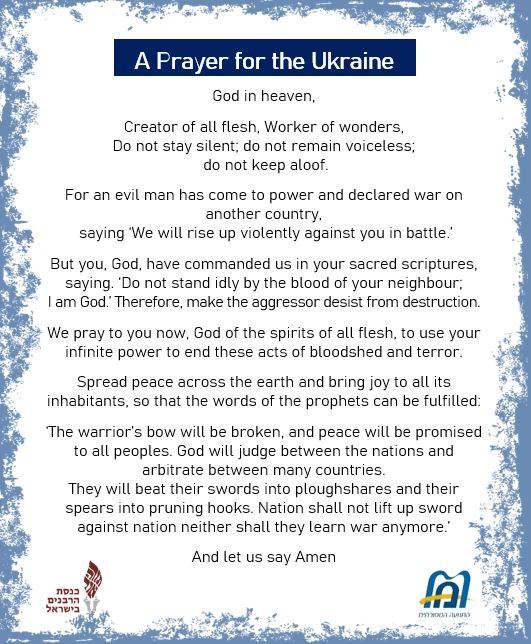
I would like to close with a prayer for peace that was delivered at a service hosted by the Masorti movement on Thursday night. 

An Eye for an Eye and Our Shared Humanity – Mishpatim 5782

For the past few months, I have participated in an interfaith Bible study group, with several other Rabbis, Pastors, Priests and Teachers.

Our learning is based on a book called The Bible with and without Jesus, by Amy-Jill Levine and Marc Zvi Brettler. The basic premise is that both Judaism and Christianity rely upon the same sacred Hebrew Scriptures, but interpret and implement them very differently.

These differing interpretations have led to deep misunderstandings over the centuries and have served as the basis for many of the classic antisemitic tropes of the past millenia.

As luck would have it, it was my turn to co-facilitate our discussion this past week, with the chapter in the book that we discussed coming from this morning’s Torah portion.

Before I get to that, I’d like to share a conversation I had with my daughter Noa a few days ago.  We were discussing the term the “Judeo-Christian Tradition” and trying to understand what it actually meant. From her perspective, whenever she heard the term, it did not really reflect her own experience and understanding of Judaism; and I have to say that I agreed with her.

What does it mean? It implies that there is a core set of shared values introduced by Judaism and then extended by Christianity. These values serve as the foundation of Western ethics.

But I had no clue where the expression comes from.

Enter Rabbi Wikipedia.

The first ever reference appeared in an 1821 letter and referred to Jews who had converted to Christianity. An 1829 reference used it to descrive a Church that had deliberately embraced some Jewish rituals so that it would better appeal to Jews. That’s not very good for us.

The earliest reference in something like the way we understand it today seems to have been in 1939. George Orwell referred to “the Judaeo-Christian scheme of morals.” This followed a lot of work that had taken place in the 1930’s to emphasize common ground between Christians and Jews so as to combat antisemitism and anti-Catholicism in the United States. 

The term gradually morphed into political use during the Cold War to contrast the ethics-based system of Western democracies with Communism. 

In 1952, President Eisenhower, one month before his inauguration, became the first President to invoke the term when he said, extemporaneously,

[The Founding Fathers said] ‘we hold that all men are endowed by their Creator … ‘ In other words, our form of government has no sense unless it is founded in a deeply felt religious faith, and I don’t care what it is. With us of course it is the Judeo-Christian concept, but it must be a religion with all men created equal.

One of my problems with the term is that it tends to over-emphasize shared values without recognizing that, in fact, there are some pretty profound differences. For example, it might focus on shared central texts like the Ten Commandments without acknowledging how differently each of our traditions might consider them.

In our group, we are learning how our respective traditions understand the same texts through completely different lenses.  Often, the Christian interpretation and the Rabbinic interpretations of central passages in the Hebrew Bible are in direct contradiction of one another.

Learning together, and openly addressing some of the passages that have historically been kind of thorny, has been a great way to increase mutual understanding as well as learn more about our own tradition.

Now we turn to this week’s Torah portion.  Among the many laws presented in Parashat Mishpatim, we encounter this one. Don’t get distracted by the first part.

When men fight, and one of them pushes a pregnant woman and a miscarriage results, but no other damage ensues, the one responsible shall be fined according as the woman’s husband may exact from him, the payment to be based on reckoning. But if other damage ensues, the penalty shall be life for life, eye for eye, tooth for tooth, hand for hand, foot for foot, burn for burn, wound for wound, bruise for bruise.

Exodus 21:22-26

This is a strange combination of legal principles. We start with a discussion of an accidentally, but violently, induced miscarriage. Then, we are suddenly talking about “life for life, eye for eye,” and so on.

There are two other occasions in the Torah in which the “eye for an eye” principle appears.  Once in Leviticus, and again in Deuteronomy. Both of them appear in different contexts. This leads us to assume that, when it came to personal injury cases, this was a governing legal principle in ancient Israel.

This legal principle is referred to in Latin as Lex Talionis, which means “law of retaliation.” talionis – retaliation

At first glance, to modern readers, this might seem bloodthirsty and vengeful. Indeed, it has been used as justification for antisemitism for millenia. Jews are overly focused on law rather than mercy. Think of the character of Shylock in the Merchant of Venice demanding his pound of flesh. 

But the truth is quite the opposite.

To gain some understanding of what this principle meant, we need to consider the society in which it came to be, and also consider how Jewish tradition has understood and applied it.

The oldest human record we have dates back to the 18th century BCE Babylonian Code of Hammurabi.  Hammurabi establishes an underlying principle of proportionality, the purpose of which was to ensure, first of all, that retaliation did not get out of hand, and secondly, that a higher class perpetrator did not get off scot-free. The innovation here is that the state took upon itself the authority to regulate and standardize payments for injuries.

In a world in which the blood feud is so tempting—think the Montagues vs. the Capulets—an “eye for an eye” limits retaliation to only an “eye for an eye.”

Here are a few examples from the Code of Hammurabi:

If an awilu, an upper-class free person should blind the eye of another awilu, they shall blind his eye.

If he should break the bone of another awilu, they shall break his bone.

If he should blind the eye of a commoner or break the bone of a commoner, he shall weigh an deliver one-half of his value (in silver).

The Torah takes this a step further.  It does not draw any distinction between the poor and the wealthy.  In Leviticus, it is clear that it applies to Israelite citizens and resident aliens alike. The law of proportionality applies equally to all. This is consistent with the Torah’s general concern with the dignity of the human being, made in God’s image.

Think of the numerous times in which the Torah forbids favoring one side over the other in a court case, or warnings against judges taking bribes, or having a single law that is administered fairly to everyone.

An eye for an eye was an incredibly egalitarian innovation—we could say improvement—over the Code of Hammurabi.

What we do not know is how an “eye for an eye” was actually practiced in ancient Israel. Was it taken literally, as in if I poked your eye out than you would poke my eye out; or was it figurative, as in if I poked your eye out, I had to pay you the value of your eye in compensation?

We just do not have any evidence, and the Bible does not include any examples of it being implemented in practice. For a religion that put such a high value on human dignity, emphasizing that every human being was created in God’s image, it does seem hard to believe that the legal system would intentionally cause the defacement of the human form.

The Rabbis of the Talmud, however, tell us exactly how they understand an “eye for an eye”: it means monetary payment. 

The Talmud goes to great lengths to demonstrate that the Torah itself, when it requires an eye for an eye, means the value of an eye rather than the actual eye itself.

It goes through many creative midrashic attempts to prove it, but then finds cause to reject each of them in turn.  In the end, there is no conclusive proof, but of course that does not prevent the Rabbis of the Talmud from interpreting it in this way.

In the course of their discussions, they raise numerous practical and ethical problems with a literal interpretation. For example, they imagine a case in which someone who is blind causes another person to become blind. Or someone missing a limb causes another person to lose a limb. How could we then fulfill the Torah’s literal principle of “an eye for an eye?”

Furthermore, what good does it do the injured party to have their attacker lose and eye or a limb?  It does not help the victim’s situation at all other than possibly satisfying some urge for vengeance.

The Mishnah establishes, again based on close, creative textual reading, that a person who injures another is liable for five categories of damages:

  1. the injury itself
  2. pain and suffering
  3. medical costs
  4. loss of income
  5. the indignity or embarrassment that the injury caused

Because the injury cannot be taken back, monetary compensation is the best that can be done. For better or for worse, it is how human beings assign value. 

Rather than being an overly legalistic, merciless application of justice, “an eye for an eye” was a major step forward, in practice, of upholding the equal dignity of every human being.

The Rabbis’ wisdom was in understanding that every person’s situation is different, and we must do the best we can to pursue justice at every opportunity, recognizing that we are imperfect, but faithful in the belief that, in the words of Dr. Martin Luther King, whose birthday we celebrated a couple of weeks ago, “the arc of the moral universe is long, but it bends towards justice.”

Being able to speak with each other honestly about where our differences in interpretation are might lead us to find, not necessarily common ground in how we understand these texts, but common ground in our shared humanity.

Iron in the Shul (After Colleyville) – Yitro 5782

I had the opportunity to learn, earlier this week, from other Conservative Rabbis, which helped me process last week’s hostage taking at Congregation Beth Israel in Colleyville, Texas. Some of what I am going to say this morning was inspired by what I learned from my colleagues.

One thing that I want to say from the outset is that there are a lot of really smart and insightful people who have a lot to say about these specific attack, as well as larger trends in antisemitism here in the United States and around the world. I am sure that you have read and heard a lot that you have found to be educational and meaningful.

I cannot hope to match the expertise of others in our Jewish community who specialize in these areas, nor is that my goal. All I can do is speak from my one particular vantage point as the Rabbi of Congregation Sinai.

A hostage crisis during Shabbat services is just about the scariest thing that I can imagine. It is a horrible scenario that has occupied my mind on many occasions over the years. To hear about it happening last weekend, especially with the prominent, courageous role played by Rabbi Charlie Cytron-Walker, really hit home for me.

It makes me sad, scared, and angry that we have to deal with such things. I don’t think there are any faith groups in the United States that have had to institute such stringent security measures at their houses of worship. It is not something that we should have to do. Simply put, it is not fair, and the need to do so directly contradicts the purpose of a synagogue.

At the end of Parashat Yitro, God delivers a few more commandments to the Israelites through Moses. One stands out. Here is the translation from our Etz Hayim Chumash:

If you make for me an altar of stones, do not build it of hewn stones;

כִּי חַרְבְּךָ הֵנַפְתָּ עָלֶיהָ וַתְּחַלְלֶהָ

for by wielding your tool upon them you have profaned them.

Exodus 20:22

The actual Hebrew word that has been translated “tool” is charb’kha, which actually means “your sword.”

The Mekhilta, an ancient midrash collection, quotes Rabbi Shimon ben Elazar.

The altar was created to lengthen a person’s years, but iron to shorten them. [Iron is the material of weaponry and killing.] It is not appropriate for that which shortens life to be wielded upon that which lengthens life!

Rabbi Yochanan ben Zakai then draws a connection between the altar and peace.   In a passage parallel to our verse, Deuteronomy instructs

אֲבָנִ֤ים שְׁלֵמוֹת֙ תִּבְנֶ֔ה אֶת־מִזְבַּ֖ח ה’ אֱ-לֹהֶ֑יךָ

With whole stones shall you build the altar of the Lord your God.

Deuteronomy 27:6

Noting the word sheleimot – “whole,” Rabbi Yohanan ben Zakai states that these stones of the altar produce shalom – “peace.”  Then he takes it a step further. 

If these stones of the altar, which neither see, nor hear, nor speak, can create peace between the Jewish people and the Holy Blessed One, what about a person who fosters peace between a husband and wife, between one city and the next, between one nation and another, between one government and another government, between one family and another family – how much the more so will such a person not suffer adversity.

Mekhilta d’Rabbi Yishmael 20:22:1-2

It was during Yohanan ben Zakai’s lifetime that the synagogue replaced the altar as the central location for Jewish worship. But it retained the same essential function. The subject of all our prayers, at a fundamental level, is shalom – “peace,” or “wholeness.” It is what we gather in synagogue for, and it is what we should strive for in our personal lives.

The midrash recognizes that there is something symbolically perverse about mixing stone and iron. The altar, and its replacement, the synagogue, should not require the sword to perform its primary function of fostering peace.

But ideals meat reality. We have a security guard at the gate every Shabbat. Our synagogue courtyard is surrounded by black iron bars. We have a sophisticated CCTV system, panic buttons all over our campus, and fancy bulletproof films covering the windows. We hold an Emergency Preparedness Shabbat just about every year during which we actually evacuate the synagogue in the middle of services under the supervision of the San Jose Police Department.

Our synagogue, this house of peace, is not just figuratively hewn from iron, it is covered in it. To protect our sanctuary, we must profane it.

What a sad and unfortunate reality. This is not a subject in which I expected to gain expertise when I decided to become a Rabbi, nor is it one in which I received any training. But it is one which, by necessity, I —we all — have had to reluctantly embrace.  What a steep price we pay.  

Yes, there are financial costs, but the more significant price is spiritual. Nobody should have to fear for their physical safety when they come to shul to pray. Parents should not have to think twice about sending their children to Religious School.  

For years, when I come into this room, I think about escape routes. I look around and try to identify what I could use as a weapon. In a synagogue!

I am done with my harangue.

Rabbi Charlie Cytron-Walker did two really important things last Shabbat: he served tea, and he threw a chair.

You have probably heard the story by now. A man, apparently homeless, showed up on Shabbat morning a few minutes before the start of services. It was cold outside, and he seemed to be seeking a place to warm up. The Rabbi welcomed him warmly, made him a cup of tea, and introduced him to the President of the congregation. At the time, there was no evidence that he posed a threat.

As soon as services began, however, the stranger pulled out a gun, and thus began an eleven hour hostage ordeal.

Towards the end, as he became increasingly agitated, Rabbi Cytron-Walker saw an opportunity.  He indicated to the two other congregants who were being held that they should be ready to attempt an escape. At a moment when the hostage taker seemed distracted, he threw a chair at him and the three of them quickly escaped.

An act of compassion and kindness, and an act of courage and, frankly, violence. Both acts should inspire us. We can look to two biblical women, both non-Israelites, whose stories model similar behaviors.

In the Book of Ruth, after her husband, brother-in-law, and father-in-law all die, Ruth binds herself and her fate to Naomi, her mother-in-law.  They return from Moab to Bethlehem, arriving destitute at the beginning of the barley harvest.

As chapter two opens, Ruth informs Naomi, “I would like to go to the fields and glean among the ears of grain, behind someone who may show me kindness.”  (Ruth 2:2)

What does this simple statement reveal? That Ruth, a Moabitess, knows that this place, where she has never set foot, is one in which a poor, foreign woman can go harvest for herself on a field belonging to another. The Book of Ruth does not mention the Torah’s obligation to leave the corners of the fields unharvested, among other mitzvot pertaining to tzedakah.

The details of the laws are beside the point. What matters is reputation. These people of Bethlehem are known to practice kindness, so when Ruth declares her intention, Naomi responds “Yes, daughter, go.”

Being compassionate, opening up our doors to let the stranger in, makes us vulnerable. Letting a stranger into our shul is a risk. That is why behaving with compassion is an act of faith, but would we prefer a Judaism which did not welcome the stranger? What would we be if we put up barriers that kept everyone else out?

Of course, evil exists. We cannot be so naive as to think that there are not those who hate us simply for being Jews.  Last weekend was the third violent attack in a synagogue on Shabbat in America in just over three years.  There have been six deadly antisemitic attacks in the United States since 2016.

According to FBI statistics, over the last several years Jews have been the targets of around 12% of all hate crimes.  Nearly two thirds of religion-based hate crimes have targeted Jews.  And we are less than two percent of the overall population.

Antisemitism is real and growing. It is not confined to a particular political ideology. Those who hate us for being Jewish do not care whether we are Reform, Conservative, or Orthodox, Democrats or Republicans. Our preparation and readiness are not misplaced.

This brings us to our second non-Israelite heroine.

Last Shabbat, while our fellow Jews were being held hostage, we read in the Haftarah about Yael. The Canaanite King Jabin had subjugated the Israelites for the past twenty years, with Sisera serving as the commander of his troops. Under the spiritual guidance and encouragement of the Chieftain Deborah, Barak leads the Israelites into victorious battle against Sisera with his nine hundred iron chariots. 

The Canaanite General flees, seeking refuge in the tent of Yael, wife of Heber the Kenite.  She offers him hospitality, feeds him, gives him milk to drink, and covers him with blankets so that he can fall asleep. Then she takes a tent peg and drives it with a hammer through his skull into the ground. In her victory song, Deborah praises this heroine.

Most blessed of women be Jael,
Wife of Heber the Kenite,
Most blessed of women in tents.

He asked for water, she offered milk;
In a princely bowl she brought him curds.

Her [left] hand reached for the tent pin,
Her right for the workmen’s hammer.
She struck Sisera, crushed his head,
Smashed and pierced his temple.

At her feet he sank, lay outstretched,
At her feet he sank, lay still;
Where he sank, there he lay—destroyed.

Judges 5:24:27

Ours is not a tradition that would have us be passive when threatened or attacked. Judaism recognizes that evil exists, and that we have a duty to fight it, that there are those who hate us, and that we must defend ourselves. Sometimes that means we must use force.

This is the uncomfortable place in which we find ourselves. How do we embrace a message of hope and peace, of compassion and openness, while also protecting ourselves from the very real threats that exist?

We cannot afford to simplistically think that there is a satisfying answer out there, if only we can find it.  The Jewish people knows that the world is messy, that human beings are imperfect and often unreliable. That our loftiest ideals have a tendency to slam into disappointing reality.

I come back to our name as a people, the name given to Jacob after he wrestles with the unnamed angel.  Yisrael – for you have striven with beings Divine and human and stayed in the game. That is who we are, and who we must continue to be.

We pray for a time when we can tear down all of the walls, remove the panic buttons and cancel the evacuation drills. In the meantime, we are Yisrael – the people who struggle. We remain committed to each other, to acting with compassion and kindness, to keeping each other safe, and to pursuing shalom in our prayers and our deeds.

Think for a moment: what are the last two words that we recite at the end of every Shabbat morning service?

At the end of Adon Olam, which we typically invite our children to lead, the final words are v’lo ira, words are aspirational and declarative: “I will not be afraid.”

Why is Pharaoh’s Court Happy? – Vayigash 5782

Parashat Vayigash continues the story of Joseph and his brothers. While Joseph recognizes his brothers when they first appear in his court in Egypt, he only reveals himself to them after he is reassured by the sincerity of their teshuvah. It is Judah’s passionate appeal for Benjamin’s life that pushes Joseph over the edge.

In a bewildering scene, he cries out to his Egyptian advisors, “Clear the room!” Then he begins sobbing so loudly that the Egyptians, now outside his chambers, can hear him.  Word even reaches Pharaoh.

It is only then that Joseph speaks, “I am Joseph your brother. Is my father still alive.”  They are shocked into speechlessness, sSo Joseph continues talking, informing his brothers that he is not going to punish them. Instead, he invites them to move with the entire family down to Egypt, where he will take care of them. He then embraces Benjamin and the others. It is a moving, emotional scene.

But suddenlty, the scan shifts, and the turns to what is going on outside the chamber. “The news reached Pharaoh’s palace: ‘Joseph’s brothers have come.’ Pharaoh and his courtiers were pleased.” 

Why? Why should they be so thrilled about this family reunion? Could it be that they really love Joseph, and they are just so happy for him?

I don’t think so. The Egyptian court is full of intrigue and duplicity. Remember Joseph’s first encounter was with the court wine steward and baker, who after doing something to displease Pharaoh are sent to prison. This is a place of scheming and backstabbing.

In fact, even though we hear numerous times that Joseph is second in Egypt only to Pharaoh, he is himself in a particularly precarious position. Think back to the moment when Joseph first gains his position.  He has just interpreted Pharaoh’s dreams as foretelling seven years of plenty followed by seven years of famine. He suggests appointing someone to stockpile the excess produce so that their will be enough to last through the years of scarcity.

Pharaoh and his court immediately recognize both the accuracy of Joseph’s dream interpretation and the wisdom of his plan. Rather than appointing Joseph on the spot, however, Pharaoh turns to the rest of the court and asks, “Could we find another like him?”

Why should Pharaoh have to even ask? He is Pharaoh, after all.

Because Joseph is a foreigner and a slave. Pharaoh astutely realizes that for Joseph to have any authority, the rest of the Egyptian court must be involved in his appointment. So he arranges a pro forma confirmation hearing.

Then Pharaoh tries to raise Joseph’s status. He gives him his royal robes and his signet ring. He places him in charge of the entire court and the entire land. He changes Joseph’s name to an Egyptian one, Tzafenat Paneach, and he gives him a high born wife, Asenat, the daughter of an Egyptian priest.

But it seems that the Egyptians never forget who Joseph is and where he comes from.

This brings us back to our question. Why are Pharaoh and the court so pleased when they learn of Joseph’s reunion with his brothers?

Nachmanides, the thirteenth century Spanish Rabbi, suggests that this news answers the question about Joseph’s station. From the perspective of the Egyptian court, Joseph rose to his exalted position from the lowest rungs of Egyptian society. He was literally an imprisoned slave. It can’t get much worse than that. 

How can such a low class person even step foot in the courtroom, much less rule?

With the arrival of the brothers, however, they discover Joseph’s pedigree. He comes from an honorable, respected family. Such an aristocrat is surely fit to appear in the royal court. “We can take orders from this guy,” they must have been thinking.

Pharaoh is overjoyed because it helps solidify Joseph’s position.

Sforno, a sixteenth century Italian rabbi, sees a different kind of bigotry informing the Egyptians’ response.  Until this moment, Joseph is suspected of not being fully loyal. As a foreigner, he cannot be trusted to always have Egypt’s best interests at heart.

Now that he has been reunited with his brothers and has inititated plans to move the entire family down to Egypt, Pharaoh and his court see Joseph as a citizen whose first loyalty is to the nation. They can trust his motives now that he is establishing roots.

According to both interpretations, the appearance of Joseph’s brothers resolves lingering questions in the Egyptian court as to Joseph’s bona fides, whether his low social status or his foreign origins.

As the story develops, however, the bigotry reemerges. When a new Pharaoh arises several generations later. The Israelites are still perceived as “other,” having grown so numerous that they now fill the land.

This Pharaoh resurrects the charge of disloyalty. “In the event of war,” he tells the court, “they may join our enemies in fighting against us and rise from the ground.” (Ex. 1:10) This provides the pretext by which to enslave the Israelites, or I suppose we could say, re-enslave them. 

Charges that Jews have dual loyalty or are of subhuman status are among the classic antisemitic tropes that persist to this day. As we see in the story of Joseph, they are nothing new. But even if the Egyptians never get to a point where they fully trust and accept the Israelites living among them, the Israelites themselves manage to stay united. This is the first generation in which the family stays together.

Isaac and Ishmael, Jacob and Esau – they went their separate ways. But the twelve sons of Jacob stick together. I would suggest that it was Judah’s courage, and Joseph’s willingness to forgive that made it happen. For both of them, it came from a deep, sincere belief that change was possible and that things could be better.

We have inherited that sincere belief. That is why we are still here, thousands of years later. It is the Jewish people’s belief that things can get better, that we can improve, that relationships can be fixed, that the world can become worthy of being saved. We are a fundamentally hopeful people, despite the many challenges that we have and continue to face.

She’s My Sister/She’s My Wife – Lekh Lekha 5782

https://venue.streamspot.com/video/8d01f5b458

The stories of Abraham and Sarah are stories of journeys. From God’s initial communication to Avram, Lekh Lekha – go forth – his life consists of one journey after another.

The initial destination, “to a land that I will show you,” with its ambiguity, gives us a pretty good idea of what is to follow. Avram will continually set out into the unknown, never knowing how exactly things will turn out, but confident and faithful in God’s promise to him. This is why Avram is held up as the paradigm of the man of faith.

As soon as he receives the oppening message from God, Avram sets out with his entire household and all of his belongings to go to the land of Canaan. Let’s pay attention to the journey.  He starts off in Shechem, which is in the northern part of the Promised land. There he builds an altar, and God promises the land to him and his offspring.  

Avram turns south and builds another altar between Beit El and Ai.  This is in the middle of the land that has been promised. He keeps traveling south toward the Negev.  He has now traversed the entire land from north to south.

Not a terrible idea, by the way.  If someone promised me a giant inheritance, I’d want to check it out also.

Then comes the surprise.  “There was a famine in the land.” Surely this is not something that Avram anticipated. Without hesitating, he picks up his household again and leaves the land to which God has just led him.

He continues south, to Egypt. Before crossing the border, Avram turns to his wife.

I know what a beautiful woman you are. If the Egyptians see you, and think, ‘She is his wife,’ they will kill me and let you live. Please say that you are my sister, that it may go well with me because of you, and that I may remain alive thanks to you.

They arrive in Egypt, and indeed, the Egyptians notice Sarai’s beauty. They even praise her to Pharaoh, who has her brought into the palace. Again, just as Avram predicted, it goes well for him because of her.  He becomes quite wealthy.

Meanwhile, back in the palace, Pharaoh and his household are struck with mighty plagues. He seems to understand that this is due to the fact that she is a married woman, after all. So he summons Avram to the palace to scold him.

What is this you have done to me! Why did you not tell me that she was your wife?  Now here is your wife. Take her and leave!”

Men are assigned to oversee Avram, and he is escorted out of the country along with all of his possessions. Basically, he is deported. But he gets to keep his stuff. Avram then reverses his earlier journey.  He goes up into the Negev with all of his wealth and then proceeds in stages to Beit El, where he worships again at the altar he had built previously.

What are we to make of this story, of Avram’s dishonesty?

The commentator Ramban is critical of Avram, claiming that he sinned twice.  First, in leaving the Promised Land in the first place.  Despite the famine, he should have had faith in God’s promise and ability to protect him. His second sin was lying to the Egyptians about being Sarai’s brother. He should have had faith in God’s ability to protect him. Instead, he sent his wife into a potentially dangerous situation

From a certain, modern perspective, we might call Avram a pimp. After all, under his instructions, Sarai is taken into the palace and Avram ends up making bank. And of course, neither the Torah nor the commentaries take into account Sarai’s perspective.

Because of these two sins, Ramban says, Avram’s journey is replicated by his descendants in the future. Think about the parallels.  A plague drives the children of Jacob down to Egypt, where they eventually remain for four hundred years and become the Israelite nation. There, the Pharaoh issues a decree to kill all male children and, according to a midrash, bring all the girls into the Egyptian homes. To rescue the Israelites, God sends plagues against the Egyptians. Finally, when the Israelites leave to return to the Promised Land, they take great wealth from the Egyptians. According to Ramban, all of these events are punishment for Avram’s lack of faith in God’s ability to protect him.

A different commentator, Radak, suggests the opposite. This is indeed a test of Avram’s faith, one that he passes with flying colors.  Avram received a promise that God will take care of him. Even though events immediately take a downward turn, i.e. a plague strikes the land that he is supposedly going to inherit, he stays the course.  Avram accepts everything that happens to him with love, never questioning God’s inentions or methods. To Radak, Avram’s commitment to stay the course is a demonstration of his great faith.

So who is right?  Is Avram a sinner, or a man of faith? 

According to Professor Nahum Sarna, they are both missing the point. To understand what happened, we need to consider the values of the Ancient Near East. By the way, these are still values that are held in some parts of the world.

In the ancient world, a brother had authority and responsibility for an unmarried sister. If the Egyptians think Sarai is Abraham’s sister, they will likely come to two conclusions: 1. we better not touch her.  2.  If she is available for marriage, we will have to negotiate a marriage contract with Avram.

Let’s imagine the scenario playing out. An Egyptian sees the beautiful Sarai. Thinking she’s single, he approaches Avram to seek marriage. Avram now has options.  He can say no to the proposal. Or, he can pretend to negotiate, stalling while he and his household prepare their escape. Now imagine if they had been honest about being husband and wife. Remember, Avram is a foreigner. An Egyptian could readily kill Avram and simply take his now widowed wife, who no longer has the protection of any male figure. From this perspective, Avram made the best possible choice, a calculated gamble that he could stay alive, keep Sarai safe, and save his household until the famine ends back in Canaan. 

Avram’s problem is that he fails to consider the possibility that Pharaoh himself will be the one to notice Sarai’s beauty. As we know from later events, normal rules do not apply to Pharaohs.

This sets the stage for the showdown between God and Pharaoh which, as Ramban astutely notes, presages the future showdown when Avram and Sarai’s descendants are rescued from Egypt and brought, at long last, to the Promised Land in final fulfillment of God’s promise.

Casting Truth to the Earth – Bereshit 5782

At the end of day six of creation, all but one thing has come into existence by the word of God.  And so God declares: 

נַֽעֲשֶׂ֥ה אָדָ֛ם בְּצַלְמֵ֖נוּ כִּדְמוּתֵ֑נוּ

“Shall we make humanity according to our form and likeness?”

Who is this “we?” Does God have a design committee?  Perhaps it is the “royal we?” The text is silent. So the midrash tells a story to answer the question.

When it comes time for the Holy Blessed One to create humanity, the ministering angels break off into factions and groupings.  Some of them say yibarei! Let humanity be created!  While others declare Al yibarei!  Don’t let them be created!

A verse in Psalms alludes to this epic argument:

חֶסֶד וֶאֱמֶת נִפְגָּשׁוּ צֶדֶק וְשָׁלוֹם נָשָׁקוּ

“Kindness and truth met, justice and peace kissed.” (Psalm 85:11)

But this was no meeting of friends, no kiss of love.  It was combat – pure and simple, with the fate of humanity in the balance.

Chesed, kindness, stands up and proclaims “Let humanity be created, for they will perform countless acts of gemilut chasadim, of lovingkindness.”

Then Emet, Truth, rises to object, “Don’t do it!  They will all be liars!”

Tzedek, Righteousness, takes his turn and declares “Let them be created, for they will give untold sums of tzedakah!”

Finally, Shalom, peace, steps forward and laments, “Let them not be created, for they will be full of violence!”

The arguments fly back and forth between the angels.  “Let them be created!”  “Don’t let them be created!” Nobody can convince the other.

So what does the Holy Blessed One do? God grabs Emet, Truth, and casts her to the ground.

Stunned, the angels look up at God and ask, “How can you treat your seal in this way?” For Truth is the seal of God.  “Let Truth rise back up from the ground!”

And then the angels turn back to each other, and the arguing breaks out again, even louder and more heated than before.

While they are otherwise engaged, God quietly sneaks out the back and creates the first human. God returns to the angels, shows them the new creation, and says “Why are you guys still arguing. Behold: humanity.”

According to this midrash, we should not read it as Na’aseh Adam (נַֽעֲשֶׂ֥ה אָדָ֛ם) – “Shall we make humanity?” but rather Na’asah Adam נַֽעֲשָׂה אָדָ֛ם – Humanity has been made in our form and our likeness.  It is not a question that God asks the angels.  It is a report, after the fact. A fait accomplis.

I love this midrash on so many levels.  It expresses the moral complexity of being human. We can be wonderful to each other, left one another up with kindness and restore each other’s dignity.  But we fight and argue. We deceive one another and behave as if we are always in competition. This is our struggle, as individuals and as a species.

The midrash also depicts a fight, a stalemate – in which nobody can convince each other of their point of view.  When we cannot agree on the truth, it is impossible to see things from another point of view, to compromise, to find common ground. To break the tie sometimes requires letting go of our need to be right. So God casts truth to the earth. It can sprout again, but only if it is fed by righteousness and kindness.

Finally, the image of God sneaking out the back to go create humanity while the angels fight is just wonderful. How often does our need to win hold us back from ever moving forward in positive direction?

Build a Parapet – Public Safety – Ki Teitzei 5781

As far as I know, this morning’s portion contains the Torah’s only example of a building code. 

When you build a new house, you shall make a parapet for your roof, so that you do not bring bloodguilt on your house if anyone should fall from it.

Deuteronomy 22:8

For those who are wondering, a parapet is a fence. 

As we might imagine, the Rabbis go into great detail outlining the particular requirements of this broadly-stated rule.

The Shulchan Arukh, the code of Jewish written in the sixteenth century by Joseph Caro, does a good job of summarizing the discussions and legal rulings that evolved over the preceding 1,500 years.

In chapter 427 of Choshen Mishpat, which happens to be the final chapter of the entire Shulchah Arukh, the laws of building a parapet are discussed.

It starts with particular details.  Which kinds of structures are included? Houses and apartments, yes; warehouses and barns, no. Synagogues and schools, no. (But don’t worry, we have a parapet around the flat parts of our roof here at Congregation Sinai.)

How tall does a house have to be to require a parapet?  How many walls?  How high does the parapet need to be? And so on.

Closely reading the Biblical text, the rabbis identify both a positive commandment to build a parapet around the roof as well as a negative commandment to not bring bloodguilt upon your house. Thus, someone who fails to build said parapet transgresses two separate commandments of the Torah.

And then the Shulchan Arukh broadens the lens to include any physical structure which might pose a danger to other people, such as a well or a pit.  If you have a manhole on your property, it needs a manhole cover or a fence around it.

And then the Shulchan Arukh takes an even bigger step back, stating that “one has a positive duty to remove and guard oneself from any life-threatening obstacle,” like unsafe drinking water.

Ending the discussion of the laws of building a parapet, and thereby ending the entire Shulchan Arukh itself, is the following statement:

Anyone who transgresses on these and similar matters by saying, “What business is it of anyone else if I put myself in danger,” or “I am not concerned with this,” he should be lashed for disobedience.

Shulchan Arukh 427:10

We began with the simple statement that a person who builds a private home must make sure that it does not have any features that might be dangerous to themself or anyone else. By the end of the section, the Rabbis have stated that the Beit Din, the Jewish court, can physically compel someone whose actions endanger not just other people, but even themself.

Jewish law has always struggled with the tension between individual autonomy and collective responsibility.

Laws such as these developed at a time when Jews were often left to their own affairs when it came to communal rules and behaviors.

Now, rather than following the Torah’s building codes, state and city regulations are in place to make sure that new construction is safe.

That there are limits to personal autonomy, especially when it comes to safety, is firmly established in Jewish law.

Consider this with respect to mask and vaccine mandates.

Our community has been so supportive with regard to the changing rules for masking and distancing in the synagogue. With the goalposts constantly moving, figuring out how to bring the community safely together has not been easy.

But we all seem to recognize the need to take into account the effects on others when we make decisions for ourselves, even when it means sometimes doing something inconvenient or uncomfortable. 

Let’s come back to the Shulkah Arukh. Joseph Caro must have wanted to end the on a positive note. Because after warning that the person who disregards safety can be compelled through lashes, he writres the following:

May good blessings come upon the person who is careful with them [i.e. the rules about public safety].

Shulchan Arukh 427:10

May good blessings come upon all of us.

Coming in from the outside – Matot-Masei 5781

Isn’t it wonderful to be inside together!

Comfortable chairs! The beautiful sanctuary! Air conditioning!

It has been a long slog. Surprisingly, much of the last year already is starting to feel like a distant memory.  It was not long ago that I was rolling out of bed on Shabbat morning to go to shul in my family room.

As life continues to return to normal – at least for those of us blessed to live here in well-vaccinated San Jose, I wonder what from the pandemic will stay with us?

This morning’s double Torah portion, Matot-Masei, concludes the Book of Numbers. To make sure we do not forget, it reviews every single stop in the wilderness at which the Israelites have camped over the previous forty years. It is important to remember everything that has transpired before the Israelites are allowed to reach their home in the Promised Land.

As the parashah begins, however, there is one final piece of action that requires attention. 

At God’s instructions, the Israelites go to war against Midian.  This is the conclusion of a long, drawn-out engagement that began back when King Balak tried to get the Prophet Balaam to curse the Israelites. Now, finally, the conflict comes to an end with battle.

One thousand men from each of the twelve tribes are selected to go to war.  The Priest Pinchas joins them, equipped with the sacred vessels and the silver trumpets.

The Israelites achieve a great victory, devastating the Midianites and their towns,  slaughtering men, women, and children, and taking vast booty.

I do not want to focus on those parts of the story, however.  I would draw our attention to the return of the Israelites warriors to the community.

Moses instructs the soldiers:

You shall stay outside the camp seven days; every one among you or among your captives who has slain a person or touched a corpse shall cleanse himself on the third and seventh days.

Numbers 31:19

On the seventh day, they wash their clothes and can then reenter the camp. 

Why is there such a long and drawn-out reentry into the camp?  If I was a soldier, the last thing I would want to do after returning home from war would be to wait outside for an extra week.  I would want to return to my family as quickly as possible.

The answer has to do with holiness and purity. After so much contact with death, the soldiers are all presumed to be in a state of ritual impurity. If they return to the camp and mingle with the rest of the Israelites, they run the risk of passing along that corpse-contamination to others. The impurity could eventually spread all the way to the Tabernacle, which would then become unfit for God’s Presence.

And so, for the good of the entire nation, the 12,000 soldiers remain in quarantine outside the camp for one week, which is the length of time required to become pure again after a person has come into direct contact with a dead body.

Despite their overwhelming victory, I imagine these soldiers are still traumatized. 

What would it feel like to reenter the camp? They have gone through the trauma of war. These seven days of quarantine, of physical and spiritual cleansing, give them a chance to make a transition to normal life, to heal. Only then can they come home.

We have a sense of what that feels like. After sixteen months away, we are now back inside our sanctuary for the first time.

It has been a traumatic year for so many. Isolation, disruptions in school and work. Some of us have gotten sick. Some of us lost family and friends to Covid.

For the sake of keeping each other free from contagion, we have had to be physically isolated from one another.  For me, personally, it has been inconvenient. But I try not to forget about who has borne the brunt of this scourge. From increased rates of illness, to worse outcomes, to slower vaccination access, and increased unemployment – it is the same people who are always at greatest risk: the poor and marginalized.

Now here we are.

The Israelite soldiers returning from war partook in rituals to mark their return to the community. It is appropriate for us as well.

Birkat Shehecheyanu seems especially fitting at this moment. There are laws for when we are supposed to recite the Shehecheyanu. Basically, we recite it when we are doing something for the first time, or the first time in a long time.  Here are some traditional occasions for Shehecheyanu:

When we eat a “new fruit” which we have not eaten in at least a year. 

When we perform any mitzvah that has a fixed time and is not common, such as blowing the shofar or dwelling in the sukkah. This is why there is a shehecheyanu at the beginning of each holiday. There are those who recite shehecheyanu over a new article of clothes, but this really only applies to something special. If one buys a new house, one should recite Shehecheyanu. When we see a friend whom we have not seen in at least thirty days, we recite Shehecheyanu.

These are all traditional moments in life for reciting this prayer. What do they have in common? These are all moments of joy, whether we are talking about reaching a momentous occasion, seeing someone special to us, or performing a joyous mitzvah.

I suspect that we do not always think closely about the meaning of the words themselves when we recite it.

“Praised are You Eternal God, sovereign of the universe…”

  • Shehecheyanu – who has given us life. Simply being alive is a gift. We often forget that. 
  • V’kiy’manu – who has sustained us. This is about flourishing.  Not only do we have life, we have been blessed with the ability to flourish. The ability to do something new and exciting brings us above the level of mere living.
  • V’higianu lazman hazeh – And who has brought us to this moment. Judaism places more value on time than on space. All of our ritual mitzvot are oriented towards sanctifying time, recognizing the specialness of each moment.

Shehecheyanu, with its many opportunities for recitation, brings these three aspects of gratitude and awareness together. We acknowledge and praise God as the source of life, as the one who grants us the ability to flourish, and as the one ultimately responsible for enabling us to enjoy sacred moments.

This moment, when we are back in our sanctuary after sixteen months away, is an especially appropriate opportunity to say shehecheyanu. We have survived. While difficult, we have had opportunities to flourish. And while we have begun to enjoy life returning back to normal, these experiences have given us a new appreciation for how blessed we are in this, and every, moment. 

.בָּרוּךְ אַתָּה יְיָ אֱלֹהֵינוּ מֶלֶךְ הָעוֹלָם, שֶׁהֶחֱיָנוּ וְקִיְּמָנוּ וְהִגִּיעָנוּ לַזְּמַן הַזֶּה.

Shalom is a Vessel for Blessing – Naso 5781

In the middle of Parashat Nasso, we come upon some of the most well-known and beloved lines in the entire Torah. These words are so popular that they can be found on the oldest known writing of verses from the Torah, dating back to the first Temple Era.

In 1979, at an archaeological dig in the Hinom Valley in Jerusalem, two small silver amulets were found by a thirteen year old boy. They were dated to the sixth or seventh century, BCE, earlier than any existing manuscript of the Torah. Those amulets contained the words of the Priestly Blessing.

יְבָרֶכְךָ֥ יְ-הֹוָ֖ה וְיִשְׁמְרֶֽךָ׃

יָאֵ֨ר יְ-הֹוָ֧ה ׀ פָּנָ֛יו אֵלֶ֖יךָ וִֽיחֻנֶּֽךָּ׃ 

יִשָּׂ֨א יְ-הֹוָ֤ה ׀ פָּנָיו֙ אֵלֶ֔יךָ וְיָשֵׂ֥ם לְךָ֖ שָׁלֽוֹם׃

For thousands of years, these words have been used to invoke God’s blessings. In the Torah, Aaron and his sons are instructed to use these words to channel God’s blessings on to the people. We include them in the Amidah, reciting them out loud whenever there is a repetition. We follow the Ashkenazi tradition at Sinai of duchenning on Yom Tov. The priests come up to the bimah to bless the congregation during the Musaf service. Parents bless their children on Friday nights using these words, and the bride and groom receive this blessing under the chuppah. 

Our tradition refers to it as the brachah hameshuleshet – The Three Part Blessing. In other words, it is a single blessing comprised of three parts. Its very structure expresses balance and completeness.  It has three lines, each of which has two parts. The three lines are comprised of three, five, and seven words which are formed by fifteen, twenty, and twenty five letters, respectively. The opening phrase of the first line and the closing phrase of the last line each have seven syllables. Jacob Milgrom describes it as “a rising crescendo.” Scribes write the Priestly Blessing with unusual spacing, another indication of its specialness.

But what does this Threefold Blessing mean? Throwing up his hands, one commentator (Kli Yakar) declares: “Numerous ideas have emerged to explain the meaning of the blessings – each person explaining them according to his intellect.” I would like to look this morning at one particular interpretation offered by the nineteenth century author of the Torah commentary HaEmek Davar, Rabbi Naftali Zvi Yehudah Berlin, known as the Netziv. Based upon his interpretation, we will see that the Threefold Blessing is in fact a single blessing, each phrase building upon its predecessor in a kind of story.

Moses is told to instruct the High Priest Aaron and his sons: “Thus shall you bless the children of Israel. Say to them…” Note that the blessing is delivered collectively, not to individuals. Consider how we recite the priestly blessing on holidays when we duchen. The priests channel God’s blessing to the entire congregation. That seems to be how Second Temple Priests would use it. If you were visiting the Temple, you could grab a priest wandering by and ask him for a blessing.  He would then assemble a group and use these words.

But then, when we get to the words of the blessing itself, the grammar changes. Yevarekhekha. “May the Lord bless you” – singular. A priest, addressing a group, speaks to them in the second person singular.

The Netziv comments that this blessing is directed to each individual “whatever it is appropriate for that person to be blessed with.” He gives a couple of examples. For someone who is dedicated to Torah study, the blessing is for increased learning. For one engaged in business, the blessing is for financial success. And so on, a blessing of abundance for whatever is most valued by each person in the group being blessed. The second part of the first line is v’yishmerakha – “and protect you.” The Netziv points out that an abundance of blessing brings with it certain risks. V’yishmerekha asks that the blessing one receives does not become a stumbling block. A Torah scholar needs to be protected from pride. A wealthy person needs protection so that affluence does not lead to evil. And so on. A blessing, unchecked has the capacity to cause suffering. The first line, therefore, is concerned with you, the individual recipient of God’s blessing. May you have abundance in whatever you most need, and may that abundance not lead to suffering.

We continue with the second line. Ya’er Adonai panav elekha. “May the Lord cause God’s light to shine upon you.” The story of blessing progresses. Light figuratively shines from the recipient of blessing. Other people, observing such success, recognize that it comes from God. It is not a matter of mere luck. The end of the second line is vichuneka – “And be gracious to you.” The story continues. When other people see that God has blessed you, they will undoubtedly come to you to ask for you to pray for God’s blessing on their behalf. Vichuneka refers to God’s grace in answering the prayers of the petitioner on behalf of others. If the first line is focused on the recipient of blessing, the second line is about extending that blessing to other people. We are asked to share our blessings. To use the gifts we have received in a way that improves the world around us.

Yisa Adonai panav elekha – “May God lift up God’s face to you.” Does God have a face? What is a face? HaEmek Davar equates a face with a midot, personal qualities. Joy and anger are reflected on a person’s face. And so, this blessing, calling for God’s face to be lifted to you, is asking for God to direct Divine attributes such as kindness, mercy, and forgiveness, towards the recipient of blessing. V’yasem l’kha shalom – “And may God place upon you peace.”  This comes at the end, after all the other blessings. Shalom is the vessel that strengthens all other blessings, says the Netziv.  “Without peace, there can be no enjoyment of any blessing.” This completes the story. A person receives blessing, the particular success that is unique to that person’s talents and interests. The sucess does not become a curse. In fact, that success can be translated to spreading blessing and success to other people as well.  The final step is God’s Presence, expressed through the metaphor of God lifting up God’s face to you.

The ending, shalom, is the coda. No blessing can be fully enjoyed unless there is peace. Or more accurately, “wholeness.” We might understand this spiritually as the kind of equanimity and peace experienced by a person who is at one with God. 

Speaking more generally, when we have opporunities to develop and maximize our talents, and we use them in ways that leave the world around us better, that is the recipe for a life well lived. Such a person experiences God’s presence and knows shleimut, wholeness, in their life. Perhaps you know someone like that, or maybe you are someone like that.  As a parent, when I bless my children on Friday night, this is the blessing for them that I hold in my heart.

This blessing contains a theology for what makes for a meaningful life. It is not enough to selfishly enjoy my own blessings. I have to work to make it possible for others to experience blessings as well. But it also contains a recognition that managing one’s blessings can be difficult.

Shalom can refer to an individual, spiritual feeling of wholeness, but we might also see shalom in more tangible terms. Peace and stability in the world around me. Without that kind of shalom, it is impossible to fully experience blessing.

The ceasefire between Israel and Hamas began yesterday (5/21/21). To be clear, it is a ceasefire, not peace.  We are far from peace. As I said last week, we are very distant from Israel. I am reluctant to dictate what I think Israel should or should not be doing.

But when I look at recent events, it seems to me that Israel is still struggling with how to live with the blessing of Jewish power. Israel has achieved so much in such a short time. As Rabbi Donniel Hartman pointed out this week, every war Israel has fought since 1973 has been an assymetrical war. It has fought against enemies with less technology, less hardware, and less military advantage. Israel’s existence has not been at stake for nearly fifty years. Israel is not fighting for its survival, and this is a tremendous blessing.

This blessing creates other kinds of challenges. Israel wrestles with how to conduct itself morally in a world that is extremely complicated and morally ambiguous. World opinion is fickle, influenced by millenia of anti-semitism and by knee-jerk inclinations to automatically take the side of those with less power. Israel still struggles to deal with opponents, such as Hamas, Hezbollah, and Iran, that deny its right to exist, that – intentionally and strategically – put Israel in morally impossible situations by launching rockets from civilian areas to civilian areas. Jews are being attacked in Europe, in Canada, and here in America simply for being Jewish.

And – Palestinians in the West Bank continue to live under Israeli military occupation and under blockade by Israel and Egypt in the Gaza Strip. Regardless of where fault might lie, living conditions for Palestinians, especially in Gaza, are terrible and should evoke our compassion. Our hearts should break for the devastation that they are experiencing.

And – especially in recent years, Israel has behaved with a certain degree of triumphalism, passively allowing or even actively encouraging the continued building of Jewish settlements in the West Bank. It has allowed discrimination against Arab citizens in Israel to persist. Yes, they are citizens and they can vote, but that is not all there is to living in a democracy. 

There are no simple solutions to any of these problems. 

The Priestly Blessing suggests that the appropriate response to our own blessings is to share it with others.  It does not seem to me that we have honestly done this with the Palestinians. I am not naive. Israel faces very real and dangerous obstacles, including those who seek its destruction. Until we all fully recognize that everyone should be entitled to pursue lives of dignity, freedom, prosperity, and democracy, including Palestinians, true blessing will remain elusive.

Remember the story of the threefold blessing. It starts with abundance, and asks that our experience of abundance not lead to suffering. Then, it asks that our abundance be something that we can share, so that others can experience their own blessings as well. Only then does God raise God’s face to us. Only then do we experience true Shalom. A Shalom that serves as a vessel for all other blessing.

May that blessing come speedily in our days. 

The Prozbul – Hillel’s Financial Creativity – Behar 5781

Trying to claim that the Torah supports this or that contemporary economic system or policy is like trying to fit a round peg into a square hole.

Jews have lived in many places and times and dealt with many different economic and political systems.  In all of those systems, there was economic struggle and human suffering, along with thriving and flourishing. We survived as a people due to cultural and religious adaptability.

Rather than try to awkwardly shoehorn the Torah into our modern theories, why don’t we instead look at what the Torah actually describes?

Parashat Behar, the first of this morning’s double parashah, presents a priestly vision of economic justice in ancient Israel. It offers details about land ownership, debt, poverty, and wealth. It describes indentured servitude and slavery.

By looking closely, perhaps we might learn something about the economic system that actually existed at the time.

First and foremost: there is no land ownership. It all belongs to God, who apportions the land to whom God sees fit. “The land must not be sold beyond reclaim, for the land is Mine; you are but strangers resident with Me.”  (25:23)  This is a core concept that we must understand. Nobody owns property.

The parashah begins with a description of the shemitah, the sabbatical year. Just as every seven days ends with Shabbat, every seven years ends with Shemitah.

The Israelites are permitted to work the land and collect the harvests for six years. The seventh year is a Shabbat Ladonai – A Sabbath unto the Lord. Every seventh year, the land must be allowed to rest. There can be no harvesting or planting. Everyone is entitled to eat what the land produces on it. The Torah specifies “you” – the Israelites, along with their slaves, employees, indentured servants, and animals.

Every seven shemitah years ends with the Yovel, the Jubilee year. On Yom Kippur of the Jubilee year, the shofar is sounded throughout the land. All harvesting and planting is forbidden, as in the Shemittah year. In addition, all property returns to the person whose holding it originally was, or his heirs.  All indentured servants are automatically redeemed as well, going free and returning to their ancestral lands.

The Torah then describes the cycle of misfortunes that lead a farmer into servitude. When things first start going downhill, the farmer can take out an interest free loan to buy seed. If that does not work, the farmer sells part of his land for more seed. But not the land, actually. It is the annual productive capacity of the land, multiplied by the number of years remaining until the Jubilee. This makes sense, since the farmer gets the land back on the 50th year. If he manages to do well, he can repurchase the land at any time before then, redeeming it. It is his perogative.

If that does not work out, he can sell the productive capacity of his remaining property. He then remains on the land and becomes a sharecropper.  The purchaser of the land has to supply the tenant farmer with seed, and the farmer tries to pay off his debt with the proceeds from the harvest.

If this does not work, the farmer sells himself and becomes an indentured servant. The purchaser now takes on full responsibility for his well-being, including paying him wages. If he makes enough to pay off his debt, he goes free. Otherwise, he must wait until the Jubilee year.

All of this applies to Israelites dealing with other Israelites. The Torah specifies different treatment for non-Israelites. Non-Israelite slaves are owned in perpetuity. They cannot redeem themselves and do not go free in the Jubilee year.

So what can we say about this economy? There is no land ownership. While a successful farmer can increase his holdings for a time, it gets reset every 50 years, so there cannot be any accumulation of wealth. There does not seem to be any money in this system. Everything is based on agricultural commodities. Since all land ultimately remains under the control of the original family, there is little flexibility. Newcomers cannot break in to this system. A person who does not want to be a farmer does not have many options, since wealth is concentrated in the productive capacity of the land. 

At the same time, there is a strong concern for justice, and for preventing people from falling through the cracks when things turn poorly for them. Israelites are responsible for their neighbors. Even when someone becomes impoverished, they retain their rights and must be supported by those who are better off. Plus, the ability to redeem the land is totally in their hands.  The purchaser is not allowed to refuse to sell it back.

Was this economic system ever put into practice? During the first Temple era, we do not know for sure. But the Prophet Jeremiah makes a point of redeeming his ancestral land before he goes into exile when the First Temple is destroyed. In the Book of Ruth, Boaz redeems the land owned by Ruth’s deceased husband.

Biblical scholars argue about the extent to which these laws were observed. But the fact that the Torah can construct such an elaborate system of wealth redistribution implies that it is reacting to some situation on the ground. Behar represents the priestly vision for a just redistribution of wealth.

During the Second Temple era, however, the shemittah and Yovel laws were definitely being observed. Nehemiah makes reference to it in the fifth century. Philo and Josephus, in their histories, describe its practice during the late Second Temple period.

But the economic situation that Jews are living under is nothing like what existed centuries earlier. Let’s fast forward to the late Second Temple period, after the biblical era has ended. The Romans are in charge. The economy has changed drastically. Property ownership exists.

There is now money, which allows for a much more complex, growth-oriented economy. Think about what money is for a moment. The Emperor issues an order to make coins. The coins have limited intrinsic value, based on what kind of metal they are made of. But the government sets a value for those coins, a value that holds to the extent that people are willing to use it.

To expand the economy, the government encourages the issuing of credit, either by banks or by wealthy individuals. They make interest-bearing loans, which increases the money supply, allows businesses to grow, and allows trade to take place over vast distances.

A wealthy class emerges. Rich people need somewhere to park their money, so they do the obvious thing. They invest in real estate. Gradually, smaller farmers become squeezed out and are forced to sell their lands to wealthy absentee landowners, who typically dwell in the cities.

Jews, of course, are living under Roman rule, and they have to adjust to this system. Those Jews living in the land of Israel are also bound by the Torah’s agricultural laws, including those of the Shemittah and Yovel.

According to Deuteronomy, debts are cancelled every seven years, during the Shemittah. That is a problem. Why would anyone make a loan, especially an interest-free loan, if it is subject to cancellation at the end of each seven year cycle?

The result are as expected: credit dries up for those who are most in need. The poor remain poor, and the wealthy refuse to step in.

This situation led Hillel HaZaken, Hillel the Elder, to take action. Mishnah Tractate Shevii details the laws of the Shemittah year. The tenth chapter introduces an economic innovation that Hillel introduced. It is called a prozbul. The word most likely comes from the Greek pros boule, which means “before the council.”

The prozbul was a contract in which a creditor appears before a Beit Din, a Jewish court, and declares, “I turn over to you, so-and-so, judges of such and such a place, that any debt that I may have outstanding, I shall collect it whenever I desire.”  (Mishnah Sheviit 10:4) In other words, the debt, which by law should be cancelled, is transferred over to the court. The court is not a person, and therefore has no obligation to cancel the debt. After the Shemittah year is over, the creditor reclaims the debt from the Beit Din.

Why did Hillel issue this decree, which so clearly goes against the spirit, if not the letter, of the Torah? The Mishnah answers that question.

When he observed people refraining from lending to one another, and thus transgressing what is written in the Torah, “Beware, lest you harbor the base thought, [‘The seventh year, the year of remission, is approaching,’ so that you are mean to your needy kinsman and give him nothing].” Hillel enacted the prozbul.

Mishnah Sheviit 10:3

According to the Mishnah, those with means behaved exactly as we would have expected them to. They stopped making loans. That is why Hillel made this dramatic change. To put it into modern terms, “he eased up on banking regulations in order to get the economy moving again.”

The prozbul is one early example of how Judaism evolved to deal with a new economic reality. Over the past two thousand years, there have been many more developments. The best ones recognized, as Hillel the Elder did, the Torah’s underlying concern. “Beware, lest you harbor the base thought so that you are mean to your needy kinsman and give him nothing.”

Whatever the economic system, whether it be barter, feudalism, mercantilism, capitalism, socialism, whatever’ism, we are supposed to take care of each other. There will always be some who do well while others struggle. We have seen this very clearly during the pandemic.

Food Banks around the country have distributed food in record numbers. We have been warned lately that the numbers of homeless Americans will rise dramatically when national and state eviction moratoriums end in the near future. I am not going to suggest that there is an obvious or simple solution to these problems. We live in a vastly complex global economy that defies simple solutions. 

But we would do well to remember the values expressed by the Torah laws: to be compassionate and generous with our neighbors, to not encumber them with unpayable debt, to support them when they stumble, and to give them opportunities to redeem themselves.